Quick Answer
The French plus-que-parfait expresses an action that happened before another past action or past moment. Form it with the imperfect of avoir or être plus a past participle, as in j'avais mangé, meaning I had eaten.
The French plus-que-parfait /plys.kə.paʁ.fɛ/ is the tense for a past action that happened before another past action. English often translates it with had + past participle: J'avais déjà mangé /ʒ‿a.vɛ de.ʒa mɑ̃.ʒe/, “I had already eaten,” or Elle était partie /ɛl e.tɛ paʁ.ti/, “She had left.” Build it with the imperfect of avoir /a.vwaʁ/ or être /ɛtʁ/ plus a past participle.
French has an estimated 321 million speakers worldwide, according to the Organisation internationale de la Francophonie, and it is an official language in 29 countries. Across all those varieties, the plus-que-parfait is a core tool for telling stories clearly, whether you are explaining a missed train in Paris, recounting a family memory in Montréal, or following a detective plot in a French series.
If you already know the French passé composé, you are close to mastering this tense. The key change is simple: replace the present-tense helper verb with its imperfect form.
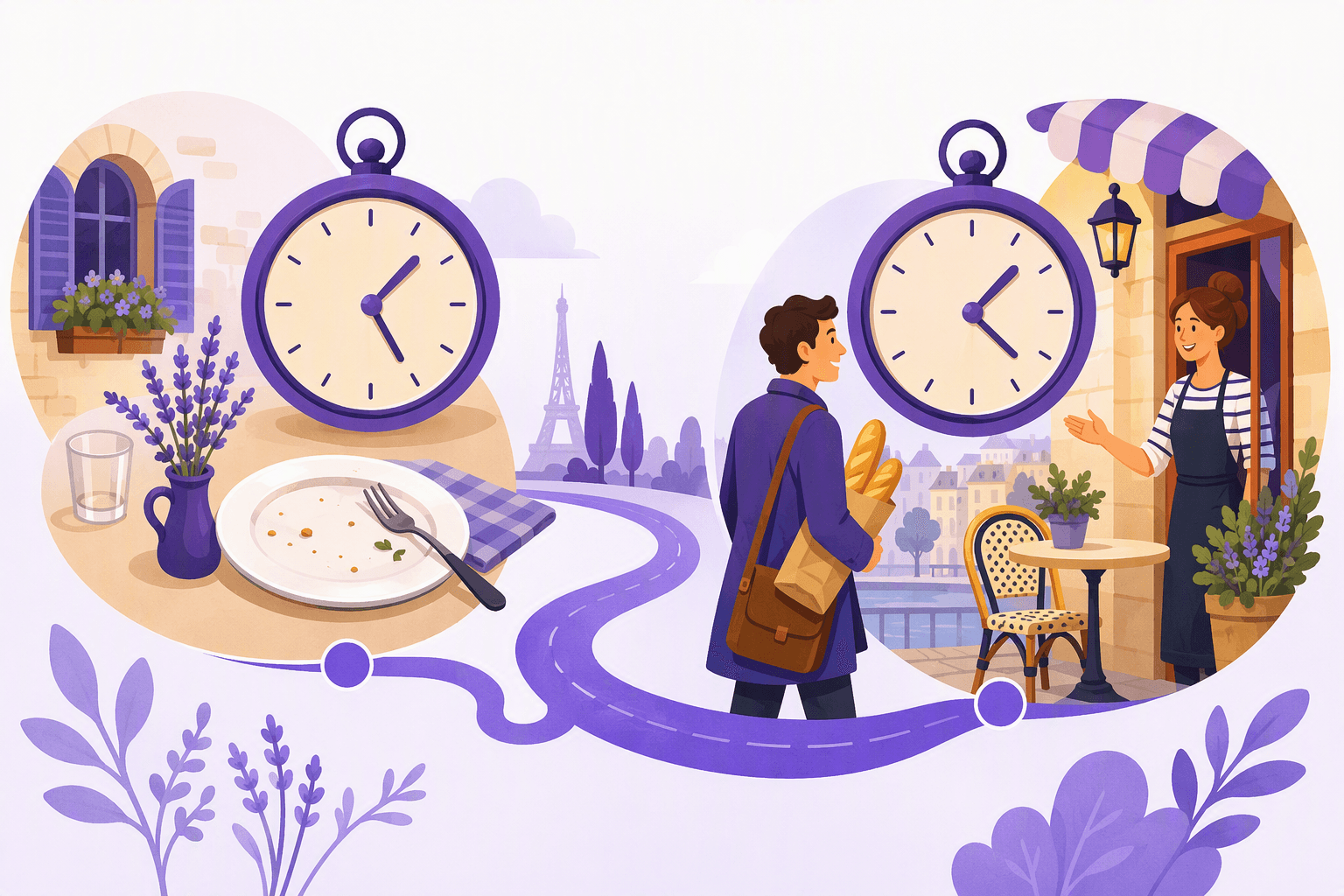
What the plus-que-parfait means
The name plus-que-parfait literally suggests something “more than completed.” In practical terms, it marks the past before the past.
Compare these two events:
- Marc lost his phone.
- Marc had left it in the taxi.
In French:
Marc a perdu son téléphone parce qu'il l'avait laissé dans le taxi.
/maʁk a pɛʁ.dy sɔ̃ te.le.fɔn paʁs kil la.vɛ le.se dɑ̃ lə tak.si/
Marc lost his phone is the later past event, so French uses the passé composé /pa.se kɔ̃.po.ze/: a perdu /a pɛʁ.dy/. Leaving it in the taxi happened first, so French uses the plus-que-parfait: avait laissé /a.vɛ le.se/.
A useful timeline looks like this:
| Time | French tense | Example event |
|---|---|---|
| Earlier past | Plus-que-parfait /plys.kə.paʁ.fɛ/ | Il avait oublié /il a.vɛ u.bli.e/ |
| Later past | Passé composé /pa.se kɔ̃.po.ze/ | Il est revenu /il ɛ ʁə.və.ny/ |
| Present | Present | Il cherche /il ʃɛʁʃ/ |
The tense is not reserved for literary French. You hear it naturally in explanations: J'avais oublié /ʒa.vɛ u.bli.e/, “I had forgotten,” is among the most useful everyday phrases in the language.
How to form the French plus-que-parfait
The formula is:
imperfect auxiliary + past participle
French uses the same two auxiliaries as the passé composé: avoir /a.vwaʁ/ for most verbs and être /ɛtʁ/ for a smaller set of movement, change-of-state, and reflexive verbs.
Avoir
Most French verbs form the plus-que-parfait with an imperfect form of avoir /a.vwaʁ/ plus their past participle.
| Subject | Avoir in the imperfect | Example with fini /fi.ni/ |
|---|---|---|
| je /ʒə/ | j'avais /ʒa.vɛ/ | j'avais fini /ʒa.vɛ fi.ni/ |
| tu /ty/ | tu avais /ty a.vɛ/ | tu avais fini /ty a.vɛ fi.ni/ |
| il, elle, on /il ɛl ɔ̃/ | avait /a.vɛ/ | elle avait fini /ɛl a.vɛ fi.ni/ |
| nous /nu/ | avions /a.vjɔ̃/ | nous avions fini /nu za.vjɔ̃ fi.ni/ |
| vous /vu/ | aviez /a.vje/ | vous aviez fini /vu za.vje fi.ni/ |
| ils, elles /il ɛl/ | avaient /a.vɛ/ | ils avaient fini /il za.vɛ fi.ni/ |
Notice that avait /a.vɛ/ and avaient /a.vɛ/ sound identical. French spelling carries grammatical information that pronunciation does not always reveal, which is one reason listening and reading practice should support each other.
Examples:
-
J'avais vu ce film. /ʒa.vɛ vy sə film/
I had seen that film. -
Nous avions pris le train. /nu za.vjɔ̃ pʁi lə tʁɛ̃/
We had taken the train. -
Vous aviez compris la question. /vu za.vje kɔ̃.pʁi la kɛs.tjɔ̃/
You had understood the question. -
Ils avaient attendu une heure. /il za.vɛ a.tɑ̃.dy yn œʁ/
They had waited an hour.
For a refresher on common high-frequency verbs, see our list of 100 common French words.
Être
Use être /ɛtʁ/ with verbs that also take être in the passé composé, such as aller /a.le/, venir /və.niʁ/, partir /paʁ.tiʁ/, arriver /a.ʁi.ve/, naître /nɛtʁ/, and mourir /mu.ʁiʁ/. Reflexive verbs also use être.
| Subject | Être in the imperfect | Example with arrivé /a.ʁi.ve/ |
|---|---|---|
| je /ʒə/ | j'étais /ʒe.tɛ/ | j'étais arrivé(e) /ʒe.tɛ a.ʁi.ve/ |
| tu /ty/ | tu étais /ty e.tɛ/ | tu étais arrivé(e) /ty e.tɛ a.ʁi.ve/ |
| il, elle, on /il ɛl ɔ̃/ | était /e.tɛ/ | elle était arrivée /ɛl e.tɛ a.ʁi.ve/ |
| nous /nu/ | étions /e.sjɔ̃/ | nous étions arrivé(e)s /nu ze.sjɔ̃ a.ʁi.ve/ |
| vous /vu/ | étiez /e.tje/ | vous étiez arrivé(e)(s) /vu ze.tje a.ʁi.ve/ |
| ils, elles /il ɛl/ | étaient /e.tɛ/ | ils étaient arrivés /il ze.tɛ a.ʁi.ve/ |
Examples:
-
Elle était déjà partie. /ɛl e.tɛ de.ʒa paʁ.ti/
She had already left. -
Nous étions descendus trop tôt. /nu ze.sjɔ̃ de.sɑ̃.dy tʁo to/
We had gotten off too early. -
Je m'étais levé avant six heures. /ʒə me.tɛ lə.ve a.vɑ̃ sis œʁ/
I had gotten up before six o’clock.
The spelling endings in parentheses show agreement. They may be silent, but they matter in writing.
When to use it
To establish what happened first
This is the central use. One action happened, then another past action occurred.
Quand je suis arrivé, le magasin avait fermé.
/kɑ̃ ʒə sɥi za.ʁi.ve lə ma.ɡa.zɛ̃ a.vɛ fɛʁ.me/
“When I arrived, the shop had closed.”
The arrival is the later event and uses the passé composé. The closure came first and uses the plus-que-parfait.
Words such as déjà /de.ʒa/, “already,” avant /a.vɑ̃/, “before,” après que /a.pʁɛ kə/, “after,” and quand /kɑ̃/, “when,” often signal a sequence. They do not mechanically require one tense, but they make the timeline easier to identify.
To explain a past result or situation
French speakers frequently use this tense when giving a reason for a past outcome.
Elle n'a pas pu entrer parce qu'elle avait perdu son billet.
/ɛl na pa py ɑ̃.tʁe paʁs kɛl a.vɛ pɛʁ.dy sɔ̃ bi.jɛ/
“She could not get in because she had lost her ticket.”
The loss explains the later inability to enter. That relationship is why the plus-que-parfait sounds natural.
In reported speech
The tense is also useful when reporting something that had happened before a past conversation.
Il m'a dit qu'il avait rencontré Léa à Lyon.
/il ma di kil a.vɛ ʁɑ̃.kɔ̃.tʁe le.a a ljɔ̃/
“He told me that he had met Léa in Lyon.”
The act of telling is in the passé composé, while the meeting occurred before it.
In hypothetical past situations
The plus-que-parfait appears in si /si/, “if,” clauses that imagine an unreal past. It often pairs with the conditional perfect.
Si j'avais su, je serais venu.
/si ʒa.vɛ sy ʒə sə.ʁɛ və.ny/
“If I had known, I would have come.”
This structure is worth memorizing as a unit:
| If-clause | Result clause |
|---|---|
| si + plus-que-parfait /si ply.sə.kə paʁ.fɛ/ | conditional perfect /kɔ̃.di.sjɔ.nɛl pa.se/ |
| Si elle avait appelé /si ɛl a.vɛ a.pə.le/ | elle serait venue /ɛl sə.ʁɛ və.ny/ |
Do not use the conditional after si /si/ in this pattern. Si j'aurais su is a common learner error. Standard French requires si j'avais su /si ʒa.vɛ sy/.
Agreement rules for past participles
The agreement rules are exactly the same as with the passé composé. This is good news: you are learning one system, not two unrelated systems.
With être
When the auxiliary is être /ɛtʁ/, the past participle usually agrees with the subject in gender and number.
- Elle était arrivée. /ɛl e.tɛ a.ʁi.ve/
- Ils étaient arrivés. /il ze.tɛ a.ʁi.ve/
- Elles étaient arrivées. /ɛl ze.tɛ a.ʁi.ve/
The pronunciation of arrivé /a.ʁi.ve/, arrivée /a.ʁi.ve/, arrivés /a.ʁi.ve/, and arrivées /a.ʁi.ve/ is usually identical. Written French displays the agreement even when speech does not.
With avoir
With avoir /a.vwaʁ/, the participle normally does not agree with the subject.
Marie avait acheté des fleurs.
/ma.ʁi a.vɛ aʃ.te de flœʁ/
But it agrees when a direct object appears before the verb.
Les fleurs que Marie avait achetées étaient magnifiques.
/le flœʁ kə ma.ʁi a.vɛ aʃ.te e.tɛ ma.ɲi.fik/
Here, les fleurs /le flœʁ/ comes before avait achetées /a.vɛ aʃ.te/. It is feminine plural, so the participle becomes achetées /aʃ.te/.
Grevisse and Goosse discuss this agreement system in Le Bon Usage, a major reference for standard French grammar. It feels detailed at first, but its purpose is consistent: French spelling marks the relationship between a past participle and a preceding direct object.
With reflexive verbs
Reflexive verbs require extra attention because se /sə/ can function as either a direct or indirect object.
Elle s'était lavée.
/ɛl se.tɛ la.ve/
“She had washed herself.” The reflexive pronoun is direct, so lavée /la.ve/ agrees with elle /ɛl/.
Elle s'était lavé les mains.
/ɛl se.tɛ la.ve le mɛ̃/
“She had washed her hands.” Here les mains /le mɛ̃/ is the direct object after the verb. The pronoun se /sə/ functions indirectly, so lavé /la.ve/ does not agree.
For most learners, mastering ordinary avoir and être forms first is the right priority. Agreement with reflexives becomes much easier after you can identify direct objects confidently.
Plus-que-parfait vs imperfect and passé composé
These three tenses often appear together in a story. They do different jobs.
| Tense | Main job | Example |
|---|---|---|
| Imperfect /ɛ̃.paʁ.fɛ/ | Background, habit, ongoing scene | Il pleuvait /il plə.vɛ/, “It was raining” |
| Passé composé /pa.se kɔ̃.po.ze/ | Completed main event | Le train est arrivé /lə tʁɛ̃ ɛ ta.ʁi.ve/, “The train arrived” |
| Plus-que-parfait /plys.kə.paʁ.fɛ/ | Earlier completed event | J'avais oublié mon parapluie /ʒa.vɛ u.bli.e mɔ̃ pa.ʁa.plɥi/, “I had forgotten my umbrella” |
Consider this mini-story:
Il pleuvait quand le train est arrivé. J'avais oublié mon parapluie à la maison.
/il plə.vɛ kɑ̃ lə tʁɛ̃ ɛ ta.ʁi.ve ʒa.vɛ u.bli.e mɔ̃ pa.ʁa.plɥi a la mɛ.zɔ̃/
The rain creates the background, the train arrival moves the story forward, and forgetting the umbrella occurred earlier. This interaction is central to French storytelling and is especially clear in film scenes, where visual context shows which event came first. Try using clips from French movies for learners to notice how narrators shift backward in time.
Riegel, Pellat, and Rioul’s Grammaire méthodique du français treats tense choice as a system of relationships, not a list of English translations. That is the most effective mindset: identify the reference point in the past, then decide whether your action happened before it.
Common mistakes to avoid
Using the passé composé for both actions
Learners may say:
Quand je suis arrivé, le magasin a fermé.
This means the shop closed when you arrived, perhaps because of your arrival. If the shop had already closed, say:
Quand je suis arrivé, le magasin avait fermé.
/kɑ̃ ʒə sɥi za.ʁi.ve lə ma.ɡa.zɛ̃ a.vɛ fɛʁ.me/
The difference changes the story.
Choosing the wrong auxiliary
Do not use avoir /a.vwaʁ/ just because it is more common.
Incorrect: J'avais allé.
Correct: J'étais allé /ʒe.tɛ a.le/, “I had gone.”
The same verbs that use être in the passé composé use être in the plus-que-parfait. If you need a reminder, review the patterns in our French irregular verbs guide.
Forgetting that English and French do not always match exactly
English sometimes uses the simple past where French prefers a plus-que-parfait because the earlier sequence needs clarity.
For example, “I realized I forgot my wallet” can become:
Je me suis rendu compte que j'avais oublié mon portefeuille.
/ʒə mə sɥi ʁɑ̃.dy kɔ̃t kə ʒa.vɛ u.bli.e mɔ̃ pɔʁ.tə.fœj/
French uses the earlier tense because forgetting occurred before the realization.
💡 Use a two-event test
Ask yourself: “Was this action already finished when the other past action happened?” If the answer is yes, the plus-que-parfait is probably the right tense. Mark the earlier action with had in English as a first check, then confirm the timeline from context.
How to make the tense automatic
Start with ten high-frequency past participles: fait /fɛ/, vu /vy/, pris /pʁi/, dit /di/, eu /y/, mis /mi/, voulu /vu.ly/, pu /py/, dû /dy/, and venu /və.ny/. Combine each with j'avais /ʒa.vɛ/ or j'étais /ʒe.tɛ/ before building longer sentences.
Then practice paired timelines aloud:
- J'avais mangé, puis je suis sorti. /ʒa.vɛ mɑ̃.ʒe pɥi ʒə sɥi sɔʁ.ti/
- Elle était partie avant mon appel. /ɛl e.tɛ paʁ.ti a.vɑ̃ mɔ̃ na.pɛl/
- Nous avions réservé avant de voyager. /nu za.vjɔ̃ ʁe.zɛʁ.ve a.vɑ̃ də vwa.ja.ʒe/
Cultural fluency includes knowing when people tell personal stories in detail. In French conversation, speakers regularly use the plus-que-parfait to justify a decision, correct a misunderstanding, or set up an anecdote. It makes an explanation sound ordered rather than abrupt, especially when you are discussing travel, work, or relationships.
🌍 Storytelling and politeness
French explanations often establish the background before delivering the main point. Saying J'avais déjà prévu quelque chose /ʒa.vɛ de.ʒa pʁe.vy kɛl.kə ʃoz/, “I had already planned something,” can soften a refusal because it provides context rather than simply saying no. For more useful social language, see how to say hello in French and how to say goodbye in French.
The plus-que-parfait becomes natural once you stop treating it as a difficult extra tense. It is simply French’s precise way to say that one past event was already complete when another past moment arrived. Learn the two auxiliary patterns, track the timeline, and use it in short stories until j'avais /ʒa.vɛ/ and j'étais /ʒe.tɛ/ feel automatic.
Frequently Asked Questions
What is the French plus-que-parfait used for?
How do you form the plus-que-parfait in French?
What is the difference between passé composé and plus-que-parfait?
Does the past participle agree in the plus-que-parfait?
Can French speakers omit the plus-que-parfait in conversation?
Sources & References
- Académie française, Dire, Ne pas dire: Plus-que-parfait, accessed 2026
- CNRTL, Trésor de la langue française informatisé: plus-que-parfait, accessed 2026
- Organisation internationale de la Francophonie, La langue française dans le monde, 2022
- Grevisse and Goosse, Le Bon Usage, De Boeck Supérieur
- Riegel, Pellat and Rioul, Grammaire méthodique du français, Presses Universitaires de France
Start learning with Wordy
Watch real movie clips and build your vocabulary as you go. Free to download.


