Quick Answer
French music vocabulary starts with chanson, paroles, refrain, couplet, and concert, then expands into genres, instruments, and the everyday phrases people use when discussing songs. This guide teaches the words you will hear in French lyrics, festivals, reviews, and conversations about music.
French music vocabulary centers on words such as la chanson /la ʃɑ̃sɔ̃/ for song, les paroles /le paʁɔl/ for lyrics, le refrain /lə ʁəfʁɛ̃/ for chorus, and le concert /lə kɔ̃sɛʁ/ for concert. Learn these foundations first, then add genre, instrument, and opinion words so you can understand French songs, discuss artists, and follow what happens at a live show.
French is spoken by an estimated 321 million people worldwide, according to the Organisation internationale de la Francophonie. That reach matters for music: French-language songs circulate far beyond France, across Belgium, Switzerland, Canada, much of Africa, the Caribbean, and online communities worldwide.
This vocabulary also gives you a better route into real listening. A chorus repeats, singers stretch vowels, and familiar emotional phrases return across genres. Pair this guide with our French pronunciation guide so that the written words on a lyric screen become sounds you can recognise.
| English | French | Pronunciation | Note |
|---|---|---|---|
| song | une chanson | oon shahN-SOHN | IPA: /yn ʃɑ̃sɔ̃/. A general word for any song. |
| music | la musique | lah moo-ZEEK | IPA: /la myzik/. Feminine noun. |
| lyrics | les paroles | lay pah-ROHL | IPA: /le paʁɔl/. Usually plural. |
| chorus | le refrain | luh ruh-FRAHN | IPA: /lə ʁəfʁɛ̃/. The repeated part of a song. |
| verse | le couplet | luh koo-PLAY | IPA: /lə kuplɛ/. A verse between choruses. |
| melody | la mélodie | lah may-loh-DEE | IPA: /la melɔdi/. The tune you sing or hum. |
| rhythm | le rythme | luh REET-muh | IPA: /lə ʁitm/. The final sound is light. |
| beat | le tempo | luh tahM-POH | IPA: /lə tɑ̃po/. Speed or pulse of a track. |
| album | un album | uhn ahl-BUHM | IPA: /œ̃ albɔm/. Similar spelling, different vowel sound. |
| singer | un chanteur | uhn shahN-TUR | IPA: /œ̃ ʃɑ̃tœʁ/. Masculine form. |
| singer | une chanteuse | oon shahN-TUHZ | IPA: /yn ʃɑ̃tøz/. Feminine form. |
| band | un groupe | uhn GROOP | IPA: /œ̃ ɡʁup/. Also means group generally. |
| concert | un concert | uhn kohn-SAIR | IPA: /œ̃ kɔ̃sɛʁ/. A live performance. |
| stage | la scène | lah SEN | IPA: /la sɛn/. Also a theatrical stage. |
| ticket | un billet | uhn bee-YEH | IPA: /œ̃ bijɛ/. Used for a concert ticket. |
| audience | le public | luh poo-BLEEK | IPA: /lə pyblik/. The crowd or audience. |
| guitar | la guitare | lah gee-TAHR | IPA: /la ɡitaʁ/. Feminine noun. |
| drums | la batterie | lah bah-tuh-REE | IPA: /la batʁi/. Literally a battery, musically drums. |
| piano | le piano | luh pyah-NOH | IPA: /lə pjano/. Stress is not strongly marked in French. |
| violin | le violon | luh vyoh-LOHN | IPA: /lə vjɔlɔ̃/. Final vowel is nasal. |
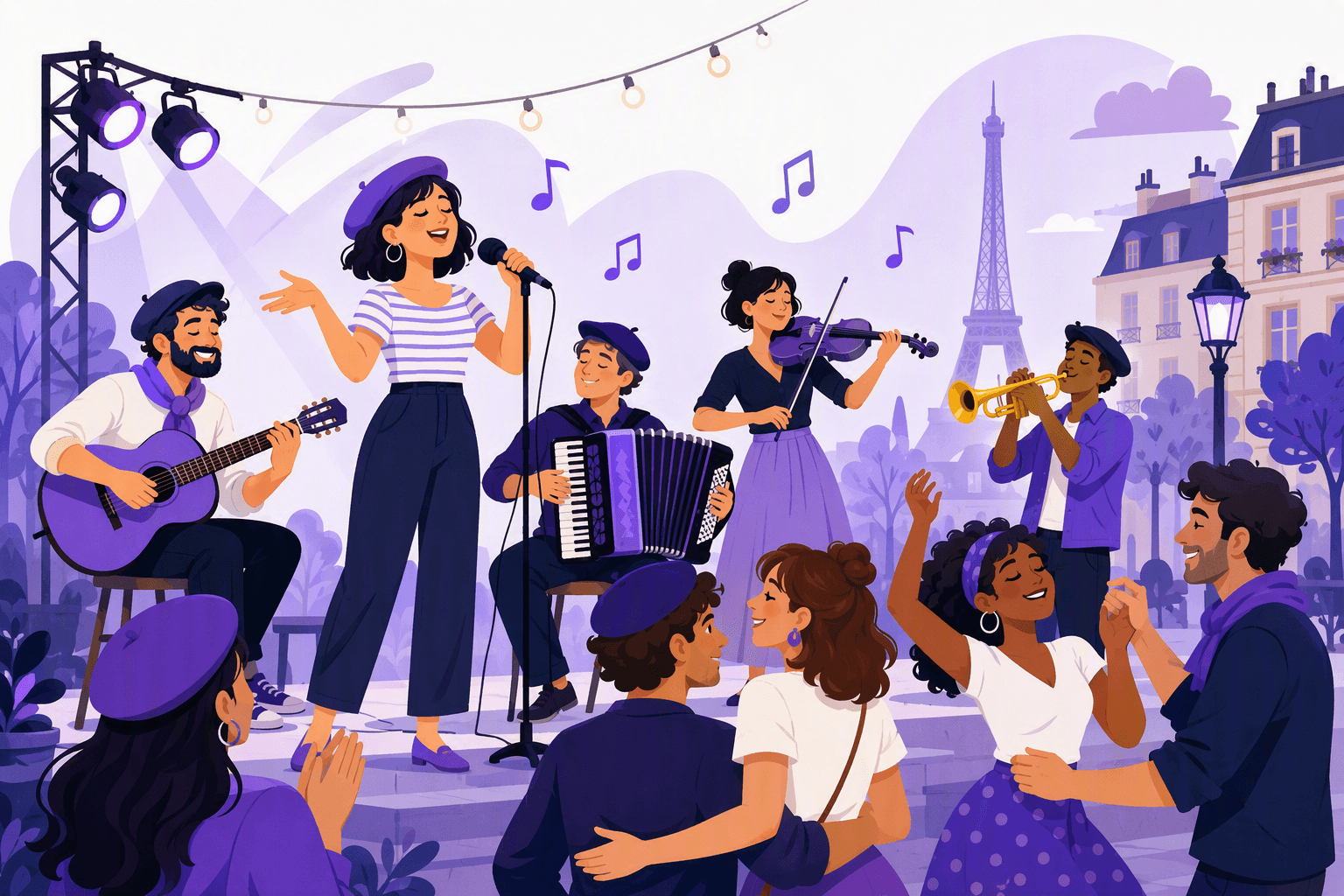
The core words you hear in every song
The words below are the backbone of music talk. You will encounter them in artist interviews, streaming descriptions, music reviews, and comments beneath a video.
French music vocabulary is useful because it belongs to a high-frequency cultural setting. A listener may not know every word in a verse, but they can still identify the refrain /lə ʁəfʁɛ̃/, notice the rythme /lə ʁitm/, and comment on the mélodie /la melɔdi/.
La chanson
La chanson /la ʃɑ̃sɔ̃/ means song. It is the normal word for a pop song, a traditional song, a children’s song, or a track by an international artist.
It also has a broader cultural meaning in the phrase la chanson française /la ʃɑ̃sɔ̃ fʁɑ̃sɛz/. This refers to a tradition of lyric-centered songwriting associated with performers such as Édith Piaf, Georges Brassens, Jacques Brel, Barbara, and later artists with strong narrative voices.
David Looseley, in Popular Music in Contemporary France, examines how French popular music has been shaped by language, cultural policy, media, and ideas about national identity. For learners, the practical lesson is simple: words carry much of the musical experience in French chanson.
Les paroles
Les paroles /le paʁɔl/ means lyrics or words. The singular la parole /la paʁɔl/ often means speech, a word, or the right to speak, but song lyrics are normally plural.
Useful examples include:
- J'aime les paroles. /ʒɛm le paʁɔl/ : I like the lyrics.
- Les paroles sont belles. /le paʁɔl sɔ̃ bɛl/ : The lyrics are beautiful.
- Je connais les paroles par cœur. /ʒə kɔnɛ le paʁɔl paʁ kœʁ/ : I know the lyrics by heart.
If you want music to improve your French, do not try to translate every lyric at once. Identify one repeated line, listen for its sounds, read it, then sing or speak it along with the recording. This is especially effective with the most common French words, which often appear in love songs and everyday storytelling.
Le refrain
Le refrain /lə ʁəfʁɛ̃/ is the chorus, the recurring section that listeners remember and sing together. In a concert, artists may pause and let le public /lə pyblik/ sing it.
The expression reprendre le refrain /ʁəpʁɑ̃dʁə lə ʁəfʁɛ̃/ means to join in or start singing the chorus again. It is a useful listening cue because the repeated words are your easiest entry point into a new song.
Le couplet
Le couplet /lə kuplɛ/ means verse. A typical song may alternate between un couplet /œ̃ kuplɛ/ and un refrain /œ̃ ʁəfʁɛ̃/.
A French song can also have un pont /œ̃ pɔ̃/, a bridge, and une introduction /yn ɛ̃tʁodyksjɔ̃/, an introduction. Knowing the structure lets you make sensible listening choices: study the chorus first, then tackle one verse at a time.
French music genres and styles
Music labels travel easily between languages, but French adds its own pronunciation, cultural associations, and terminology. The CNRTL, France’s major historical and lexical reference resource, records how many genre labels developed through contact with English while taking on distinct French uses.
La chanson française
La chanson française /la ʃɑ̃sɔ̃ fʁɑ̃sɛz/ is not one fixed sound. It is a broad label for French lyric-based songwriting, often associated with careful wording, distinctive vocal interpretation, and intimate performance.
A chanteur à texte /ʃɑ̃tœʁ a tɛkst/ is a singer known particularly for words and literary writing. You may also hear auteur-compositeur-interprète /otœʁ kɔ̃pozitœʁ ɛ̃tɛʁpʁɛt/, meaning a performer who writes, composes, and performs their own work.
Le rap
Le rap /lə ʁap/ is rap, and le rap français /lə ʁap fʁɑ̃sɛ/ is one of the most commercially and culturally visible areas of French-language music. French rap vocabulary includes un flow /œ̃ flo/ for a rapper’s rhythmic delivery and une punchline /yn pœ̃tʃlajn/ for a memorable, hard-hitting line.
Rap is not always ideal for absolute beginners because delivery can be fast and slang-heavy. Yet it is excellent for learners who already know core grammar and want to hear urban pronunciation, wordplay, register changes, and contemporary references. If a lyric includes strong language, consult our French swear words guide before repeating it in public.
La variété
La variété /la vaʁjete/ refers broadly to mainstream popular music, often called la variété française /la vaʁjete fʁɑ̃sɛz/. The label can cover radio pop, melodic ballads, television-friendly performers, and older popular standards.
Unlike the English word variety, it is not about having many different options. In French music discussion, it is a genre and industry label.
L'électro
L'électro /letʁo/ is a shortened form of electronic music. You may see la musique électronique /la myzik elɛktʁɔnik/ in formal writing, while people commonly say de l'électro /də letʁo/ in casual conversation.
France has played an outsized role in electronic music, from early experimental work to French house and modern club scenes. Terms such as le DJ /lə didʒe/, un morceau /œ̃ mɔʁso/ for track, and danser /dɑ̃se/ for to dance will appear constantly in this context.
Le rock
Le rock /lə ʁɔk/ is rock music. You may also encounter le rock alternatif /lə ʁɔk altɛʁnatif/, alternative rock, or le rock indépendant /lə ʁɔk ɛ̃depɑ̃dɑ̃/, indie rock.
French speakers often use un morceau /œ̃ mɔʁso/ for a song or piece, especially when discussing rock, rap, or electronic tracks. It is less tied to lyrical singing than une chanson /yn ʃɑ̃sɔ̃/.
Talking about instruments and sound
Instrument words are useful at concerts, in music lessons, and whenever you want to describe why a track sounds the way it does.
La guitare /la ɡitaʁ/ is guitar, la batterie /la batʁi/ is drums, le piano /lə pjano/ is piano, la basse /la bas/ is bass guitar, and le violon /lə vjɔlɔ̃/ is violin. Notice that la batterie has another non-musical meaning, battery, so context does the work.
For sound quality, use these common adjectives:
| French expression | IPA | Meaning and use |
|---|---|---|
| c'est entraînant | /sɛ ɑ̃tʁɛnɑ̃/ | It is catchy and makes you want to move. |
| c'est mélodieux | /sɛ melodjø/ | It is melodious. |
| c'est calme | /sɛ kalm/ | It is calm or relaxing. |
| c'est puissant | /sɛ pɥisɑ̃/ | It is powerful. |
| c'est émouvant | /sɛ emuvɑ̃/ | It is moving or emotional. |
| c'est bruyant | /sɛ bʁɥijɑ̃/ | It is loud or noisy. |
To say that a song stays in your mind, use j'ai cette chanson dans la tête /ʒe sɛt ʃɑ̃sɔ̃ dɑ̃ la tɛt/, literally “I have this song in my head.” It has the same basic idea as having a song stuck in your head.
At a French concert or festival
France’s Fête de la Musique /fɛt də la myzik/ takes place every year on 21 June. Launched in France in 1982, it now inspires free public performances and related events in more than 120 countries, according to France’s Ministry of Culture.
The event is culturally distinctive because it mixes professionals and amateurs. You might hear a full-stage act, a conservatory ensemble, a local choir, or someone playing on a pavement within the same evening.
Here are practical phrases for live music:
- On va voir un concert ? /ɔ̃ va vwaʁ œ̃ kɔ̃sɛʁ/ : Shall we go see a concert?
- Tu as acheté les billets ? /ty a aʃte le bijɛ/ : Did you buy the tickets?
- La salle est pleine. /la sal ɛ plɛn/ : The venue is full.
- Le groupe monte sur scène. /lə ɡʁup mɔ̃t syʁ sɛn/ : The band is coming on stage.
- C'était génial ! /setɛ ʒenjal/ : That was great!
- Tu connais cet artiste ? /ty kɔnɛ sɛt aʁtist/ : Do you know this artist?
La salle /la sal/ can mean a room, hall, or concert venue. A smaller venue may be called une salle de concert /yn sal də kɔ̃sɛʁ/, while a large festival performance is often on une scène /yn sɛn/.
🌍 Applauding and calling for more
At the end of a performance, French audiences commonly applaud and shout Bravo ! /bʁavo/. For an encore, you may hear Une autre ! /yn otʁ/, meaning “Another one!”, or Encore ! /ɑ̃kɔʁ/. These are lively but normal audience responses, not rude interruptions.
How to use French songs without only memorising lyrics
Music is powerful input, but passive listening alone does not guarantee learning. Jean-Jacques Nattiez, in Music and Discourse, treats music as a system shaped by creation, the musical object, and listeners’ interpretation. For language learners, that means a song can be studied from several angles: sound, grammar, cultural context, and personal response.
Choose a song with a clear voice and a manageable pace. Listen once only for mood, then read the title and chorus. On the next listen, mark words you already know, especially pronouns, negation, time words, and repeated verbs.
Avoid treating every song as formal French. Lyrics regularly omit ne /nə/ in negation, change word order, use slang, and bend grammar for rhyme. This is normal artistic language, not necessarily the best model for a formal email or a first meeting.
💡 Use a three-listen routine
First, listen without subtitles and identify the mood. Second, read the French lyrics while listening and underline repeated words. Third, replay only one verse and say it aloud with the singer. A short, repeated clip teaches more than one distracted play of an entire album.
Film and television songs can be particularly helpful because visual context gives you clues about tone and meaning. If you prefer learning from scenes rather than static lyric sheets, read our guide on how to learn a language with movies.
Essential opinions about French music
When someone recommends a track, you do not need complex vocabulary to respond naturally. Start with these reliable reactions:
- J'adore cette chanson. /ʒadɔʁ sɛt ʃɑ̃sɔ̃/ : I love this song.
- J'aime bien le rythme. /ʒɛm bjɛ̃ lə ʁitm/ : I quite like the rhythm.
- Les paroles me touchent. /le paʁɔl mə tuʃ/ : The lyrics move me.
- Ce n'est pas mon style. /sə nɛ pa mɔ̃ stil/ : It is not my style.
- Ça me fait penser à toi. /sa mə fɛ pɑ̃se a twa/ : It makes me think of you.
- Cette chanson me donne envie de danser. /sɛt ʃɑ̃sɔ̃ mə dɔn ɑ̃vi də dɑ̃se/ : This song makes me want to dance.
The final phrase works especially well in friendly conversation because it describes a physical reaction rather than making a technical judgment. For romantic songs and affectionate lyrics, you may also want our guide to saying “I love you” in French.
Build your French music vocabulary through repetition
Start with ten words: chanson /ʃɑ̃sɔ̃/, paroles /paʁɔl/, refrain /ʁəfʁɛ̃/, couplet /kuplɛ/, rythme /ʁitm/, mélodie /melɔdi/, album /albɔm/, concert /kɔ̃sɛʁ/, scène /sɛn/, and artiste /aʁtist/. These terms unlock descriptions, interviews, lyric annotations, and concert conversation.
Then choose one genre you genuinely enjoy. Repetition matters more than genre prestige: a catchy song you play ten times gives you clearer sound patterns than a famous classic you never return to. When you can greet artists, react to a performance, and say goodbye after a show, the phrases from our guide to saying goodbye in French will feel just as useful as the music terms themselves.
Frequently Asked Questions
What is the French word for music?
What is a chanson in French?
How do you say lyrics in French?
How do French people say they like a song?
What French music should beginners listen to?
Sources & References
- Organisation internationale de la Francophonie, La langue française dans le monde, 2022
- Ministère de la Culture, Fête de la Musique, accessed 2026
- CNRTL, Trésor de la langue française informatisé, accessed 2026
- SNEP, L'économie de la production musicale, accessed 2026
- David Looseley, Popular Music in Contemporary France, Berg
Start learning with Wordy
Watch real movie clips and build your vocabulary as you go. Free to download.


