Quick Answer
French house vocabulary starts with la maison for house, l'appartement for apartment, la cuisine for kitchen, and la chambre for bedroom. This guide gives you 80+ useful French words for rooms, furniture, appliances, and the everyday phrases you need to describe where you live.
French house vocabulary begins with la maison /la mɛ.zɔ̃/ for house, l'appartement /la.paʁ.tə.mɑ̃/ for apartment, la cuisine /la kɥi.zin/ for kitchen, and la chambre /la ʃɑ̃bʁ/ for bedroom. Learn every noun with its article, because French gender affects the words around it: la maison est grande /la mɛ.zɔ̃ ɛ ɡʁɑ̃d/ means “the house is big,” while l'appartement est grand /la.paʁ.tə.mɑ̃ ɛ ɡʁɑ̃/ uses the masculine form.
These words are useful far beyond a textbook. You hear them in apartment listings, family conversations, TV shows, hotel stays, and everyday questions about where someone lives. Start with the vocabulary below, then use it in full sentences.
French is spoken by roughly 321 million people worldwide according to the Organisation internationale de la Francophonie, and it has official status in 29 countries. That means a “home” can be described differently in Paris, Montréal, Dakar, Brussels, or Geneva, but this core vocabulary travels well.
If you are building your basics, pair these words with our guide to common French words and practice saying them as part of simple descriptions.
| English | French | Pronunciation | Note |
|---|---|---|---|
| house | la maison | lah meh-ZOHN | Feminine noun. Also means home in many contexts. |
| apartment | l'appartement | lah-par-teh-MAHN | Masculine noun. |
| building | l'immeuble | lee-MUH-bluh | Usually an apartment building. |
| home | le foyer | luh fwah-YAY | Often emotional or formal, rather than a building. |
| at my place | chez moi | shay MWAH | A very common everyday expression. |
| address | l'adresse | lah-DRESS | Feminine noun. |
| floor or story | l'étage | lay-TAHZH | Do not confuse with le sol, the floor surface. |
| ground floor | le rez-de-chaussée | luh reh-doh-shoh-SAY | French buildings count this separately from the first floor. |
| elevator | l'ascenseur | lah-sahn-SUHR | Masculine noun. |
| stairs | l'escalier | less-kah-LYAY | Usually singular in French. |
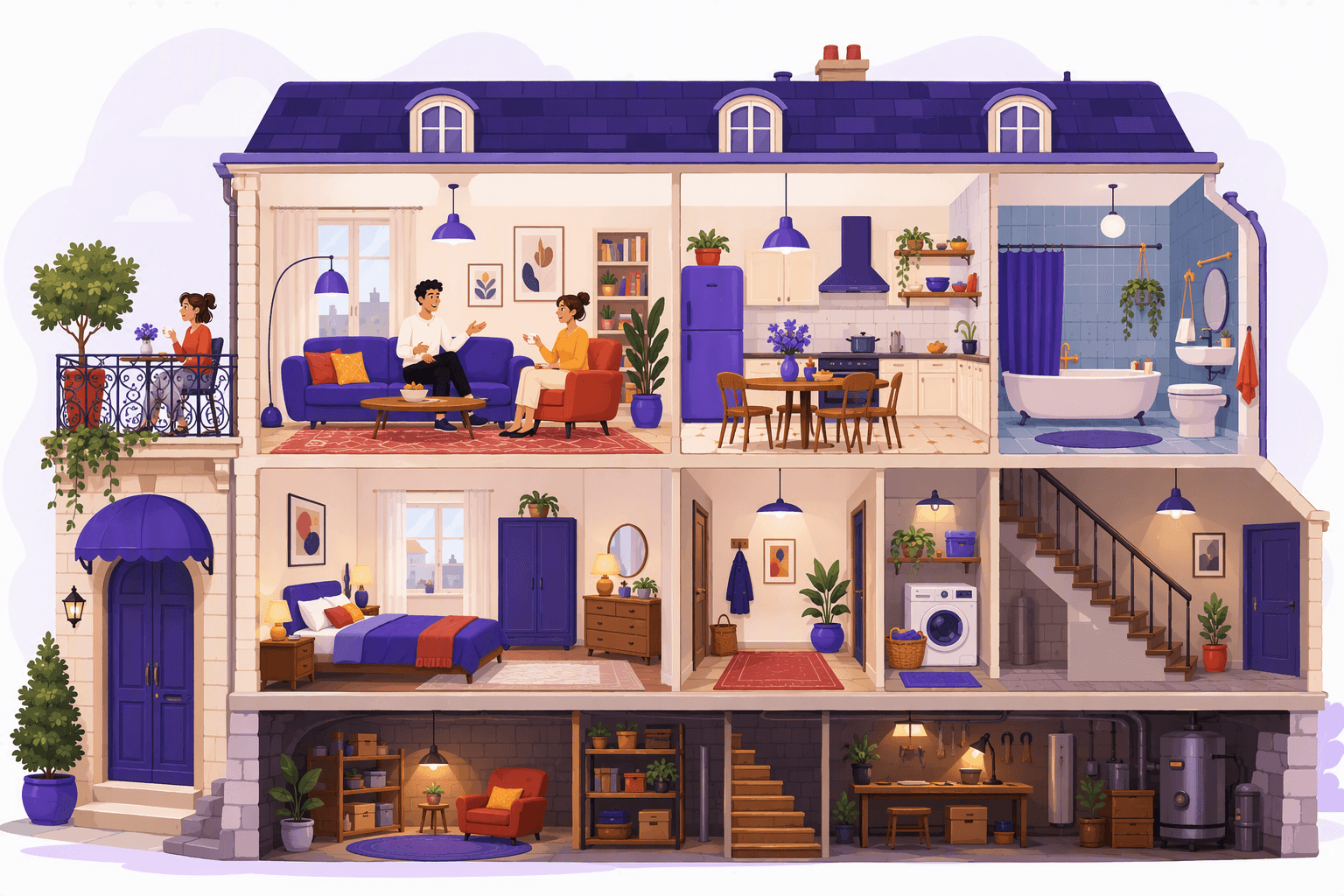
The most important French words for where you live
The two everyday choices are la maison /la mɛ.zɔ̃/ and l'appartement /la.paʁ.tə.mɑ̃/. Use la maison for a house and l'appartement for an apartment or flat.
A residential building is un immeuble /œ̃.n‿i.mœbl/. In France, the ground floor is le rez-de-chaussée /lə ʁe.d(ə).ʃo.se/, and the floor above it is le premier étage /lə pʁə.mje e.taʒ/. This can confuse English speakers, because “first floor” often means ground floor in North American English.
The word chez /ʃe/ is particularly useful. Chez moi /ʃe mwa/ means “at my place,” while chez toi /ʃe twa/ means “at your place.” You can say On mange chez moi ce soir /ɔ̃ mɑ̃ʒ ʃe mwa sə swaʁ/, meaning “We’re eating at my place tonight.”
🌍 French apartment numbering
In many French buildings, an address may include a building entrance, floor, and door number. A resident might say au troisième étage, porte à gauche /o tʁwa.zjɛm e.taʒ pɔʁt a ɡoʃ/, meaning “on the third floor, door on the left.” This kind of detail is practical when visiting someone in a dense city.
Rooms in a French home
Learn the room plus its article from the beginning. French articles are not optional decoration: they show gender and help you form natural sentences.
| English | French | Pronunciation | Note |
|---|---|---|---|
| entrance or hallway | l'entrée | lahn-TRAY | Feminine noun. |
| living room | le salon | luh sah-LOHN | The main sitting room. |
| dining room | la salle à manger | lah sahl ah mahn-ZHAY | Literally room for eating. |
| kitchen | la cuisine | lah kwee-ZEEN | Feminine noun. |
| bedroom | la chambre | lah SHAHM-bruh | Can also mean a hotel room. |
| bathroom | la salle de bains | lah sahl duh BAHN | Often written salle de bain in casual use. |
| toilet | les toilettes | lay twah-LET | Usually plural. |
| office | le bureau | luh byoo-ROH | Also means desk. |
| laundry room | la buanderie | lah bwahn-dree | Less common in small apartments. |
| attic | le grenier | luh gruh-NYAY | Storage space under the roof. |
| basement | la cave | lah kahv | Often used for a cellar or storage unit. |
| garage | le garage | luh gah-RAHZH | Masculine noun. |
| balcony | le balcon | luh bal-KOHN | Masculine noun. |
| terrace | la terrasse | lah teh-RASS | Outdoor paved space. |
| garden | le jardin | luh zhar-DAN | Masculine noun. |
Talking about rooms naturally
To say that a room is in your home, use il y a /il j‿a/, meaning “there is” or “there are.” For example, Il y a deux chambres dans la maison /il j‿a dø ʃɑ̃bʁ dɑ̃ la mɛ.zɔ̃/ means “There are two bedrooms in the house.”
Use dans /dɑ̃/ for “in” and à côté de /a ko.te də/ for “next to.” You might say La cuisine est à côté du salon /la kɥi.zin ɛ a ko.te dy sa.lɔ̃/, meaning “The kitchen is next to the living room.”
French distinguishes la salle de bains /la sal də bɛ̃/, the bathroom, from les toilettes /le twa.lɛt/, the toilet. Asking Où sont les toilettes ? /u sɔ̃ le twa.lɛt/ is the normal, polite way to ask where the restroom is.
For more practical daily phrases, see our French travel phrases guide, especially before staying in a hotel or rental.
Furniture in French
Furniture is les meubles /le møbl/ in French. The singular un meuble /œ̃ mœbl/ means one piece of furniture, such as a table, wardrobe, or dresser.
| English | French | Pronunciation | Note |
|---|---|---|---|
| table | la table | lah tahbl | Feminine noun. |
| chair | la chaise | lah shehz | Feminine noun. |
| sofa | le canapé | luh kah-nah-PAY | Masculine noun. |
| armchair | le fauteuil | luh fuh-TOY | Masculine noun. |
| bed | le lit | luh lee | Masculine noun. |
| pillow | l'oreiller | loh-ray-YAY | Masculine noun. |
| blanket | la couverture | lah koo-vair-TYOOR | Feminine noun. |
| wardrobe | l'armoire | lar-MWAHR | Feminine noun. |
| dresser | la commode | lah koh-MOHD | A chest of drawers. |
| shelf | l'étagère | lay-tah-ZHAIR | Feminine noun. |
| desk | le bureau | luh byoo-ROH | Also means office. |
| lamp | la lampe | lah lahmp | Feminine noun. |
| mirror | le miroir | luh mee-RWAHR | Masculine noun. |
| curtain | le rideau | luh ree-DOH | Usually plural when discussing window coverings. |
| rug | le tapis | luh tah-PEE | The final s is pronounced. |
Appliances, fixtures, and small household objects
A French kitchen is often described with les appareils électroménagers /le.za.pa.ʁɛj.z‿e.lɛk.tʁo.me.na.ʒe/, meaning household appliances. In rental listings, a place described as meublé /mø.ble/ is furnished, while non meublé /nɔ̃ mø.ble/ is unfurnished.
| English | French | Pronunciation | Note |
|---|---|---|---|
| refrigerator | le réfrigérateur | luh ray-free-zhay-rah-TUHR | In casual speech, many people say le frigo. |
| oven | le four | luh foor | Masculine noun. |
| stove | la cuisinière | lah kwee-zee-NYAIR | Can mean cooker or stove. |
| microwave | le micro-ondes | luh mee-kroh-OHND | Usually masculine singular. |
| dishwasher | le lave-vaisselle | luh lahv-vay-SELL | Literally wash-dishes. |
| washing machine | le lave-linge | luh lahv-LANZH | Also called une machine à laver. |
| sink | l'évier | lay-VYAY | Kitchen sink. |
| shower | la douche | lah doosh | Feminine noun. |
| bathtub | la baignoire | lah ben-YWAHR | Feminine noun. |
| window | la fenêtre | lah fuh-NETR | Feminine noun. |
| door | la porte | lah port | Feminine noun. |
| wall | le mur | luh myoor | Masculine noun. |
| floor surface | le sol | luh sol | Not the same as l'étage, a building level. |
| ceiling | le plafond | luh plah-FOHN | Masculine noun. |
| key | la clé | lah KLAY | Also spelled clef in some musical contexts. |
Essential phrases for describing your home
Knowing isolated nouns is useful, but sentences make the vocabulary usable. Start with a few reusable patterns.
J'habite dans un appartement /ʒa.bit dɑ̃.z‿œ̃.na.paʁ.tə.mɑ̃/ means “I live in an apartment.” Say J'habite dans une maison /ʒa.bit dɑ̃.z‿yn mɛ.zɔ̃/ if you live in a house.
Ma chambre est petite mais lumineuse /ma ʃɑ̃bʁ ɛ pə.tit mɛ ly.mi.nøz/ means “My bedroom is small but bright.” Notice that petite /pə.tit/ and lumineuse /ly.mi.nøz/ are feminine because la chambre /la ʃɑ̃bʁ/ is feminine.
La cuisine est moderne /la kɥi.zin ɛ mɔ.dɛʁn/ means “The kitchen is modern.” Le salon est confortable /lə sa.lɔ̃ ɛ kɔ̃.fɔʁ.tab(ə)/ means “The living room is comfortable.”
Je cherche mes clés /ʒə ʃɛʁʃ me kle/ means “I’m looking for my keys.” This is a useful phrase at home, in a hotel, or while visiting friends.
💡 Learn nouns with a visual scene
Instead of memorizing a disconnected list, describe a room from a movie or TV scene. Pause and identify the canapé /ka.na.pe/, fenêtre /fə.nɛtʁ/, table /tabl/, and porte /pɔʁt/. Visual context makes gender, objects, and sentence patterns easier to remember.
Gender patterns that help, but do not replace learning articles
Many French words ending in -tion are feminine, but house vocabulary has plenty of exceptions and borrowed words. The safest habit is to memorize la table /la tabl/, not just table /tabl/, and le canapé /lə ka.na.pe/, not just canapé /ka.na.pe/.
Alain Rey’s Dictionnaire historique de la langue française is a useful reminder that everyday French vocabulary has many origins. Le garage /lə ɡa.ʁaʒ/, for example, entered French through the verb garer /ɡa.ʁe/, meaning to put away or park.
Henriette Walter’s work on the history and variety of French also helps explain why familiar household words can change by region. In Québec, un divan /œ̃ di.vɑ̃/ is common for a sofa, alongside un canapé /œ̃ ka.na.pe/. In France, un frigo /œ̃ fʁi.ɡo/ is the everyday shortened form of un réfrigérateur /œ̃ ʁe.fʁi.ʒe.ʁa.tœʁ/.
French home culture and useful rental vocabulary
In France, le loyer /lə lwa.je/ is rent, le propriétaire /lə pʁɔ.pʁi.e.tɛʁ/ is the landlord, and le bail /lə baj/ is the lease. Les charges /le ʃaʁʒ/ are extra building or utility costs, so an advertisement may distinguish loyer hors charges /lwa.je ɔʁ ʃaʁʒ/ from the total monthly payment.
An interphone /ɛ̃.tɛʁ.fɔn/ is a building entry phone or buzzer, and la copropriété /la kɔ.pʁɔ.pʁi.e.te/ refers to a jointly owned apartment building. These are practical words for real-world housing, even if they rarely appear in beginner courses.
The Académie française dictionary and CNRTL both record the established meanings and grammatical information for words such as maison /mɛ.zɔ̃/, salon /sa.lɔ̃/, and cuisine /kɥi.zin/. Use reliable dictionaries when you meet a word in a subtitle or listing, especially because a single word can have more than one meaning.
For greetings when visiting someone, learn how to say hello in French. When you leave, a natural à bientôt /a bjɛ̃.to/ can be more appropriate than a formal goodbye.
A simple practice routine
Choose one room each day and name five objects in it. Start with Dans ma cuisine, il y a un frigo, un four et une table /dɑ̃ ma kɥi.zin il j‿a œ̃ fʁi.ɡo œ̃ fuʁ e yn tabl/.
Then add location words: Le livre est sur la table /lə li.vʁ ɛ syʁ la tabl/, “The book is on the table,” or Le chat est sous le canapé /lə ʃa ɛ su lə ka.na.pe/, “The cat is under the sofa.” This converts passive recognition into usable French.
Finally, watch a short French scene set in a home and listen for familiar words. Everyday dialogue frequently includes rooms, meals, cleaning, arrivals, and departures, making home vocabulary especially easy to reinforce through context.
Frequently Asked Questions
How do you say house in French?
What is the difference between maison and appartement in French?
Are French room names masculine or feminine?
How do I say my house is big in French?
What French words are useful when renting an apartment?
Sources & References
- Organisation internationale de la Francophonie, La langue française dans le monde, 2022
- Académie française, Dictionnaire de l'Académie française, accessed 2026
- CNRTL, Trésor de la langue française informatisé, accessed 2026
- Alain Rey, Dictionnaire historique de la langue française, Le Robert
- Henriette Walter, Le français dans tous les sens, Robert Laffont
Start learning with Wordy
Watch real movie clips and build your vocabulary as you go. Free to download.


