Quick Answer
French fashion vocabulary starts with vêtement for clothing, robe for dress, chemise for shirt, chaussures for shoes, and élégant for stylish. This guide teaches 70+ practical words for describing outfits, shopping in France, discussing fabrics, and understanding fashion conversations.
French fashion vocabulary includes les vêtements /le vɛtmɑ̃/ for clothes, une robe /yn ʁɔb/ for a dress, une chemise /yn ʃəmiz/ for a shirt, des chaussures /de ʃosyʁ/ for shoes, and chic /ʃik/ for elegant or stylish. Learn these words and you can describe an outfit, ask for a size, understand a boutique conversation, and talk naturally about French style.
French is spoken by around 321 million people worldwide, according to the Organisation internationale de la Francophonie. That makes French clothing vocabulary useful far beyond Paris, from Brussels and Geneva to Montréal, Dakar, and Abidjan. The words may travel, but fashion culture and local usage can shift from one French-speaking place to another.
Fashion is also unusually visible in French daily language. Paris remains one of the major cities associated with international fashion weeks, while ordinary speakers use la mode /la mɔd/ to discuss trends, taste, and what is currently popular. Start with French greetings, then use these words to move from introductions to real shopping and style conversations.
| English | French | Pronunciation | Note |
|---|---|---|---|
| clothing | les vêtements | /le vɛtmɑ̃/ | Singular vêtement means one garment. |
| an outfit | une tenue | /yn t(ə)ny/ | A complete look or outfit. |
| a shirt | une chemise | /yn ʃəmiz/ | Usually a button-up shirt. |
| a T-shirt | un tee-shirt | /œ̃ ti ʃœʁ/ | Also written T-shirt. |
| a sweater | un pull | /œ̃ pyl/ | Short for pull-over. |
| a jacket | une veste | /yn vɛst/ | A light jacket or blazer. |
| a coat | un manteau | /œ̃ mɑ̃to/ | For colder weather. |
| a dress | une robe | /yn ʁɔb/ | A dress, not a bathrobe. |
| a skirt | une jupe | /yn ʒyp/ | Feminine noun. |
| trousers | un pantalon | /œ̃ pɑ̃talɔ̃/ | Usually singular in French. |
| jeans | un jean | /œ̃ dʒin/ | Often singular, even for one pair. |
| shorts | un short | /œ̃ ʃɔʁt/ | The final consonant is pronounced. |
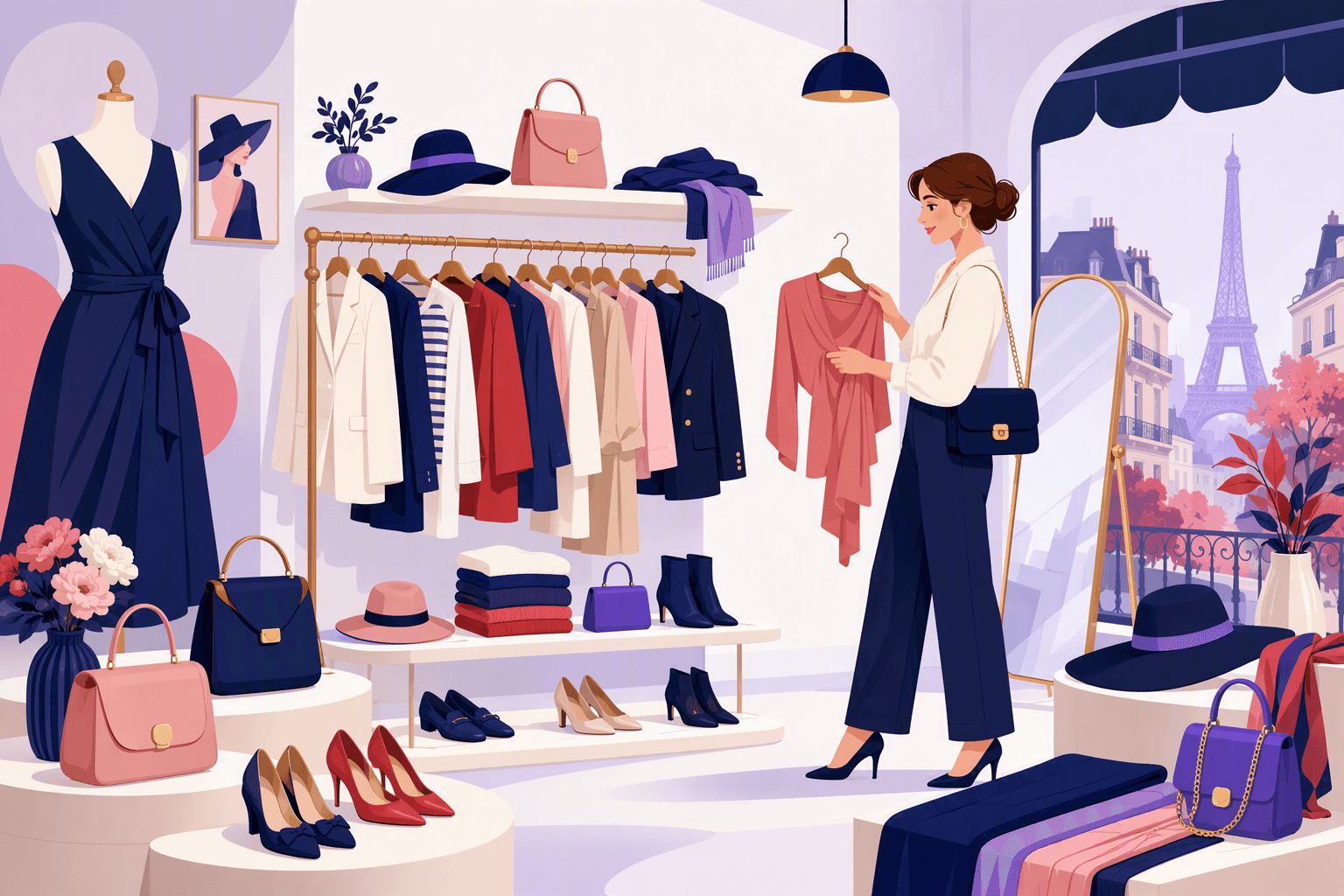
The core clothing words you will hear first
The broadest word is vêtement /vɛtmɑ̃/. Use un vêtement /œ̃ vɛtmɑ̃/ for one garment and des vêtements /de vɛtmɑ̃/ for clothes as a category. If you mean a complete look, choose une tenue /yn t(ə)ny/, a word you will hear in fashion media and everyday compliments.
For example, J'aime ta tenue /ʒɛm ta t(ə)ny/ means “I like your outfit.” It sounds warmer and more specific than commenting on one item. A person can also say une tenue décontractée /yn t(ə)ny dekɔ̃tʁakte/ for a casual outfit or une tenue de soirée /yn t(ə)ny də swaʁe/ for eveningwear.
French makes useful distinctions between une veste /yn vɛst/ and un manteau /œ̃ mɑ̃to/. A veste is a jacket, blazer, or lighter outer layer. A manteau is a coat designed for cold weather.
La chemise /la ʃəmiz/
A chemise /ʃəmiz/ usually means a button-up shirt. It can be worn by any gender, and descriptions often follow it: une chemise blanche /yn ʃəmiz blɑ̃ʃ/ means a white shirt.
Do not confuse it with un chemisier /œ̃ ʃəmizje/, which usually means a women’s blouse. In a shop, this difference matters because the garment sections may be organized separately.
Le pull /lə pyl/
A pull /pyl/ is a sweater. It comes from English pullover, but French shortened it and made it fully ordinary vocabulary.
You can say un pull en laine /œ̃ pyl ɑ̃ lɛn/ for a wool sweater or un pull à col roulé /œ̃ pyl a kɔl ʁule/ for a turtleneck. The word col /kɔl/ means collar or neckline.
Le pantalon /lə pɑ̃talɔ̃/
French normally uses singular pantalon /pɑ̃talɔ̃/ where English uses plural “trousers” or “pants.” Say un pantalon noir /œ̃ pɑ̃talɔ̃ nwaʁ/ for black trousers.
The same pattern applies to un jean /œ̃ dʒin/, meaning a pair of jeans. You may see des jeans /de dʒin/ too, especially when speaking generally about several pairs, but singular is extremely common for one item.
Shoes, accessories, and the details that complete an outfit
| English | French | Pronunciation | Note |
|---|---|---|---|
| shoes | des chaussures | /de ʃosyʁ/ | Usually plural. |
| sneakers | des baskets | /de baskɛt/ | Common everyday term in France. |
| boots | des bottes | /de bɔt/ | For ankle boots or taller boots. |
| sandals | des sandales | /de sɑ̃dal/ | Common summer footwear. |
| high heels | des talons hauts | /de talɔ̃ o/ | Literally high heels. |
| a handbag | un sac à main | /œ̃ sak a mɛ̃/ | A purse or handbag. |
| a backpack | un sac à dos | /œ̃ sak a do/ | Literally a bag on the back. |
| a belt | une ceinture | /yn sɛ̃tyʁ/ | Useful with trousers and dresses. |
| a scarf | une écharpe | /yn eʃaʁp/ | For warmth, unlike a light scarf. |
| a hat | un chapeau | /œ̃ ʃapo/ | Generic word for a hat. |
| jewelry | des bijoux | /de biʒu/ | Singular bijou means one piece. |
| glasses | des lunettes | /de lynɛt/ | Can mean glasses or sunglasses with de soleil. |
French speakers commonly call sneakers des baskets /de baskɛt/. This can surprise English speakers because the word resembles “baskets,” but in France it usually means athletic or casual sneakers. In Québec, des espadrilles /de zɛspadʁij/ is often more familiar for sneakers.
For footwear in general, use des chaussures /de ʃosyʁ/. You can ask Vous avez ces chaussures en 39 ? /vu zave se ʃosyʁ ɑ̃ tʁɑ̃tnœf/ to ask whether shoes are available in French size 39. European sizing is standard in France, so it is worth reviewing French numbers before you shop.
Accessories often provide the most natural material for compliments. J'adore ton sac à main /ʒadɔʁ tɔ̃ sak a mɛ̃/ means “I love your handbag,” while Cette écharpe te va bien /sɛt eʃaʁp tə va bjɛ̃/ means “That scarf suits you.”
Les baskets /le baskɛt/
Use baskets /baskɛt/ in relaxed everyday speech. A salesperson may also use chaussures de sport /ʃosyʁ də spɔʁ/ when emphasizing that the footwear is intended for exercise.
The term does not necessarily imply that someone plays basketball. A pair of white lifestyle sneakers is still des baskets blanches /de baskɛt blɑ̃ʃ/.
Le sac /lə sak/
A sac /sak/ is a bag, but the expression after it changes the type. Un sac à main /œ̃ sak a mɛ̃/ is a handbag, un sac à dos /œ̃ sak a do/ is a backpack, and un sac de voyage /œ̃ sak də vwajaʒ/ is a travel bag.
This pattern is practical because French retail labels often use short, literal categories. Once you know sac /sak/, the second noun usually tells you its purpose.
Fabrics, colors, and style adjectives
| English | French | Pronunciation | Note |
|---|---|---|---|
| fashion | la mode | /la mɔd/ | Fashion, trend, or what is popular. |
| stylish | stylé | /stile/ | Casual, modern compliment. |
| elegant | élégant | /eleɡɑ̃/ | Élégante for a feminine noun. |
| casual | décontracté | /dekɔ̃tʁakte/ | Décontractée for a feminine noun. |
| fashionable | à la mode | /a la mɔd/ | Means in fashion or trendy. |
| old-fashioned | démodé | /demɔde/ | Can sound critical. |
| cotton | le coton | /lə kɔtɔ̃/ | Common fabric label. |
| wool | la laine | /la lɛn/ | Used for sweaters and coats. |
| silk | la soie | /la swa/ | Smooth, fine fabric. |
| leather | le cuir | /lə kɥiʁ/ | Used for shoes, bags, and jackets. |
| black | noir | /nwaʁ/ | Noire before or after a feminine noun. |
| white | blanc | /blɑ̃/ | Blanche is the feminine form. |
How French speakers talk about style
The basic word for fashion is la mode /la mɔd/. To say something is fashionable, say à la mode /a la mɔd/. This is a living expression, not merely a label for luxury clothing: Ce style est à la mode /sə stil ɛ a la mɔd/ means “This style is fashionable.”
For a more modern, casual compliment, use stylé /stile/ for a masculine noun or masculine person, and stylée /stile/ for feminine. Ta veste est stylée /ta vɛst ɛ stile/ sounds natural among friends. It is closer to “cool-looking” than formal fashion criticism.
Roland Barthes, in The Fashion System, examines fashion as a language of signs. That perspective helps explain why words such as chic /ʃik/, élégant /eleɡɑ̃/, and décontracté /dekɔ̃tʁakte/ do more than identify clothes. They signal social setting, taste, and the impression a wearer wants to create.
Anne Hollander’s Seeing Through Clothes similarly treats clothing as part of how people are seen and understood. In French conversation, saying c'est élégant /sɛ teleɡɑ̃/ often praises restraint and proportion, not only expense or trendiness.
Chic /ʃik/
Chic /ʃik/ is one of the most useful French style words because its form does not change for gender or number. You can say une robe chic /yn ʁɔb ʃik/, un restaurant chic /œ̃ ʁɛstoʁɑ̃ ʃik/, or ils sont chic /il sɔ̃ ʃik/.
It suggests polish, good taste, and suitability. A black dress may be chic /ʃik/ because of its cut, fabric, or simplicity, even when it is not expensive.
Décontracté /dekɔ̃tʁakte/
Décontracté /dekɔ̃tʁakte/ means relaxed or casual. It works for clothing and atmosphere: une tenue décontractée /yn t(ə)ny dekɔ̃tʁakte/ is a casual outfit, while une ambiance décontractée /yn ɑ̃bjɑ̃s dekɔ̃tʁakte/ is a relaxed atmosphere.
Its opposite is often habillé /abije/, meaning dressed up or smartly dressed. Une soirée habillée /yn swaʁe abije/ calls for more formal clothing.
Les matières /le matjɛʁ/
For fabrics and materials, use la matière /la matjɛʁ/ in the singular and les matières /le matjɛʁ/ in the plural. On a label, you may see coton /kɔtɔ̃/, laine /lɛn/, soie /swa/, or cuir /kɥiʁ/.
When shopping, ask C'est en quelle matière ? /sɛt ɑ̃ kɛl matjɛʁ/ meaning “What material is it?” For a more specific question, say Est-ce que c'est du cuir ? /ɛs kə sɛ dy kɥiʁ/ meaning “Is it leather?”
Shopping phrases you can use in a French boutique
A useful opening is Bonjour, je cherche une robe /bɔ̃ʒuʁ ʒə ʃɛʁʃ yn ʁɔb/, meaning “Hello, I am looking for a dress.” For polite greetings and openings, see our guide to saying hello in French.
To ask to try something on, say Puis-je l'essayer ? /pɥi ʒə lesɛje/. In everyday speech, Je peux l'essayer ? /ʒə pø lesɛje/ is also common. The fitting room is la cabine d'essayage /la kabin desɛjaʒ/.
Here are four phrases worth memorizing:
- Quelle taille faites-vous ? /kɛl taj fɛt vu/ means “What size are you?”
- Je fais du 38 /ʒə fɛ dy tʁɑ̃thɥit/ means “I am a size 38.”
- Vous l'avez en noir ? /vu lave ɑ̃ nwaʁ/ means “Do you have it in black?”
- C'est trop cher /sɛ tʁo ʃɛʁ/ means “It is too expensive.”
💡 Use polite forms in shops
In France, begin with bonjour /bɔ̃ʒuʁ/ when entering a boutique and use vous /vu/ with staff. A direct request without a greeting can sound abrupt, even when your French vocabulary is correct.
Gender agreement matters in fashion descriptions
French adjectives change according to the noun they describe. Un pantalon noir /œ̃ pɑ̃talɔ̃ nwaʁ/ is masculine because pantalon /pɑ̃talɔ̃/ is masculine. Une robe noire /yn ʁɔb nwaʁ/ is feminine because robe /ʁɔb/ is feminine.
Some changes are highly visible. Blanc /blɑ̃/ becomes blanche /blɑ̃ʃ/, and élégant /eleɡɑ̃/ becomes élégante /eleɡɑ̃t/. Fashion descriptions give you frequent, useful practice with this grammar pattern.
| Masculine noun | Feminine noun |
|---|---|
| un pull noir /œ̃ pyl nwaʁ/ | une robe noire /yn ʁɔb nwaʁ/ |
| un manteau élégant /œ̃ mɑ̃to eleɡɑ̃/ | une veste élégante /yn vɛst eleɡɑ̃t/ |
| un style décontracté /œ̃ stil dekɔ̃tʁakte/ | une tenue décontractée /yn t(ə)ny dekɔ̃tʁakte/ |
For the wider grammar system behind these changes, our French noun gender guide gives practical patterns for identifying masculine and feminine nouns.
French fashion culture: polished does not always mean formal
French style is often reduced to a stereotype of black clothing, luxury labels, and Parisian perfection. Real life is more varied. What matters in many settings is looking soigné /swaɲe/, meaning neat, cared for, and intentional.
A simple outfit can be soigné /swaɲe/ if it fits well, is clean, and suits the occasion. Conversely, an expensive item may look misplaced if it does not match the setting. This emphasis on context is why tenue correcte /t(ə)ny kɔʁɛkt/, literally “appropriate attire,” appears on invitations and venue policies.
The Fédération de la Haute Couture et de la Mode distinguishes the formal world of haute couture from ready-to-wear fashion, known as le prêt-à-porter /lə pʁɛtapɔʁte/. You do not need couture vocabulary to shop successfully, but knowing prêt-à-porter /pʁɛtapɔʁte/ helps you recognize a common store and fashion-industry category.
🌍 Compliments and personal style
French compliments about appearance are common among friends, but a specific compliment often sounds most natural. Instead of only saying tu es belle /ty ɛ bɛl/, try j'aime beaucoup ta veste /ʒɛm boku ta vɛst/. It focuses on the garment and feels friendly without becoming overly personal.
Learn fashion words through scenes, not isolated lists
Vocabulary becomes easier to recall when you connect it to a visual moment. Notice what a character puts on before leaving home, what they comment on in a shop, or how they describe someone arriving at an event. A scene creates a practical memory for manteau /mɑ̃to/, baskets /baskɛt/, or élégant /eleɡɑ̃/.
Try a three-step routine: watch a short French scene once for meaning, watch again and write down clothing words, then describe the outfit aloud using Il porte /il pɔʁt/ or Elle porte /ɛl pɔʁt/, meaning “He is wearing” and “She is wearing.” Finish by practicing a natural departure with our guide to saying goodbye in French.
French fashion vocabulary is most useful when it helps you notice real people, real contexts, and your own preferences. Learn a few high-frequency nouns first, then add colors, materials, and adjectives until you can describe an outfit in a full sentence.
Frequently Asked Questions
What is clothing called in French?
What is the French word for fashion?
How do I ask for a different size in French?
Is French fashion vocabulary different in France and Canada?
What does chic mean in French?
Sources & References
- Organisation internationale de la Francophonie, La langue française dans le monde, 2022
- CNRTL, Trésor de la langue française informatisé, accessed 2026
- Roland Barthes, The Fashion System, University of California Press
- Anne Hollander, Seeing Through Clothes, University of California Press
- Fédération de la Haute Couture et de la Mode, Official Fashion Week Information, accessed 2026
Start learning with Wordy
Watch real movie clips and build your vocabulary as you go. Free to download.


