Quick Answer
To say countries and nationalities in French, learn each country's grammatical gender, then match nationality adjectives to the person's gender and number. This guide covers major country names, nationalities, pronunciation, and the prepositions you need to say where someone is from.
Countries and Nationalities in French
To talk about countries and nationalities in French, learn the country’s gender first, then choose the matching nationality adjective. You say en France /ɑ̃ fʁɑ̃s/ but au Canada /o ka.na.da/, and a French woman is française /fʁɑ̃.sɛz/ while a French man is français /fʁɑ̃.sɛ/.
French is spoken by more than 320 million people worldwide, according to the Organisation internationale de la Francophonie. It has official-language status in 29 states and governments, so country and nationality vocabulary is useful far beyond France, whether you are meeting people, watching films, or planning travel.
A nationality question often appears early in a conversation, just after a greeting. Review how to say hello in French alongside this vocabulary, then practise answering naturally rather than reciting a list.
| Country in English | French | Pronunciation | Note |
|---|---|---|---|
| France | la France | lah FRAHNSS | Feminine country. |
| Canada | le Canada | luh kah-nah-DAH | Masculine country. |
| United States | les États-Unis | lay zay-TAH-zoo-NEE | Plural country name. |
| United Kingdom | le Royaume-Uni | luh rwah-YOHM oo-NEE | Masculine country. |
| Ireland | l'Irlande | leer-LAHND | Feminine country. |
| Australia | l'Australie | loh-strah-LEE | Feminine country. |
| New Zealand | la Nouvelle-Zélande | lah noo-VEHL zay-LAHND | Feminine country. |
| Germany | l'Allemagne | lah-leh-MAHN-yuh | Feminine country. |
| Austria | l'Autriche | loh-TREESH | Feminine country. |
| Switzerland | la Suisse | lah SWEESS | Feminine country. |
| Belgium | la Belgique | lah behl-ZHEEK | Feminine country. |
| Spain | l'Espagne | leh-SPAHN-yuh | Feminine country. |
| Italy | l'Italie | lee-tah-LEE | Feminine country. |
| Portugal | le Portugal | luh por-too-GAHL | Masculine country. |
| Greece | la Grèce | lah GREHSS | Feminine country. |
| Turkey | la Turquie | lah toor-KEE | Feminine country. |
| Morocco | le Maroc | luh mah-ROK | Masculine country. |
| Algeria | l'Algérie | lahl-zhay-REE | Feminine country. |
| Tunisia | la Tunisie | lah too-nee-ZEE | Feminine country. |
| Senegal | le Sénégal | luh say-nay-GAHL | Masculine country. |
| Côte d'Ivoire | la Côte d'Ivoire | lah koht dee-VWAHR | Feminine country. |
| Democratic Republic of the Congo | la République démocratique du Congo | lah ray-poo-BLEEK day-moh-krah-TEEK doo KOHN-goh | Often shortened to la RDC. |
| Madagascar | Madagascar | mah-dah-gah-SKAR | Masculine in standard usage. |
| India | l'Inde | lahnd | Feminine country. |
| China | la Chine | lah SHEEN | Feminine country. |
| Japan | le Japon | luh zhah-POHN | Masculine country. |
| South Korea | la Corée du Sud | lah koh-RAY doo SOOD | Feminine country. |
| Brazil | le Brésil | luh bray-ZEEL | Masculine country. |
| Mexico | le Mexique | luh mek-SEEK | Masculine country. |
| Argentina | l'Argentine | lar-zhahn-TEEN | Feminine country. |
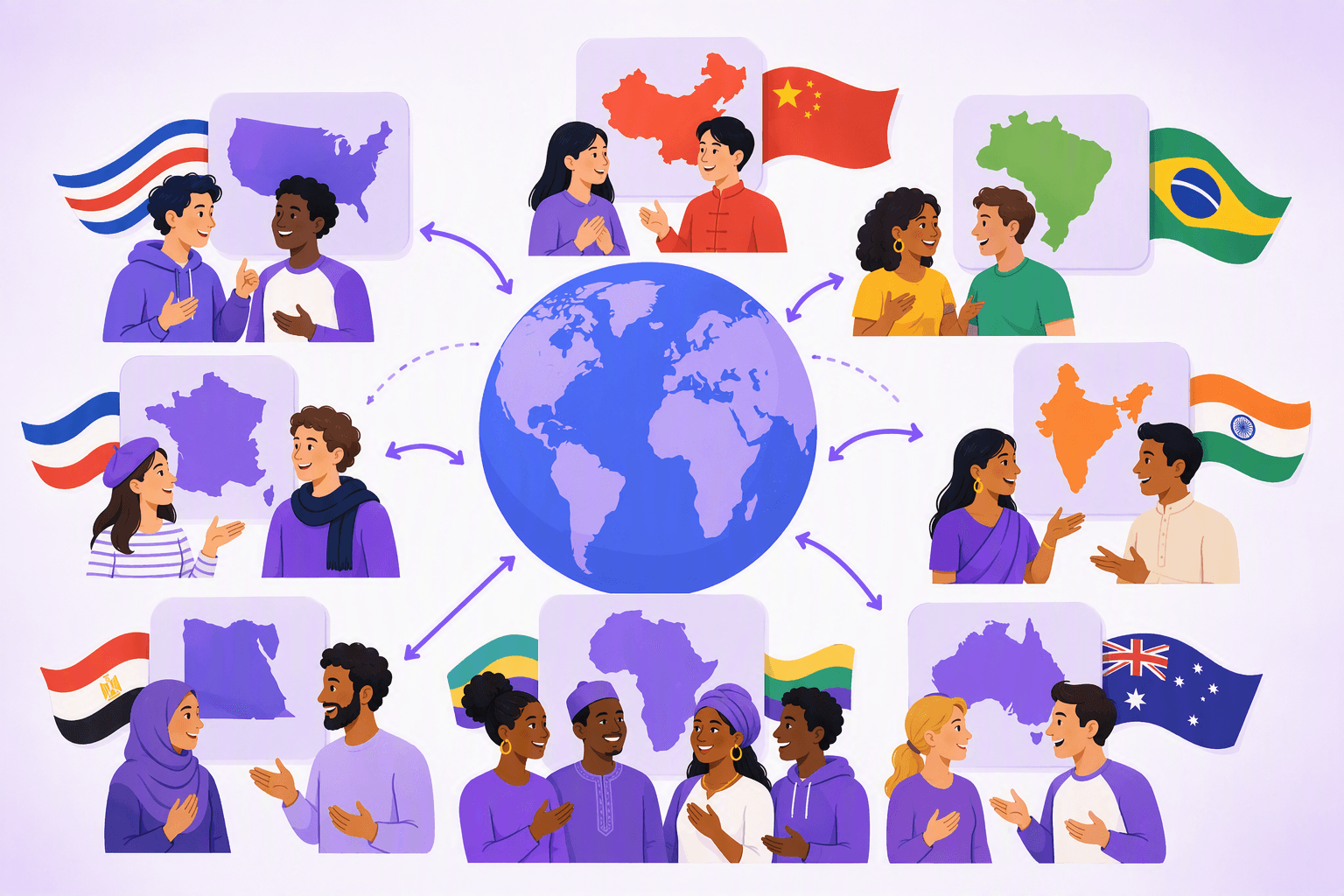
The essential rule: every country has a gender
French nouns have grammatical gender, and countries are no exception. Most country names ending in -e are feminine, including la France /la fʁɑ̃s/, l’Italie /li.ta.li/, and la Chine /la ʃin/.
Many country names without -e are masculine, such as le Canada /lə ka.na.da/, le Japon /lə ʒa.pɔ̃/, and le Portugal /lə pɔʁ.ty.ɡal/. This pattern is helpful, but it is not perfect: le Mexique /lə mɛk.sik/ ends in -e but is masculine.
Plural countries use les, as in les États-Unis /le.z‿e.ta.z‿y.ni/. You do not need to memorize a separate gender label for plural countries because their preposition pattern is always aux /o/.
En
Use en /ɑ̃/ with feminine countries and countries beginning with a vowel sound:
- J’habite en France. /ʒa.bit ɑ̃ fʁɑ̃s/, I live in France.
- Elle voyage en Italie. /ɛl vwa.jaʒ ɑ̃ i.ta.li/, She is travelling in Italy.
- Nous allons en Iran. /nu za.lɔ̃ ɑ̃ i.ʁɑ̃/, We are going to Iran.
The vowel rule explains en Afghanistan /ɑ̃ na.fɡa.nis.tɑ̃/ even though l’Afghanistan is masculine. The pronunciation begins with a vowel sound, so French uses en.
Au
Use au /o/ with masculine singular countries:
- Il vit au Canada. /il vi.to ka.na.da/, He lives in Canada.
- Je vais au Japon. /ʒə vɛ o ʒa.pɔ̃/, I am going to Japan.
- On travaille au Maroc. /ɔ̃ tʁa.vaj o ma.ʁɔk/, We work in Morocco.
Au is a contraction of à le. French does not allow à le Canada in standard modern usage.
Aux
Use aux /o/ with plural countries:
- Elle habite aux États-Unis. /ɛl a.bit o.z‿e.ta.z‿y.ni/, She lives in the United States.
- Ils vont aux Pays-Bas. /il vɔ̃.to pe.i.ba/, They are going to the Netherlands.
The final consonant of aux links to the following vowel in aux États-Unis, producing a /z/ liaison.
💡 Learn the country with its article
Do not memorize only France or Canada. Learn la France /la fʁɑ̃s/ and le Canada /lə ka.na.da/ as complete units. The article tells you which preposition you will need later.
Nationalities in French: agreement matters
Nationality words usually work as adjectives. They agree with the person they describe, which means they can change for masculine, feminine, singular, and plural.
Il est français /il ɛ fʁɑ̃.sɛ/ means he is French. Elle est française /ɛl ɛ fʁɑ̃.sɛz/ means she is French. For a mixed group or an all-male group, use français /fʁɑ̃.sɛ/. For an all-female group, use françaises /fʁɑ̃.sɛz/.
The masculine and feminine forms can sound identical. For example, canadien /ka.na.djɛ̃/ and canadienne /ka.na.djɛn/ differ, but suisse /sɥis/ stays unchanged for a Swiss man or woman. Written agreement still matters.
| Nationality in English | French | Pronunciation | Note |
|---|---|---|---|
| French man / French woman | français / française | frahn-SAY / frahn-SEHZ | Language: le français. |
| Canadian man / Canadian woman | canadien / canadienne | kah-nah-DYEN / kah-nah-DYEN | Final n is pronounced. |
| American man / American woman | américain / américaine | ah-may-ree-KAN / ah-may-ree-KEN | Usually means from the US. |
| English man / English woman | anglais / anglaise | ahn-GLAY / ahn-GLEHZ | For England, not the whole UK. |
| British man / British woman | britannique | bree-tah-NEEK | Same masculine and feminine form. |
| German man / German woman | allemand / allemande | ah-leh-MAHN / ah-leh-MAHND | Language: l'allemand. |
| Swiss man / Swiss woman | suisse | SWEESS | Same masculine and feminine form. |
| Belgian man / Belgian woman | belge | BEHLZH | Same masculine and feminine form. |
| Spanish man / Spanish woman | espagnol / espagnole | eh-spah-NYOL / eh-spah-NYOL | Language: l'espagnol. |
| Italian man / Italian woman | italien / italienne | ee-tah-LYEN / ee-tah-LYEN | Language: l'italien. |
| Portuguese man / Portuguese woman | portugais / portugaise | por-too-GAY / por-too-GEHZ | Language: le portugais. |
| Moroccan man / Moroccan woman | marocain / marocaine | mah-roh-KAN / mah-roh-KEN | Language: l'arabe is widely spoken. |
| Algerian man / Algerian woman | algérien / algérienne | ahl-zhay-RYEN / ahl-zhay-RYEN | Not the same as algérien Arabic. |
| Senegalese man / Senegalese woman | sénégalais / sénégalaise | say-nay-gah-LAY / say-nay-gah-LEHZ | French has official status in Senegal. |
| Ivorian man / Ivorian woman | ivoirien / ivoirienne | ee-vwah-RYEN / ee-vwah-RYEN | From Côte d'Ivoire. |
| Chinese man / Chinese woman | chinois / chinoise | shee-NWAH / shee-NWAHZ | Language: le chinois. |
| Japanese man / Japanese woman | japonais / japonaise | zhah-poh-NAY / zhah-poh-NEHZ | Language: le japonais. |
| Korean man / Korean woman | coréen / coréenne | koh-ray-EN / koh-ray-EN | Language: le coréen. |
| Brazilian man / Brazilian woman | brésilien / brésilienne | bray-zee-LYEN / bray-zee-LYEN | Language: le portugais. |
| Mexican man / Mexican woman | mexicain / mexicaine | mek-see-KAN / mek-see-KEN | Language: l'espagnol. |
When nationality words are nouns
French can use nationality terms as nouns for people. In that case, capitalize them.
- C’est un Français. /sɛ.t‿ɛ̃ fʁɑ̃.sɛ/, He is a French person.
- C’est une Française. /sɛ.tyn fʁɑ̃.sɛz/, She is a French person.
- Les Canadiens parlent français et anglais. /le ka.na.djɛ̃ paʁl fʁɑ̃.sɛ e ɑ̃.ɡlɛ/, Canadians speak French and English.
When the word is an adjective, it stays lowercase: un film français /œ̃ film fʁɑ̃.sɛ/, a French film. French spelling conventions make this distinction visible, although speech does not.
Maurice Grevisse and André Goosse discuss agreement as a central feature of French adjective grammar in Le Bon Usage. Nationality vocabulary is an efficient place to practise it because the change has a clear social meaning: it identifies who is being described.
Countries, nationalities, and languages are not identical
A country, its people, and its main language often have related words, but they are not interchangeable. Le Canada /lə ka.na.da/ is the country, canadien /ka.na.djɛ̃/ or canadienne /ka.na.djɛn/ describes a person, and le français /lə fʁɑ̃.sɛ/ is a language.
The relationship can be more complex than English suggests. A person from Belgium may be belge /bɛlʒ/, but Belgium has three official languages: Dutch, French, and German. A person from Switzerland is suisse /sɥis/, while Switzerland recognizes four national languages: German, French, Italian, and Romansh.
Ethnologue lists French among the world’s most widely used languages, but national identity and language use do not map one-to-one. In Senegal, for instance, sénégalais /se.ne.ɡa.lɛ/ identifies nationality, while French functions as an official language alongside many widely spoken African languages.
🌍 Francophone does not mean French
Francophone /fʁɑ̃.kɔ.fɔn/ means French-speaking. It does not mean someone is French or lives in France. A person can be Canadian, Senegalese, Belgian, Swiss, Haitian, or Congolese and be francophone. This distinction is especially useful in international French-speaking settings.
How to say where you are from
The most natural question is Tu viens d’où ? /ty vjɛ̃ du/, literally where do you come from? Use Vous venez d’où ? /vu və.ne du/ with strangers, older people, or in formal situations.
Your answer depends on country gender:
| Country type | Question answer pattern | Example |
|---|---|---|
| Feminine country | Je viens de | Je viens de France. /ʒə vjɛ̃ də fʁɑ̃s/ |
| Masculine country | Je viens du | Je viens du Canada. /ʒə vjɛ̃ dy ka.na.da/ |
| Vowel-starting country | Je viens d’ | Je viens d’Italie. /ʒə vjɛ̃ di.ta.li/ |
| Plural country | Je viens des | Je viens des États-Unis. /ʒə vjɛ̃ de.z‿e.ta.z‿y.ni/ |
Notice the difference between being somewhere and coming from somewhere. J’habite au Japon /ʒa.bit o ʒa.pɔ̃/ means I live in Japan, while je viens du Japon /ʒə vjɛ̃ dy ʒa.pɔ̃/ means I come from Japan.
This is one reason country articles matter so much. French learners who know a nationality adjective but not the country’s gender may produce understandable speech, yet their prepositions will sound unnatural.
Useful introduction sentences
Use these short patterns to turn your vocabulary into a real exchange:
- Je suis américain. /ʒə sɥi a.me.ʁi.kɛ̃/, I am American, said by a man.
- Je suis américaine. /ʒə sɥi a.me.ʁi.kɛn/, I am American, said by a woman.
- Je suis originaire du Brésil. /ʒə sɥi.z‿ɔ.ʁi.ʒi.nɛʁ dy bʁe.zil/, I am originally from Brazil.
- Ma famille vient d’Algérie. /ma fa.mij vjɛ̃ dal.ʒe.ʁi/, My family comes from Algeria.
- Elle parle portugais et français. /ɛl paʁl pɔʁ.ty.ɡɛ e fʁɑ̃.sɛ/, She speaks Portuguese and French.
- On habite en Belgique. /ɔ̃ na.bit ɑ̃ bɛl.ʒik/, We live in Belgium.
The verb être /ɛtʁ/, to be, is common for nationality. The expression venir de /və.niʁ də/, to come from, identifies origin. Être originaire de /ɛtʁ ɔ.ʁi.ʒi.nɛʁ də/ is slightly more formal and useful when discussing family background.
For an introduction that starts smoothly, pair these patterns with the greetings in our French hello guide. At the end of the conversation, use a natural farewell from our French goodbye guide.
Common mistakes English speakers make
Saying à France
French does not say à France /a fʁɑ̃s/ for in France. Use en France /ɑ̃ fʁɑ̃s/. The preposition à /a/ is generally for cities: à Paris /a pa.ʁi/, in Paris.
Using English-style capitalization everywhere
In French, nationality adjectives and language names are usually lowercase: une actrice italienne /yn ak.tʁis i.ta.ljɛn/ and la langue italienne /la lɑ̃ɡ i.ta.ljɛn/. Capitalize a nationality only when it is a noun referring to people: un Italien /œ̃ ni.ta.ljɛ̃/.
Forgetting feminine forms
Avoid describing a woman as italien /i.ta.ljɛ̃/ or espagnol /ɛs.pa.ɲɔl/. Use italienne /i.ta.ljɛn/ and espagnole /ɛs.pa.ɲɔl/. The feminine ending is sometimes silent in speech, but it is still required in writing.
Treating américain as all-American
In everyday French, américain /a.me.ʁi.kɛ̃/ usually means from the United States. For the continents, use nord-américain /nɔʁ a.me.ʁi.kɛ̃/, North American, or sud-américain /syd a.me.ʁi.kɛ̃/, South American, when precision matters.
Claude Hagège’s work on language and society emphasizes that language choices carry cultural categories as well as grammatical rules. In French, choosing francophone /fʁɑ̃.kɔ.fɔn/ rather than français /fʁɑ̃.sɛ/, or britannique /bʁi.ta.nik/ rather than anglais /ɑ̃.ɡlɛ/, can make your description more accurate and respectful.
A practical way to memorize country vocabulary
Study country names in four linked parts: the article, the destination phrase, the origin phrase, and the nationality. For example: le Japon /lə ʒa.pɔ̃/, au Japon /o ʒa.pɔ̃/, du Japon /dy ʒa.pɔ̃/, japonais /ʒa.pɔ.nɛ/.
Then say a full sentence aloud. Movie scenes and interviews are especially useful because speakers introduce themselves, mention holidays, discuss travel, and describe family origins in natural contexts. Combine repeated listening with French pronunciation practice so that country names become words you can recognize at real conversational speed.
Once these forms feel automatic, you can talk about where you live, where you have travelled, and who you have met with much more confidence. If the topic turns personal, our guide to saying I love you in French can help you move beyond introductions.
Frequently Asked Questions
How do you say nationality in French?
Do French nationality words have gender?
Why do French country names use different prepositions?
Is français a nationality or a language?
How do I ask where someone is from in French?
Sources & References
- Organisation internationale de la Francophonie, La langue française dans le monde, 2022
- Académie française, Dictionnaire de l'Académie française, accessed 2026
- CNRTL, Trésor de la langue française informatisé, accessed 2026
- Ethnologue, 27th edition, 2024
- Maurice Grevisse and André Goosse, Le Bon Usage, De Boeck Supérieur
Start learning with Wordy
Watch real movie clips and build your vocabulary as you go. Free to download.


