Quick Answer
French cognates are French and English words with a shared origin and similar meaning, such as important and important. They can give English speakers a fast vocabulary boost, but false friends such as actuellement and actually require extra care.
French cognates are one of the fastest ways for English speakers to recognize French vocabulary: words such as important /ɛ̃.pɔʁ.tɑ̃/, nation /na.sjɔ̃/, and restaurant /ʁɛs.to.ʁɑ̃/ look familiar because French and English share centuries of linguistic history. The catch is pronunciation and meaning: some look-alikes are reliable, while false friends can lead you badly off course. Learn the high-value patterns, then treat every familiar word as a clue rather than a guarantee.
French is spoken by an estimated 321 million people across five continents, according to the Organisation internationale de la Francophonie. That global reach means French vocabulary appears in many settings, from a Paris café to Canadian media, African business, international diplomacy, and film.
For a beginner, cognates make real French feel less opaque from day one. They are especially common in writing, news, education, food, politics, art, and professional contexts. Pair them with practical phrases from our guide to saying hello in French, and you can begin recognizing useful language immediately.
| French | Pronunciation | Note |
|---|---|---|
| important | an-por-TAHN | /ɛ̃.pɔʁ.tɑ̃/. Same core meaning, masculine form. |
| nation | nah-SYOHN | /na.sjɔ̃/. A country or people considered as a political community. |
| possible | poh-SEE-bluh | /pɔ.si.bl(ə)/. Usually follows être: c'est possible. |
| restaurant | res-toh-RAHN | /ʁɛs.to.ʁɑ̃/. French final sounds differ from English. |
| culture | kool-TYOOR | /kyl.tyʁ/. Used for art, customs, and shared social practices. |
| minute | mee-NOOT | /mi.nyt/. A minute of time, with stress unlike English. |
| famille | fah-MEE-yuh | /fa.mij/. Means family. |
| différent | dee-feh-RAHN | /di.fe.ʁɑ̃/. Agree it with the noun: différente, différents, différentes. |
| accident | ak-see-DAHN | /ak.si.dɑ̃/. Means an accident or incident. |
| excellent | ek-seh-LAHN | /ɛk.se.lɑ̃/. Means excellent, often with a nasal final vowel. |
| information | an-for-mah-SYOHN | /ɛ̃.fɔʁ.ma.sjɔ̃/. Often used in the plural for information items. |
| université | oo-nee-ver-see-TAY | /y.ni.vɛʁ.si.te/. Means university. |
| police | poh-LEESS | /pɔ.lis/. Usually refers to the police as an institution. |
| réponse | ray-POHNS | /ʁe.pɔ̃s/. Means answer or response. |
| situation | see-too-ah-SYOHN | /si.tɥa.sjɔ̃/. Used for a situation or set of circumstances. |
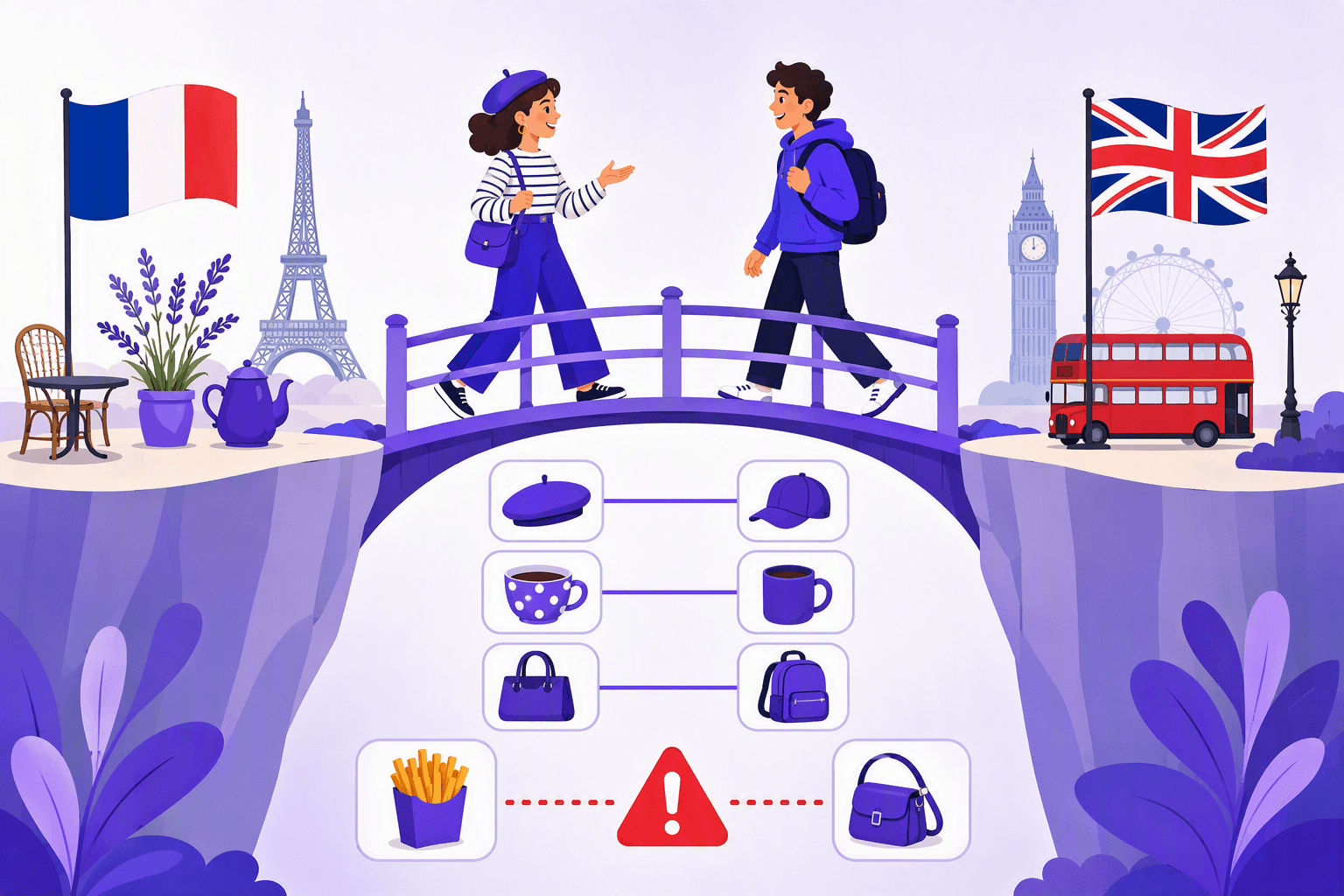
Why French and English share so many words
English is a Germanic language, but much of its vocabulary comes from French and Latin. After the Norman Conquest of England in 1066, French was used for centuries among the ruling class, in courts, administration, and elite culture.
That history left English with pairs such as freedom and liberty, ask and demand, or kingly and royal. The first word in each pair often has Germanic roots, while the second reflects French influence.
Henriette Walter's L'Aventure des langues en Occident traces how languages develop through contact, migration, trade, and political power. English did not simply borrow a few elegant French terms. It absorbed a huge layer of French vocabulary that still shapes its everyday and formal registers.
Baugh and Cable's A History of the English Language similarly documents the lasting effect of French on English after 1066. This is why an English speaker can often recognize French words relating to institutions, emotions, science, food, and abstract ideas.
The cognate advantage, and its limits
A cognate is not merely a word that looks similar. Strictly speaking, it is a word related through a common historical source. In language learning, people often use the term more broadly for familiar-looking French-English pairs with related meanings.
This distinction matters because apparent similarity can be misleading. A word may be historically related but have shifted in meaning, or it may look familiar by coincidence.
The CNRTL, France's major lexical resource, is useful for checking a word's definitions, etymology, and historical development. Its entries show why vocabulary is rarely as simple as a direct one-word translation.
Reliable cognates
Reliable cognates tend to keep a close meaning in both languages. These are especially useful for reading and listening:
| English | French | IPA | Practical note |
|---|---|---|---|
| animal | animal | /a.ni.mal/ | Same broad meaning |
| document | document | /dɔ.ky.mɑ̃/ | A written or digital document |
| énergie | énergie | /e.nɛʁ.ʒi/ | Energy, physical or electrical |
| général | général | /ʒe.ne.ʁal/ | General, often after the noun |
| hospital | hôpital | /o.pi.tal/ | Hospital, but note the accent |
| musique | musique | /my.zik/ | Music |
| naturel | naturel | /na.ty.ʁɛl/ | Natural |
| problème | problème | /pʁɔ.blɛm/ | Problem |
| spécial | spécial | /spe.sjal/ | Special |
| télévision | télévision | /te.le.vi.zjɔ̃/ | Television |
These words still need French pronunciation. French generally gives each syllable more even weight than English, and stress does not jump strongly onto one syllable. For a fuller explanation of rhythm, vowels, and final consonants, see our French pronunciation guide.
Cognates that change grammatical shape
A familiar root may appear with a different ending in French. This is one of the easiest patterns to learn.
| English pattern | Common French pattern | Example |
|---|---|---|
| -tion | -tion | information /ɛ̃.fɔʁ.ma.sjɔ̃/ |
| -ity | -ité | possibilité /pɔ.si.bi.li.te/ |
| -ic | -ique | politique /pɔ.li.tik/ |
| -al | -el or -al | naturel /na.ty.ʁɛl/, national /na.sjɔ.nal/ |
| -ous | -eux or -euse | dangereux /dɑ̃.ʒə.ʁø/ |
| -ence | -ence | différence /di.fe.ʁɑ̃s/ |
Do not treat these as automatic conversion rules. They are recognition patterns, not a license to invent French words. Still, they help you make educated guesses while reading an article, watching a series, or scanning a museum sign.
Pronunciation is where cognates become French
The spelling may be familiar, but English pronunciation rules will not produce natural French. A French cognate should be learned as a new sound pattern, not as an English word spoken with a French accent.
Take important /ɛ̃.pɔʁ.tɑ̃/. English speakers may expect a final consonant and a strong stressed syllable. In French, the final t is not pronounced, and the ending contains a nasal vowel.
Likewise, restaurant /ʁɛs.to.ʁɑ̃/ does not end like English restaurant. The final vowel is nasal, the French r is produced farther back in the throat, and each syllable remains audible.
Watch final consonants
Many French word-final consonants are silent, though there are important exceptions. In grand /ɡʁɑ̃/, the final d is silent. In important /ɛ̃.pɔʁ.tɑ̃/, the final t is silent as well.
But in avec /a.vɛk/, the c is pronounced. Instead of memorizing one universal rule, learn the pronunciation as part of each new word.
Notice nasal vowels
French nasal vowels are central to cognate pronunciation. In nation /na.sjɔ̃/, information /ɛ̃.fɔʁ.ma.sjɔ̃/, and différent /di.fe.ʁɑ̃/, the vowel and following nasal consonant combine into one nasal sound.
Do not pronounce the final n as a separate English-style consonant when it closes the syllable. Training your ear with short scenes is effective here, because you hear the word in its natural speed and sentence rhythm. Our guide to learning French with movies can help you choose material that is engaging without being incomprehensible.
False friends that matter most
False friends, or faux amis /fo.z‿a.mi/, are the price of having an easy cognate vocabulary. They look reassuring, so learners tend to use them too confidently.
The most useful strategy is to learn high-frequency false friends as complete pairs: the French word, its real meaning, and the French word you need for the English idea.
Actuellement
Actuellement /ak.tɥɛl.mɑ̃/ means currently or at present. It does not mean “actually.”
For “actually,” use en fait /ɑ̃ fɛ/ in many everyday contexts. Saying actuellement when correcting someone may sound as if you are discussing the present moment instead.
Attendre
Attendre /a.tɑ̃dʁ/ means to wait for, not to attend. You can say J'attends le train /ʒa.tɑ̃ lə tʁɛ̃/, meaning “I am waiting for the train.”
To attend an event, French often uses assister à /a.si.ste a/. For example, J'assiste au concert /ʒa.sist o kɔ̃.sɛʁ/ means “I am attending the concert.”
Librairie
Librairie /li.bʁɛ.ʁi/ means bookstore. A library is bibliothèque /bi.bli.jɔ.tɛk/.
This is a practical travel false friend. If you ask for a librairie, you will be directed toward books for sale, not a public study space or lending collection.
Location
Location /lɔ.ka.sjɔ̃/ means rental or renting, not a place. For “location” as a place, use lieu /ljø/, endroit /ɑ̃.dʁwa/, or emplacement /ɑ̃.pla.sə.mɑ̃/, depending on the context.
A sign advertising location de voitures /lɔ.ka.sjɔ̃ də vwa.tyʁ/ is offering car rental.
Sensible
Sensible /sɑ̃.si.bl(ə)/ means sensitive, not sensible. A sensitive subject is un sujet sensible /œ̃ sy.ʒɛ sɑ̃.si.bl(ə)/.
For “sensible” in the meaning “reasonable,” French often uses raisonnable /ʁɛ.zɔ.na.bl(ə)/.
Préservatif
Préservatif /pʁe.zɛʁ.va.tif/ means condom. It is not a general preservative used in food.
Food preservatives are called conservateurs /kɔ̃.sɛʁ.va.tœʁ/. This is a classic example of why a familiar word should be checked before you use it in a serious situation.
Blesser
Blesser /ble.se/ means to injure or to hurt, physically or emotionally. It does not mean “to bless.”
The verb “to bless” is bénir /be.niʁ/. The two words can create an especially confusing sentence if you rely on spelling alone.
⚠️ Do not translate word by word
A familiar-looking French word is a hypothesis, not proof. Before using it, check its meaning, gender, pronunciation, and the preposition that follows it. This matters most with verbs, where one wrong preposition can change the whole sentence.
Cognates can sound more formal in French
French and English do not always assign the same social tone to shared Latin-based vocabulary. English uses many French-derived words in ordinary speech, while French may have a shorter, more common alternative.
For instance, commencer /kɔ.mɑ̃.se/ means “to begin,” but débuter /de.by.te/ is also common. Both are normal, yet the surrounding sentence and region influence which sounds more natural.
Another useful distinction is demander /də.mɑ̃.de/, which means “to ask,” not “to demand.” English speakers often feel its force is stronger than it is because of the English word demand. In everyday French, demander une question is less idiomatic than poser une question /po.ze yn kɛs.tjɔ̃/, literally “to put a question.”
🌍 Why French cognates appear often in formal settings
French vocabulary has long carried prestige in English-speaking law, diplomacy, cuisine, fashion, and the arts. That shared history explains why cognates are frequent in formal writing. In spoken French, however, the most natural word is sometimes shorter and less visibly related to English.
A practical method for learning French cognates
Start with cognates that appear in material you genuinely consume. A documentary may give you documentaire /dɔ.ky.mɑ̃.tɛʁ/, histoire /is.twaʁ/, and politique /pɔ.li.tik/. A restaurant scene may give you menu /mə.ny/, service /sɛʁ.vis/, and addition /a.di.sjɔ̃/.
Then follow four steps:
- Recognize the word in context. Guess from the scene, sentence, or image before looking it up.
- Confirm the French meaning. Check a trusted dictionary such as the Académie française dictionary or the CNRTL.
- Record pronunciation and gender. Learn la situation /la si.tɥa.sjɔ̃/, not only situation /si.tɥa.sjɔ̃/.
- Make one usable sentence. For example: La situation est difficile /la si.tɥa.sjɔ̃ ɛ di.fi.sil/, “The situation is difficult.”
This method turns passive recognition into vocabulary you can retrieve when speaking. It also prevents the common mistake of collecting a long list of look-alikes without knowing how they behave in a sentence.
Build beyond familiar words
Cognates can create quick wins, but French fluency depends on high-frequency function words, verbs, and everyday expressions that do not resemble English. Words such as être /ɛtʁ/, avoir /a.vwaʁ/, aller /a.le/, faire /fɛʁ/, and vouloir /vu.lwaʁ/ carry far more conversational weight than many elegant cognates.
Use cognates to understand the topic of a scene, then focus your practice on the small words that connect ideas. You will hear that combination in greetings, apologies, invitations, and affection. Once you are comfortable with basic vocabulary, practice social language through our guides to French goodbyes and ways to say I love you in French.
The best result is not sounding like you are translating English vocabulary into French. It is recognizing shared roots quickly, checking the traps, and using the French word naturally in the moment.
Frequently Asked Questions
What are French cognates?
How many French cognates are there in English?
Are French cognates always pronounced like English words?
What are false friends in French?
Can I rely on cognates when speaking French?
Sources & References
- Organisation internationale de la Francophonie, La langue française dans le monde, 2022
- Centre National de Ressources Textuelles et Lexicales, TLFi and lexical resources, accessed 2026
- Académie française, Dictionnaire de l'Académie française, accessed 2026
- Henriette Walter, L'Aventure des langues en Occident, Robert Laffont
- Albert C. Baugh and Thomas Cable, A History of the English Language, Routledge
Start learning with Wordy
Watch real movie clips and build your vocabulary as you go. Free to download.


