Quick Answer
The best free language learning resources are the ones that give you daily listening and reading input you can actually understand, plus a simple way to review vocabulary. Start with your local library (ebooks, audiobooks, graded readers), add one podcast or YouTube channel for listening, and use free flashcards or subtitles to capture new words. With consistent practice, free resources can take you to an intermediate level, especially for widely supported languages like English, Spanish, French, and German.
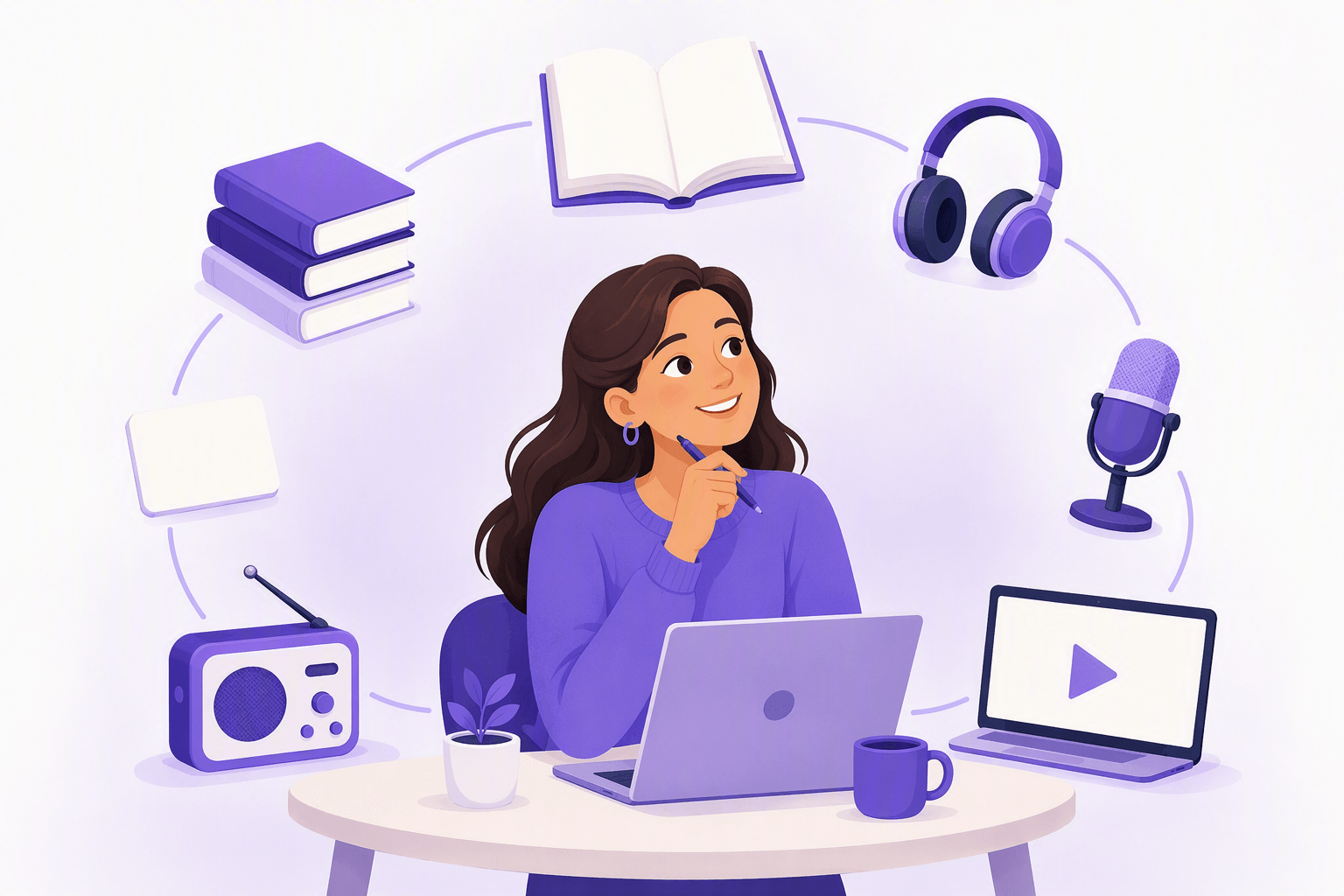
Free language learning resources that actually work are the ones you will use every day: a library for reading and audio, one reliable listening source (podcast, YouTube, radio), and a lightweight way to review vocabulary. You do not need a paid app to start, but you do need a routine that turns free content into repeatable practice.
English is a good example of why free resources can be enough for real progress. Ethnologue estimates roughly 1.5 billion English speakers worldwide (L1 plus L2), which means there is an endless supply of free content at every level, from learner news to full movies and TV (Ethnologue, 27th edition, 2024). The trick is choosing the right inputs and using them in a way that builds skills, not just entertainment.
If you are learning English specifically, you will also benefit from learning how people really speak. That includes slang and taboo language, even if you do not plan to use it. Two helpful companions to this guide are our English slang list and our English swear words guide, because they help you recognize tone in real scenes.
What "free" really means (and what it costs)
Free resources usually cost one of three things: time, attention, or friction.
Time cost is obvious. You might spend longer searching for good material than you would inside a paid course.
Attention cost is the ads, algorithmic distractions, and endless scrolling. If you rely on social platforms, you need rules that protect your study time.
Friction cost is setup. Free tools often require you to build your own system for review, tracking, and progression.
💡 A realistic goal for free learning
If you can do 30 minutes a day for 90 days, free resources can move you from "I know some words" to "I can follow simple conversations." The biggest upgrade is not paying, it is showing up daily.
The core principle: input plus retrieval
Most free resources fall into two categories: input (listening and reading) and retrieval (practice that forces you to recall).
Stephen Krashen’s work on comprehensible input is often summarized as a simple idea: you improve when you understand messages in the language. That is why learner podcasts, graded readers, and subtitled shows are so powerful when they are at the right level.
On the other side, Robert Bjork’s research on "desirable difficulties" in memory is a useful lens for why review matters. If you only consume content, you recognize words but cannot produce them. Retrieval practice, like flashcards or quick quizzes, turns recognition into usable skill.
The best free plan combines both: lots of understandable input, plus small daily retrieval.
Start with the public library (the most underrated free resource)
Public libraries are not just for paper books. Many offer ebooks, audiobooks, online magazines, and language-learning platforms through partnerships.

What to look for at your library
Ask about:
- Graded readers in your target language
- Audiobooks with matching ebooks, so you can read and listen together
- Children’s nonfiction, which is often clear and information-dense
- Free access to digital services through your library card
In many cities, libraries also host conversation groups or cultural events. Those are free speaking opportunities with low pressure.
🌍 Why libraries work so well for adults
UNESCO’s adult learning work emphasizes access and continuity: adults learn best when resources are easy to reach and usable over time. Libraries solve both problems because they are stable, local, and designed for repeated use, not one-time motivation.
A simple library routine that works
Pick one short book you can finish. Finishing builds momentum.
Read 10 pages a day, then listen to 10 minutes of audio. If you cannot find matching audio, listen to any related content, like a short documentary.
Write down 5 new words per day. Review them for 2 minutes the next day.
Free websites for structured lessons (use them as scaffolding)
Structured lessons are useful early on because they reduce decision fatigue. You do not want to spend your first month guessing what to study.
British Council LearnEnglish
British Council’s LearnEnglish materials are designed for learners and cover listening, reading, grammar, and vocabulary (British Council, LearnEnglish, accessed 2026). The strength is clarity and level labeling.
Use it to build a base, then transition to more real content. If you stay only in worksheets, your listening will lag.
VOA Learning English
VOA Learning English offers slower, clearer news and stories with transcripts (VOA Learning English, accessed 2026). This is ideal for building listening confidence.
A practical method is "listen, then read, then listen again." The second listen usually feels dramatically easier, and that feeling is your brain building prediction.
YouTube and podcasts (free listening that scales)
Listening is where many self-learners stall because real speech is fast and messy. The fix is not to avoid real speech, it is to step up difficulty gradually.
How to choose a good channel or podcast
Pick sources with:
- Clear audio
- Consistent topics
- Transcripts or subtitles when possible
- Episodes that are 5 to 20 minutes long
Avoid sources that are mostly jokes, cross-talk, or heavy slang until you have a base. You will get there, but not on day one.
The "one clip, three passes" method
Use this on any short audio, including a movie scene:
- First pass: listen without subtitles, just for the main idea.
- Second pass: listen with subtitles or transcript, mark unknown words.
- Third pass: listen again without subtitles, aiming to catch the same meaning.
This method is especially effective with film dialogue because you get context from the scene. If you want curated options, start with our best movies to learn English list and pick one you would watch anyway.
⚠️ Subtitles can become a crutch
If you always watch with subtitles in your native language, you are practicing reading, not listening. Switch to target-language subtitles as soon as you can, and occasionally do a no-subtitle pass to test your listening.
Free reading resources that build vocabulary fast
Reading is the quiet engine of vocabulary growth. It is also easier to control than listening because you can pause without losing the thread.
Graded readers and simplified news
Graded readers exist because vocabulary load matters. If every sentence has three unknown words, you cannot build flow.
Simplified news sources, learner stories, and short nonfiction are ideal for daily reading. Your goal is volume and consistency, not perfect comprehension.
Fan communities and interest-based reading
Once you have a base, interest-based reading is a cheat code: recipes, game guides, sports recaps, or hobby forums. You already know the topic, so your brain can infer language.
If you are learning English and you like internet culture, slang will show up constantly. Keep a reference list nearby, like our English slang guide, but treat it as recognition training, not a checklist to speak.
Free speaking practice (without paying for tutoring)
Speaking is the hardest skill to get for free, but it is possible.
Language exchanges
Language exchanges work best when you bring structure. Otherwise, you talk about your weekend forever and never improve.
A simple format:
- 15 minutes in your target language
- 15 minutes in your partner’s target language
- One shared topic per session (food, work, travel, movies)
- One correction rule (only correct repeated mistakes)
Shadowing and self-talk
If you cannot find a partner, you can still build speaking muscle.
Shadowing means repeating immediately after a speaker, copying rhythm and reductions. It is awkward at first, but it trains your mouth.
Self-talk is narrating your actions in simple sentences. It sounds silly, but it forces retrieval.
Free vocabulary and review tools (keep it lightweight)
You do not need a complex system. You need one place to store words and a habit to review them.
Flashcards (digital or paper)
Digital flashcards are convenient, but paper is fine. The key is retrieval: cover the answer and force recall.
If you want a deeper system, spaced repetition is the idea behind most flashcard apps. We explain how to use it effectively in our spaced repetition guide.
What words should you save?
Save words that meet at least one of these:
- You saw them twice in one week
- They unlock a topic you care about
- They appear in common phrases
For English learners, numbers are a high-value set because they show up everywhere: prices, dates, times, sports, work metrics. If you need a refresher, our numbers in English guide helps you cover the patterns quickly.
Using movies and TV for free (legally)
You do not need to pirate content to learn. Many countries have free, legal streaming options through public broadcasters, library services, or ad-supported platforms.
Why film dialogue helps
Movies and TV give you pragmatic language: how people soften requests, disagree politely, or signal sarcasm. That is hard to learn from textbook sentences.
Linguist Deborah Tannen’s work on conversational style is a useful reminder here: meaning is not only in words, it is in pacing, repetition, and indirectness. Film and TV make those patterns visible.
A practical "scene mining" workflow
Pick one show. Rewatching beats constantly switching.
Choose a 30 to 90 second scene. Extract:
- 1 useful phrase
- 5 words you actually want
- 1 pronunciation detail (linking, reductions, stress)
Then reuse the scene over a week. Repetition is what turns a cool scene into skill.
Free resources by skill (a quick map)
You will learn faster if you match the resource to the skill you need.
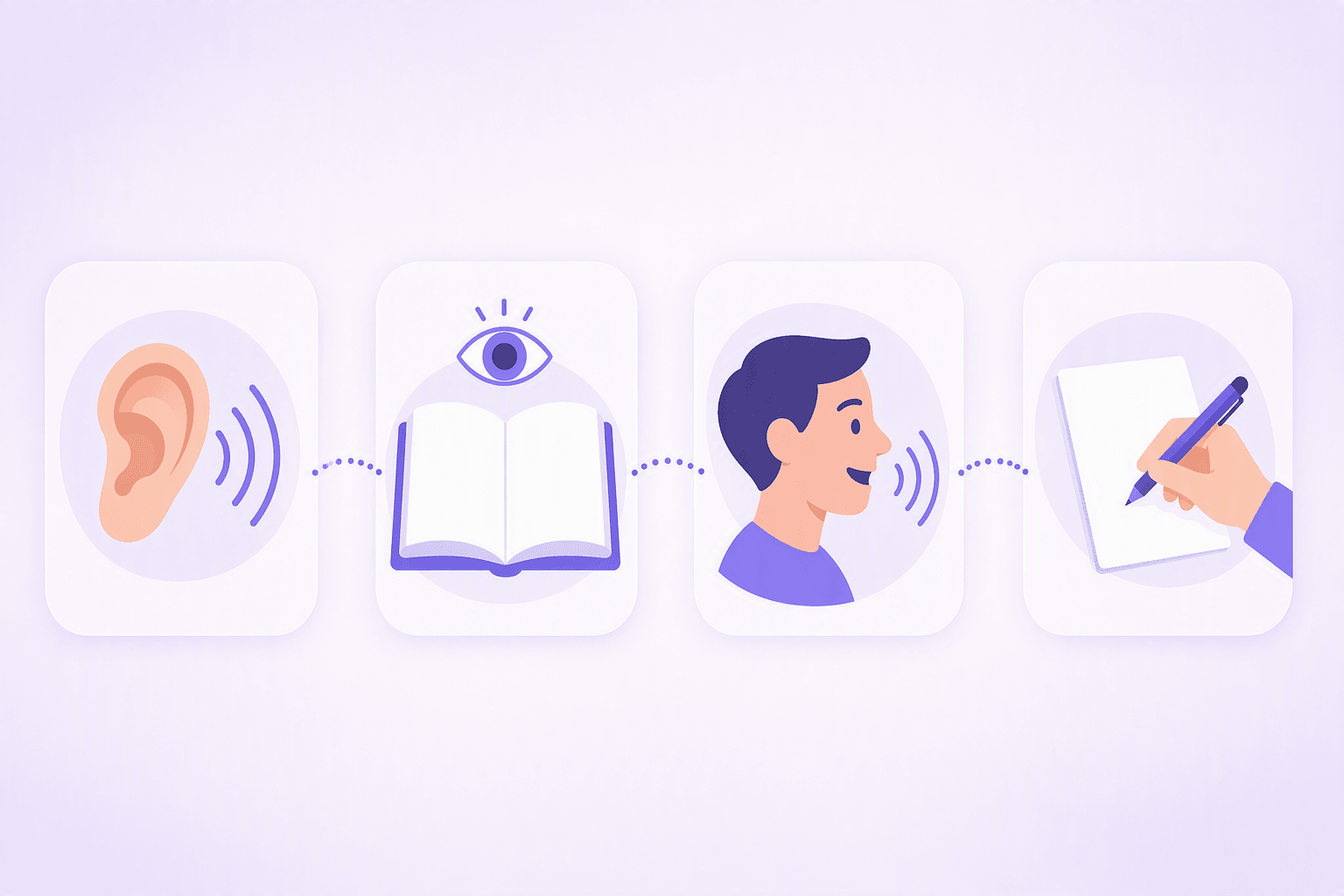
Listening
Use learner news, podcasts, and short YouTube videos with transcripts. Then graduate to real interviews and shows.
Reading
Use graded readers, simplified articles, and interest-based texts. Track repeated words.
Speaking
Use language exchanges, shadowing, and short recorded monologues. Keep topics narrow.
Writing
Write short daily paragraphs and get feedback when possible. Even without feedback, writing forces you to notice gaps.
A 4-week free study plan you can actually follow
This is a realistic plan for busy adults. Adjust the time, not the structure.
Week 1: Build the habit
- 10 minutes: structured lesson (British Council or similar)
- 10 minutes: easy listening with transcript
- 10 minutes: easy reading
- 2 minutes: review yesterday’s words
Goal: show up daily.
Week 2: Add repetition
Keep the same structure, but repeat the same listening source all week. Repetition reduces cognitive load and increases noticing.
Goal: recognize more without pausing.
Week 3: Add one real-media scene
Add one short movie or TV scene three times per week. Use the "one clip, three passes" method.
Goal: tolerate natural speed.
Week 4: Add speaking output
Do one language exchange or one recorded monologue twice this week. Keep it short.
Goal: speak without freezing.
💡 How to measure progress without tests
Track three things: minutes listened, pages read, and number of scenes repeated. These are input metrics you control. Fluency metrics are delayed, but input metrics predict them.
Common mistakes with free resources (and how to avoid them)
Mistake 1: Collecting resources instead of studying
If you have 12 apps and 40 bookmarks, you are procrastinating in a socially acceptable way.
Pick one resource per skill and commit for 30 days.
Mistake 2: Going too hard too early
If you jump straight into fast, slang-heavy content, you will feel like you are failing. You are not failing, you are just using material that is too dense.
Use level-appropriate input, then step up gradually.
Mistake 3: Avoiding messy language
Real English includes fillers, reductions, and taboo language. You do not have to use it, but you should recognize it.
If you watch modern shows, you will hear slang and swearing. Use guides like English swear words for comprehension, and choose when to speak more formally.
How Wordy fits into a free-first approach
A free-first approach is smart, but many learners hit a bottleneck: they can find content, but they cannot turn it into repeatable practice.
Wordy is designed for that bottleneck by turning short movie and TV clips into structured listening practice with vocabulary review. If you are already using films, compare your approach with our broader guide on learning a language with movies, then decide whether a clip-based tool helps you stay consistent.
The bottom line
Free language learning resources are enough to make serious progress if you build a simple system: library reading and audio, one daily listening source, and a small review habit. Keep your resource list small, repeat materials, and measure progress by time spent with understandable input.
If you want one next step, pick a show from our best movies to learn English guide, choose one short scene, and repeat it three times this week. That single habit often does more than downloading another app.
Frequently Asked Questions
Can you learn a language to fluency using only free resources?
What is the single best free resource for language learning?
How many minutes a day should I study with free resources?
How do I choose content that is not too hard?
What free resources are best specifically for learning English?
Sources & References
- Ethnologue, 27th edition, 2024
- British Council, LearnEnglish (accessed 2026)
- VOA Learning English (accessed 2026)
- UNESCO Institute for Lifelong Learning, Global Report on Adult Learning and Education (accessed 2026)
- American Library Association, Public Libraries and Community Learning resources (accessed 2026)
Start learning with Wordy
Watch real movie clips and build your vocabulary as you go. Free to download.


