Quick Answer
English has adopted Korean words for food, martial arts, business, and pop culture. Familiar examples include kimchi, taekwondo, chaebol, mukbang, and hallyu, each carrying a cultural meaning that English often cannot replace with one exact word.
English has borrowed a growing set of Korean words, especially for foods, martial arts, business structures, and online culture. Words such as kimchi, taekwondo, chaebol, and mukbang stay recognizably Korean in English because they describe ideas with cultural detail that a simple translation would lose. If you are building natural modern vocabulary, these terms belong beside the current expressions in our English slang guide.
Korean is spoken by roughly 82 million people worldwide and is an official language in both North Korea and South Korea. As Korean restaurants, music, dramas, cosmetics, and digital media have reached larger international audiences, English has increasingly kept Korean names rather than replacing them.
This is how borrowing usually works. As Philip Durkin explains in Borrowed Words: A History of Loanwords in English, English expands by adopting terms for new objects, practices, and cultural concepts. Korean loanwords are a clear modern example: the borrowed word often arrives together with the thing it names.
| Meaning in English | English | Pronunciation | Note |
|---|---|---|---|
| Fermented vegetable dish | kimchi | KEEM-chee | From Korean 김치 /kim.tɕʰi/. |
| Korean martial art | taekwondo | ty-KWON-doh | From Korean 태권도 /tʰɛ.k͈wʌn.do/. |
| Family-controlled business group | chaebol | CHAY-bol | From Korean 재벌 /tɕɛ.bʌl/. |
| Eating-video broadcast | mukbang | MUHK-bahng | From Korean 먹방 /mʌk.p͈aŋ/. |
| Korean cultural wave | hallyu | HAHL-yoo | From Korean 한류 /han.nju/. |
| Korean rice liquor | soju | SOH-joo | From Korean 소주 /so.dʑu/. |
| Youngest group member | maknae | MAHNG-nay | From Korean 막내 /maŋ.nɛ/. |
| Cute, affectionate behavior | aegyo | EH-gyoh | From Korean 애교 /ɛ.ɡjo/. |
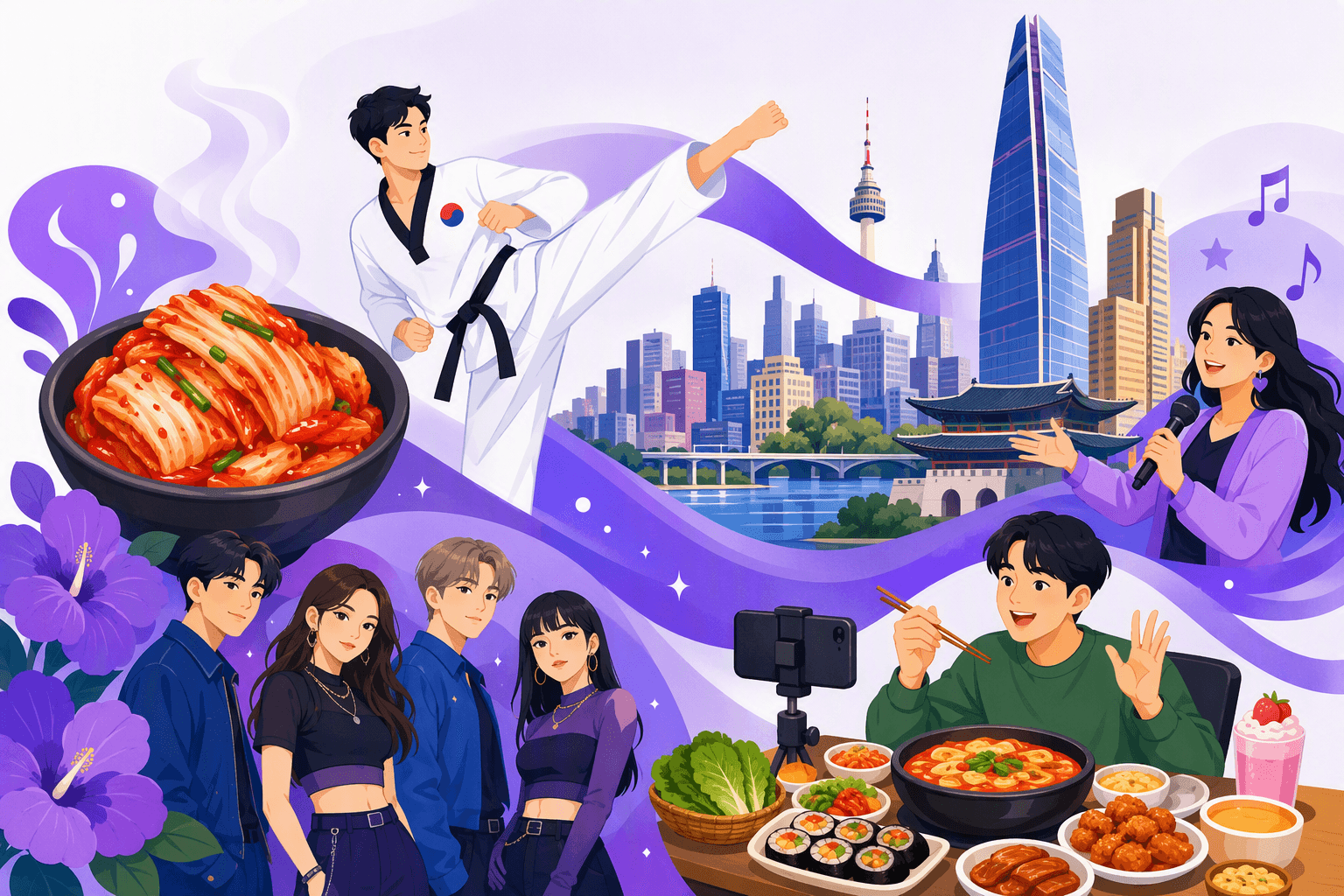
Why English keeps Korean words
A loanword is not merely a foreign-looking label. It can carry a compact cultural reference. Calling kimchi only fermented vegetables, for example, misses its ingredients, preparation methods, regional varieties, and role at meals.
The same applies to chaebol. You could say large company, but that does not describe the family ownership, network of affiliates, and economic history associated with major South Korean conglomerates.
Ho-min Sohn's The Korean Language shows how Korean words often pack social relationships and cultural assumptions into short expressions. When English adopts those expressions, the original term can remain the clearest option.
Korean loanwords also enter English through different paths:
- Food and drink: restaurant menus, recipes, grocery packaging, and cooking shows.
- Sports: international martial arts organizations and competitions.
- Business journalism: reporting on South Korea's economy and major corporations.
- Entertainment: subtitles, fan communities, K-pop, K-dramas, and variety shows.
- Internet culture: livestreams, social platforms, and video trends.
Food words that became everyday English
Korean food words are among the most established borrowings. They are useful because they name specific dishes, flavors, and ingredients rather than vague categories.
Kimchi
Kimchi comes from 김치 /kim.tɕʰi/. In English, it usually refers to spicy fermented vegetables, often napa cabbage or radish, seasoned with chili, garlic, ginger, and fermented seafood or other savory ingredients.
The word is now standard on English-language menus and in dictionaries. It can be used as a mass noun, as in “We bought kimchi,” or as a count noun when discussing varieties, as in “The shop sells several kimchis.”
Kimchi is also more than a side dish. UNESCO inscribed Kimjang, the collective making and sharing of kimchi in the Republic of Korea, on its Intangible Cultural Heritage list in 2013. That recognition helps explain why translating it as pickled cabbage is inaccurate: not all kimchi is cabbage, and the social practice is central to its meaning.
Bibimbap
Bibimbap comes from 비빔밥 /pi.bim.p͈ap/ and is pronounced approximately BEE-bim-bahp. It is a rice dish served with mixed vegetables, often meat or egg, and a spicy sauce.
The name describes mixed rice, but English speakers normally use bibimbap rather than mixed rice because the English description does not identify the dish. In menus, you may see variations such as stone-pot bibimbap or vegetarian bibimbap.
Bulgogi
Bulgogi comes from 불고기 /pul.ɡo.ɡi/, approximately bool-GOH-gee. It refers to Korean-style marinated grilled meat, commonly beef, although chicken and pork versions are also common.
The literal Korean elements relate to fire and meat, but English usage treats bulgogi as the name of a prepared dish or flavor profile. A bulgogi sandwich, for example, may combine Korean-seasoned meat with a non-Korean format.
Gochujang
Gochujang comes from 고추장 /ko.tɕʰu.dʑaŋ/, approximately goh-choo-JAHNG. It is a fermented red chili paste with heat, sweetness, salt, and deep savory flavor.
English recipe writing increasingly uses gochujang without translating it. Red pepper paste is a rough description, but it does not distinguish this fermented Korean ingredient from other chili pastes.
Soju
Soju comes from 소주 /so.dʑu/, approximately SOH-joo. It is a clear Korean distilled spirit, traditionally associated with social drinking and shared meals.
In English, soju is a product name and a cultural reference. Saying Korean vodka can help a beginner imagine the appearance, but it is not a precise definition because soju has its own production styles, alcohol strengths, and drinking customs. For practical meal language, see our guide to Korean food culture.
🌍 Food names are not interchangeable
Korean food words often remain untranslated because a direct English label removes useful distinctions. Kimchi is not simply pickles, gochujang is not simply hot sauce, and bibimbap is not simply a rice bowl. Use the Korean word when you mean the specific dish or ingredient.
Words from sport, business, and daily life
Not every Korean loanword concerns food. A few have become standard terms in sports reporting, economics, and English-language discussions of Korean society.
Taekwondo
Taekwondo comes from 태권도 /tʰɛ.k͈wʌn.do/, approximately ty-KWON-doh. It is a Korean martial art and an Olympic combat sport known for its dynamic kicking techniques.
The English spelling is standardized enough that most speakers recognize it immediately. It functions like other sport names: people train in taekwondo, earn a taekwondo belt, or watch taekwondo competitions.
The term includes elements connected to foot, fist, and way or path. Still, English speakers do not need to analyze the parts every time. The borrowed word identifies the martial art as a whole.
Chaebol
Chaebol comes from 재벌 /tɕɛ.bʌl/, approximately CHAY-bol. It refers to a large, family-controlled South Korean business group with a web of affiliated companies.
This word appears mostly in financial reporting and political analysis. A sentence such as “The chaebols have significant influence on the economy” assumes a South Korean context and is more precise than “big companies.”
Do not use chaebol for every large company. A multinational corporation in the United States or Germany is not automatically a chaebol. The term points specifically to a Korean corporate structure and its history.
Hanbok
Hanbok comes from 한복 /han.bok/, approximately HAHN-bok. It is traditional Korean clothing, including garments worn for celebrations, ceremonies, holidays, and cultural performances.
English sometimes calls it Korean traditional dress, but hanbok is the normal term when discussing the garment itself. Its silhouette, fabric, color choices, and social uses have no exact English equivalent.
Jjimjilbang
Jjimjilbang comes from 찜질방 /tɕ͈im.dʑil.baŋ/, approximately jjeem-jeel-BAHNG. It is a Korean bathhouse or sauna complex, often with heated rooms, bathing areas, food, and places to rest.
A spa may be the closest English category, but it can create the wrong image. A jjimjilbang is often a social and practical public space, not only a luxury treatment venue.
K-pop and online culture words
The Korean Wave has supplied English with newer vocabulary. These terms may feel familiar in fan communities even when they are still less common in formal writing.
Hallyu
Hallyu comes from 한류 /han.nju/, approximately HAHN-lyoo. It means the Korean Wave, the international growth of South Korean popular culture through music, drama, film, beauty, games, and food.
In English journalism, Hallyu is usually capitalized when it names the cultural phenomenon. It is useful when discussing the broader movement rather than one individual K-pop group or television show.
The word gained traction because Korean cultural exports often travel together. A drama can lead viewers to Korean music, fashion, food, and language study. Watching subtitled stories is also one way to notice how borrowed vocabulary moves between languages. Our best movies to learn English guide explains how to turn screen time into active vocabulary practice.
Mukbang
Mukbang comes from 먹방 /mʌk.p͈aŋ/, approximately MUHK-bahng. The Korean term is formed from words associated with eating and broadcasting.
Originally, it referred especially to online eating broadcasts, often livestreamed with viewer interaction. In current English, mukbang can refer more loosely to a video in which someone eats a large amount of food on camera.
That broader English meaning is common online, but it can erase the interactive broadcasting culture that shaped the Korean original. Context matters when you use it.
Maknae
Maknae comes from 막내 /maŋ.nɛ/, approximately MAHNG-nay. It means the youngest person in a family or group.
K-pop fans often call the youngest member of an idol group the maknae. English fan communities may also use it playfully outside K-pop, but the word still strongly signals Korean pop-culture context.
Aegyo
Aegyo comes from 애교 /ɛ.ɡjo/, approximately EH-gyoh. It refers to intentionally cute, sweet, or childlike behavior, often used to show affection or charm.
English words such as cute or adorable do not fully capture aegyo. The Korean term describes a performance or style of behavior, not just a person's appearance. It can be affectionate, comic, expected in entertainment, or awkward depending on the relationship and setting.
💡 Use newer loanwords with context
Words such as maknae and aegyo are well understood in many K-pop spaces, but not by every English speaker. Add a short explanation the first time you use one in general writing, especially for readers unfamiliar with Korean entertainment.
How Korean loanwords behave in English
Once borrowed, words normally follow English grammar. You can say “three bottles of soju,” “a taekwondo class,” “a mukbang video,” or “several kinds of kimchi.” The Korean spelling may remain, while pronunciation shifts slightly toward English sound patterns.
Plural forms vary. Food names often stay unchanged after a number, as in “two bibimbap bowls” or “three kinds of kimchi.” When English speakers discuss distinct versions, regular plurals can appear: “regional kimchis” or “different bulgogis.”
Capitalization also changes over time. A word may begin as a capitalized cultural label in English publications and later become lowercase as it becomes familiar. Dictionaries and major style guides are useful references, but actual usage differs between menus, academic writing, news reporting, and fan communities.
Avoid treating every Korean-looking word as casual slang. Chaebol is a specialized business term, hanbok is a cultural noun, and taekwondo is a sport name. If you want to understand how tone changes across informal English, compare these borrowings with the expressions in our guide to English swear words, where context can affect how safe a word is to use.
A practical way to learn borrowed words
Learn each word with a scene, object, or situation rather than as an isolated translation. Picture kimchi being served at a meal, a taekwondo class practicing kicks, or a news article analyzing a chaebol.
Then notice the grammar around the word. English learners often know the noun but miss the useful patterns: “order bibimbap,” “practice taekwondo,” “watch a mukbang,” “belong to a chaebol,” and “be the group’s maknae.”
Korean loanwords show that English is not a closed system. It keeps changing as people exchange food, stories, products, and ideas. Learning these terms makes current English easier to understand, especially in entertainment, restaurant culture, and online conversation.
Frequently Asked Questions
What are common English words borrowed from Korean?
Is kimchi an English word or a Korean word?
What does chaebol mean in English?
What does mukbang mean?
Why are more Korean words entering English now?
Sources & References
- Ethnologue, Korean, 27th edition, 2024
- Oxford English Dictionary, entries for kimchi, taekwondo, chaebol, and mukbang, accessed 2026
- National Institute of Korean Language, Standard Korean Language Dictionary, accessed 2026
- UNESCO, Kimjang, Making and Sharing Kimchi in the Republic of Korea, Intangible Cultural Heritage Lists
- Merriam-Webster Dictionary, entries for kimchi, taekwondo, and mukbang, accessed 2026
Start learning with Wordy
Watch real movie clips and build your vocabulary as you go. Free to download.