English Present Tense Guide: Simple Present vs Present Continuous (With Real Examples)
Quick Answer
Use the simple present for facts, routines, and habits (I work, she plays). Use the present continuous for actions happening now or temporary situations (I am working, she is playing). This guide shows how to form both tenses, when native speakers choose each one, and the most common mistakes learners make.
Use the simple present for facts, routines, and stable situations (I work, she lives), and use the present continuous for actions happening now or temporary situations (I am working, she is living with friends). This guide shows how to form both, when native speakers choose each one, and how to avoid the mistakes that make your English sound unnatural.
English is also a global language: Ethnologue estimates about 1.5 billion speakers when you include native and second-language users (Ethnologue, 27th edition, 2024). That means the “present tense” you learn has to work across accents and regions, from India to Ireland, not just one classroom model.
If you want extra listening practice for these tenses, pair this guide with real dialogue: see our picks for the best movies to learn English.
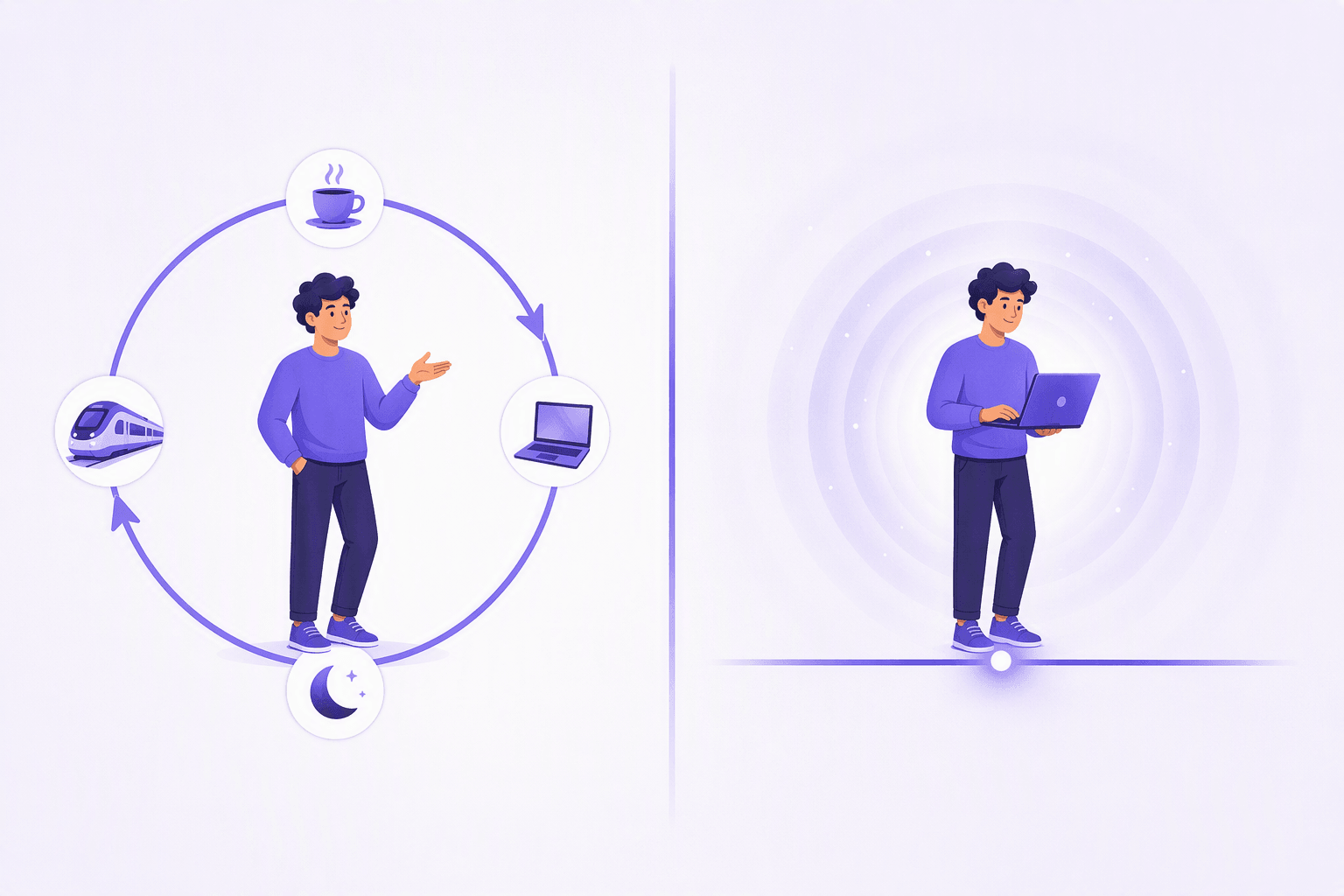
The two present tenses you actually need
Most learners think “present tense” is one thing. In modern English, everyday speech relies on two main present-time forms: simple present and present continuous.
Simple present: what it’s for
Use the simple present for:
- Habits and routines: “I take the train.”
- General truths: “Water boils at 100°C.”
- Permanent or stable situations: “She lives in Toronto.”
- Schedules and timetables (especially transport and events): “The train leaves at 6.”
Cambridge Dictionary and the British Council both teach this core division between routine/fact vs action-now (Cambridge Dictionary, accessed 2026; British Council, accessed 2026).
Present continuous: what it’s for
Use the present continuous for:
- Right now: “I’m eating.”
- Around now (current period): “I’m studying for my exams.”
- Temporary situations: “She’s staying with her aunt this month.”
- Trends and change: “Prices are rising.”
A useful mental shortcut: simple present is “how life is,” present continuous is “what’s happening.”
How to form the simple present (and pronounce it clearly)
The simple present is the base verb, except for third-person singular.
Affirmative forms
| Subject | Verb "work" | Pronunciation |
|---|---|---|
| I/you/we/they | work | WURK |
| he/she/it | works | WURKS |
The key grammar point is the -s on he/she/it. The key pronunciation point is that the ending is not always a full “s” sound.
The -s ending: -s, -z, and -iz
In real speech, the third-person ending has three common pronunciations:
- /s/ after voiceless sounds: “works” (WURKS), “stops” (STAHPS)
- /z/ after voiced sounds: “plays” (PLAYZ), “runs” (RUNZ)
- /ɪz/ after s, z, sh, ch, x: “watches” (WAH-chiz), “misses” (MIS-iz)
This matters because learners often over-pronounce “works” as WURK-iz. That extra syllable can make you harder to understand.
Spelling rules for third-person singular
- Most verbs: add -s: work → works
- Ends in -s, -sh, -ch, -x, -o: add -es: watch → watches
- Consonant + y: y → -ies: study → studies
- Vowel + y: add -s: play → plays
Negatives in the simple present (do not + base verb)
Negatives use do/does + not + base verb.
| Subject | Negative | Pronunciation |
|---|---|---|
| I/you/we/they | do not work | doo NAHT WURK |
| he/she/it | does not work | duhz NAHT WURK |
In conversation, “do not” and “does not” usually contract:
- don’t (DOHNT)
- doesn’t (DUHZ-uhnt)
The most common mistake: keeping the -s
Incorrect: “She doesn’t works.”
Correct: “She doesn’t work.”
The -s moves to does. Once you use does/doesn’t, the main verb stays in the base form.
Questions in the simple present (do/does + subject)
Questions also use do/does + subject + base verb.
- “Do you work here?” (doo yoo WURK heer)
- “Does she work here?” (duhz shee WURK heer)
Short answers:
- “Yes, I do.” (yehs, eye doo)
- “No, she doesn’t.” (noh, shee DUHZ-uhnt)
If you want a clean overview of question structure beyond the present tense, our English question words guide pairs well with this.
How to form the present continuous (be + -ing)
The present continuous has two parts:
- the verb be (am/is/are)
- the main verb with -ing
Affirmative forms
| Subject | Form | Pronunciation |
|---|---|---|
| I | am working | am WUR-king |
| you/we/they | are working | ahr WUR-king |
| he/she/it | is working | iz WUR-king |
In natural speech, contractions are extremely common:
- I’m (EYE-m)
- you’re (YOOR)
- we’re (WEER)
- they’re (THAYR)
- he’s/she’s/it’s (HEEZ, SHEEZ, IT’S)
Spelling rules for -ing
- Most verbs: add -ing: work → working
- Ends in silent -e: drop -e: make → making
- One syllable, vowel + consonant: double consonant: run → running
- Ends in -ie: change to y: lie → lying
Negatives and questions in the present continuous
Negatives:
- “I’m not working.” (EYE-m naht WUR-king)
- “She isn’t working.” (shee IZ-uhnt WUR-king)
- “They aren’t working.” (thay AHR-uhnt WUR-king)
Questions:
- “Are you working?” (ahr yoo WUR-king)
- “Is she working?” (iz shee WUR-king)
Short answers:
- “Yes, I am.” (yehs, eye am)
- “No, she isn’t.” (noh, shee IZ-uhnt)
Choosing the right present tense: a decision guide
Learners often know the rules but freeze in real conversation. Use this quick decision process.

Step 1: Is it happening right now?
If yes, use present continuous.
- “I’m driving, can I call you back?”
- “She’s talking to her boss.”
Step 2: Is it a routine, fact, or stable situation?
If yes, use simple present.
- “I drive to work every day.”
- “She works at a bank.”
Step 3: Is it temporary, changing, or “these days”?
If yes, present continuous is usually better.
- “I’m working from home this week.”
- “He’s looking for a new job.”
This “stable vs temporary” contrast is a standard description in reference grammars, including Huddleston and Pullum’s The Cambridge Grammar of the English Language (no single rule covers every edge case, but this distinction explains most real usage).
Stative verbs: why “I’m knowing” sounds wrong
Many high-frequency verbs describe states rather than actions. Merriam-Webster discusses “stative” as a category tied to states and conditions (Merriam-Webster, accessed 2026).
Common stative verbs include:
- know, believe, understand
- like, love, hate, prefer
- need, want
- own, belong
- seem, appear
Typical pattern:
- “I know.” (eye NOH)
- “I like it.” (eye LYK it)
- “She needs help.” (shee NEEDZ help)
When stative verbs appear in continuous (and what it means)
Native speakers sometimes use a stative verb in the continuous to change the meaning, often to sound more immediate, temporary, or emotional:
- “I’m loving this song.” (more like “I’m really enjoying this right now”)
- “He’s being rude.” (temporary behavior, not permanent personality)
These are real, but they are not the safest default for learners. Start with the standard rule, then notice exceptions in movies and TV.
Present continuous for the future (a very common real-life use)
English often uses the present continuous to talk about planned future arrangements, especially when there is a time marker.
- “I’m meeting Alex tomorrow.” (eye-m MEE-ting AL-eks tuh-MAH-roh)
- “We’re flying on Friday.” (weer FLY-ing on FRY-day)
This can feel strange if your first language uses a future tense for all future meanings. In English, the “future” is spread across several forms. If you want the full system, our English future tense guide explains how native speakers choose between will, going to, and present forms.
Simple present for schedules (and why it sounds official)
For timetables, the simple present is standard:
- “The movie starts at 8.” (thuh MOO-vee STAHRTS at AYT)
- “My flight leaves at noon.” (my flyt LEEVZ at NOON)
This is common in announcements, calendars, and customer service. It can sound slightly more “fixed” than “is starting,” because the schedule exists even if nobody is watching.
The “always” trick: emotion vs neutral habit
Compare:
- “He always forgets.” (neutral description of a habit)
- “He’s always forgetting!” (complaint, frustration, eye-roll energy)
This is a small but powerful meaning difference. It is also a cultural cue: English speakers often soften criticism with humor, but the grammar still signals annoyance.
💡 A movie-listening hack for present tenses
When you watch a scene, pause and label each present tense you hear as either "routine/fact" (simple present) or "now/temporary" (present continuous). This trains your ear to connect grammar with meaning, not with worksheets.
Common learner errors (and the fixes)
These mistakes show up across many first-language backgrounds.
Error 1: Using simple present for “right now”
Incorrect: “I eat now.”
Natural: “I’m eating now.”
“I eat now” is possible, but it usually means a life change: “I used to skip breakfast, but I eat now.”
Error 2: Using present continuous for permanent states
Incorrect: “I’m living in Canada” (when you mean it as a stable fact).
Often better: “I live in Canada.”
“I’m living in Canada” can be correct if you want to imply it is temporary or part of a current phase.
Error 3: Forgetting the verb “be”
Incorrect: “She working today.”
Correct: “She’s working today.”
English needs the auxiliary. If you drop it, you sound like you are speaking a different dialect or a learner variety.
Error 4: “He don’t” and “she don’t”
In many English dialects, “don’t” can appear more widely, but in standard written English and most taught varieties:
- “He doesn’t.”
- “She doesn’t.”
If your goal is exams, work emails, and interviews, keep the standard pattern.
Error 5: Pronouncing -ed and -s endings unclearly
Present tense is not only grammar, it is also endings. If you drop third-person -s in speech, listeners may still understand you, but it can signal “learner English” immediately.
For a focused pronunciation plan, see our English pronunciation guide.
Present tense in real conversation: what natives actually do
Textbook examples are clean. Real dialogue is messy, fast, and full of contractions.
Contractions are the default, not “informal extras”
In everyday speech, most people say:
- “I’m” more than “I am”
- “She’s” more than “She is”
- “Don’t” more than “Do not”
This is one reason movie dialogue is such good input: you hear grammar in its natural speed and rhythm. Our guide to learning with movies explains how to turn that input into repeatable practice.
English present tense and politeness
Present forms often carry politeness indirectly:
- “Do you want to…?” is a neutral offer.
- “Are you wanting to…?” is less common and can sound overly careful or unnatural in many contexts.
Politeness research in pragmatics, including the classic framework by Brown and Levinson (Politeness: Some Universals in Language Usage, Cambridge University Press), helps explain why English often prefers indirect questions and softeners. In present-tense requests, the grammar you choose can change how pushy you sound.
A cultural note: present tense in workplace English
In many English-speaking workplaces, simple present is used for role clarity:
- “I handle vendor invoices.”
- “She manages the calendar.”
Present continuous is used for status updates:
- “I’m handling invoices this morning.”
- “She’s managing the calendar while he’s out.”
That distinction matters in meetings because it separates “my responsibility” from “my current task.”
🌍 Why 'I work in sales' and 'I'm working in sales' feel different
"I work in sales" sounds like a stable identity or job role. "I'm working in sales" often sounds temporary, like a current assignment, a contract, or a phase while you plan your next move. Native speakers hear that nuance even when the speaker does not intend it.
Practice: turn rules into automatic speech
Grammar becomes useful when you can produce it quickly.
Drill 1: two-sentence contrast
Pick a verb and say two sentences:
- Habit: “I drink coffee every morning.”
- Now: “I’m drinking coffee right now.”
Do this with: work, study, cook, watch, read, drive.
Drill 2: “these days” vs “every day”
- “These days, I’m learning English.” (current period)
- “Every day, I learn something new.” (habit)
Drill 3: question switching
Make a statement, then ask it:
- “You work here.” → “Do you work here?”
- “She’s working today.” → “Is she working today?”
If you need number practice for times and schedules, our English numbers guide helps you say dates, hours, and prices smoothly.
Present tense and slang: what to copy, what to avoid
If you learn from social media, you will see grammar that is not standard. Some of it is dialect, some is playful style, and some is simply typing shortcuts.
Examples you might see:
- “He be working” (dialectal habitual meaning in some varieties)
- “She working” (dropped auxiliary in casual writing)
These forms can be meaningful inside communities, but they are risky in exams and professional settings. If you are curious about informal registers, start with our English slang guide, but keep your “default English” in standard present forms.
⚠️ Do not learn grammar from insults
Swear words and insults are memorable, so learners copy them, but they often come with nonstandard grammar, sarcasm, and social risk. If you want to understand them for listening, our English swear words guide is for comprehension, not for daily use.
A simple checklist you can use mid-conversation
When you are speaking and you hesitate, run this list:
- Is it happening now? Use am/is/are + -ing.
- Is it a habit, fact, or schedule? Use the base verb (add -s for he/she/it).
- Is the verb a state (know, like, need)? Default to simple present.
- If you used do/does, keep the main verb in base form.
That is enough to sound natural in most daily situations.
Learn present tense faster with real clips
Worksheets teach forms, but clips teach timing, contractions, and the situations that trigger each tense. If you want a structured way to hear and repeat present tense in context, Wordy uses short movie and TV clips with interactive subtitles and review tools, so you practice “I’m working” and “I work” the way people actually say them.
Frequently Asked Questions
What is the difference between simple present and present continuous?
Can you use the present continuous with 'always'?
Why can’t I say 'I am knowing' or 'I am liking'?
When do I add -s to a verb in the present tense?
Is 'I work now' wrong?
Sources & References
- Cambridge Dictionary, 'present simple' and 'present continuous' entries, accessed 2026
- British Council, LearnEnglish grammar: present simple and present continuous, accessed 2026
- Merriam-Webster Dictionary, entries for 'stative verb' and 'present tense', accessed 2026
- Ethnologue, 27th edition, 2024
- Huddleston, R. & Pullum, G.K., The Cambridge Grammar of the English Language, Cambridge University Press
Start learning with Wordy
Watch real movie clips and build your vocabulary as you go. Free to download.


