Advanced Colors in English: 80+ Shades, Tones, and Color Idioms You Actually Hear
Quick Answer
Advanced English color vocabulary goes beyond basic words like red and blue. English uses precise shade names (like maroon, teal, and taupe), material-based labels (like charcoal and ivory), and idioms (like 'green with envy' or 'in the red') that show up in movies, work, and everyday conversation.
Advanced English color vocabulary is mainly about learning shade names (like navy, burgundy, and taupe), common modifiers (like off-white and bluish-gray), and everyday idioms (like in the red and green with envy) so you can describe what you actually see in real life.
English is used worldwide, and Ethnologue estimates about 1.5 billion total English speakers (including L2 speakers) in its 2024 edition. That global reach matters for color words because fashion, film, and marketing spread certain shade names quickly, but everyday usage still stays practical and context-driven.
If you want a simpler starting point first, read Colors in English. For numbers and measurements that often appear with colors (paint, clothing sizes, prices), Numbers in English 1-100 helps too.

How advanced color vocabulary works in real English
Basic colors (red, blue, green) are the foundation, but real conversation usually needs one more layer of precision. People say navy instead of dark blue, beige instead of light brown, and ivory instead of yellowish white.
A useful way to think about advanced color words is that English borrows from objects. We name colors after wine (burgundy), plants (olive), stones (turquoise), metals (silver), and materials (charcoal). Dictionaries like Cambridge and Merriam-Webster reflect this object-based pattern across many entries (accessed 2026).
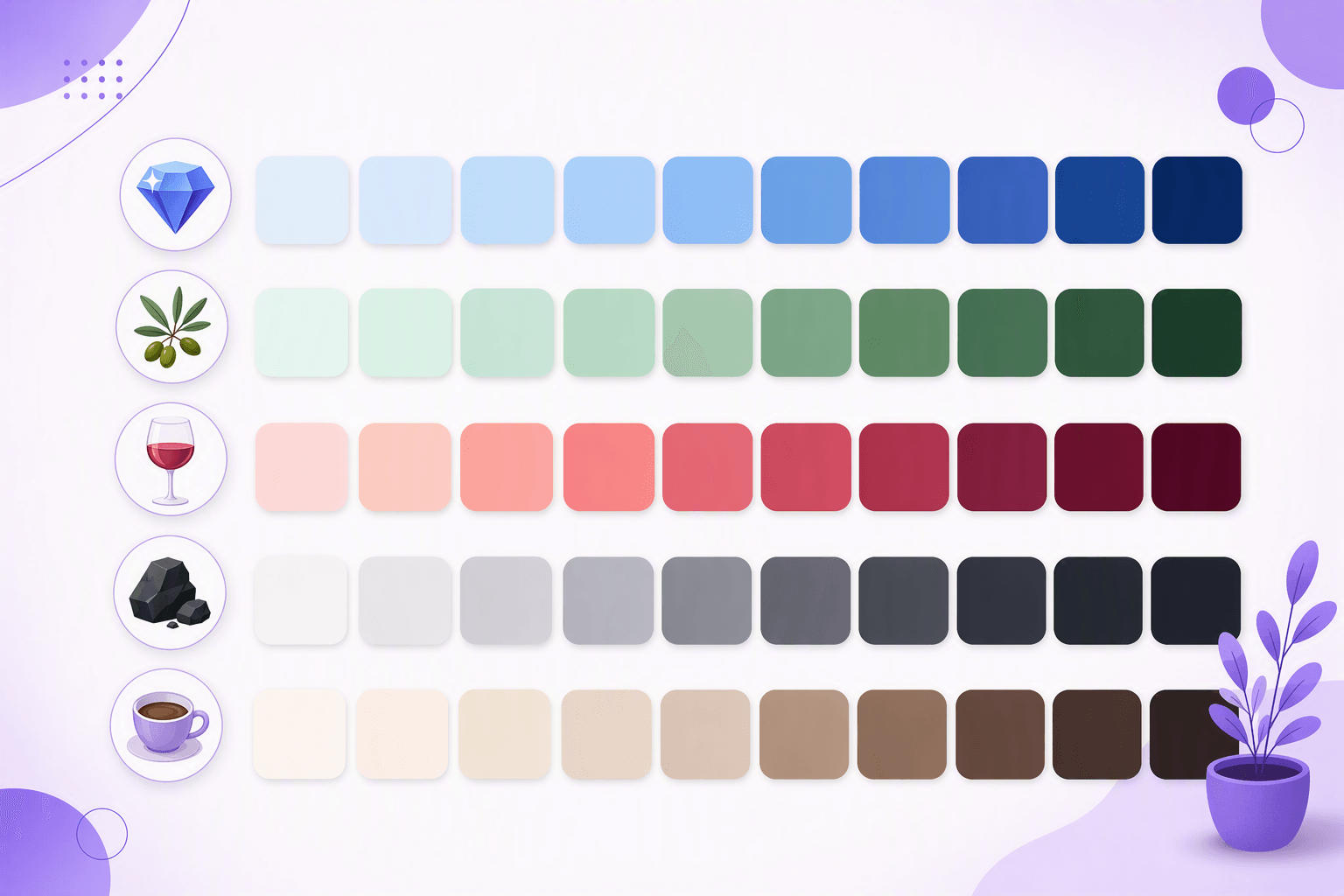
Shade, tint, tone: the practical difference
In art theory, a tint is a color plus white, a shade is a color plus black, and a tone is a color plus gray. In everyday English, people do not always use these terms strictly, but the idea is still useful.
When someone says a muted green or a dusty pink, they are describing a toned-down, grayish version. When someone says deep red, they usually mean darker and richer.
The most common modifiers native speakers use
You can sound natural without memorizing hundreds of shade names if you master modifiers. These are the ones you will hear constantly:
- light / dark
- pale / deep
- bright / vivid
- muted / dusty
- warm / cool
- -ish (greenish, bluish)
- off- (off-white, off-black)
💡 A fast, natural pattern
If you know the base color plus one modifier, you can describe most real objects: 'a muted teal jacket', 'a deep burgundy lipstick', 'an off-white wall'. This is how people talk when they are not trying to sound technical.
Quick Reference: advanced color words (with pronunciation)
| English | Pronunciation | Formality |
|---|---|---|
| Navy | NAY-vee | casual |
| Teal | TEEL | casual |
| Turquoise | TUR-koyz | casual |
| Cyan | SYE-an | formal |
| Magenta | muh-JEN-tuh | formal |
| Maroon | muh-ROON | casual |
| Burgundy | BUR-gun-dee | casual |
| Beige | BAYZH | casual |
| Taupe | TOHP | casual |
| Ivory | EYE-vuh-ree | casual |
| Charcoal | CHAR-kohl | casual |
| Slate | SLAYT | casual |
80+ advanced color words you can actually use
The list below focuses on words you will hear in movies, shopping, makeup, sports commentary, and everyday descriptions. The pronunciations are General American approximations.
| English | Pronunciation | Note |
|---|---|---|
| navy | NAY-vee | Very dark blue, common for suits and uniforms. |
| royal blue | ROY-uhl BLOO | Bright, saturated blue. |
| sky blue | SKY BLOO | Light, clear blue. |
| baby blue | BAY-bee BLOO | Very light blue, often pastel. |
| powder blue | POW-der BLOO | Soft, pale blue, common in clothing. |
| cobalt | KOH-bawlt | Strong, deep blue, often used in design. |
| indigo | IN-dih-goh | Deep blue with a purple edge. |
| periwinkle | PAIR-ih-wing-kuhl | Light blue-purple. |
| teal | TEEL | Blue-green, often darker than turquoise. |
| turquoise | TUR-koyz | Bright blue-green, like the gemstone. |
| aqua | AH-kwuh | Water-like blue-green, common in marketing. |
| cyan | SYE-an | Technical print/screen term (CMYK/RGB contexts). |
| mint | MINT | Very light green with a cool feel. |
| sage | SAYJ | Muted, grayish green, popular in interiors. |
| olive | AH-liv | Yellowish green, common for jackets and pants. |
| lime | LYME | Bright yellow-green. |
| emerald | EM-er-uhld | Rich jewel green. |
| forest green | FOR-ist GREEN | Deep green, outdoors association. |
| hunter green | HUN-ter GREEN | Very dark green, classic preppy color. |
| chartreuse | shar-TROOZ | Very bright yellow-green, hard to miss. |
| scarlet | SKAR-lit | Bright, vivid red. |
| crimson | KRIM-zuhn | Deep, strong red. |
| maroon | muh-ROON | Dark red with brown/purple undertone. |
| burgundy | BUR-gun-dee | Wine-like dark red-purple. |
| brick red | BRIK RED | Earthy red, like clay brick. |
| rust | RUHST | Orange-brown, like oxidized metal. |
| coral | KOR-uhl | Pink-orange, common in makeup. |
| salmon | SAM-uhn | Soft pink-orange. |
| rose | ROHZ | Pink with a romantic association. |
| blush | BLUHSH | Very soft, pale pink (also a makeup product). |
| hot pink | HAHT PINGK | Very bright, intense pink. |
| fuchsia | FYOO-shuh | Strong pink-purple. |
| magenta | muh-JEN-tuh | Technical and design term for pink-purple. |
| mauve | MAWV | Muted purple-pink. |
| lavender | LAV-en-der | Light purple, soft and floral. |
| lilac | LY-lak | Pale purple, similar to lavender. |
| plum | PLUHM | Dark purple, like the fruit skin. |
| eggplant | EG-plant | Very dark purple, common in clothing. |
| mustard | MUHS-terd | Deep yellow with brown undertone. |
| gold | GOHLD | Metallic or warm yellow. |
| amber | AM-ber | Warm yellow-orange, also used for lights. |
| ivory | EYE-vuh-ree | Creamy off-white. |
| cream | KREEM | Warm, soft off-white. |
| beige | BAYZH | Light brown, neutral. |
| tan | TAN | Light brown, also skin tone after sun. |
| khaki | KAH-kee | Dusty tan, often pants and uniforms. |
| camel | KAM-uhl | Warm tan, common for coats. |
| taupe | TOHP | Gray-brown, very common in decor. |
| charcoal | CHAR-kohl | Dark gray, softer than pure black. |
| slate | SLAYT | Gray with a blue tone. |
| ash | ASH | Pale gray, like cooled ash. |
| smoke | SMOHK | Gray with a hazy feel. |
| steel | STEEL | Cool gray, metallic association. |
| silver | SIL-ver | Metallic gray. |
| pewter | PYOO-ter | Dull silver-gray. |
| graphite | GRAF-yte | Dark gray, pencil-lead association. |
| jet black | JET BLAK | Very deep, intense black. |
| off-black | AWF-BLAK | Almost black, slightly lighter or warmer. |
| midnight | MID-nyte | Extremely dark blue, near black. |
| chocolate | CHOK-luht | Rich dark brown. |
| espresso | eh-SPREH-soh | Very dark brown, coffee association. |
| mocha | MOH-kuh | Medium brown, coffee association. |
| chestnut | CHES-nuht | Reddish brown. |
| mahogany | muh-HAH-guh-nee | Deep reddish brown, wood association. |
| copper | KAH-per | Reddish metallic orange-brown. |
| bronze | BRAHNZ | Brownish metallic tone. |
| peach | PEECH | Soft orange-pink. |
| apricot | AY-prih-kot | Warm orange with a soft feel. |
| tangerine | TAN-juh-reen | Bright orange. |
| pumpkin | PUHMP-kin | Deep orange, seasonal association. |
| wine | WYNE | Deep red-purple, casual descriptor. |
| jewel tones | JOO-uhl TOHNZ | Category: saturated colors like emerald, sapphire, ruby. |
| pastel | pa-STEL | Category: light, soft colors. |
| neon | NEE-ahn | Category: extremely bright, glowing colors. |
Color idioms and what they really mean
Color idioms are not just decoration, they carry social meaning. Anna Wierzbicka’s work on semantic primes and cultural scripts is a useful reminder here: words that look universal often carry culture-specific assumptions, and color idioms are a clear example.
Dictionaries like the OED and Cambridge list many of these idioms with usage notes (accessed 2026). The key is to learn the meaning, the tone, and the typical situations.
| English | Pronunciation | Formality |
|---|---|---|
| In the red | in thuh RED | polite |
| In the black | in thuh BLAK | polite |
| Green with envy | GREEN with EN-vee | casual |
| Once in a blue moon | wuns in uh BLOO MOON | casual |
| White lie | WYTE LYE | casual |
| Red flag | RED FLAG | casual |
| Green light | GREEN LYTE | polite |
| Gray area | GRAY AIR-ee-uh | polite |
In the red / in the black
These are everyday finance metaphors. A business can be in the red (losing money) or in the black (profitable).
You will hear them in workplace English and in news dialogue. If you are learning professional English, pair this with English Business Vocabulary.
Green with envy
This means extremely jealous. It is dramatic, but still common, especially in playful teasing.
In movies, it often appears as a quick punchline: someone sees a new car, a promotion, a relationship, and a friend reacts with mock jealousy.
Red flag
A red flag is a warning sign, especially in dating, hiring, or any situation where you are evaluating someone’s behavior.
This phrase is now mainstream internet English, and it overlaps with modern slang patterns. If you want more of that style, see English slang.
Green light
To green light something is to approve it so it can move forward. You will hear it in offices, film production talk, and group projects.
It is a good example of how traffic-light logic became a general metaphor in English.
Gray area
A gray area is something unclear, not fully right or wrong, not fully allowed or forbidden. It is common in policy, workplace rules, and relationship boundaries.
In real conversation, it often softens disagreement: "It’s kind of a gray area."
White lie
A white lie is a small lie told to avoid hurting someone’s feelings. It is common, but it can be sensitive because it still admits dishonesty.
Research on politeness strategies in pragmatics, including the framework in Brown and Levinson’s Politeness: Some Universals in Language Usage (Cambridge University Press), helps explain why cultures develop these softening moves.
⚠️ Idiom trap: do not translate literally
If you translate color idioms word-for-word into another language, you can sound confusing or rude. Learn them as fixed meanings: 'red flag' means 'warning sign', not literally a red object.
How to talk about color like a native speaker
Advanced color vocabulary is useful, but native-like speech is mostly about choosing the right level of detail. You rarely need the perfect shade name, you need a shade name that fits the situation.
Use the "good enough" shade in conversation
If you are describing a friend’s jacket, teal vs turquoise is often too precise. But navy vs bright blue is meaningful.
A practical rule: use one of these tiers.
- Tier 1: basic (blue, green)
- Tier 2: common shade (navy, teal, beige)
- Tier 3: niche or technical (cyan, magenta, chartreuse)
Add a reference object when you are unsure
Native speakers do this constantly:
- "It’s kind of olive, like army green."
- "It’s a dusty pink, like rose but more muted."
- "It’s charcoal, not quite black."
This strategy is more natural than guessing a fancy word.
Learn colors through scenes, not lists
Color words stick when they attach to a visual. Movies and TV are ideal because wardrobe and lighting force characters to describe what they see.
If you want a curated approach, start with Best Movies to Learn English. Pay attention to scenes with shopping, makeovers, uniforms, cars, and home renovation.
Common mistakes learners make with English color words
Mixing up beige, tan, and khaki
Beige is a neutral light brown, often slightly gray or creamy. Tan is warmer and more general, and khaki often suggests a dusty, uniform-like tan.
If you are not sure, beige is safest for interiors, tan is safest for skin or leather, and khaki is safest for pants.
Overusing "light" and "dark"
Light and dark are correct, but they can sound repetitive. Rotate in pale, deep, muted, and bright when it fits.
This also helps you understand dialogue better because scripts often avoid repeating the same adjective.
Confusing gray and grey
Both spellings are correct. Gray is more common in American English, and grey is more common in British English, but you will see both everywhere.
If you are curious about these broader differences, American vs British English breaks down the patterns.
Cultural notes: why some shades feel "formal" or "casual"
Color vocabulary is tied to social meaning. A navy suit reads professional in many English-speaking contexts, while neon colors read playful or attention-seeking.
In the US and UK, workplace dress codes often treat dark neutrals (navy, charcoal, black) as safe. Meanwhile, words like blush, mauve, and rose are strongly associated with cosmetics and fashion marketing, so you will hear them more in those contexts.
🌍 Why 'nude' is tricky
In fashion and cosmetics, 'nude' is used for a skin-tone-like beige, but what counts as 'nude' varies by brand and person. Many companies now label multiple 'nude' shades. In conversation, it can be clearer to say 'beige', 'tan', or 'light brown' instead.
Practice: build sentences you can reuse
Here are sentence frames that show up in real English. Swap in any word from the tables.
- "Do you have this in navy?"
- "I want something more muted, maybe sage or taupe."
- "That looks like a red flag to me."
- "We’re in the red this quarter."
- "It’s kind of off-white, not pure white."
If you want more everyday building blocks, combine this with the 100 most common English words so your color descriptions feel fluent, not forced.
Using advanced colors without sounding unnatural
The goal is clarity, not showing off. If you say chartreuse in a casual setting, it can sound like you are trying to be clever, unless the other person is also talking in design terms.
When you are unsure, choose a common shade name plus a modifier. That is what native speakers do under time pressure, and it is what actors do in fast dialogue.
If you also want to understand the emotional tone of stronger language that sometimes appears next to color idioms in movies, you can compare with English swear words. Many scenes mix polite description with harsh reactions, and recognizing both registers helps comprehension.
One last step: learn colors through real clips
Memorizing lists helps, but color vocabulary becomes automatic when you hear it attached to a visual moment. Watch a scene, pause when you hear a color, repeat it, then describe something in your own room using the same pattern.
For more learning methods that work well with authentic dialogue, browse the Wordy blog and pick one topic that matches what you actually watch.
Frequently Asked Questions
What are advanced color words in English?
What is the difference between teal and turquoise?
Why do English speakers say 'off-white' or 'almost black'?
What does 'in the red' mean in English?
How can I learn color vocabulary faster from movies and TV?
Sources & References
- Cambridge Dictionary, color and idiom entries (accessed 2026)
- Merriam-Webster, color word entries and usage notes (accessed 2026)
- Oxford English Dictionary, selected color term entries (accessed 2026)
- Ethnologue: Languages of the World, English language entry (27th edition, 2024)
Start learning with Wordy
Watch real movie clips and build your vocabulary as you go. Free to download.


