Quick Answer
Basic colors in English: red, blue, green, yellow, orange, purple, pink, black, white, brown, grey/gray. In British English it is “colour” (with a u), in American English it is “color” (without a u). Both are correct, just do not mix them.
English is the most widely learned second language in the world, and color vocabulary is among the first lessons in almost every course. According to Ethnologue’s 2024 data, nearly 1.5 billion people learn English or use it as a second language, and all of them had to learn: red, blue, green.
English has one advantage: English color words do not change for gender or number at all. There is no agreement, and there are no separate masculine and feminine forms. The word red stays the same for a red apple, a red car, and red shoes. This makes English color vocabulary much easier than in languages like French or German.
At the same time, there is a classic spelling puzzle: British colour and American color. The two forms have the same pronunciation, /ˈkʌlər/, but you should use one spelling consistently. Berlin and Kay’s 1969 study, now considered foundational, showed that basic color categories develop in a surprisingly similar way across the world’s languages: red, white, and black come first, then green and yellow, then blue. English follows this exact order.
"The English colour vocabulary is one of the richest in the world, with hundreds of named shades, yet its basic colour system maps neatly onto the universal evolutionary sequence first documented in Berlin and Kay's foundational 1969 study."
(David Crystal, The Cambridge Encyclopedia of the English Language, Cambridge University Press, 2019)
This guide walks through basic colors and shades, explains the colour / color spelling split, and introduces idiomatic expressions that everyday English relies on. For interactive practice, check the Wordy English learning page.

Basic colors in English
There are eleven basic colors that every English learner should master. These words are fully clear on their own, without any modification, to any native English speaker.
| English | Pronunciation | Note |
|---|---|---|
| red | rɛd | |
| blue | bluː | |
| yellow | JEL-oh | |
| green | ɡriːn | |
| orange | OR-inj | |
| purple | PUR-pul | |
| pink | pɪŋk | |
| black | blæk | |
| white | waɪt | |
| brown | braʊn | |
| grey / gray | ɡreɪ | British: grey, American: gray |
💡 Colour or color? The most important spelling difference
In British English, colour is standard. In American English, color is standard. They have the same pronunciation: /ˈkʌlər/. This difference applies to many British words ending in -our: favour/favor, honour/honor, neighbour/neighbor. If you are preparing for a Cambridge exam, use the British form consistently. If you are preparing for the TOEFL (a more US-based test), use the American form. The key point is simple: never mix the two in the same text.
The same British vs American split appears with grey / gray. In British literature and media, you will almost always see grey. In American English, gray is more common, although grey also appears in some proper names in the United States (for example, Greyhound). The Oxford English Dictionary lists both forms as standard variants.
Shades and compound colors
After you learn the basic colors, the next step is learning more precise shades. These words matter most for clothing, interior design, and describing nature.
| English | Pronunciation | Note |
|---|---|---|
| navy blue | NAY-vee bloo | |
| sky blue | sky bloo | |
| turquoise | TUR-kwoyz | |
| bright green | braɪt ɡriːn | |
| crimson | KRIM-zun | |
| scarlet | SKAR-lit | |
| beige | beɪʒ | A loanword from French |
| ivory | EYE-vuh-ree | |
| gold | ɡoʊld | |
| silver | SIL-vur |
Turquoise entered English through French, and it ultimately came from medieval Turkey. The stone’s name literally means “Turkish” (pierre turquoise, Turkish stone). Beige is also a French loanword, and English kept its original, unusual pronunciation: /beɪʒ/, not “bayzh” and not “beej.”
Crimson and scarlet both refer to dark red shades, but they are not the same. Crimson has a bluish red tone (like crimson dye). Scarlet is more orange-red. According to the Oxford English Dictionary, scarlet has Arabic and Persian roots, and it comes from the name of a type of cloth, siqillāt.
Color + modifier combinations
English uses a simple, consistent system for describing shades: you put the modifier before the color. This differs from French (where the modifier comes after the color), and it works like the prefixes “light-” or “dark-” in English.
The four most important modifiers:
| Modifier | Meaning | Example | English equivalent |
|---|---|---|---|
| light | light | light blue | light blue |
| dark | dark | dark green | dark green |
| bright | bright, saturated | bright red | bright red |
| pale | pale, washed-out | pale yellow | pale yellow |
You can combine these modifiers with any basic color: light brown (light brown), dark purple (dark purple), bright orange (bright orange), pale pink (pale pink).
💡 Deep and rich: advanced shade vocabulary
Besides dark, two other words often describe darker, more saturated shades. Deep suggests a rich, intense shade: deep blue (the blue of the sea), deep red. Rich suggests a full, concentrated color: rich burgundy, rich brown. Both sound more positive than neutral dark.
English also uses many compound shade names that link a color to an object, a natural phenomenon, or a material:
- midnight blue (midnight blue, a darkened blue)
- forest green (forest green, a deep muted green)
- cream (cream, an off-white)
- coral (coral, an orange-pink)
- mustard yellow (mustard yellow, a greenish yellow)
- charcoal grey (charcoal grey, a blackish dark grey)
Color idioms in English
In English, colors go far beyond simple description. Color-based idioms are part of everyday communication. You hear them in movies, news reports, and workplace conversations. Without them, natural native content can be hard to understand.
| English | English | Pronunciation | Note |
|---|---|---|---|
| sad, down | feeling blue | FEE-ling bloo | Example: I've been feeling blue all week. |
| jealous | green with envy | green with EN-vee | Example: She was green with envy. |
| blinded by anger | seeing red | SEE-ing red | Example: He was seeing red after the argument. |
| profitable | in the black | in the blæk | Financial term |
| unprofitable, in debt | in the red | in the red | Financial term |
| very rarely | once in a blue moon | wʌns in ə bloo moon | Example: He calls once in a blue moon. |
| a golden chance | golden opportunity | GOL-den op-ur-TYOO-nuh-tee | Example: Don't miss this golden opportunity. |
| the outcast of the family | black sheep | blæk sheep | Example: He's the black sheep of the family. |
| a harmless lie | white lie | waɪt laɪ | Example: It was just a white lie. |
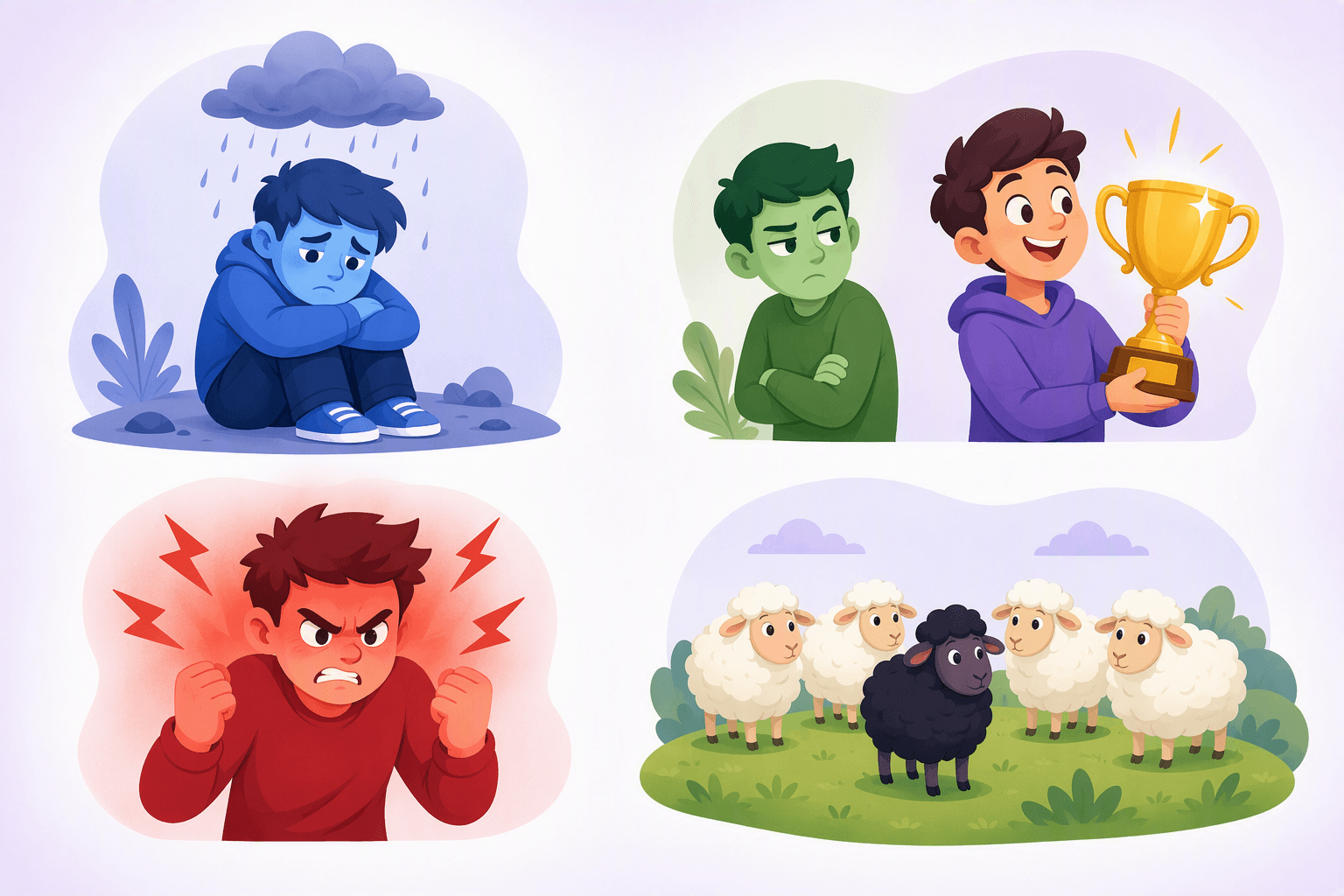
The origin of feeling blue goes back to 15th-century maritime customs. If a ship’s captain died during a voyage, the ship raised a blue flag. This visual sign of sadness later became part of the expression. Once in a blue moon connects to the lunar cycle. People once called the second full moon in a single month a blue moon, which is naturally rare.
🌍 Color symbolism: what is black in English can be white elsewhere
Cultural meanings of colors can differ dramatically. In English, white is the color of purity, innocence, and weddings, think of a white wedding dress. In many Asian cultures (China, Japan, Korea), white is the color of mourning and funerals. In English, black can also refer to formal events (black tie = formal dress), not only mourning. In English, green can mean nature and envy, but it also means a go-ahead (green light = permission), and in the United Kingdom people also informally call banknotes green. Cultural context helps explain why wearing white to a Japanese wedding can be a bad choice.
Colors in sentences
The table below shows how basic colors appear in natural English sentences. Notice that the color comes before the noun as an adjective, which is how English works.
| English sentence | English sentence | Pronunciation |
|---|---|---|
| The sky is blue. | The sky is blue. | ðə skaɪ ɪz bluː |
| I bought a red apple. | I bought a red apple. | aɪ bɔːt ə red ˈæpəl |
| The grass is green after the rain. | The grass is green after the rain. | ðə ɡrɑːs ɪz ɡriːn ˈɑːftər ðə reɪn |
| The sun is yellow. | The sun is yellow. | ðə sʌn ɪz ˈjeloʊ |
| There was white snow yesterday. | There was white snow yesterday. | ðer wəz waɪt snoʊ ˈjestərdeɪ |
| I'd like a black coffee. | I'd like a black coffee. | aɪd laɪk ə blæk ˈkɒfi |
| Her hair is brown. | Her hair is brown. | hər her ɪz braʊn |
| What colour is your car? | What colour is your car? | wɒt ˈkʌlər ɪz jɔːr kɑːr |
| The house is grey and white. | The house is grey and white. | ðə haʊs ɪz ɡreɪ ənd waɪt |
| She came in an orange jacket. | She came in an orange jacket. | ʃiː keɪm ɪn ən ˈɒrɪndʒ ˈdʒækɪt |
The question What colour is your car? uses the British form. An American speaker would usually say: What color is your car? The difference is only spelling.
⚠️ British and American usage: a few hidden differences
The grey/gray and colour/color split is well known, but there are a few less obvious differences too. In British English, besides navy blue, navy is also common on its own (for example, a navy coat). British English calls the bright yellow-green color lime green. In American English, people sometimes just say lime. Auburn (reddish brown, most often for hair) and ginger (orange-red hair) are used more in British contexts. Americans more often say red hair for similar hair colors.
Practice with real English content
Color vocabulary sticks best when you meet it in real English contexts. English movies and series are full of color idioms and shade descriptions, from seeing red to golden opportunity. Dictionaries often fail to explain them well, but context makes them click fast.
Wordy lets you work with real English content using interactive subtitles. When a color word appears in dialogue, you can tap it and instantly see the pronunciation and meaning. If it is an idiom, you also get the explanation. This works much better than memorizing word lists.
Also check our guide to the best English movies for language learners, where we recommend films that help you understand natural native vocabulary by ear, including colors and idioms.
Frequently Asked Questions
How do you say the basic colors in English?
What is the difference between “colour” and “color”?
How do you say “szürke” in English?
How do you say color shades in English?
What are some common color idioms in English?
Sources & References
- Crystal, David (2019). The Cambridge Encyclopedia of the English Language. Cambridge University Press.
- Oxford English Dictionary (2025). oed.com, colour etymology.
- Merriam-Webster Dictionary (2026). merriam-webster.com.
- Berlin, B. & Kay, P. (1969). Basic Color Terms. University of California Press.
Start learning with Wordy
Watch real movie clips and build your vocabulary as you go. Free to download.


