Quick Answer
Comprehensible input in Spanish means listening to and reading Spanish you can mostly understand, so acquisition happens through the message rather than through grammar drills. Spanish is the best-served language in the world for this method: Dreaming Spanish alone offers thousands of level-graded videos, and learner podcasts, graded readers, and a huge Netflix catalog cover every step after that. This guide gives you a two-minute self-test to find your level, then maps real resources to A1-A2, B1-B2, and C1, including the Castilian versus Latin American question.
Comprehensible input in Spanish means spending your study time listening to and reading Spanish that you can mostly understand, slightly stretching material where context carries you past the words you do not know yet. No language on earth is better supplied for this method: with roughly 600 million speakers worldwide (Instituto Cervantes, El español en el mundo 2024), Spanish has learner video libraries, podcasts, graded readers, and a Netflix back catalog deep enough to feed every level from zero to native-speed drama.
If you want the fastest possible answer, here is the single best starting resource per level:
| Your level | Start here | Why |
|---|---|---|
| A1-A2 | Dreaming Spanish (superbeginner and beginner videos) | Slow speech plus drawings means you understand from day one |
| B1-B2 | Español con Juan podcast + one series with Spanish subtitles | Natural-speed Spanish that stays followable |
| C1 | Native podcasts and films, subtitles off | The job is now volume, range, and accents |
The rest of this guide explains how to confirm your level and gives you a full menu for each stage.
i+1 in 60 seconds
The theory behind all of this is Stephen Krashen's input hypothesis: we acquire language by understanding messages that sit one small step beyond our current level, which he abbreviated i+1. Material you understand completely teaches nothing new, and material far above you is noise; the stretch zone in between is where acquisition happens. That is the whole recap on purpose, because we cover the theory, the evidence, and the criticisms in depth in our guide to what comprehensible input is. This article is about the Spanish-specific question: what do you actually watch, listen to, and read?
"Language acquisition does not require extensive use of conscious grammatical rules, and does not require tedious drill." — Stephen Krashen, Principles and Practice in Second Language Acquisition (1982)
Finding your level in Spanish
You do not need a placement exam. Run this two-minute self-test against three concrete probes, one per level band, and see where comprehension breaks.
- The A2 probe. Play a Dreaming Spanish intermediate video or an episode of the learner sitcom Extra en español. Can you retell what happened in your own words? If yes, you are at least solid A2 and ready for B1 material. If it dissolves into sound, stay with superbeginner and beginner video.
- The B1 probe. Play five minutes of a natural-speed learner podcast such as Español con Juan or No Hay Tos, no transcript. If you follow the thread and only lose occasional words, you are B1 or above. If you catch topics but not sentences, you are still consolidating A2.
- The B2 probe. Play a scene from a native series, Élite, La Casa de Papel, Club de Cuervos, with Spanish subtitles. Comfortable? You are B2 and native media is now your main food source. Following only with heavy pausing? You are B1: keep native TV in scene-sized doses and lean on intermediate podcasts.
Two calibration rules from the research: aim for material where you understand roughly 90-98% of the words, and remember that reaching about 95% coverage of movie dialogue requires knowing around the 3,000 most frequent word families (Webb and Rodgers, Applied Linguistics, 2009). That number is why "just watch Netflix" fails at A2 and works at B2. If you want the formal level definitions behind the labels, see our CEFR scale guide. And retest every few weeks: learners keep training wheels on far too long.
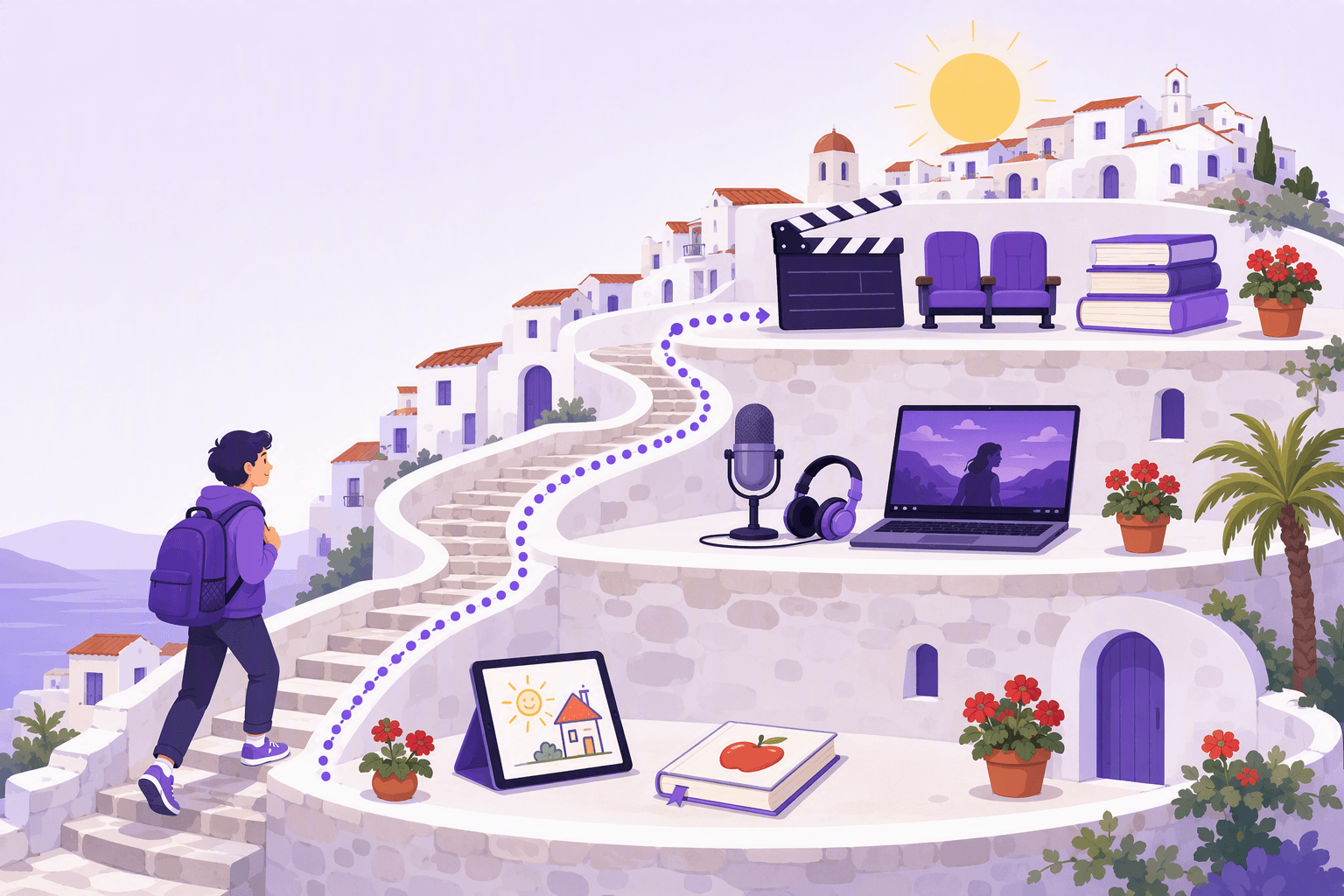
Spanish input sources by level
A1-A2: learner-made video, first readers, slow podcasts
Dreaming Spanish is the defining comprehensible-input resource for any language, with thousands of videos sorted into superbeginner, beginner, intermediate, and advanced levels. Superbeginner videos use drawings, gestures, and relentless context so that a true zero beginner follows a story in Spanish within minutes. Watching a lot of this, an hour a day is a common target, is the closest thing Spanish learning has to a cheat code, and the site's roadmap frames the whole journey as about 1,500 hours of input.
Learner podcasts for this band include Duolingo Spanish Podcast (real stories in slow Spanish with English narration scaffolding, good for the very start), News in Slow Spanish (current events at reduced speed, in Castilian and Latin American editions), and the early episodes of Español con Juan once you can hold a thread.
Graded readers start paying off as soon as you can decode sentences. Paco Ardit's Spanish Novels series runs from A1 to C2 with strictly controlled vocabulary, and Olly Richards' Short Stories in Spanish volumes (Teach Yourself) are the standard bookstore option for A2-B1. Because vocabulary is capped to your level, readers keep you inside the 98% comprehension zone that makes extensive reading work.
Kids' shows, with a caveat. Pocoyó, originally produced in Spain, is genuinely beginner-friendly: minimal dialogue, a patient narrator, and visuals that do all the work. Dubbed Peppa Pig and Bluey episodes in Spanish are short, domestic, and repetitive in the best way. But do not assume all children's content is easy; animated series aimed at older kids are full of fantasy vocabulary and songs, and often sit at B1 rather than A2.
B1-B2: real-speed podcasts, series with Spanish subtitles, teen TV
This is the band where native media starts to open, and where the intermediate plateau kills the most momentum. The fix is volume of just-right input, not harder input.
Podcasts carry the level. Español con Juan is the standout: Juan Fernández, a language teacher from Granada, delivers funny, rambling monologues in natural but clear Spanish, aimed exactly at B1-B2 learners. Hoy Hablamos publishes a daily episode on everyday topics from Spain, with transcripts. No Hay Tos does the same job in Mexican Spanish, two relaxed hosts, real speed, learner-aware. Between those three you can fill a commute for years.
TV series and telenovelas now work if you add support: Spanish subtitles on, scene-by-scene viewing, rewatching. Good B1-B2 entry points are Extra en español (a sitcom written for learners), Club de Cuervos (Mexican comedy, conversational pace), Gran Hotel and Las Chicas del Cable (Spanish period dramas with clean diction), and classic telenovela-style shows such as Café con Aroma de Mujer, where emotional, repetitive dialogue is a feature for learners, not a bug. Our best movies to learn Spanish list ranks films the same way, from Coco upward.
YouTube adds free breadth: Easy Spanish interviews people on the street with dual subtitles, Español con María and Hola Spanish make learner-aimed videos at natural speed, and Dreaming Spanish's intermediate and advanced catalog stays useful deep into B2.
C1: native everything, subtitles off
At C1 the menu is simply "Spanish media", and the job is range. Native podcasts on topics you care about, films from Almodóvar to Cuarón, fast comedies, news, and deliberately varied accents: Caribbean Spanish, Rioplatense from Argentina, Chilean speech, Andalusian clipping. Turn subtitles off as your default and bring them back only for the hardest material. If a native show feels easy, that is not wasted time, it is volume, but your i+1 now lives in unfamiliar registers and regions, so seek those out.
Castilian vs. Latin American Spanish input
The honest answer: this choice matters less than learners fear. The varieties share the overwhelming majority of their grammar and core vocabulary, the Real Academia Española and the associated academies coordinate a common standard, and input in one transfers almost entirely to the other. The audible differences are distinción (the z/ce/ci sound in Spain), vosotros (Spain-only plural you), voseo in Argentina and elsewhere, and slang everywhere.
Practical policy: let your goal pick your accent, and let your interest pick your content. Moving to Madrid? Weight your diet toward Hoy Hablamos, Élite, and Spanish films. Working with Mexico? No Hay Tos, Club de Cuervos, Mexican YouTube. No specific goal? Mix freely, which is what Dreaming Spanish does by design with teachers from Spain, Mexico, Colombia, and beyond. A trained ear handles both varieties; only your own speaking settles into one.
The clip-based repetition method
Whatever your level, the highest-density input technique is the same: take a short clip of real Spanish, 30 to 90 seconds, watch it with Spanish subtitles, rewatch it without, and say a line or two out loud. The second and third passes are where fast native speech resolves into words, and short clips make repetition cheap enough that you actually do it. This is exactly the method Wordy packages: curated scenes from real movies and shows, small enough to fully understand, with the vocabulary from each clip feeding your review deck. Manual or app-assisted, the principle is identical: one well-digested scene beats an episode of fog.
💡 The two-resource rule
At any given time, run exactly two pillars: one comfort source slightly below your level for volume (a podcast you barely have to try for) and one stretch source at i+1 (a series or reader with a few unknowns per minute). More than two active resources usually means none of them get enough hours.
A sample week of Spanish input (B1 learner, about 6 hours)
| Day | Input | Time |
|---|---|---|
| Monday | Español con Juan episode on the commute, one Élite scene with Spanish subtitles in the evening | 45 min |
| Tuesday | Dreaming Spanish intermediate videos, one clip studied line by line | 50 min |
| Wednesday | Hoy Hablamos episode, then reread with the transcript | 40 min |
| Thursday | Graded reader chapter, rewatch of Monday's scene without subtitles | 50 min |
| Friday | Easy Spanish street interviews, one new clip with repetition | 45 min |
| Saturday | Long session: half a film from the best movies list, Spanish subtitles, pausing freely | 90 min |
| Sunday | Comfort day: Pocoyó or an easy Dreaming Spanish playlist, plus finishing the reader chapter | 40 min |
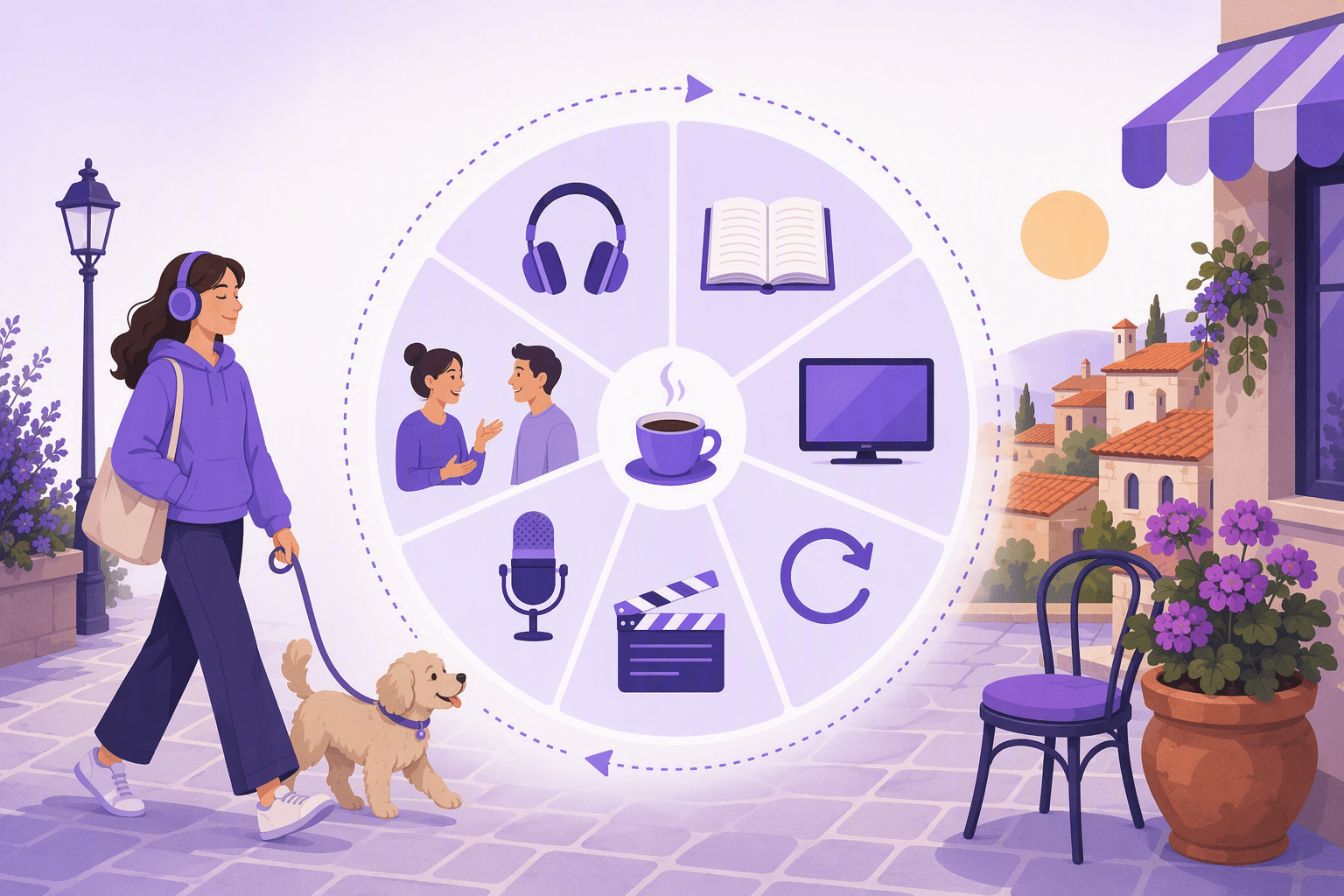
The structure to copy is not the specific shows but the ratios: mostly listening, a daily anchor habit, one long weekend block, repetition built in, and everything within your 90-98% comprehension band. Swap any row for content you genuinely enjoy, the affective filter argument says the version of this plan you look forward to beats the version you endure. For grammar and pronunciation reference alongside all this input, keep our Spanish hub bookmarked, and give it two to three months before judging results; that is roughly when scene-sized native TV stops feeling like a wall.
Frequently Asked Questions
What is the best comprehensible input for Spanish beginners?
Is Dreaming Spanish enough to become fluent?
Can I use Money Heist or other native Netflix shows as comprehensible input?
Should I choose Latin American or Castilian Spanish input?
How many hours of Spanish input do I need to understand native TV?
Sources & References
- Instituto Cervantes, El español en el mundo 2024 (annual report)
- Krashen, S., *Principles and Practice in Second Language Acquisition*, Pergamon Press, 1982
- Webb, S. & Rodgers, M.P.H., 'The Lexical Coverage of Movies', Applied Linguistics, 2009
- U.S. Department of State, Foreign Service Institute, foreign language training categories
- Real Academia Española (RAE), Diccionario de la lengua española, 23rd edition
Start learning with Wordy
Watch real movie clips and build your vocabulary as you go. Free to download.


