Quick Answer
The best way to learn Spanish for beginners is to combine understandable listening, high-frequency vocabulary, short daily speaking practice, and basic grammar in a routine you can sustain. Start with useful phrases, hear them repeatedly in real contexts, and use them before trying to master every rule.
The best way to learn Spanish for beginners is to build a daily routine around understandable Spanish you can hear, read, repeat, and use: learn high-frequency phrases, listen to short real conversations, speak from the first week, and study only the grammar that helps you say more. You do not need to memorize a giant word list or wait until you feel ready. Twenty to forty focused minutes most days will beat an ambitious plan you abandon after two weeks.
Spanish is one of the most practical languages for English speakers to learn. Instituto Cervantes reports that Spanish has roughly 600 million potential speakers worldwide, including close to 500 million native speakers. It is an official language in 20 sovereign countries, and it is used extensively in the United States, where Spanish-language media, workplaces, and communities offer constant opportunities for real exposure.
If your goal is everyday conversation rather than a grammar exam, use this plan to create momentum. Start with language you will actually say, then use media, reading, and short conversations to make it stick. Our guide to how to say hello in Spanish is an excellent first set of phrases to put into practice.
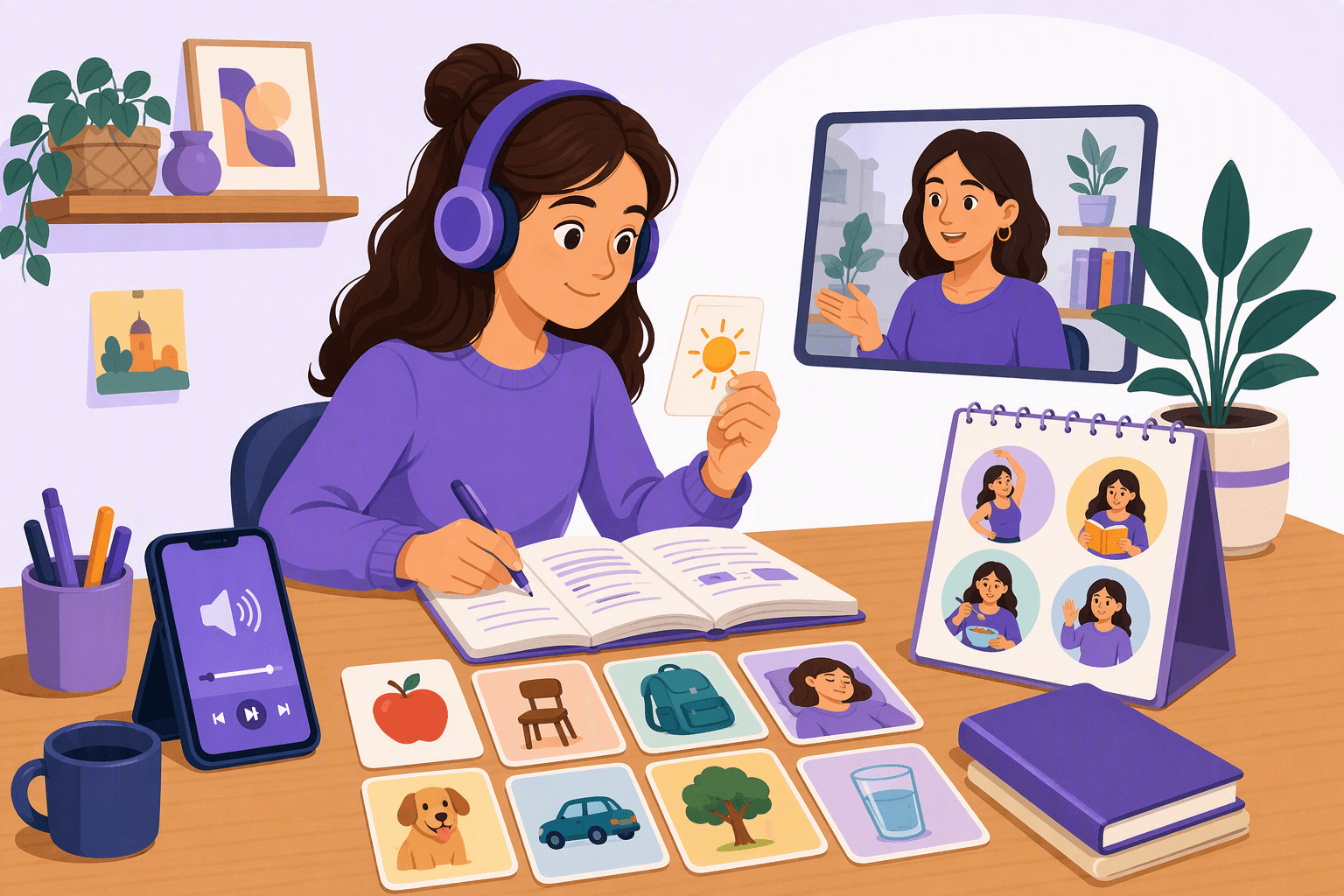
Start with a clear, useful goal
A vague goal such as learning Spanish makes it hard to choose material or notice progress. A useful beginner goal is specific: introduce yourself, order a meal, message a friend, understand a simple show scene, or speak with relatives for five minutes.
The Common European Framework of Reference for Languages, often called the CEFR, describes A1 learners as people who can use familiar everyday expressions and meet immediate needs. That is a realistic first milestone. You do not need advanced verb tenses to ask for help, buy something, or make basic plans.
Write one practical outcome for the next eight weeks. For example: “I want to hold a three-minute conversation about myself, my family, and my weekend.” Every activity in your routine should support that outcome.
Use Spanish connected to your life
Choose vocabulary from your actual routines: your work, food, hobbies, neighborhood, family, and travel plans. If you love football, cooking, games, fashion, or movies, those topics give new words a meaningful home.
A word learned inside a personally relevant sentence is easier to remember than an isolated dictionary entry. Instead of memorizing the noun for coffee, learn a sentence you might use: Quiero un café, por favor /ˈkjeɾo uŋ kaˈfe poɾ faˈβoɾ/, meaning “I want a coffee, please.”
💡 Choose a small first target
For your first month, aim to understand and use 100 to 150 high-frequency words plus a set of reliable phrases. This is enough to begin making sentences, recognizing patterns, and having short exchanges.
Build a daily Spanish routine that you can repeat
The most effective routine is not the longest possible routine. It is the one that fits your real week, including busy days. A beginner who studies 30 minutes on five days each week gets far more useful repetition than someone who studies four hours once a month.
Research on second-language acquisition by Rod Ellis emphasizes the roles of meaningful input, interaction, and attention to language form. In practice, this means you need to encounter Spanish that you understand, attempt to communicate, and occasionally pause to notice how a phrase is built.
A realistic 30-minute plan
Use this structure as a starting point:
| Time | Activity | What to do |
|---|---|---|
| 10 minutes | Listening | Watch or hear a short beginner-friendly Spanish clip two or three times. |
| 8 minutes | Vocabulary | Review useful words and phrases from the clip with example sentences. |
| 7 minutes | Speaking | Repeat lines aloud, answer simple prompts, or record yourself. |
| 5 minutes | Grammar and writing | Notice one pattern and write three personal sentences with it. |
On a busy day, reduce the plan to 10 minutes. Listen to one short clip, repeat two lines, and review five words. The habit remains intact, which is more valuable than treating missed study as failure.
A weekly rhythm also helps. Use four days for new material, one day for review and speaking, one day for relaxed Spanish media, and one rest day. Rest is not wasted time. Memory strengthens when you return to material after a gap.
Make listening active, not background noise
Listening is where many beginners feel overwhelmed because normal Spanish can sound fast and connected. Do not begin with long films or news broadcasts. Start with 15 to 45 second clips where the situation is visible and the speakers repeat everyday language.
First, watch for the general meaning. Next, listen again and identify a few familiar words. Then read subtitles or a transcript if available, replay the line, and say it with the speaker. Finally, hide the text and see what you can catch.
This approach turns a clip into repeated, meaningful practice. It also teaches rhythm, pronunciation, and natural word order together. For a fuller method, see how to learn a language with movies.
Learn phrases before isolated grammar rules
Grammar matters, but beginners learn it best when it solves a communication problem. Memorizing a full conjugation chart without seeing it in conversation often creates recognition without confidence.
Begin with sentence frames that you can adapt. For example, me gusta /me ˈɣusta/, “I like,” lets you talk about food, music, places, and activities. Quiero /ˈkjeɾo/, “I want,” is useful for requests and plans. Tengo /ˈteŋɡo/, “I have,” helps you describe possessions, needs, and age.
Use the frame, then swap one word at a time:
- Me gusta la música /me ˈɣusta la ˈmusika/, “I like music.”
- Me gusta el café /me ˈɣusta el kaˈfe/, “I like coffee.”
- Quiero aprender español /ˈkjeɾo apɾenˈdeɾ espaˈɲol/, “I want to learn Spanish.”
- Tengo hambre /ˈteŋɡo ˈambɾe/, “I am hungry.”
This method gives grammar a job. You begin noticing that Spanish nouns have gender, that verbs change form, and that articles matter, but the patterns arrive inside language you can use.
Focus on these grammar foundations first
For the first three months, prioritize these topics:
- Present-tense forms of common verbs, especially ser /seɾ/, estar /esˈtaɾ/, tener /teˈneɾ/, ir /iɾ/, hacer /aˈseɾ/, querer /keˈɾeɾ/, and poder /poˈðeɾ/.
- Gender and number, such as masculine and feminine nouns, singular and plural adjectives.
- Basic sentence order, usually subject, verb, and object, while recognizing that Spanish can omit a subject pronoun.
- Question words, including qué /ke/, “what,” dónde /ˈdonde/, “where,” and cuándo /ˈkwando/, “when.”
- Common past-time expressions, such as yesterday, last week, and “I went,” before studying every past tense in detail.
Do not panic when a rule has exceptions. The Real Academia Española explains norms across the Spanish-speaking world, but everyday language also varies by country, city, generation, and relationship. Your goal at the beginning is clear communication, not perfect grammatical coverage.
Speak from your first week
Speaking early does not mean forcing yourself into an hour-long conversation with a stranger. It means producing short, manageable Spanish every day. Repeat one line, describe one object, answer one question, or record a 30-second voice note.
Language educators Patsy Lightbown and Nina Spada, in How Languages are Learned, distinguish between exposure alone and the active work learners do with language. Saying a phrase makes you retrieve it, hear your own gaps, and connect pronunciation with meaning.
Try this simple progression:
| Week | Speaking target |
|---|---|
| 1 | Introduce yourself and say where you are from. |
| 2 | Describe your daily routine in five sentences. |
| 3 | Order a drink or meal in a role-play. |
| 4 | Talk for one minute about a hobby or favorite show. |
| 5 to 8 | Have two short conversations each week with a tutor, partner, or friend. |
Record yourself once a week using the same prompt. Your early recordings may sound hesitant, but comparing them after a month gives you concrete evidence of improvement.
Copy sound, rhythm, and whole chunks
Spanish spelling is generally more predictable than English spelling, but pronunciation still deserves early attention. Hear a phrase, copy it as a complete unit, and compare your rhythm to the speaker’s rhythm.
For example, Buenos días /ˈbwenos ˈdias/, “good morning,” works best as one greeting rather than as two separately translated words. The same is true of gracias /ˈɡɾasjas/, “thank you,” and por favor /poɾ faˈβoɾ/, “please.”
Avoid building your accent around English spellings. Use Spanish audio and IPA when needed, then repeat at a comfortable speed. Our Spanish pronunciation guide can help you tackle vowels, rolled sounds, and stress without overcomplicating your first month.
Use media at the right difficulty level
Movies and TV shows are motivating because they give words a voice, a face, and a social setting. But a beginner does not benefit much from trying to understand an entire fast-paced crime drama without support.
Choose short scenes with visible context. A character entering a shop, greeting a friend, asking for directions, or ordering food gives you clues beyond individual words. Rewatching one useful scene is more effective than constantly jumping to a new show.
When you are ready for practical dialogue, explore Spanish movies and TV shows for learners. Use clips as study material, not a test of whether you can understand everything.
🌍 Spanish is not one single accent
Spanish is spoken across Spain, Latin America, the Caribbean, and multilingual communities worldwide. You may hear tú /tu/ in many places, vos /bos/ in parts of Latin America, and usted /usˈteð/ in formal or regionally common situations. Pick one main input variety at first, but listen widely enough to recognize that variation is normal.
Learn vocabulary through retrieval and review
Reading a word once is not learning it. You need to meet it again, understand it in a fresh sentence, and retrieve it from memory. Spaced review is useful because it brings a word back just as it begins to fade.
Keep vocabulary focused. Add five to 10 useful items a day, not 50 random nouns. For each new item, collect:
- The word or phrase
- A short example sentence
- Audio or a pronunciation model
- A personal connection or image
- A reminder of where you encountered it
For instance, do not save only adiós /aˈðjos/, “goodbye.” Save it with a situation: Adiós, nos vemos mañana /aˈðjos nos ˈβemos maˈɲana/, “Goodbye, see you tomorrow.” Then compare it with the many alternatives in our guide to saying goodbye in Spanish.
Expect confusion, then use it as feedback
Beginners often assume confusion means they are bad at languages. Usually, it means the material is slightly beyond their current level, which is exactly where learning happens when support is available.
If a video is too difficult, shorten it. If a grammar rule feels abstract, find five real examples. If you freeze while speaking, prepare a few sentence starters and use them repeatedly.
Common beginner mistakes are predictable:
- Translating English word-for-word
- Trying to learn every verb tense at once
- Studying only with an app and never speaking
- Avoiding listening because it feels difficult
- Comparing your accent to native speakers too early
- Treating regional variation as an error
These are fixable habits, not signs that Spanish is unusually difficult. For English speakers, the U.S. Foreign Service Institute places Spanish among the more accessible major languages, estimating about 600 to 750 classroom hours to reach professional working proficiency. Basic social communication comes much sooner with regular exposure.
⚠️ Do not memorize rude language as your first conversation tool
Spanish slang and swear words change sharply by country and can sound much harsher than a direct English translation suggests. Learn them for recognition and media comprehension, but use them cautiously until you understand the local tone. Our Spanish swear words guide explains the context and severity.
Your first 90 days of Spanish
A 90-day plan gives beginners enough time to create a real base without pretending fluency happens overnight.
Days 1 to 30: Build survival Spanish
Learn greetings, introductions, numbers, food, common questions, basic present-tense verbs, and 100 to 150 frequent words. Listen to short clips daily and speak aloud for a few minutes.
By day 30, aim to introduce yourself, ask simple questions, order something, and understand predictable beginner dialogue.
Days 31 to 60: Expand into daily life
Add routines, family, directions, shopping, work or school topics, and simple past references. Begin two short conversations per week, even if they are scripted at first.
At this stage, start noticing patterns rather than memorizing isolated translations. You will recognize forms before you can produce them reliably, which is normal.
Days 61 to 90: Build conversation stamina
Use longer clips, simple graded readers, and regular speaking sessions. Tell short stories about yesterday, explain your preferences, and ask follow-up questions instead of stopping after one answer.
Use Spanish around a topic you genuinely enjoy. A learner interested in relationships and affectionate dialogue can also practice natural expressions through our guide to saying I love you in Spanish, while paying attention to context and tone.
The method that works is the method you keep using
There is no secret shortcut that replaces attention, repetition, and real contact with Spanish. The best beginner method is a balanced system: understandable input, useful vocabulary, early speaking, small grammar lessons, and regular review.
Start today with one short clip, five phrases, and a 30-second introduction. Repeat tomorrow. After a few months, those small sessions become a working foundation for travel, friendships, media, and the much larger world of Spanish conversation.
Frequently Asked Questions
What is the fastest way for a beginner to learn Spanish?
How long does it take to learn basic Spanish?
Should beginners learn Spanish grammar first?
Is watching Spanish TV useful for beginners?
Should I learn Spain Spanish or Latin American Spanish first?
Sources & References
- Instituto Cervantes, El español: una lengua viva, 2024
- U.S. Department of State, Foreign Service Institute Language Difficulty Rankings, accessed 2026
- Council of Europe, Common European Framework of Reference for Languages: Companion Volume, 2020
- Real Academia Española, Diccionario panhispánico de dudas, accessed 2026
- Rod Ellis, Understanding Second Language Acquisition, Oxford University Press
Start learning with Wordy
Watch real movie clips and build your vocabulary as you go. Free to download.


