Quick Answer
The best way to learn French for beginners is to combine a short daily study routine with understandable listening, high-frequency vocabulary, guided speaking, and regular review. Start with phrases you can use immediately, listen to French every day, and build toward simple conversations rather than trying to master every grammar rule first.
The best way to learn French for beginners is to study a little every day while combining useful phrases, understandable listening, spoken practice, and spaced review. For your first 90 days, aim for 30 to 45 minutes daily: learn high-frequency words in context, listen to short French clips repeatedly, say sentences aloud, and use basic grammar to communicate rather than memorizing isolated rules.
French is an especially worthwhile language to build steadily. The Organisation internationale de la Francophonie reports roughly 321 million French speakers worldwide, and French has official status in 29 countries across five continents. That reach means your beginner vocabulary can become useful in travel, work, films, music, online communities, and conversations far beyond France.
The key is avoiding the common beginner trap: spending weeks collecting word lists without hearing how French works in real speech. Start with sounds and complete phrases, then make grammar serve communication.
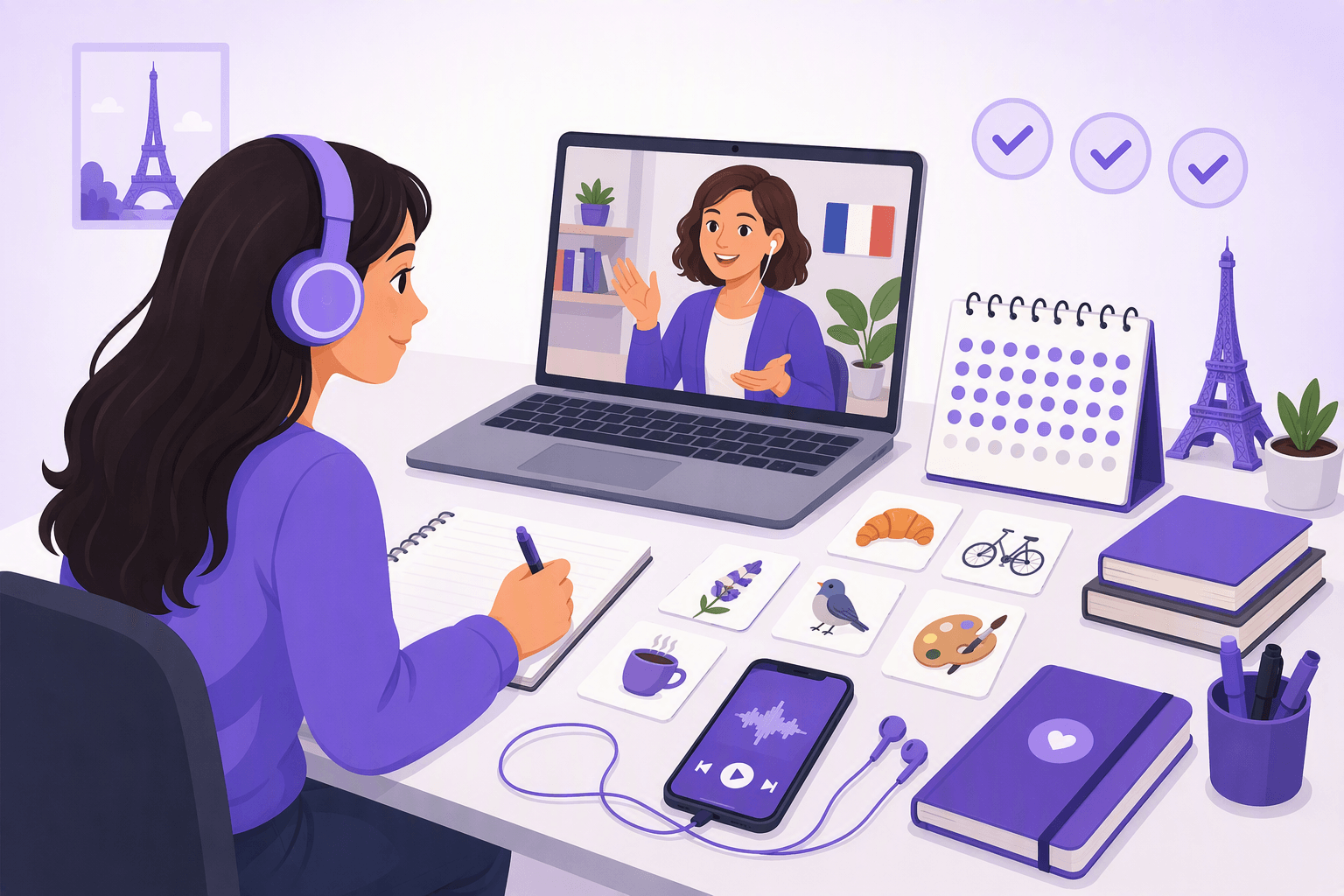
What a French beginner should focus on first
A beginner does not need every verb tense, every irregular form, or a perfect accent before speaking. You need a small set of building blocks that appear constantly.
The Council of Europe’s CEFR framework describes A1 users as able to handle familiar everyday expressions and basic interactions when the other person speaks slowly and clearly. That is a practical first target, not perfection.
Your initial priorities should be:
- Understand and say common greetings.
- Introduce yourself and ask basic questions.
- Learn high-frequency verbs and sentence patterns.
- Train your ear for French sound connections.
- Build a habit of speaking before you feel fully ready.
- Review old material often enough that it becomes automatic.
For greeting basics, begin with our guide to saying hello in French. A greeting is not just a vocabulary item in French. It is an important signal of politeness, particularly in shops, cafés, medical offices, and other public interactions.
The 90-day French learning plan
A good beginner plan gets gradually more demanding without becoming overwhelming. Think in three stages: survival French, everyday French, and connected French.
Days 1 to 30: Build survival French
During your first month, learn sounds, core phrases, and the most useful present-tense structures. Keep your daily sessions short and repeatable.
Focus on expressions such as:
- Bonjour /bɔ̃.ʒuʁ/, hello or good day
- Merci /mɛʁ.si/, thank you
- S’il vous plaît /sil vu plɛ/, please
- Je m’appelle... /ʒə ma.pɛl/, my name is...
- Je voudrais... /ʒə vu.dʁɛ/, I would like...
- Je ne comprends pas /ʒə nə kɔ̃.pʁɑ̃ pa/, I do not understand
- Pouvez-vous répéter ? /pu.ve vu ʁe.pe.te/, can you repeat?
- Où est... ? /u ɛ/, where is...?
Learn these as complete sound patterns. Do not initially pull every sentence apart and analyze it word by word. First, make it easy to recognize and say.
French pronunciation needs attention from day one because spelling and sound do not line up as closely as they do in Spanish or Italian. For example, the final consonant in petit /pə.ti/ is normally silent, while a following vowel can create liaison in phrases such as petits amis /pə.ti.z‿a.mi/.
💡 Start with useful sentences
Choose five phrases each week that you could realistically say in a café, on a trip, or during a conversation. Repeat them aloud several times, then make one small change to each phrase, such as changing a name, place, time, or food item.
Days 31 to 60: Build everyday sentence patterns
In your second month, move from memorized phrases to flexible patterns. You will still make mistakes, but you will be able to say more with the words you already know.
Start with a small group of essential verbs:
| French verb | IPA | Core use |
|---|---|---|
| être | /ɛtʁ/ | to be |
| avoir | /a.vwaʁ/ | to have |
| aller | /a.le/ | to go |
| faire | /fɛʁ/ | to do or make |
| vouloir | /vu.lwaʁ/ | to want |
| pouvoir | /pu.vwaʁ/ | to be able to |
| aimer | /ɛ.me/ | to like or love |
| prendre | /pʁɑ̃dʁ/ | to take |
Use the verbs in short, reusable sentences. Say je veux un café /ʒə vø œ̃ ka.fe/, I want a coffee, then change one part: je veux un billet /ʒə vø œ̃ bi.jɛ/, I want a ticket.
This is more effective than learning disconnected vocabulary because it teaches grammar, pronunciation, and meaning together. Rod Ellis, in Understanding Second Language Acquisition, emphasizes that second-language development depends on meaningful exposure as well as opportunities to use the language.
At this stage, learn basic negation with ne...pas /nə pa/. In careful written French, je ne sais pas /ʒə nə sɛ pa/ means I do not know. In fast informal speech, many speakers drop ne and say je sais pas /ʒə sɛ pa/.
That difference matters. Learn the standard form so you can write and recognize it, but listen for the shorter spoken form in films, series, interviews, and ordinary conversation. Our French negation guide explains how these forms work in greater detail.
Days 61 to 90: Connect ideas and speak more freely
By month three, your goal is not to sound fluent. It is to keep a simple conversation moving.
Add connectors such as et /e/, and; mais /mɛ/, but; parce que /paʁs kə/, because; puis /pɥi/, then; and donc /dɔ̃k/, so. These small words make basic French sound more connected.
Instead of saying only j’aime le cinéma /ʒɛm lə si.ne.ma/, I like cinema, aim for something like: J’aime le cinéma parce que les films français sont intéressants /ʒɛm lə si.ne.ma paʁs kə le film fʁɑ̃.sɛ sɔ̃.t‿ɛ̃.te.ʁe.sɑ̃/, I like cinema because French films are interesting.
Make a weekly recording of yourself answering three prompts:
- Comment tu t’appelles ? /kɔ.mɑ̃ ty ta.pɛl/, what is your name?
- Qu’est-ce que tu aimes faire ? /kɛs kə ty ɛm fɛʁ/, what do you like doing?
- Qu’est-ce que tu as fait aujourd’hui ? /kɛs kə ty a fɛ o.ʒuʁ.dɥi/, what did you do today?
At first, use notes. Then try again without them. The gap between the two recordings reveals exactly what to review.
A daily French routine that works
You do not need a three-hour study block. A 35-minute routine done six days a week gives you more useful repetition than an exhausting session once a week.
| Time | Activity | Purpose |
|---|---|---|
| 5 minutes | Review old words and phrases | Prevent forgetting |
| 10 minutes | Listen to a short French clip | Train recognition and rhythm |
| 10 minutes | Learn 3 to 6 new phrases in context | Build usable vocabulary |
| 5 minutes | Say sentences aloud | Connect listening to speaking |
| 5 minutes | Write a tiny message or diary entry | Notice grammar gaps |
Keep one rest day, or use it only for relaxed listening. A sustainable routine beats an ambitious schedule that disappears after two weeks.
Bill VanPatten’s work on input processing is useful here: learners cannot consciously process every grammar detail while trying to understand meaning. That is why listening to short clips several times works so well. On the first pass, understand the situation. On the next pass, notice a phrase. On a later pass, listen for sound details.
For a structured way to work with scenes, see our guide on learning a language with movies. A brief scene with repetition is more valuable for a beginner than watching an entire film passively with English subtitles.
Learn French pronunciation through listening, not spelling
French beginners often read every letter they see. That creates a pronunciation habit that is hard to undo.
Pay special attention to these features:
Nasal vowels
French has vowel sounds produced partly through the nose. In bon /bɔ̃/, good, the final n is not pronounced as a separate English-style /n/. In français /fʁɑ̃.sɛ/, French, the first vowel is nasal too.
You do not need a perfect nasal vowel immediately. Your first goal is to hear that bon /bɔ̃/ and bonne /bɔn/ are different words with different final sounds.
Silent endings
Many French word-final consonants are silent: parler /paʁ.le/, to speak; petit /pə.ti/, small; and vous /vu/, you. Do not assume a letter is spoken just because it appears on the page.
Liaison and linked speech
French often links words together. In vous avez /vu.za.ve/, you have, the /z/ joins the two words. This can make beginner listening feel fast even when the speaker is not talking quickly.
Listen for groups of sounds rather than individual written words. French is easier when your ear expects connected chunks.
🌍 Why 'bonjour' matters so much
In many French-speaking settings, opening an interaction with bonjour /bɔ̃.ʒuʁ/ is a basic act of social recognition. Walking into a bakery and immediately asking for something without greeting the staff can sound abrupt, even if you add s’il vous plaît /sil vu plɛ/. Learn the greeting as part of the request.
The grammar beginners actually need
Grammar is useful when it helps you say what you mean. For your first three months, focus on a limited set of topics.
Articles and gender
French nouns are masculine or feminine. Learn each noun with its article: le livre /lə li.vʁ/, the book; la table /la tabl/, the table.
Do not rely only on endings to guess gender. Patterns exist, but exceptions are common. Treat the article as part of the word.
Present tense
Start with je /ʒə/, I; tu /ty/, you informal; il /il/ and elle /ɛl/, he and she; nous /nu/, we; and vous /vu/, you formal or plural.
You will hear on /ɔ̃/ constantly in conversation. It often means we: on va au cinéma /ɔ̃ va o si.ne.ma/, we are going to the cinema. In everyday French, it is often more natural than nous allons /nu za.lɔ̃/.
Questions
Learn several question patterns, not one rigid formula:
- Tu parles français ? /ty paʁl fʁɑ̃.sɛ/, do you speak French?
- Est-ce que tu parles français ? /ɛs kə ty paʁl fʁɑ̃.sɛ/, do you speak French?
- Vous parlez français ? /vu paʁ.le fʁɑ̃.sɛ/, do you speak French?
The first is common in casual speech. The third is polite and useful with strangers. Learn more in our French question formation guide.
How to use apps, tutors, and media wisely
Apps can help you establish a daily habit, review vocabulary, and get exposure to grammar. They are not a complete speaking environment.
Use an app for short practice, then add one real-world activity: send a voice note, describe your day aloud, read a simple dialogue, or repeat a scene from a show. The best tool is the one that gets you hearing, recalling, and producing French regularly.
A tutor or language exchange partner is especially useful once you know 100 to 200 common words. You do not need to wait until you are advanced. Ask for short, predictable conversations: introductions, hobbies, food, directions, weekend plans.
French media is valuable because it exposes you to pace, emotion, hesitation, interruptions, and politeness that textbooks cannot fully reproduce. Start with material designed for learners, then move to short scenes with French subtitles.
Mistakes that slow down French beginners
The fastest way to lose momentum is to make your plan too difficult. Avoid these habits.
Waiting to speak
You will not feel ready before speaking. Say basic sentences from week one, even alone. Speaking exposes what you cannot yet retrieve and makes your listening more active.
Translating every word
French and English do not always organize ideas in the same way. Learn chunks such as j’ai besoin de /ʒe bə.zwɛ̃ də/, I need, and il y a /il ja/, there is or there are, as whole units.
Studying only grammar
Grammar without listening can produce sentences you recognize on paper but cannot understand in speech. Pair every grammar point with audio and at least three personal examples.
Ignoring register
French changes with context. Salut /sa.ly/ is appropriate with friends, but bonjour /bɔ̃.ʒuʁ/ is safer with strangers. Similarly, tu /ty/ and vous /vu/ are not interchangeable. Learn politeness as part of vocabulary, not as an optional cultural extra.
Learning rude vocabulary too early
You will encounter slang and swear words in films and online content. Recognition is useful, but do not make them your first active vocabulary. Context, region, age, and relationship matter greatly. If you are curious, use our French swear words guide to understand tone before repeating anything.
Your first-week French checklist
Use this simple checklist to begin today:
- Learn how to greet someone and say goodbye.
- Memorize your name, nationality, and one hobby in French.
- Learn numbers 1 to 20.
- Listen to 10 minutes of slow French every day.
- Learn five phrases for asking for help.
- Record yourself saying a 30-second introduction.
- Review yesterday’s phrases before adding new ones.
- Practice one polite exchange, such as ordering a drink.
Finish each week by asking yourself one question: what can I now say without looking? That is more meaningful than counting how many lessons you completed.
French becomes manageable when you treat it as a set of sounds, patterns, and social choices you meet repeatedly. Begin with everyday phrases, listen closely, speak early, review often, and let your study materials include real French voices. When you are ready to expand your social vocabulary, practice natural French goodbyes and other short exchanges you can use immediately.
Frequently Asked Questions
Can I learn French by myself as a beginner?
How long does it take to learn basic French?
Should beginners learn French grammar first?
Is watching French TV useful for beginners?
What French should I learn first?
Sources & References
- Organisation internationale de la Francophonie, La langue française dans le monde, 2022
- Council of Europe, Common European Framework of Reference for Languages: Companion Volume, 2020
- Alliance Française, French course levels and CEFR framework, accessed 2026
- Rod Ellis, Understanding Second Language Acquisition, Oxford University Press
- Bill VanPatten, While We’re on the Topic, American Council on the Teaching of Foreign Languages
Start learning with Wordy
Watch real movie clips and build your vocabulary as you go. Free to download.


