Quick Answer
The best way to learn English for beginners is to combine daily listening to real speech, a small set of high-frequency words and phrases, and short speaking practice you can repeat. Start with 20 to 30 minutes a day: listen with subtitles, learn 10 core words, and say 5 sentences out loud. This plan builds comprehension first, then accuracy, then confidence.
The best way to learn English for beginners is a daily routine that combines real listening, a small core vocabulary, and short speaking practice you repeat, not a huge grammar syllabus you never use. If you do 20 to 30 minutes every day, you can build comprehension quickly, start talking in week one, and avoid the common beginner trap of knowing rules but freezing in conversation.
English is also a practical target: Ethnologue lists roughly 1.5 billion English speakers worldwide (L1 plus L2), and English is used as an official language in dozens of countries, which means you can find real input everywhere, from YouTube to customer support chats (Ethnologue, 27th edition, 2024). Your job as a beginner is to turn that abundance into a structured habit.
If you want a media-first path, start with movies and TV for English learners, then add a small speaking loop and a vocabulary system that matches what you just heard.
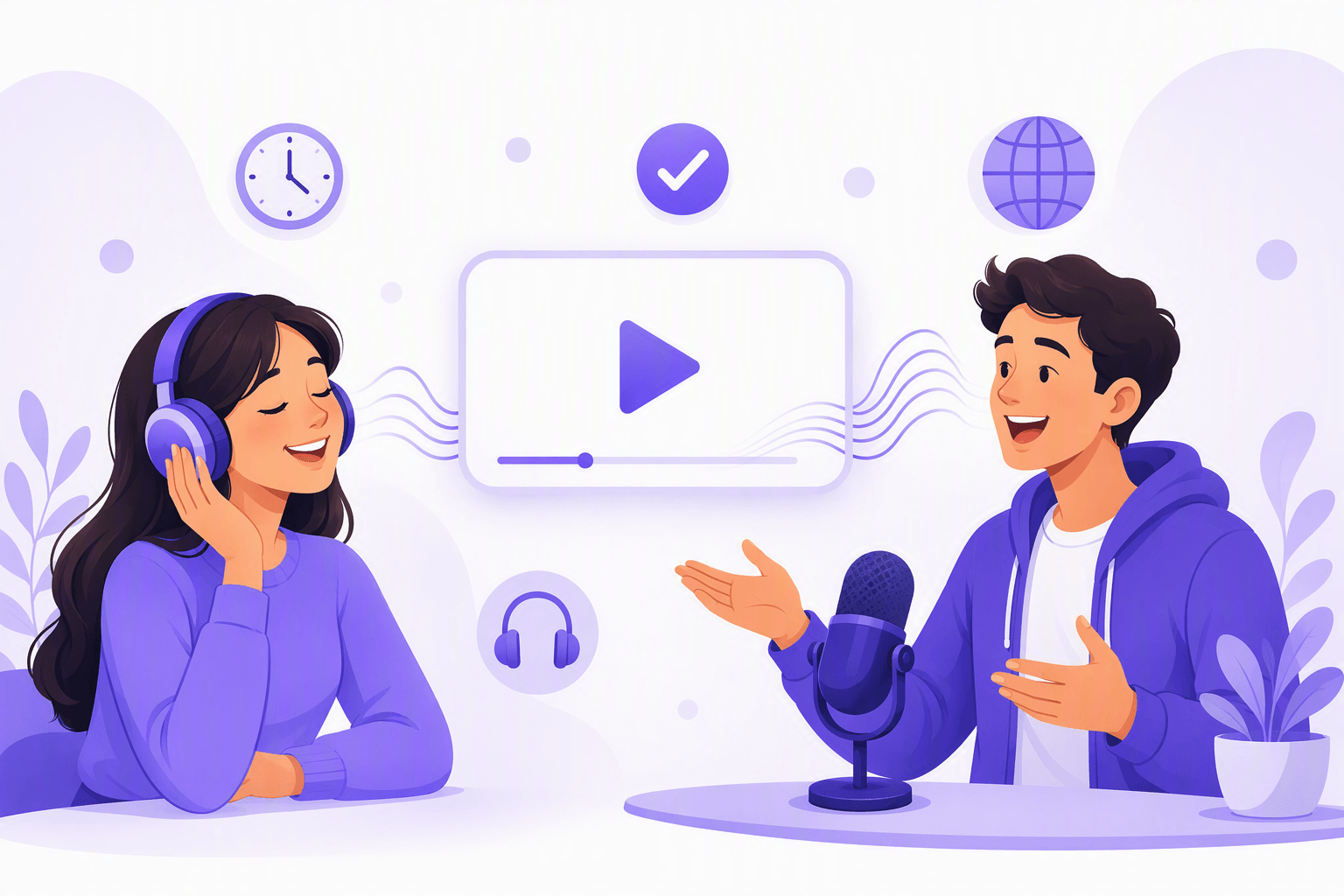
The beginner method that works: input, then output, then accuracy
Beginners often ask for a single best app or a single best textbook. The reality is that language learning is a skill, so the best method is a workflow you can repeat.
A reliable workflow has three parts: input (listening and reading), output (speaking and writing), and accuracy (feedback and correction). The order matters, because your brain needs examples before it can produce them.
Why listening comes first (even if your goal is speaking)
If you cannot hear word boundaries, you cannot copy pronunciation, and you cannot respond fast. That is why listening is the highest-leverage beginner skill.
Stephen Krashen’s work on second-language acquisition argues that comprehension is the engine that drives acquisition, and beginners need understandable input before they can speak comfortably. You do not need to agree with every detail of his model to use the practical takeaway: understand first, then speak more.
Why you should speak from day one (but in a controlled way)
Speaking early is not about perfect grammar. It is about training your mouth and timing.
Merrill Swain’s Output Hypothesis emphasizes that producing language helps you notice gaps in what you can say. For beginners, that means short, repeatable sentences, not open-ended debates.
Where grammar fits (small, targeted, and tied to what you hear)
Grammar is most useful when it explains patterns you already met in real sentences. Diane Larsen-Freeman’s work on grammar as a dynamic skill aligns with this: grammar is not only rules, it is how form, meaning, and use work together in context.
So for beginners, grammar should be a small daily habit that supports speaking and listening, not the main event.
The 30-day plan (20 to 30 minutes a day)
This plan is designed for busy beginners. It also scales: if you have more time, extend each block, but keep the same structure.
💡 Your daily minimum
Do 10 minutes of listening, 5 minutes of vocabulary, and 5 minutes of speaking. If you only have 20 minutes, do not skip speaking. One spoken minute daily beats one long speaking session per month.
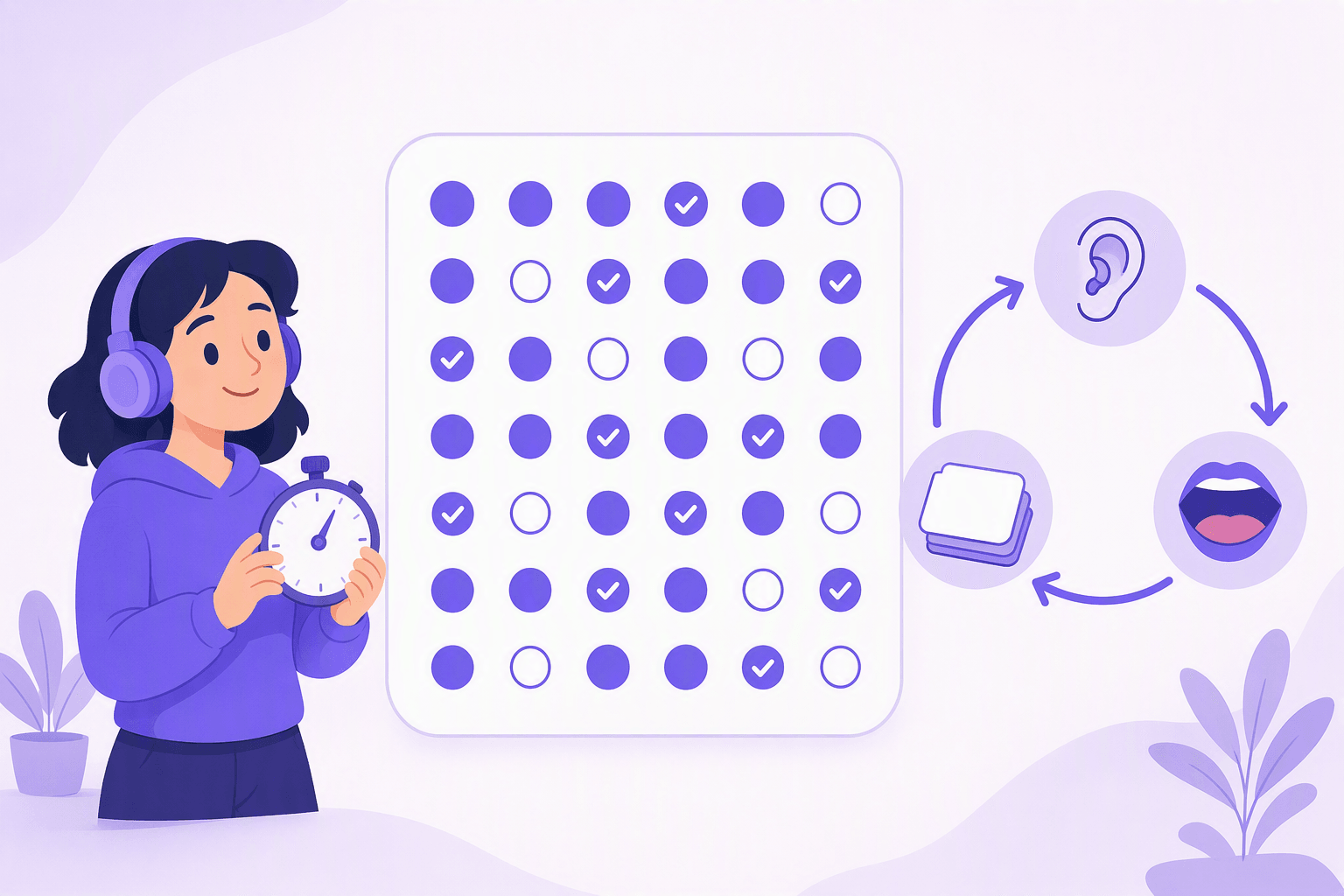
Days 1 to 7: build your survival loop
Pick one short clip (30 to 90 seconds) with clear dialogue. Watch it with English subtitles first, then without.
Then do five spoken sentences that you can reuse anywhere:
- "Hi, my name is ___." (HY, my NAYM iz)
- "I am from ___." (eye AM fruhm)
- "I live in ___." (eye LIV in)
- "I don't understand." (eye DOHNT uhn-der-STAND)
- "Can you say that again, please?" (kan yoo SAY that uh-GEHN pleez)
Record yourself once a day. The goal is not to sound native, it is to sound clear.
Days 8 to 14: add pronunciation and speed
Keep the same clip, but now shadow it. Shadowing means you speak along with the audio, slightly behind the speaker.
Focus on rhythm and reductions, because English is stress-timed. Many learners pronounce every syllable equally, which makes speech hard to understand.
Use a dictionary audio model when you are unsure. Cambridge Dictionary entries are a good baseline for pronunciation checks (Cambridge Dictionary, accessed 2026).
Days 15 to 21: expand with patterns, not lists
Add two patterns that generate many sentences:
- "I want to ___." (eye WAHNT too)
- "I have to ___." (eye HAV too)
Now you can produce dozens of useful lines:
- "I want to practice English." (eye WAHNT too PRAK-tis ING-glish)
- "I have to go now." (eye HAV too GOH now)
At this stage, learn numbers because they unlock real life tasks: prices, times, dates. Use numbers in English as your reference and practice saying them out loud.
Days 22 to 30: start real conversations with guardrails
Do two short conversations per week, 10 minutes each, with a tutor or exchange partner. Keep the topic narrow: introductions, ordering food, directions, work basics.
Use CEFR as a sanity check for what "beginner" means. A1 is simple phrases and basic personal information, A2 is routine tasks and short exchanges (Council of Europe, CEFR, accessed 2026). If you can do A2 tasks, you are already functional.
What to study first (and what to ignore)
Beginners waste time on low-frequency vocabulary and advanced grammar. You will progress faster if you prioritize what appears everywhere.
The core words that unlock real sentences
Start with function words and basic verbs:
- I, you, we, they
- a, an, the
- to, for, with, in, on, at
- be, have, do, go, want, need
If you want a frequency-based list, use 100 most common English words as your anchor, but do not memorize it as a spreadsheet. Learn the words inside sentences you can say.
Pronunciation priorities: clarity beats accent
Beginners should not obsess over sounding American or British. Your goal is to be understood.
Prioritize:
- Word stress: PRE-sent (noun) vs pre-SENT (verb)
- Final consonants: "cap" vs "cab"
- Vowel length contrasts: "ship" vs "sheep"
David Crystal’s work on English highlights how rhythm and stress shape intelligibility. Practically, that means you should copy stress patterns from real speech, not pronounce English like it is syllable-timed.
What to ignore for now
Skip these in month one:
- Rare idioms
- Complex phrasal verb lists
- Advanced tense debates (present perfect vs past perfect)
- Slang you cannot place socially
You can still enjoy slang content, but treat it as recognition practice, not production. If you are curious, browse English slang to understand what you see online, but do not force it into your beginner speaking.
How to use movies and TV without wasting time
Watching passively feels productive, but it often becomes entertainment with subtitles. The fix is to use clips, repetition, and a small notebook system.
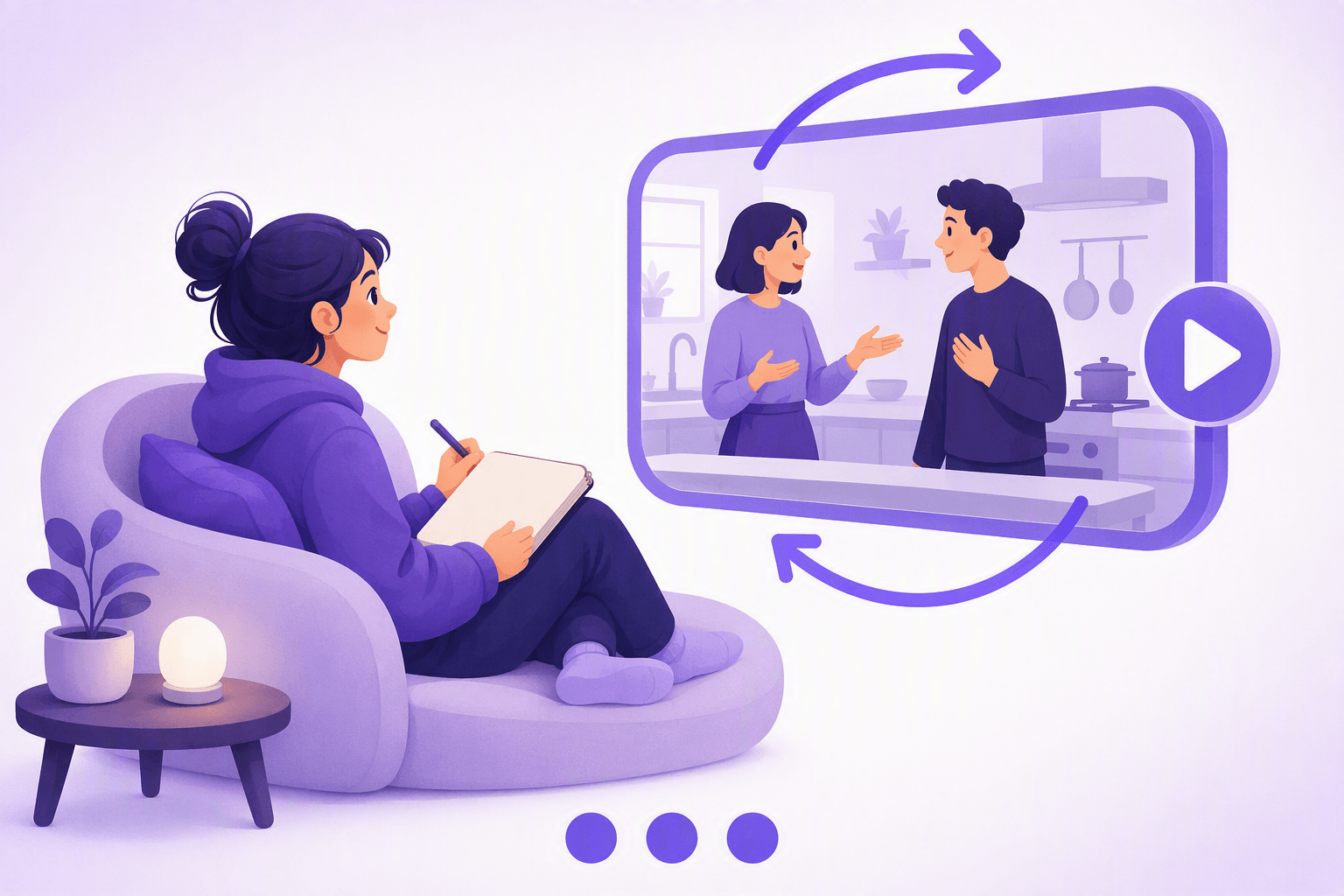
Choose the right kind of clip
A good beginner clip has:
- One setting (kitchen, office, street)
- Two speakers
- Clear audio
- A simple goal (asking, refusing, apologizing)
If you need suggestions, start with the titles in best movies to learn English and pick scenes with everyday dialogue.
The 3-pass method (works even at A1)
Pass 1: Watch with English subtitles, understand the situation.
Pass 2: Watch again, pause and repeat key lines out loud.
Pass 3: Watch without subtitles, catch what you can, then check what you missed.
This method trains listening, pronunciation, and memory at the same time.
⚠️ Avoid the subtitle trap
If you always read subtitles, your listening will lag behind. Use subtitles as a tool, then remove them. A good target is understanding the same clip without subtitles by the end of the week.
A beginner-friendly speaking system (that does not require confidence)
Confidence is usually a result, not a prerequisite. Build a system where speaking is small, predictable, and repeatable.
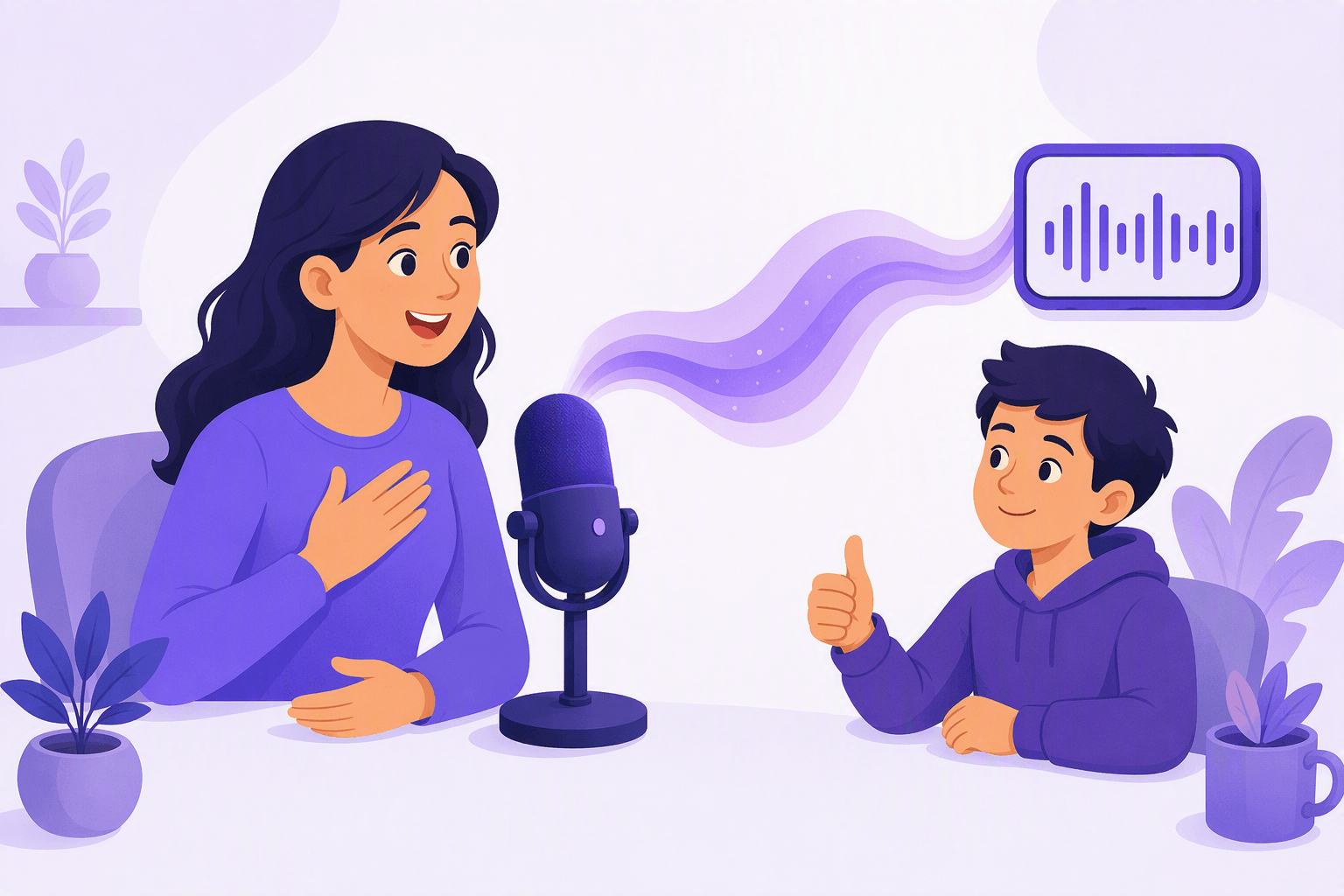
The 5-sentence daily drill
Every day, say five sentences in these categories:
- Identity: "I am a student." (eye AM uh STOO-dent)
- Routine: "I work on Mondays." (eye WURK on MUN-dayz)
- Preference: "I like coffee." (eye LYK KAW-fee)
- Need: "I need help." (eye NEED HELP)
- Question: "Where is the bathroom?" (wehr iz thuh BATH-room)
Rotate the nouns and verbs, but keep the structure stable. This builds automaticity.
Record, compare, adjust
Record one take, then compare it to a native model from a clip or dictionary audio. Cambridge Dictionary is useful for single words, and movie clips are useful for connected speech (Cambridge Dictionary, accessed 2026).
Do not chase perfection. Fix one thing per day, like the final consonant in "need" or the stress in "bathroom."
Cultural reality: English changes by place and situation
English is not one uniform thing. It varies by country, region, and social setting, and beginners benefit from knowing that early.
Global English vs local English
British Council research on English as a global language emphasizes that many English conversations happen between non-native speakers, especially in international workplaces and travel contexts (British Council, The English Effect, accessed 2026). That is good news: clear, simple English is often the most effective English.
Politeness is often indirect
In many English-speaking contexts, requests are softened:
- "Can you...?" is normal.
- "Could you...?" is more polite.
- "Do you mind...?" is polite but tricky for beginners because "No" can mean "Yes, I can do it."
Research on politeness strategies (Brown and Levinson, Politeness: Some Universals in Language Usage, Cambridge University Press) is a useful lens here: speakers often protect the other person’s "face" by sounding less direct. As a beginner, you can sound polite just by adding "please" and using "could."
Slang and swearing are social signals, not just vocabulary
Many learners want to sound natural fast, so they jump to slang and swear words. The risk is that you use a strong word in a mild situation, or you copy a term that is tied to a specific community.
If you want to understand what you hear, read English swear words as a recognition guide. For speaking, wait until you can judge tone and relationship.
🌍 A practical rule for beginners
If you would not say it to a teacher, a coworker, or a stranger, do not say it in English yet. Learn it for comprehension first, then decide later if it fits your identity and your environment.
Tools that help beginners (without overcomplicating it)
You do not need ten apps. You need one input source, one vocabulary system, and one speaking outlet.
Input: short clips beat long episodes
Short clips let you repeat, and repetition is where learning happens. If you like the movie method, Wordy’s approach is built around short scenes with interactive subtitles and review, rather than full episodes where you drift.
If you prefer YouTube, choose channels with clear speech and consistent topics. Keep the same speaker for a week to adapt to their accent.
Vocabulary: review what you actually hear
Spaced repetition is effective when the words come from your life. Save words from your clip, not random lists.
If you use Anki, keep the cards simple and sentence-based. For a practical setup, see Anki for language learning.
Speaking: schedule it like a workout
Two short sessions per week is enough to start. The key is that it is scheduled.
Use a script at first. Scripts are not cheating, they are training wheels.
Common beginner mistakes (and how to fix them fast)
Mistake 1: studying too much, speaking too little
Fix: set a daily speaking minimum, even 60 seconds. Your mouth needs reps.
Mistake 2: learning words without pronunciation
Fix: every new word needs an audio model and one spoken sentence. If you cannot say it, you do not really own it.
Mistake 3: trying to understand every word
Fix: aim for gist first. Your brain learns patterns from repeated exposure, not from translating every line.
Mistake 4: switching resources constantly
Fix: stay with one clip and one routine for a full week. Variety feels good, but it slows consolidation.
💡 A simple weekly scorecard
At the end of each week, answer: Can I understand my clip without subtitles? Can I say 20 sentences without stopping? If yes, you are progressing, even if you still make grammar mistakes.
A realistic next step after 30 days
After 30 days, your goal is not fluency. Your goal is momentum and a clear path to A2.
Add:
- One longer listening session per week (30 to 45 minutes)
- One grammar topic per week (articles, past tense, questions)
- One new clip per week, but keep reviewing the old one
For grammar that beginners actually need, start with articles, because "a/an/the" affects almost every sentence. Use English articles when you are ready to tighten accuracy.
If you want the simplest version of this plan
Do this every day:
- Watch one short English clip twice.
- Write down 5 useful lines.
- Say those 5 lines out loud, record once.
- Review yesterday’s 5 lines.
That is the best way to learn English for beginners because it is sustainable, it trains real listening, and it turns passive exposure into active skill.
If you want a ready-made library of level-appropriate scenes, start on /learn/english, then pair it with one weekly conversation and a small review habit.
Frequently Asked Questions
What is the best way to learn English for beginners at home?
How long does it take a beginner to learn English?
Should beginners start with grammar or speaking?
Is watching movies a good way to learn English for beginners?
What should I learn first in English vocabulary?
Sources & References
- Ethnologue, 27th edition, 2024
- British Council, The English Effect (accessed 2026)
- Cambridge Dictionary, English pronunciation and word entries (accessed 2026)
- Council of Europe, Common European Framework of Reference for Languages (CEFR) (accessed 2026)
Start learning with Wordy
Watch real movie clips and build your vocabulary as you go. Free to download.


