Quick Answer
The best language learning podcasts are the ones you can understand enough to follow, while still hearing new words and natural rhythm. In practice, that means a mix of graded learner podcasts (for structure) and native podcasts (for real speed, slang, and culture), used with transcripts, repeat listening, and a simple vocabulary capture routine.
The best language learning podcasts are the ones that fit your level and give you a repeatable routine, ideally with transcripts, clear audio, and episodes you can re-listen to without getting bored. For most learners, the fastest progress comes from combining a structured learner podcast (to build core grammar and high-frequency vocabulary) with at least one native podcast (to train real speed, reductions, humor, and culture).
Podcasts work because they let you stack hours of listening, which is the bottleneck for many learners who can read better than they can understand speech. English is a particularly high-value target: Ethnologue estimates roughly 1.5 billion total English speakers worldwide (L1 plus L2), which means there is endless audio at every difficulty level (Ethnologue, 27th edition, 2024).
If your goal is English specifically, pair this guide with our listening-heavy picks like best movies to learn English, then add vocabulary you actually hear in real life, including English slang when you are ready.
What makes a podcast good for language learning
A podcast can be popular and still be a poor learning tool. For learning, you want predictable difficulty, clean audio, and a way to confirm what you heard.
Comprehension beats difficulty
If you cannot follow the main idea, you will spend the whole episode guessing. A practical target is understanding most sentences, while still meeting new words you can learn through context.
Paul Nation’s work on vocabulary learning emphasizes that comprehension and repeated encounters matter for turning unknown words into known words. You do not need to memorize everything, but you do need enough understanding for your brain to connect sound, meaning, and usage.
Transcripts and “confirmable listening”
Transcripts turn listening into something you can verify. You listen, you check, you notice what you missed, then you listen again.
This matters in English because reduced speech is normal: “going to” becomes “gonna,” “did you” becomes “didja,” and word boundaries blur. A transcript makes those patterns visible.
Episode length and re-listenability
Short episodes are easier to repeat. Long episodes can still work if they are segmented, or if you can bookmark time stamps.
A simple rule: if you would not re-listen to it, it is probably not the right learning podcast for you.
Best language learning podcasts (12 picks)
These are grouped by the kind of support they provide. Some are explicitly “language learning podcasts,” others are native shows that become powerful once you have a transcript strategy.
💡 How to use this list
Pick one structured learner podcast and one native podcast. Use the learner show for clarity and confidence, and the native show for real speed and culture. Rotate episodes, do not binge randomly.
Structured learner podcasts (best for A1 to B1)
1) LearnEnglish Podcasts (British Council)
If you are learning English, the British Council’s LearnEnglish Podcasts are one of the safest bets for clear audio and learner-focused pacing (British Council, LearnEnglish Podcasts, accessed 2026). The tone is practical and the topics are everyday.
Use it for: building listening confidence and “daily life” vocabulary.
2) ESL Pod (English as a Second Language Podcast)
This classic format is explanation-heavy, which is exactly what many beginners need. The value is not speed, it is clarity and repetition.
Use it for: turning confusing everyday phrases into something you can actually hear in the wild.
3) VOA Learning English
VOA Learning English is designed to be accessible, often with slower delivery and clear articulation. It is especially useful if you want news-style vocabulary without jumping straight into fast native broadcasts.
Use it for: bridging from learner audio to real news.
4) All Ears English
This is a good “conversation culture” show for learners who already have basics and want to sound more natural. It often focuses on pragmatic choices: what sounds friendly, what sounds stiff, and what is too direct.
Use it for: social English, small talk, and tone.
Intermediate podcasts with transcripts (best for B1 to B2)
5) TED Talks Daily (with transcripts)
TED’s ecosystem is useful because many talks have transcripts and clear stage audio. The language is often formal, but the structure is learner-friendly: introductions, signposting, and repeated key terms.
Use it for: academic listening, presentations, and topic vocabulary.
6) The Daily (New York Times style daily news)
Daily news podcasts are a strong intermediate step because they are consistent and predictable. The downside is speed and proper nouns.
Use it for: training “real adult listening” in manageable doses.
7) Stuff You Should Know
This show is long-running, conversational, and full of paraphrasing, which helps comprehension. Hosts often restate ideas in different words, which creates natural repetition.
Use it for: building endurance and learning how English speakers explain things casually.
Native podcasts (best for B2 to C2)
8) This American Life
This is narrative audio with high production quality. You get multiple voices, emotions, and storytelling rhythm.
Use it for: natural pacing, humor, and cultural references.
9) Radiolab
Radiolab mixes interviews, narration, and sound design. The language can be dense, but the storytelling pulls you through.
Use it for: listening under cognitive load, meaning you learn to keep going even when you miss a phrase.
10) The Joe Rogan Experience (select clips, not full episodes)
Long-form, unscripted conversation is where you meet real interruptions, fillers, and slang. It is also where you meet the messiness of real speech.
Use it for: advanced listening realism, but only if you can tolerate long episodes and you choose segments carefully.
⚠️ Choose your content responsibly
Some native podcasts include explicit language, controversial topics, or aggressive debate styles. If you are learning English for work or school, be selective. For vocabulary curiosity, our English swear words guide explains severity and context so you do not repeat something inappropriate by accident.
11) Comedy and panel shows (UK and US)
Comedy is a listening “boss level” because it relies on timing, implication, and shared culture. If you want to understand native humor, podcasts are a direct route.
Use it for: sarcasm, understatement, and cultural literacy.
To avoid confusion, it helps to know differences in everyday usage. Our American vs British English guide is a good companion when you start mixing US and UK shows.
12) A hobby podcast you genuinely like
The best native podcast is often not a “learning” podcast at all. It is a show about your hobby: fitness, design, true crime, football, cooking, gaming.
Use it for: motivation and repeated domain vocabulary, which is how adults actually build fluency in real life.
How to choose the right podcast for your level
The same podcast can be perfect for one learner and useless for another. Use these filters.
Step 1: test with a 3-minute sample
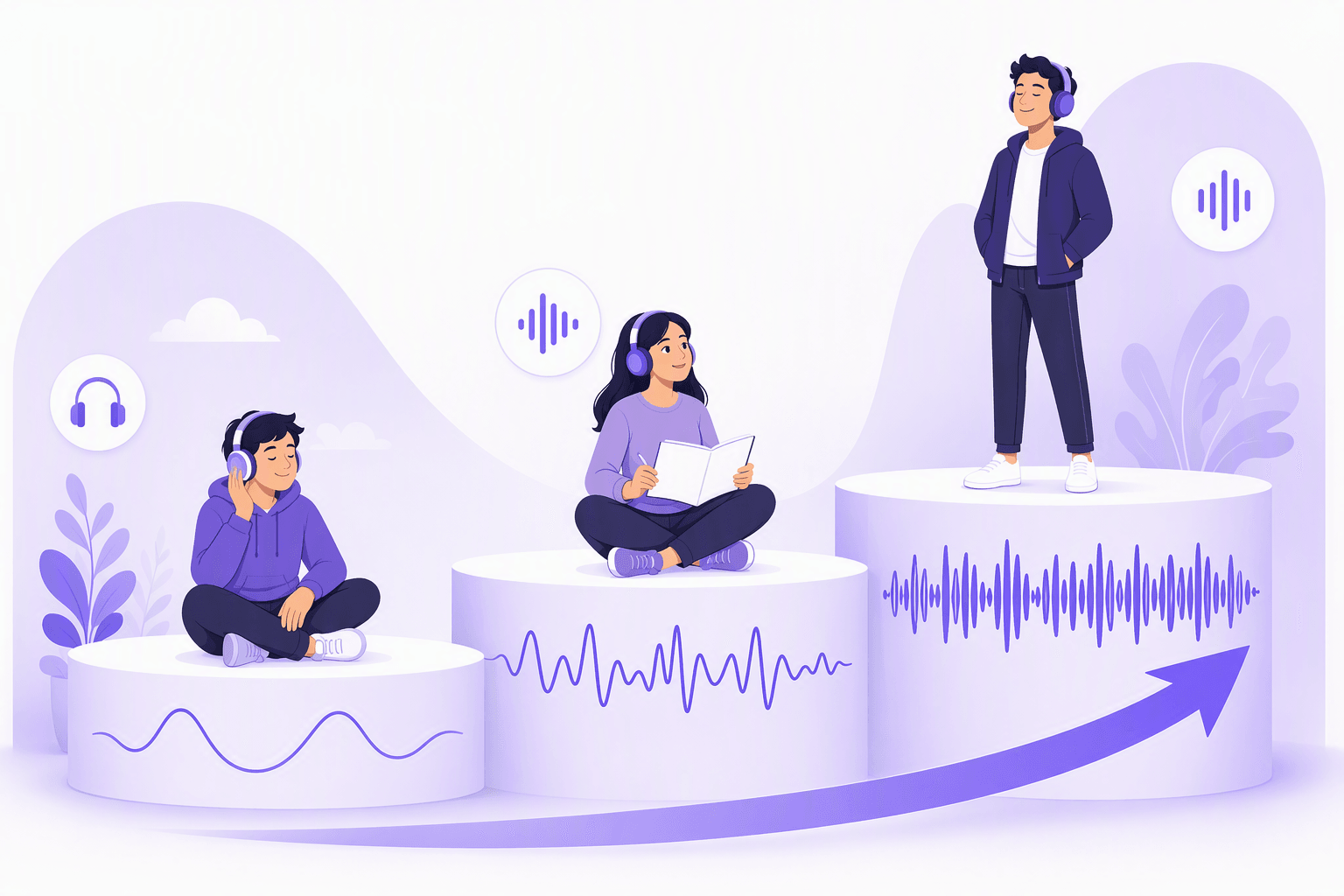
Play three minutes without pausing. If you cannot summarize the main idea in one sentence, it is too hard right now.
If it is too easy, that is not a problem. Easy listening builds speed and automaticity, which many learners lack.
Step 2: check for support features
Look for at least one of these:
- transcripts
- episode summaries
- clear segment structure
- consistent hosts and audio quality
If you have none of these, you will still learn, but you will waste time.
Step 3: match accent to your goals
English is spoken across many countries, and accent exposure matters. The U.S. Census Bureau reports tens of millions of people in the United States speak a language other than English at home, which is one reason you hear so many English varieties in daily life (U.S. Census Bureau, Language Use in the United States, accessed 2026).
If you are moving to Canada, listen to Canadian voices. If you work with UK clients, add UK shows. If you take IELTS, mix accents so you do not panic when the speaker changes.
A simple 20-minute podcast routine that works
You do not need complicated systems. You need repeatable steps.
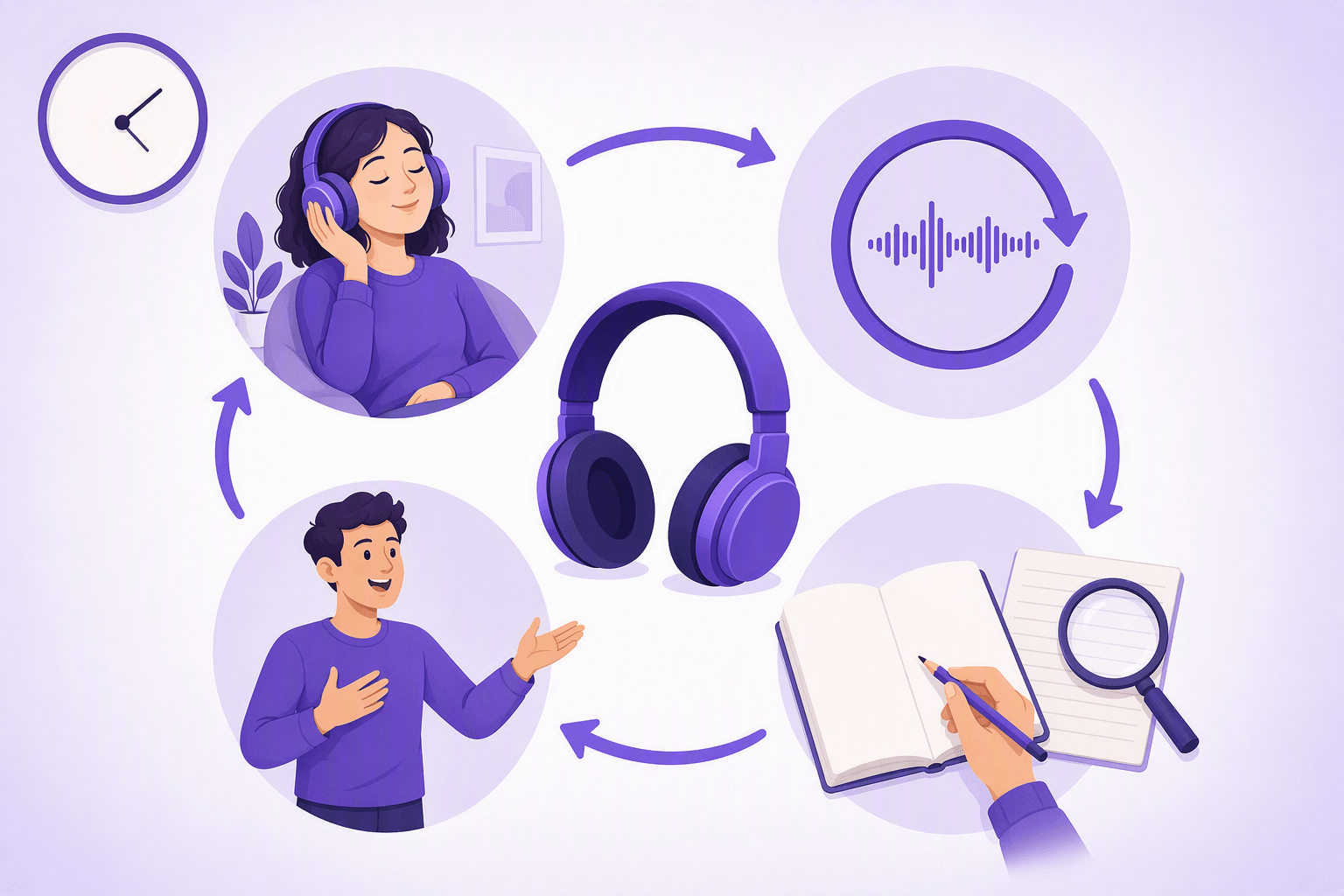
Minute 1 to 5: first listen for meaning
Listen once without pausing. Your job is to understand the story, not every word.
Write one sentence: “This episode is about…”
Minute 6 to 12: replay one short segment
Pick 30 to 60 seconds. Replay it three times.
On the second replay, write down any phrases you think are useful. On the third replay, focus on pronunciation and reductions.
Minute 13 to 18: confirm with transcript (or “dictation”)
If you have a transcript, read while listening. Notice what you misheard.
If you do not have a transcript, do a quick dictation: write what you hear, then compare with any available summary, captions, or a dictionary search for the key phrase.
Minute 19 to 20: speak
Say the best sentence out loud three times. Then paraphrase it in your own words.
This is where listening turns into usable language.
💡 Make numbers automatic
Many learners understand stories but freeze on numbers, dates, and prices. Add one short “numbers episode” per week, then drill the phrases you heard. Our English numbers guide helps you make number listening automatic, which pays off in travel and work calls.
How podcasts build “real” listening skills
Podcasts are not just vocabulary. They train the parts of listening that textbooks rarely cover.
Reduced speech and linking
Native speakers link words and reduce sounds, especially in casual conversation. Podcasts expose you to this constantly.
David Crystal’s work on English pronunciation and rhythm highlights that English is stress-timed, meaning unstressed syllables compress and vowels reduce. That is why “I want to go” can sound like “I wanna go,” and why learners often feel native speech is “too fast” even when it is not.
Turn-taking, hesitation, and filler words
Real conversation includes “um,” “you know,” “like,” and restarts. Learners who only study scripted audio often struggle when speech becomes messy.
Podcasts, especially interview formats, give you realistic turn-taking patterns you can copy.
Pragmatics: what sounds polite, pushy, or distant
Language is social. The same sentence can be friendly or rude depending on tone, directness, and context.
Deborah Tannen’s work on conversational style is useful here: people interpret involvement, interruption, and directness differently across communities. Listening to different podcast styles helps you build intuition for what “normal” sounds like in the variety of English you need.
Common mistakes that make podcast learning slow
Mistake 1: only passive listening
Passive listening is not useless, but it is slow. If you want measurable improvement, add one active segment per episode.
Mistake 2: switching shows constantly
You learn faster when you stick with the same hosts. Your brain adapts to their voice, pacing, and favorite phrases.
Mistake 3: choosing content that is too hard
Struggling through incomprehensible audio feels productive, but it often becomes noise. Use graded content until you can follow the story, then increase difficulty.
Mistake 4: collecting vocabulary without reusing it
If you save 30 new words per episode, you will never review them. Save 3 to 7 items, then reuse them in speaking or writing.
If you like flashcards, pair your podcast routine with a simple spaced repetition workflow. Our Anki guide for language learning shows how to keep it lightweight.
Podcast learning vs movies and TV
Podcasts are excellent for volume and repetition. Movies and TV are excellent for context, emotion, and visual cues.
A balanced plan uses both:
- podcasts for daily listening reps
- movies and TV for “situational language” and memory hooks
If you want that visual support, start with our best movies to learn English, then use podcasts to keep progress steady between viewing sessions.
🌍 A cultural detail podcasts teach better than textbooks
Podcasts expose you to how English speakers signal agreement without saying “yes.” You hear “right,” “exactly,” “totally,” “for sure,” and “I mean,” plus supportive sounds like “mm-hmm.” These are small, but they are the glue of natural conversation, and they vary by region and age group.
A realistic recommendation by level (quick picks)
If you are A1 to A2
Choose one learner podcast with slow speech and explanations. Re-listen to the same episode across two days.
Your goal is confidence, not speed.
If you are B1
Add transcripts and start shadowing short segments. You are building the bridge from “classroom English” to real English.
This is also when learners start noticing slang. Use it carefully and learn tone, not just meaning. Our English slang guide helps you avoid using internet phrases in the wrong setting.
If you are B2 and above
Add native podcasts in topics you care about. Focus on speed, reductions, and pragmatic choices.
At this level, the biggest win is consistency. A daily 20-minute routine beats a weekend binge.
If you want to learn through real scenes, not just audio
Podcasts are powerful, but they are still audio-only. If you want to connect listening to facial expressions, timing, and real dialogue, movie and TV clips can make phrases stick faster.
Wordy teaches languages through short, real scenes with interactive subtitles and review, so you can capture the exact lines you want and practice them until they are automatic. If that approach fits your learning style, start with the English learning page and combine it with one podcast from this list for daily listening volume.
Frequently Asked Questions
What is the best podcast for learning a language?
Can podcasts make you fluent?
How long should I listen to podcasts each day to improve?
Should I listen to podcasts in my target language even if I understand very little?
Are transcripts necessary for language learning podcasts?
Sources & References
- British Council, LearnEnglish Podcasts (accessed 2026)
- Cambridge Dictionary, 'podcast' definition and usage (accessed 2026)
- Ethnologue, 27th edition, 2024
- OECD, Adult skills and lifelong learning indicators (accessed 2026)
- U.S. Census Bureau, Language Use in the United States (accessed 2026)
Start learning with Wordy
Watch real movie clips and build your vocabulary as you go. Free to download.


