Quick Answer
The best English textbooks in 2026 depend on your goal: use a general coursebook series for structure, a grammar reference for accuracy, and a vocabulary or exam book for your specific target. The fastest progress usually comes from pairing a textbook with daily listening to real speech, so you learn the forms and then hear them at natural speed.
The best English textbooks in 2026 are the ones that match your level, your goal (general fluency, grammar accuracy, business, or an exam), and your study style, and most learners progress fastest by pairing one structured coursebook with daily listening to real English. English is the world’s most widely learned second language, and with about 1.5 billion total speakers (Ethnologue, 27th edition, 2024), the biggest challenge is not finding materials, it is choosing a book that fits your exact next step.
A textbook is not your whole plan, it is your spine. For listening and natural phrasing, you still need real speech, for example movie dialogue, podcasts, and interviews, which is why many learners combine books with curated media like our picks of the best movies to learn English.
How to choose the right English textbook (the 5-minute decision)
Start with your level, not your ambition
If you are A1 to A2, you need a book that teaches survival functions: introductions, basic questions, time, shopping, and simple past and future. If you are B1 to B2, you need range and accuracy: conditionals, reported speech, discourse markers, and more natural collocations.
If you are C1, the “best textbook” is usually not a coursebook at all. It is a skills book (writing, pronunciation, academic English) plus lots of real input.
Pick the book type that matches your goal
Most learners do best with a two-book stack:
- A coursebook series for structure (units, review, audio).
- A grammar or vocabulary book for precision and repetition.
If your goal is an exam, add an exam book later, after you can comfortably understand the exam’s listening and reading difficulty. IELTS and TOEFL publishers are clear that the tests measure real ability, not just familiarity with the format (IELTS and ETS resources, accessed 2026).
Check for audio, answers, and “boring but essential” features
For self-study, a book without audio is a trap. English is stress-timed, and you need to hear reductions, linking, and rhythm, not just see words on a page.
Also check for answer keys, transcripts, and review sections. These are what turn a textbook into a system.
Avoid the two common textbook mistakes
⚠️ Two mistakes that waste months
- Buying a book that is too hard because it looks 'advanced'. You end up translating, not learning.
- Buying five books and finishing none. One good coursebook plus one support book beats a shelf of half-used materials.
The best English textbook categories (and who each is for)
Instead of pretending there is one “best English textbook,” it is more accurate to choose by category. This is also how major publishers design their catalogs, aligned to CEFR levels (Cambridge University Press and Assessment guidance, accessed 2026).
Best all-in-one coursebook series (A1 to C1)
A coursebook series is your main path. It gives you graded input, a grammar syllabus, and controlled practice that builds toward freer speaking and writing.
What to look for:
- Clear CEFR labeling (A1, A2, B1, B2, C1).
- Audio that matches the dialogues and listening tasks.
- Regular review units and progress checks.
Who it’s best for:
- Self-learners who need structure.
- Classroom learners who want extra practice at home.
Best grammar books (A2 to C1)
A grammar book is where you fix the errors that keep repeating. Many learners can communicate at B1 while still making the same tense or article mistakes for years.
In prose, it helps to remember what linguist Michael Swan emphasizes in Practical English Usage (Oxford University Press): learners need clear explanations of real problems, not just formal rules. A good grammar reference also teaches what is common, what is possible, and what is unusual.
Who it’s best for:
- Learners who feel “stuck” at intermediate.
- Writers who need accuracy for work or study.
Best vocabulary and collocations books (B1 to C1)
Vocabulary growth is not only “more words.” It is also better word partnerships: make a decision, heavy rain, take responsibility. This is why collocations matter.
Lexicographer John Sinclair’s work on corpus linguistics influenced modern vocabulary teaching by showing how much language comes in chunks, not isolated words. A good vocabulary book trains you to notice and reuse those chunks.
Who it’s best for:
- Learners who understand a lot but sound unnatural.
- Learners preparing for writing-heavy exams.
Best exam prep books (IELTS, TOEFL, Cambridge exams)
Exam books are tools, not foundations. Use them when you already have the base grammar and vocabulary, then train speed, strategy, and task familiarity.
British Council and ETS both publish detailed test format information and preparation guidance (accessed 2026). Use those official resources to verify that your book matches the current exam.
Who it’s best for:
- Learners with a deadline and a target score.
- Learners who need timed practice and feedback.
A practical “best English textbooks” shortlist (by level)
This section is intentionally brand-light. Editions change, and what matters most is choosing the right type and level, then actually finishing it.
A1 to A2: beginners who need speaking confidence
Choose a beginner coursebook that:
- Uses lots of pictures and short dialogues.
- Has slow, clear audio.
- Recycles the same grammar and vocabulary many times.
Add one support resource:
- A basic grammar workbook with many short exercises.
- A pronunciation starter focused on stress and common vowel sounds.
If numbers are a weak point, fix them early because they appear everywhere: dates, prices, phone numbers, schedules. Use a focused resource like our numbers in English guide as a quick companion.
B1: the “plateau” level where structure matters most
B1 is where learners often feel stuck: you can communicate, but you repeat the same simple structures. Your textbook should push you into:
- Past narrative (past simple vs present perfect).
- Future forms (will vs going to vs present continuous).
- Comparatives, modals, and first and second conditionals.
Add one support resource:
- A grammar reference with clear examples and a lot of practice.
- A vocabulary book that teaches collocations and phrasal verbs.
Also start training real listening daily. Textbook audio is graded, but real English is not.
B2: the level where “natural English” begins
At B2, the best textbooks are the ones that teach:
- Discourse: however, actually, in fact, to be honest.
- Register: formal vs informal email, polite disagreement.
- Pronunciation: sentence stress and reductions.
This is also the level where learners meet slang and informal speech more often. A textbook will not teach you everything you hear online, so treat it as your base and use a separate guide for modern usage, for example our English slang list.
C1: advanced learners who need precision and style
At C1, you should choose books by skill:
- Academic writing, argument structure, and referencing.
- Presentation and meeting language for work.
- Advanced pronunciation and listening.
A useful C1 “textbook” can be a high-level reader with authentic articles, plus a writing book that forces you to edit and rewrite.
How to use an English textbook so it actually works
Most people do not fail because the book is bad. They fail because the method is passive.
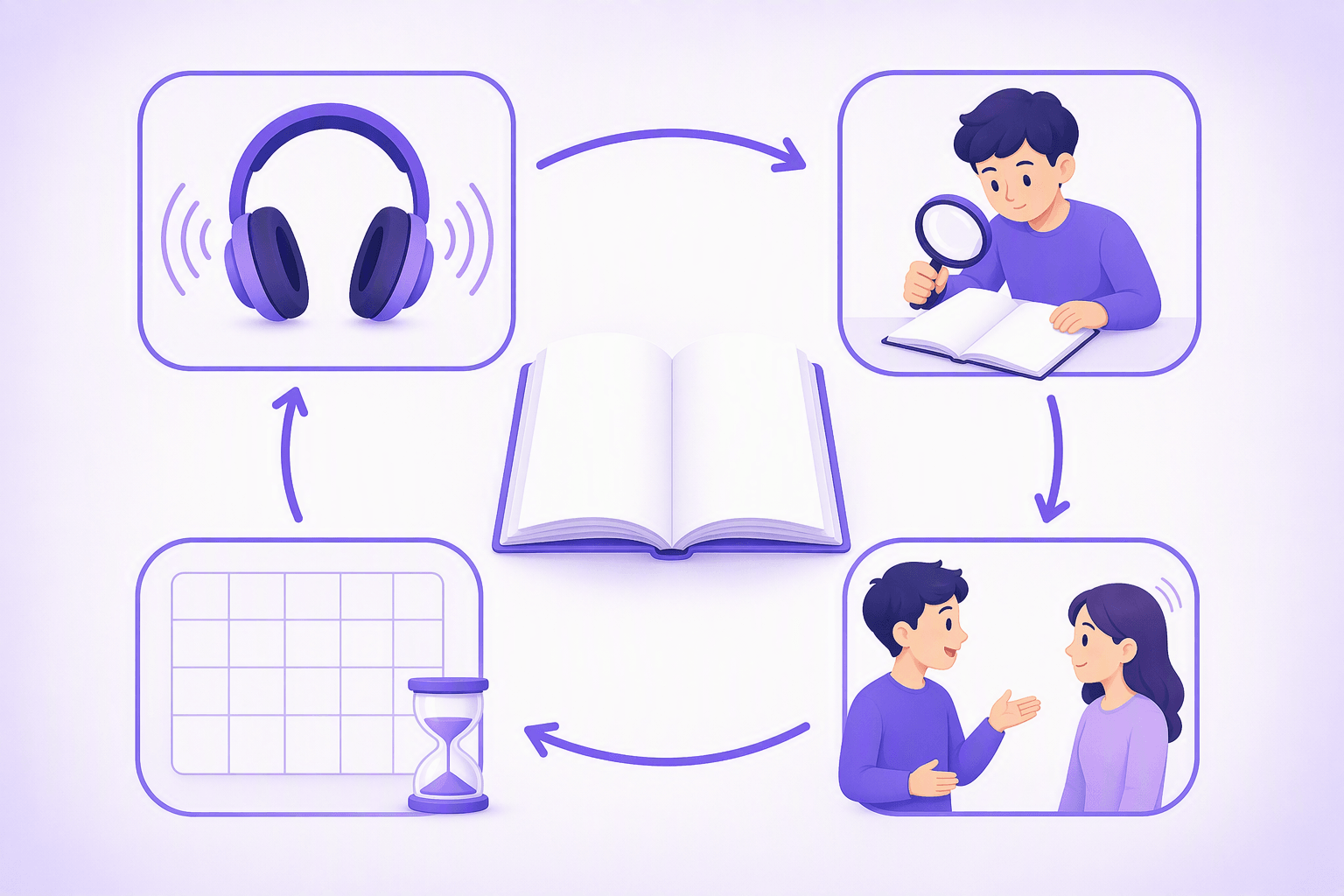
Use the “input first, output second” routine
- Listen first (without reading), then listen again with the text.
- Mark stress and linking in the transcript.
- Shadow the audio, meaning speak along with it, copying rhythm.
This fits what many teachers observe in practice: learners need repeated, meaningful input before accurate output becomes automatic. The British Council’s learner resources strongly emphasize regular listening and reading as the base of progress (accessed 2026).
Turn each unit into 20 reusable sentences
A unit often contains 8 to 15 target sentences that carry the grammar and vocabulary. Your job is to turn them into a personal mini-phrasebook.
Example (General American pronunciation approximations included):
- “Could you give me a hand?” (kood yoo GIV mee uh HAND)
- “I’m not sure what you mean.” (ym naht SHOOR wuht yoo MEEN)
- “It depends on the situation.” (it dih-PENDZ on thuh sit-choo-AY-shuhn)
Write your own versions, then say them out loud.
Do “closed book” speaking
After an exercise, close the book and speak for 60 seconds using the target grammar. If the unit is present perfect, talk about your life experiences.
If you cannot speak, you do not own the grammar yet. This is the simplest self-test.
Build a review loop (or the book disappears)
Textbooks are linear, but memory is not. Use a spaced review system:
- Day 1: learn the unit.
- Day 2: redo key exercises quickly.
- Day 7: do a mini speaking test.
- Day 14: write a short paragraph using the unit language.
If you already use flashcards, connect the book to your system. Our Anki guide for language learning shows how to turn sentences into cards without drowning in reviews.
Textbooks vs real English: what books cannot teach well
Textbooks are excellent for structure. They are weaker at the messy parts of real life.
Natural speed, reductions, and overlapping speech
Real English includes:
- “gonna” (GUN-uh) for “going to”
- “wanna” (WAHN-uh) for “want to”
- “kinda” (KYN-duh) for “kind of”
Many textbooks mention these, but you need hours of listening to recognize them instantly. Movies and TV help because you see context and emotion, not just audio.
If you want a curated starting point, use our best movies to learn English list and rewatch scenes until you can shadow them.
Slang, taboo language, and social risk
A textbook will not teach you how people swear, insult, flirt, or argue. That is partly because these are socially risky, and partly because slang changes fast.
If you want to understand modern speech, learn slang as comprehension first, production second. For taboo language, treat it as cultural literacy, not a goal. If you are curious, see our English swear words guide, but keep it as recognition unless you are very sure about context.
🌍 A cultural reality about 'correct' English
English is used across dozens of countries and hundreds of local communities. What sounds polite in one place can sound cold or overly direct in another. A textbook teaches a safe, neutral standard, which is useful, but real belonging comes from noticing how people soften requests, show humor, and signal friendliness in your specific context.
Writing for real audiences
Textbook writing tasks are often artificial. If your goal is work or study, add real tasks:
- Write emails you could actually send.
- Summarize articles you actually read.
- Record yourself explaining your job or your opinion.
Then get feedback, from a teacher, a language exchange partner, or an editing tool.
A simple “textbook stack” for common goals
Goal: everyday fluency (A2 to B2)
Stack:
- One CEFR-aligned coursebook.
- One collocations or vocabulary book.
Daily routine:
- 20 minutes coursebook.
- 10 minutes shadowing audio.
- 10 minutes real listening (podcast, movie clip, interview).
Goal: grammar accuracy (B1 to C1)
Stack:
- One grammar reference with exercises.
- One writing-focused book or workbook.
Weekly routine:
- Two grammar sessions focused on your top 3 errors.
- One writing task, then edit it the next day.
Goal: IELTS or TOEFL score
Stack:
- One general B2 coursebook if you are not solid yet.
- One official-format exam practice book.
Routine:
- Alternate skill days: listening, reading, writing, speaking.
- Do timed sections weekly, then analyze mistakes.
ETS and IELTS publish official preparation guidance and example tasks (accessed 2026). Use those to confirm your materials match the real test.
What to look for when buying (print vs digital)
Print is better for focus, digital is better for audio and search
Print:
- Easier deep focus.
- Easier annotation.
Digital:
- Faster lookup.
- Often integrates audio and video.
If you buy print, make sure you can still access the audio legally and easily. If the audio is hidden behind a broken code system, you will stop using it.
Used books are fine, but check the audio access
Older editions can be excellent, especially for grammar. For coursebooks, the biggest risk is missing audio, missing answer keys, or outdated online access.
If you buy used, confirm:
- You can download or stream the audio.
- You have the answer key.
- The level matches your current ability.
A realistic plan: finish one book in 8 to 12 weeks
Pick one main coursebook and commit to finishing it. Consistency beats intensity.
Here is a simple schedule:
- 5 days/week: 30 to 45 minutes.
- 1 day/week: review and speaking test.
- 1 day/week: rest or fun input.
If you want a structured beginner plan that blends study with real input, start with our language learning tips for beginners, then plug your chosen textbook into that routine.
Final recommendation (what to buy if you want one clear answer)
If you want the most reliable setup, buy:
- A CEFR-aligned English coursebook at your exact level (A2, B1, B2).
- A trusted grammar reference with exercises.
- A listening habit using real English, ideally with transcripts or subtitles.
Textbooks give you the map. Real speech gives you the road. If you want a movie-first way to make textbook English feel alive, start with a short scene from our best movies to learn English list and practice it until you can shadow it smoothly, then go back to your next unit and notice how much easier it feels.
Frequently Asked Questions
What is the best English textbook for self-study?
Do I need a textbook to become fluent in English?
Which English textbooks are best for IELTS or TOEFL?
How long should I use one English textbook before switching?
Are older English textbooks still worth buying?
Sources & References
- British Council, LearnEnglish and English learning resources (accessed 2026)
- Cambridge University Press and Assessment, CEFR guidance and English course materials (accessed 2026)
- ETS, TOEFL iBT test information and preparation resources (accessed 2026)
- IELTS (British Council, IDP, Cambridge), IELTS test format and preparation resources (accessed 2026)
- Ethnologue, 27th edition, 2024
Start learning with Wordy
Watch real movie clips and build your vocabulary as you go. Free to download.


