Quick Answer
In most modern English accents, there is no common perfect rhyme for "orange." That is not a myth, it is a phonetics problem: the vowel plus the final "-nj" sound combination is rare. Still, you can use near rhymes like "door hinge," "sporange," and accent-based options in poetry, rap, and songwriting.
In most accents, there is no common perfect rhyme for "orange", but you can still rhyme it effectively using near rhymes (like "door hinge"), rare true-rhyme candidates (like "sporange"), and slant rhymes shaped by accent, rhythm, and delivery.
| English | English | Pronunciation | Formality |
|---|---|---|---|
| Best everyday near rhyme (phrase) | door hinge | DOR HINJ | casual |
| Rare close rhyme (technical word) | sporange | SPOR-inj | formal |
| Accent-based slant rhyme | foreign | FOR-in | casual |
| Common slant rhyme in songs | porridge | POR-ij | casual |
| Performance option (phrase) | four-inch | FOR INCH | slang |
If you are learning English pronunciation more broadly, pair this with Wordy's listening practice on real dialogue, and keep a reference list like our English slang guide for sound patterns that show up in fast speech.
What counts as a rhyme in English?
A rhyme is not about matching spelling, it is about matching sounds.
In phonetics, a "perfect rhyme" usually means the final stressed vowel and everything after it matches, while the earlier consonants differ. That is why "time" and "rhyme" rhyme, even though the first letters are different.
A "near rhyme" (also called a slant rhyme) is close enough to feel intentional, especially in music. English poetry has used near rhyme for centuries, and modern rap uses it constantly.
"Rhyme is a phenomenon of sound, not of spelling, and it depends on the listener's perception as much as on strict phonetic identity."
John C. Wells, phonetician, Longman Pronunciation Dictionary (3rd ed.)
Perfect rhyme vs near rhyme (quick test)
A practical test you can use:
- Perfect rhyme: the last stressed vowel plus ending consonants match exactly.
- Near rhyme: one sound differs (often the vowel), but the rhythm makes it feel matched.
- Phrase rhyme: a multiword phrase matches the target word's ending sounds.
"Orange" is famous because it resists the first category in mainstream accents.
Why "orange" has (almost) no perfect rhymes
In most modern varieties of English, "orange" is pronounced roughly OR-inj (pronunciation approximation: "OR-inj"). The final sound is like "inj" (as in "hinge": "HINJ").
The problem is that English has very few common words that end with that same "inj" sound while also matching the stressed vowel before it. Rhyming needs both parts.
The sound pattern is rare
English has plenty of "-nge" spellings, but not many that land on the same ending sound. Compare:
- "change" (pronunciation approximation: "CHAYNJ") ends with "aynj", not "orinj".
- "hinge" (pronunciation approximation: "HINJ") ends with "inj", but the vowel is different.
So you can match the ending consonant cluster ("-nj"), or you can match the vowel ("OR"), but matching both is hard.
Accent differences matter more than people think
English is spoken worldwide, and pronunciation varies a lot. Ethnologue estimates around 1.5 billion total English speakers (native plus second-language), spread across well over 100 countries and territories where English is used in education, government, or daily life.
That matters because "orange" can shift:
- Some speakers say OR-inj ("OR-inj").
- Some say AHR-inj ("AHR-inj"), especially in certain UK and Irish contexts.
- Some reduce it in fast speech, closer to ORnj ("ORnj").
Those small shifts can make a slant rhyme feel tighter.
💡 A fast way to pick a rhyme that works
If you are writing lyrics, say your line out loud at performance speed. If the listener hears the same ending shape (OR + inj), it works, even if a dictionary would not call it a perfect rhyme.
The closest "real word" rhyme: sporange
sporange
"Sporange" is a technical term in biology, meaning a structure that produces spores. It is used in botany and mycology, not in everyday conversation.
Pronunciation approximation: SPOR-inj ("SPOR-inj").
In many pronunciations, that is extremely close to OR-inj ("OR-inj"). That is why "sporange" is often mentioned as the "one word" that rhymes with "orange."
The catch is usage frequency. Most audiences will not recognize it, so it can sound like you are bending the language to win a trivia contest.
🌍 When 'sporange' lands well
Saying "sporange" can be funny on purpose, because it signals "I know this is a hard rhyme." In comedy writing and playful rap, that self-awareness is part of the punchline.
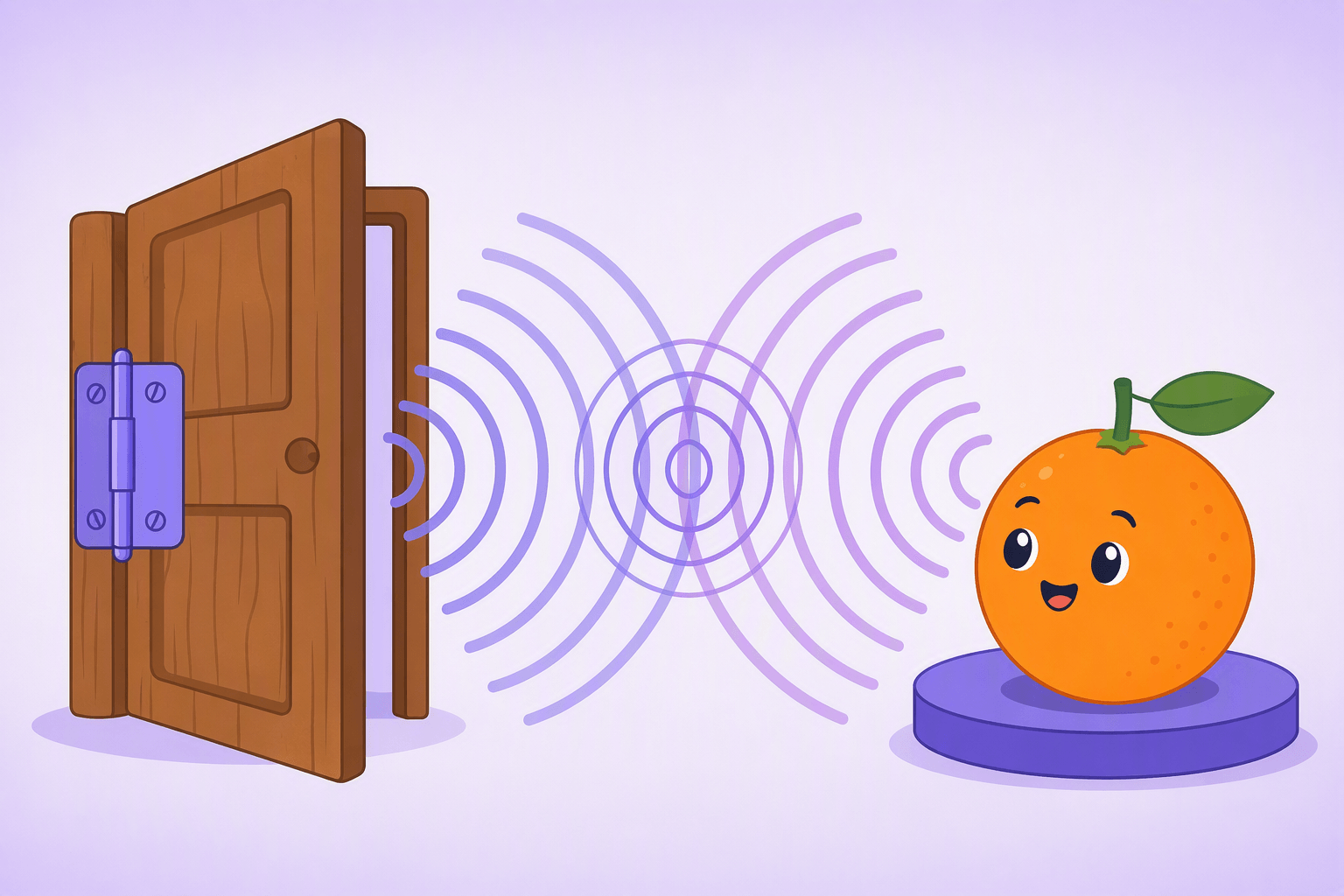
The best practical rhyme: door hinge
door hinge
"Door hinge" is not a single word, but it is the most natural phrase rhyme for many speakers.
Pronunciation approximation: DOR HINJ ("DOR HINJ").
If you say "orange" as OR-inj ("OR-inj"), then "door hinge" can match the vowel and the final "inj" sound closely enough that most listeners accept it immediately.
This is why "door hinge" shows up in songwriting discussions, and why it is a go-to example in classrooms.
How to make "door hinge" sound tighter
Small delivery choices help:
- Reduce "door" to "dor" (DOR).
- Say "hinge" quickly (HINJ), not over-articulated.
In other words, you are shaping the phrase to match the target sound, which is exactly what performers do.
Strong near rhymes (single words) you can actually use
Below are options that do not perfectly rhyme in most accents, but often work in poetry, rap, and casual wordplay. I am including pronunciation approximations so you can decide based on your own accent.
foreign
"Foreign" is often suggested because it can be pronounced FOR-in ("FOR-in") or FOR-ən ("FOR-uhn") in some varieties.
If your "orange" is closer to OR-inj ("OR-inj"), "foreign" is a slant rhyme, matching the opening vowel feel but not the final consonant.
porridge
"Porridge" is POR-ij ("POR-ij"). It shares the "OR" vowel and a similar rhythm, but ends with "ij" rather than "inj."
In singing, that difference can blur, especially if consonants are softened.
storage
"Storage" is STOR-ij ("STOR-ij") for many speakers, though some say STOR-ij with a clearer "j" sound.
It is a common, usable near rhyme because it keeps the stressed "OR" and the two-syllable shape.
forage
"Forage" is FOR-ij ("FOR-ij"). Similar logic to "storage," and it is a real everyday word, which helps it feel less forced.
mortgage
"Mortgage" is MOR-gij ("MOR-gij") or MOR-gij with a silent "t" in standard pronunciation.
It is not close in the final consonants, but the stressed vowel and cadence can make it work in a tight rhyme scheme.
⚠️ Do not trust spelling for rhymes
Words that look similar often do not rhyme, and words that look different often do. English spelling is historically layered, so always choose rhymes by sound, not letters.
Phrase rhymes that work in performance
When you allow phrases, "orange" becomes much easier.
Here are phrase options that are common in lyric writing discussions, with pronunciation approximations:
- "four inch" (FOR INCH)
- "your binge" (YOR BINJ)
- "sore twinge" (SOR TWINJ)
- "core cringe" (KOR KRINJ)
These are not dictionary rhymes, but they are effective because they match multiple sound cues: the "OR" vowel, the ending "nj" or "nj-like" consonants, and the rhythm.
Why phrase rhymes feel satisfying
Listeners do not only hear the last syllable. They hear patterns across the bar or line.
That is why multisyllabic rhyme is so powerful in rap, and why phrase rhymes can feel more "perfect" than a single-word near rhyme.
If you like this kind of sound-based patterning, you will also enjoy how slang plays with sound and reduction in fast speech. See our modern English slang list for examples where pronunciation changes the feel of a phrase.
A quick guide to using near rhymes without sounding awkward
Near rhymes fail when they look like you are trying too hard. They succeed when they serve meaning, rhythm, or humor.
1) Put the rhyme on an unstressed beat
If the rhyme word is not the main punch, the audience is more forgiving.
Example idea (not a fixed quote): place "orange" at the end of a line, then make the next line end with a phrase rhyme that lands on a lighter beat.
2) Use internal rhyme
Instead of forcing a line-ending rhyme, rhyme inside the line.
Internal rhyme lets you echo "OR" sounds (OR, FOR, MOR) while ending the line with a different word that fits the meaning.
3) Use consonance with the "nj" sound
Even if you cannot match the vowel, you can match the ending consonant feel:
- hinge (HINJ)
- cringe (KRINJ)
- twinge (TWINJ)
- binge (BINJ)
This creates a family resemblance that feels intentional.
4) Use assonance with the "OR" vowel
Match the vowel instead:
- more (MOR)
- door (DOR)
- four (FOR)
- shore (SHOR)
Then let the ending consonants differ. This is common in pop songwriting.
The cultural reason "orange" became the famous example
"Orange" is not the only hard-to-rhyme word, but it is culturally sticky.
It is common, concrete, and taught early. It is also a color, a fruit, and a brand-friendly word, so it shows up everywhere.
English-speaking culture also loves "impossible challenges" framed as trivia. "What rhymes with orange?" became a party question, a classroom prompt, and a comedy setup.
That is similar to how people treat other language "puzzles," like counting systems and irregular forms. If you are learning patterns in English, our guides to English numbers and English months show how history shapes what feels "logical" today.
A pronunciation mini-lesson: say "orange" clearly
If you are an English learner, the rhyme problem is less important than saying the word naturally.
Here is a practical breakdown:
- Start with OR ("OR" like "or").
- Add inj ("inj" like the end of "hinge": "HINJ").
Put it together: OR-inj ("OR-inj").
Common learner mistakes
- Saying "or-ANJ" with a strong "anj" like "banj" (too open).
- Adding an extra syllable: "OR-uh-nj" (too many beats).
- Over-pronouncing the "g" (there is no hard "g" sound).
💡 Use a minimal pair to train your ear
Practice "hinge" (HINJ) vs "orange" (OR-inj). Keep the ending the same, only change the first vowel. This trains the exact part that makes rhyming hard.
If you need a rhyme in a specific style (poem vs rap vs kids)
Different genres tolerate different levels of "imperfect."
Poetry
Modern English poetry often accepts slant rhyme as a deliberate artistic choice. If your poem is serious, choose near rhymes that support meaning, like "forage" or "storage," rather than novelty terms.
Rap and hip-hop
Rap rewards dense sound patterning. A phrase rhyme like "door hinge" can be the start of a longer chain, not the whole trick.
You can also stack internal rhymes around it: OR sounds (more, door, four) plus "nj" sounds (binge, cringe, twinge).
Kids' rhymes and classroom chants
For kids, clarity matters more than technical correctness. "Orange" can pair with "door hinge" because it is concrete, visual, and easy to act out.
A classroom can literally point to a door hinge, which makes the rhyme memorable.
A compact list you can copy into your notes
Here is a curated set, grouped by how they function.
Closest options
- "sporange" (SPOR-inj)
- "door hinge" (DOR HINJ)
Strong slant rhymes (common words)
- "porridge" (POR-ij)
- "storage" (STOR-ij)
- "forage" (FOR-ij)
- "mortgage" (MOR-gij)
- "foreign" (FOR-in)
Consonance helpers (match the ending feel)
- "hinge" (HINJ)
- "cringe" (KRINJ)
- "twinge" (TWINJ)
- "binge" (BINJ)
Learn rhyming by listening to real dialogue
Rhymes are easiest when your ear is trained to hear stress and vowel quality, not just letters on a page.
That is one reason movie and TV clips are so effective for pronunciation. You hear reductions, linking, and the real rhythm that makes near rhymes feel natural.
If you want more playful, real-world English that bends rules on purpose, read our complete guide to English swear words. It is a surprisingly good way to learn intensity, stress, and sound patterns, as long as you use it responsibly.
Conclusion: the honest answer, plus the useful one
The honest answer is that "orange" has no widely used perfect rhyme in most modern English accents.
The useful answer is that you can rhyme it anyway, by using "door hinge," the rare technical word "sporange," and a toolbox of slant rhymes and phrase rhymes that fit your accent and your rhythm.
For more English pattern practice beyond rhymes, browse the Wordy blog and build your own mini reference lists as you learn.
Frequently Asked Questions
What words rhyme with orange?
Does "sporange" really rhyme with orange?
Why is it so hard to rhyme with orange?
Do any accents have a perfect rhyme for orange?
How do rappers rhyme with orange?
Sources & References
- Oxford English Dictionary, "orange" (entry and pronunciation), 2026
- Cambridge Dictionary, "rhyme" (definition and usage notes), 2026
- Merriam-Webster Dictionary, "orange" (pronunciation variants), 2026
- Ethnologue (SIL International), "English" (speaker estimates), 27th edition, 2024
- Wells, J.C., Longman Pronunciation Dictionary, 3rd edition, 2008
Start learning with Wordy
Watch real movie clips and build your vocabulary as you go. Free to download.


