Quick Answer
The most useful way to ask where the bathroom is in Spanish is ¿Dónde está el baño? It is polite, widely understood across the Spanish-speaking world, and appropriate in restaurants, shops, stations, and homes.
The standard way to say where is the bathroom in Spanish is ¿Dónde está el baño? /ˈdonde esˈta el ˈbaɲo/. It is understood throughout the Spanish-speaking world and is appropriate in a restaurant, hotel, museum, shop, airport, or someone’s home. Add disculpe /disˈkulpe/ before it to sound especially polite: Disculpe, ¿dónde está el baño? /disˈkulpe ˈdonde esˈta el ˈbaɲo/.
Spanish has more than 600 million potential speakers worldwide according to the Instituto Cervantes, and it is an official language in 20 sovereign countries. That reach means bathroom vocabulary varies by region, but a few core phrases will get you help almost anywhere.
If you are building survival Spanish for a trip, pair this question with essential Spanish travel phrases and a natural Spanish hello. A polite greeting before your question makes a small but meaningful difference.
| English | Spanish | Pronunciation | Formality |
|---|---|---|---|
| Where is the bathroom? | ¿Dónde está el baño? | DOHN-deh es-TAH el BAHN-yoh | polite |
| Excuse me, where is the bathroom? | Disculpe, ¿dónde está el baño? | dees-KOOL-peh, DOHN-deh es-TAH el BAHN-yoh | formal |
| Can I use the bathroom? | ¿Puedo usar el baño? | PWEH-doh oo-SAR el BAHN-yoh | polite |
| Where are the restrooms? | ¿Dónde están los servicios? | DOHN-deh es-TAHN lohs sehr-BEE-syohs | polite |
| I need to go to the bathroom. | Necesito ir al baño. | neh-seh-SEE-toh eer al BAHN-yoh | casual |
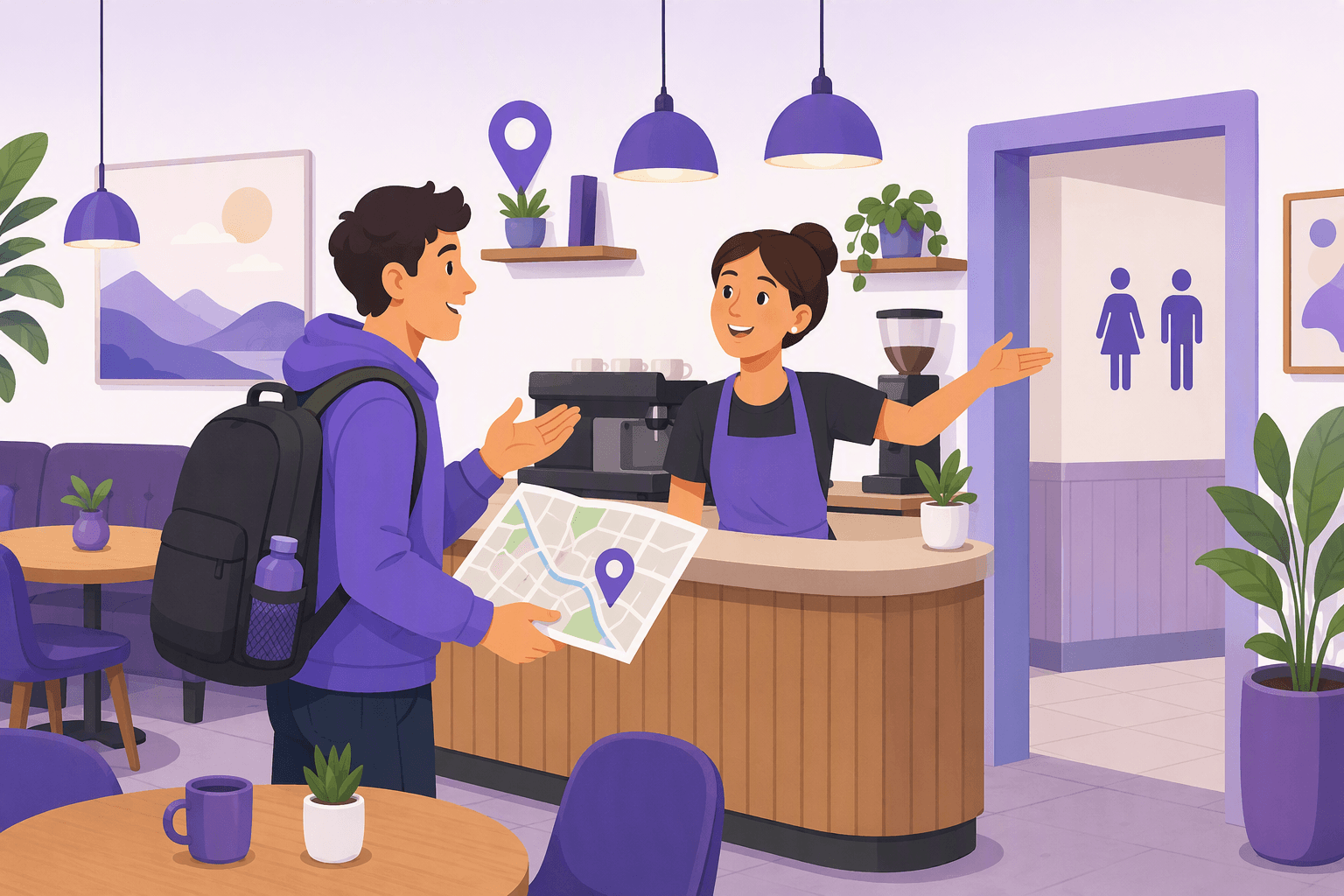
The one phrase to memorize
¿Dónde está el baño?
¿Dónde está el baño? /ˈdonde esˈta el ˈbaɲo/ is the phrase to memorize first. Literally, it asks where the bathroom is.
The question has three useful parts:
- dónde /ˈdonde/ means where
- está /esˈta/ means is or is located
- el baño /el ˈbaɲo/ means the bathroom
Spanish uses estar /esˈtar/, rather than ser /ser/, for physical location. That same grammar appears in ¿Dónde está la estación? /ˈdonde esˈta la estaˈsjon/, meaning where is the station?
The Real Academia Española and the Asociación de Academias de la Lengua Española describe baño /ˈbaɲo/ as both the act or place of bathing and, in everyday use, a room with sanitary facilities. In practical travel Spanish, it is the reliable general term.
/DOHN-deh es-TAH el BAHN-yoh/
Literal meaning: Where is the bathroom?
“Perdón, ¿dónde está el baño?”
Excuse me, where is the bathroom?
The safest all-purpose question in Spanish. Use it in public places, restaurants, hotels, and homes.
Make the question polite
Disculpe
Use disculpe /disˈkulpe/ before your question when speaking to a stranger, employee, server, receptionist, or older person. It is the singular polite form, based on usted /usˈted/.
Disculpe, ¿dónde está el baño? /disˈkulpe ˈdonde esˈta el ˈbaɲo/ is warm, direct, and appropriate in nearly every setting. You do not need elaborate wording when you urgently need a restroom.
If you are interrupting several people, use disculpen /disˈkulpen/. In a busy café, you might say Disculpen, ¿dónde están los servicios? /disˈkulpen ˈdonde esˈtan los seɾˈβisjos/.
Perdón
Perdón /peɾˈdon/ also means excuse me or sorry. It is slightly shorter and extremely common when you need to get someone’s attention.
Say Perdón, ¿el baño? /peɾˈdon el ˈbaɲo/ if the situation is urgent. This abbreviated question is natural in conversation, especially when you are already standing near a counter or speaking with staff.
/dees-KOOL-peh, DOHN-deh es-TAH el BAHN-yoh/
Literal meaning: Excuse me, where is the bathroom?
“Disculpe, ¿dónde está el baño más cercano?”
Excuse me, where is the nearest bathroom?
Use disculpe with staff and strangers. It works across Latin America and Spain without sounding stiff.
Por favor
Add por favor /poɾ faˈβoɾ/ when you want a clearly polite request: ¿Dónde está el baño, por favor? /ˈdonde esˈta el ˈbaɲo poɾ faˈβoɾ/.
In Spanish, politeness is not only about the words you choose. A greeting, calm tone, and a brief gracias /ˈɡɾasjas/ afterward often matter more than making the sentence long.
Linguist Penelope Brown and anthropologist Stephen Levinson’s work on politeness explains why small softeners such as apologies and courteous requests support social interaction. In Spanish, disculpe /disˈkulpe/ and por favor /poɾ faˈβoɾ/ do that work without making your request unnatural.
When you need permission
¿Puedo usar el baño?
Use ¿Puedo usar el baño? /ˈpwedo uˈsaɾ el ˈbaɲo/ when the bathroom is not obviously public. It means can I use the bathroom?
This is the right phrase in someone’s home, a small shop, a private office, or a café that keeps its restroom behind a staff-only door. Asking ¿Dónde está el baño? /ˈdonde esˈta el ˈbaɲo/ assumes one is available to customers, while ¿Puedo usar el baño? /ˈpwedo uˈsaɾ el ˈbaɲo/ asks permission.
/PWEH-doh oo-SAR el BAHN-yoh/
Literal meaning: Can I use the bathroom?
“¿Puedo usar el baño, por favor?”
Can I use the bathroom, please?
Best for homes, small businesses, and places where restroom access may be restricted to customers.
¿Me presta el baño?
In several Latin American countries, you may hear ¿Me presta el baño? /me ˈpɾesta el ˈbaɲo/. Literally, it means will you lend me the bathroom?
English speakers may find that phrasing unusual, but it is a conventional and polite request in parts of Mexico, Central America, Colombia, and elsewhere. Use it mainly after hearing locals use it, or stick to ¿Puedo usar el baño? /ˈpwedo uˈsaɾ el ˈbaɲo/, which travels more easily.
Necesito ir al baño
Necesito ir al baño /neseˈsito iɾ al ˈbaɲo/ means I need to go to the bathroom. It is useful when explaining why you must leave, asking a guide to stop, or speaking with someone who is helping you.
For example: Necesito ir al baño, ¿hay uno cerca? /neseˈsito iɾ al ˈbaɲo ai ˈuno ˈseɾka/. This means I need to go to the bathroom, is there one nearby?
Bathroom words by country and setting
baño
Baño /ˈbaɲo/ is universally safe. It is the default word in Mexico, Central America, much of South America, and Spanish-speaking communities in the United States.
On a sign, you may see baños /ˈbaɲos/, the plural form. It often labels a restroom area with separate facilities for different users.
servicios
In Spain, los servicios /los seɾˈβisjos/ is a common public-restroom term. You may see it in bars, stations, restaurants, and shopping centers.
Ask ¿Dónde están los servicios? /ˈdonde esˈtan los seɾˈβisjos/ when you are in Spain. The plural verb están /esˈtan/ matches the plural noun servicios /seɾˈβisjos/.
aseo
Aseo /aˈseo/ is another common word in Spain, especially on signs and in formal or public contexts. It can mean toilet, washroom, or wash area.
¿Dónde está el aseo? /ˈdonde esˈta el aˈseo/ is entirely natural in Spain. It may sound more formal or regional in Latin America, but it will usually be understood.
sanitario
Sanitario /saniˈtaɾjo/ is common in Mexico and appears on signs in airports, malls, schools, and public buildings. You may see sanitarios /saniˈtaɾjos/ for restrooms.
You can ask ¿Dónde están los sanitarios? /ˈdonde esˈtan los saniˈtaɾjos/, though baño /ˈbaɲo/ is more conversational. The Diccionario de la lengua española records sanitario /saniˈtaɾjo/ as a term connected with hygiene and sanitary facilities.
el WC
You may encounter el WC /ele ˈuβe ˈθe/ in Spain, particularly on signs. It comes from the English abbreviation for water closet, but Spanish speakers pronounce the letters in Spanish.
Do not worry if you cannot say it. ¿Dónde está el baño? /ˈdonde esˈta el ˈbaɲo/ remains clearer for most learners.
🌍 Do not rely only on 'toilet'
In everyday Spanish, asking for el baño is more natural than trying to translate toilet word for word. The term inodoro /inoˈdoɾo/ usually refers to the toilet fixture itself, not the whole room. Ask for the baño, aseo, servicios, or sanitarios instead.
What to say in restaurants, bars, and cafés
A restaurant is where learners often need this phrase first. After you sit down, a simple Perdón, ¿dónde está el baño? /peɾˈdon ˈdonde esˈta el ˈbaɲo/ is enough.
In Spain, some cafés reserve restrooms for customers. Buying a coffee or small item before asking can be the smoothest approach, especially in busy central areas. In much of Latin America, restroom access practices vary just as much by venue as by country.
When you receive directions, listen for these useful words:
| English | Spanish | Pronunciation | Note |
|---|---|---|---|
| straight ahead | todo recto | TOH-doh REHK-toh | Often used when giving walking directions. |
| to the right | a la derecha | ah lah deh-REH-chah | Derecha means right. |
| to the left | a la izquierda | ah lah ees-KYEHR-dah | Izquierda means left. |
| at the end | al fondo | al FOHN-doh | Common for the back of a building or corridor. |
| upstairs | arriba | ah-RREE-bah | Can mean upstairs or up. |
| downstairs | abajo | ah-BAH-hoh | Can mean downstairs or down. |
For example, Al fondo, a la derecha /al ˈfondo a la deˈɾetʃa/ means at the back, on the right. Está abajo /esˈta aˈβaxo/ means it is downstairs.
If you miss the answer, use ¿Puede repetir, por favor? /ˈpwede repeˈtiɾ poɾ faˈβoɾ/, meaning can you repeat, please? Learn more options in our guide to asking someone to repeat themselves in Spanish.
Gendered signs and accessible facilities
You may see mujeres /muˈxeɾes/ for women and hombres /ˈombɾes/ for men on restroom doors. Some venues use icons rather than words, while others use damas /ˈdamas/ and caballeros /kaβaˈʝeɾos/, which are more formal labels.
For an accessible restroom, ask ¿Hay un baño accesible? /ai un ˈbaɲo akseˈsiβle/. In some places, you may see baño adaptado /ˈbaɲo aðapˈtado/ on signage.
If you need baby-changing facilities, ask ¿Hay cambiador para bebés? /ai kambjaˈdoɾ paɾa beˈβes/. Not every location has one, so this direct question is useful in airports, malls, and larger restaurants.
🌍 Regional variation is normal
Francisco Moreno Fernández’s work on Spanish varieties emphasizes that Spanish is a pluricentric language: there is no single everyday vocabulary shared in exactly the same way everywhere. Bathroom terms are a practical example. Learn baño first, then notice local words on signs and repeat the term people around you use.
Common mistakes to avoid
¿Dónde es el baño?
Avoid ¿Dónde es el baño? /ˈdonde es el ˈbaɲo/. English uses is for both identity and location, but Spanish distinguishes ser /seɾ/ from estar /esˈtaɾ/.
Use está /esˈta/ for location: ¿Dónde está el baño? /ˈdonde esˈta el ˈbaɲo/. The same pattern applies to a hotel, exit, pharmacy, and train platform.
Quiero el baño
Quiero el baño /ˈkjeɾo el ˈbaɲo/ literally means I want the bathroom. It can sound abrupt because it states a desire without making a question or request.
Say ¿Puedo usar el baño? /ˈpwedo uˈsaɾ el ˈbaɲo/ or ¿Dónde está el baño? /ˈdonde esˈta el ˈbaɲo/ instead. Clear grammar makes the interaction easier for everyone.
El inodoro
Inodoro /inoˈdoɾo/ is not wrong, but it normally names the toilet itself. Asking ¿Dónde está el inodoro? /ˈdonde esˈta el inoˈdoɾo/ may sound overly literal or clinical.
Keep baño /ˈbaɲo/ as your default. It is what you will hear in everyday dialogue, including in Spanish-language films and series.
Practice with realistic mini-dialogues
At a restaurant:
Tú: Disculpe, ¿dónde está el baño? /disˈkulpe ˈdonde esˈta el ˈbaɲo/
Camarero: Al fondo, a la izquierda. /al ˈfondo a la isˈkjeɾða/
Tú: Muchas gracias. /ˈmutʃas ˈɡɾasjas/
At a private home:
Tú: ¿Puedo usar el baño, por favor? /ˈpwedo uˈsaɾ el ˈbaɲo poɾ faˈβoɾ/
Anfitrión: Claro, está arriba. /ˈklaɾo esˈta aˈriβa/
Tú: Gracias. /ˈɡɾasjas/
At a train station in Spain:
Tú: Perdón, ¿dónde están los servicios? /peɾˈdon ˈdonde esˈtan los seɾˈβisjos/
Empleado: En la planta baja. /en la ˈplanta ˈβaxa/
Tú: Perfecto, gracias. /peɾˈfekto ˈɡɾasjas/
A fast memory plan
Memorize one full sentence: Disculpe, ¿dónde está el baño? /disˈkulpe ˈdonde esˈta el ˈbaɲo/. Then learn the response words derecha /deˈɾetʃa/, izquierda /isˈkjeɾða/, arriba /aˈriβa/, and abajo /aˈβaxo/.
Watch for the phrase in real scenes rather than practicing it only as an isolated translation. A waiter pointing toward a corridor, a traveler asking at a station, or a character entering a café gives the phrase a setting, gesture, and emotional cue that make it easier to remember.
Once you have asked, finish warmly with gracias /ˈɡɾasjas/. When you leave the venue, use one of these natural ways to say goodbye in Spanish. Small interactions like this are exactly where practical Spanish becomes usable.
Frequently Asked Questions
How do you say where is the bathroom in Spanish?
Is baño the same as toilet in Spanish?
What do people in Mexico call a bathroom?
What is restroom in Spain Spanish?
How do I ask for a bathroom politely in Spanish?
Sources & References
- Instituto Cervantes, El español: una lengua viva, 2024
- Real Academia Española and Asociación de Academias de la Lengua Española, Diccionario de la lengua española, accessed 2026
- Real Academia Española and Asociación de Academias de la Lengua Española, Nueva gramática de la lengua española
- Francisco Moreno Fernández, Variedades de la lengua española, Routledge
- FundéuRAE, recomendaciones lingüísticas, accessed 2026
Start learning with Wordy
Watch real movie clips and build your vocabulary as you go. Free to download.


