Quick Answer
Summer in Spanish is verano. Learn practical Spanish summer vocabulary for hot weather, beach days, travel, food, holidays, and everyday conversations, with pronunciation and cultural notes for Spain and Latin America.
Summer in Spanish is el verano /el βeˈɾano/. To talk naturally about it, learn words for heat, beaches, vacations, summer food, and the different ways people spend the season across Spain and Latin America. A simple sentence such as En verano hace mucho calor /em beˈɾano ˈase ˈmutʃo kaˈloɾ/ means “In summer, it is very hot.”
Spanish is spoken by more than 600 million potential speakers worldwide, according to the Instituto Cervantes. That reach matters for summer vocabulary: the season arrives in June in Spain and Mexico, but in December in Argentina, Chile, and Uruguay. The words below travel well, while regional notes help you sound more aware of local usage.
If you are starting with basic conversation, pair these words with our guide to saying hello in Spanish. A greeting and a weather comment are one of the easiest ways to begin a real conversation.
| English | Spanish | Pronunciation | Note |
|---|---|---|---|
| summer | el verano | el beh-RAH-noh | The standard word for the summer season. |
| sun | el sol | el sohl | Masculine noun. |
| heat | el calor | el kah-LOR | Used in Hace calor, meaning it is hot. |
| hot weather | el tiempo caluroso | el TYEHM-poh kah-loo-ROH-soh | Describes a hot period or climate. |
| heatwave | la ola de calor | lah OH-lah deh kah-LOR | Common in weather reports. |
| shade | la sombra | lah SOHM-brah | Useful when escaping the sun. |
| sunshine | el sol | el sohl | Spanish often uses sol for both sun and sunshine. |
| sunset | la puesta de sol | lah PWEHS-tah deh sohl | Literally a setting of the sun. |
| sunrise | el amanecer | el ah-mah-neh-SER | Also means dawn. |
| storm | la tormenta | lah tor-MEHN-tah | Summer storms can be brief and intense. |
| humidity | la humedad | lah oo-meh-DAHD | Often used with mucha, meaning a lot of. |
| to get tan | broncearse | brohn-seh-AHR-seh | Reflexive verb. |
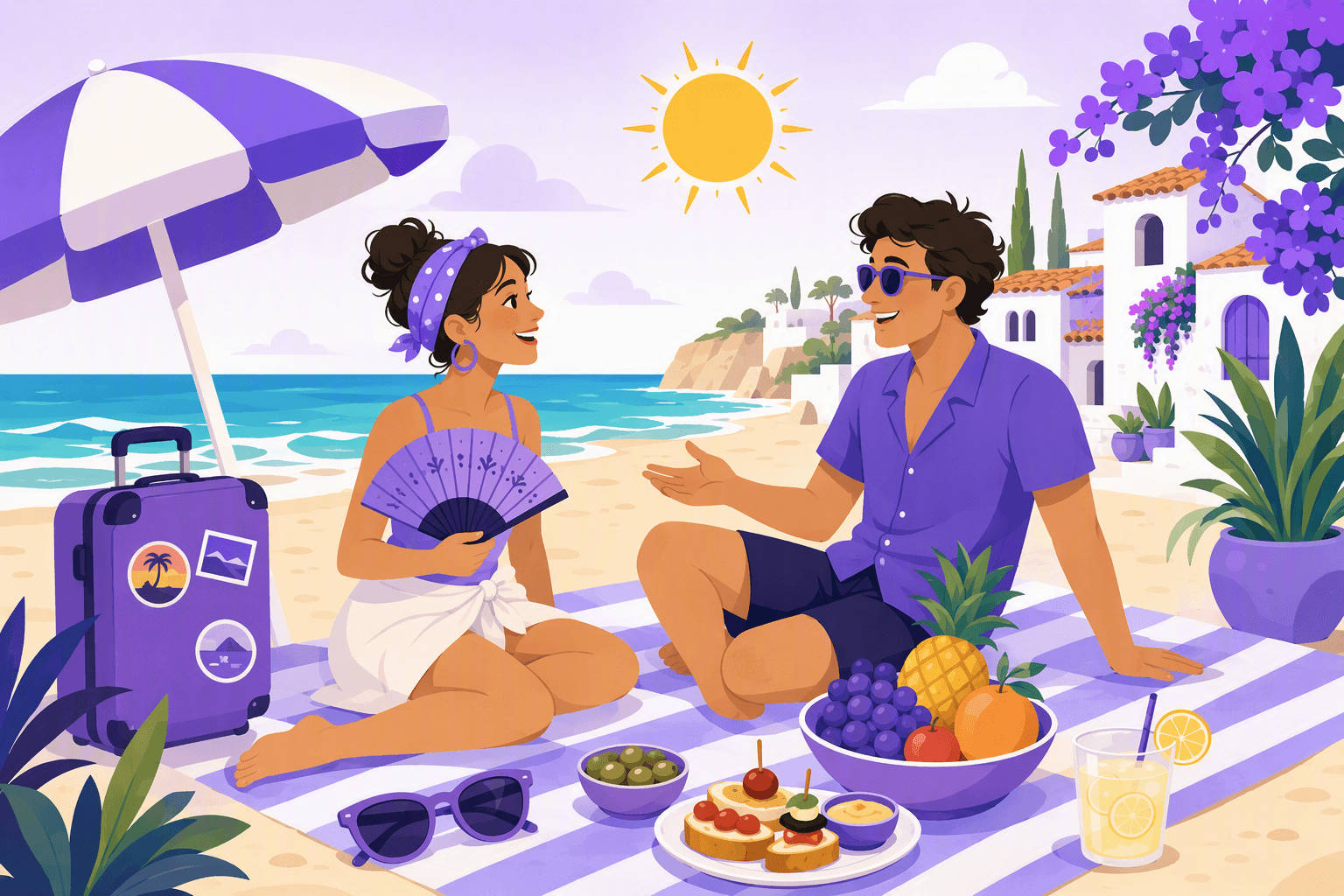
Essential sentences for summer weather
The central weather phrase is Hace calor /ˈase kaˈloɾ/, literally “It makes heat.” Spanish does not usually say the direct equivalent of “the weather is hot” in everyday speech. Use Hace frío /ˈase ˈfɾio/ for cold weather and Hace buen tiempo /ˈase βwen ˈtjempo/ when the weather is pleasant.
For more intensity, add mucho /ˈmutʃo/: Hace mucho calor /ˈase ˈmutʃo kaˈloɾ/. You may hear Qué calor hace /ke kaˈloɾ ˈase/ when someone reacts to a hot day, often with an exclamation in speech.
The Real Academia Española records verano /beˈɾano/ as the warmest season of the year. But climate changes the daily reality considerably: a dry August afternoon in Madrid feels different from a humid summer day in Havana, Cartagena, or Buenos Aires.
El verano /el βeˈɾano/
Verano /beˈɾano/ is a masculine noun, so it takes el /el/: el verano /el βeˈɾano/. To say “in summer,” use en verano /em beˈɾano/, without an article.
- Me gusta el verano. /me ˈɣusta el βeˈɾano/ means “I like summer.”
- En verano vamos a la playa. /em beˈɾano ˈbamos a la ˈplaʝa/ means “In summer, we go to the beach.”
- El verano pasado fui a México. /el βeˈɾano paˈsaðo fwi a ˈmexiko/ means “Last summer I went to Mexico.”
Notice that pasado /paˈsaðo/ agrees with verano /beˈɾano/, so it ends in masculine -o. For a fuller explanation of seasonal weather phrases and Spanish sentence patterns, practice them in short clips and real conversations rather than memorizing isolated lists.
Beach vocabulary in Spanish
A beach day is one of the most useful summer topics, whether you are visiting the Mediterranean coast, the Caribbean, the Pacific, or a lake. The common word for beach is la playa /la ˈplaʝa/, but a few object names change by country.
For example, sombrilla /somˈbɾiʝa/ often means a beach umbrella in Spain. In parts of Latin America, people may simply say parasol /paɾaˈsol/ or use another regional term. Francisco Moreno Fernández’s work on varieties of Spanish highlights this basic fact of the language: shared grammar does not erase regional vocabulary.
| English | Spanish | Pronunciation | Note |
|---|---|---|---|
| beach | la playa | lah PLAH-yah | The most common word for beach. |
| sand | la arena | lah ah-REH-nah | Feminine noun. |
| sea | el mar | el mahr | Usually masculine, though feminine use exists in poetic language. |
| wave | la ola | lah OH-lah | Useful in surf and swimming contexts. |
| coast | la costa | lah KOHS-tah | A coastal area or shoreline. |
| island | la isla | lah EES-lah | The initial s is pronounced. |
| beach umbrella | la sombrilla | lah sohm-BREE-yah | Especially common in Spain. |
| towel | la toalla | lah toh-AH-yah | The ll sounds like y in most regions. |
| swimsuit | el traje de baño | el TRAH-heh deh BAHN-yoh | A broad, neutral term. |
| flip-flops | las chanclas | lahs CHAHN-klahs | Common in Spain and many Latin American regions. |
| sunscreen | el protector solar | el proh-tek-TOR soh-LAHR | Also called bloqueador solar in many countries. |
| to swim | nadar | nah-DAHR | Verb meaning to swim. |
| to sunbathe | tomar el sol | toh-MAHR el sohl | Literally to take the sun. |
La playa /la ˈplaʝa/
At the beach, Voy a tomar el sol /boi a toˈmaɾ el sol/ means “I’m going to sunbathe.” Voy a nadar /boi a naˈðaɾ/ means “I’m going to swim.”
Use Ponerse protector solar /poˈneɾse pɾotekˈtoɾ soˈlaɾ/ for “to put on sunscreen.” The reflexive verb ponerse /poˈneɾse/ is useful here because the action is done to yourself.
💡 A useful beach question
Ask ¿Podemos alquilar una sombrilla? /poˈðemos alkiˈlaɾ una somˈbɾiʝa/ to ask whether you can rent a beach umbrella. In some places, alquilar /alkiˈlaɾ/ may be replaced by rentar /renˈtaɾ/, especially in Mexico and parts of Central America.
Summer travel and vacation words
Las vacaciones /las βakaˈsjones/ means “vacation” or “holidays,” and it is normally plural in Spanish. A person can say Estoy de vacaciones /esˈtoi de βakaˈsjones/, meaning “I’m on vacation.”
In Spain, the late-July and August holiday period can reshape city life, with offices quieter and coastal towns far busier. In many Latin American countries, school vacations occur at different times, especially south of the Equator. That is why asking about local schedules is more useful than assuming a Northern Hemisphere calendar.
| English | Spanish | Pronunciation | Note |
|---|---|---|---|
| vacation | las vacaciones | lahs bah-kah-SYOH-nehs | Usually plural in Spanish. |
| trip | el viaje | el BYAH-heh | A trip or journey. |
| tourist | el turista | el too-REES-tah | Can refer to a man or woman, article changes with gender. |
| hotel | el hotel | el oh-TEL | Stress falls on the final syllable. |
| reservation | la reserva | lah reh-SEHR-bah | For hotels, restaurants, and tickets. |
| suitcase | la maleta | lah mah-LEH-tah | Common across the Spanish-speaking world. |
| passport | el pasaporte | el pah-sah-POR-teh | Essential travel document. |
| flight | el vuelo | el BWEH-loh | From the verb volar, to fly. |
| airport | el aeropuerto | el ah-eh-roh-PWEHR-toh | Stress on PWEHR. |
| to travel | viajar | byah-HAHR | Regular -ar verb. |
| to pack | hacer la maleta | ah-SER lah mah-LEH-tah | Literally to make the suitcase. |
| to relax | relajarse | reh-lah-HAR-seh | Reflexive verb. |
Las vacaciones /las βakaˈsjones/
A reliable travel phrase is Quiero hacer una reserva /ˈkjeɾo aˈseɾ una reˈseɾβa/, meaning “I want to make a reservation.” At a hotel, say Tengo una reserva a nombre de... /ˈteŋɡo una reˈseɾβa a ˈnombɾe de/, “I have a reservation under the name of...”
For airport phrases, study our practical guide to travel phrases in Spanish. It covers the vocabulary you need when a summer trip involves tickets, documents, directions, and unexpected changes.
🌍 Summer means different things across the Spanish-speaking world
In Spain, verano /beˈɾano/ often brings late dinners, outdoor festivals, village celebrations, and crowded coasts. In Argentina and Uruguay, the same word refers to December through February, when families may head to Atlantic beaches during the end-of-year holiday period. Spanish vocabulary stays largely shared, but the calendar and cultural rhythm do not.
Summer food and drinks in Spanish
Food vocabulary makes conversations more social. A summer meal may involve cold dishes, grilled food, fruit, ice cream, or a drink shared outdoors. Do not assume that one dish represents every Spanish-speaking place: gazpacho /ɡaθˈpatʃo/ is strongly associated with southern Spain, while Caribbean and Latin American summer tables follow their own regional traditions.
Claire Kramsch’s Language and Culture emphasizes that language learning includes knowing how words fit social practices. Learning la sobremesa /la soβɾeˈmesa/, for example, gives you more than a translation: it names the unhurried conversation that can follow a meal in Spain and elsewhere.
| English | Spanish | Pronunciation | Note |
|---|---|---|---|
| ice cream | el helado | el eh-LAH-doh | Also means frozen or cold as an adjective. |
| ice | el hielo | el HYEH-loh | Useful when ordering drinks. |
| cold drink | la bebida fría | lah beh-BEE-dah FREE-ah | Fría agrees with bebida. |
| water | el agua | el AH-gwah | Uses el in singular but remains feminine. |
| lemonade | la limonada | lah lee-moh-NAH-dah | A refreshing non-alcoholic option. |
| fruit | la fruta | lah FROO-tah | Often used in the singular as a collective noun. |
| watermelon | la sandía | lah sahn-DEE-ah | A classic summer fruit. |
| melon | el melón | el meh-LON | Accent marks final stress. |
| barbecue | la barbacoa | lah bahr-bah-KOH-ah | Common for a cookout or grilled meal. |
| gazpacho | el gazpacho | el gahs-PAH-choh | A chilled soup strongly associated with Spain. |
| to toast | brindar | breen-DAHR | Used for making a toast. |
| cheers | ¡Salud! | sah-LOOD | Used when making a toast. |
La sandía /la sanˈdi.a/
La sandía /sanˈdi.a/ is watermelon, while el melón /meˈlon/ is melon. At a market, you can ask ¿Tiene sandía fresca? /ˈtj̯ene sanˈdi.a ˈfɾeska/, meaning “Do you have fresh watermelon?”
For a cold drink, say Quisiera una bebida fría, por favor /kiˈsjera una beˈβiða ˈfɾi.a poɾ faˈβoɾ/. The conditional quisiera /kiˈsjera/ is a polite way to order, especially at cafés and restaurants.
Activities and summer social life
Summer vocabulary is not only about objects. Verbs let you describe actual plans: swimming, hiking, camping, dancing, going out, and spending time with friends. These are the words you will hear in invitations, text messages, and casual conversations.
| English | Spanish | Pronunciation | Note |
|---|---|---|---|
| to go out | salir | sah-LEER | Used for going out socially. |
| to go for a walk | pasear | pah-seh-AHR | A relaxed walk or stroll. |
| to hike | hacer senderismo | ah-SER sehn-deh-REES-moh | Literally to do hiking. |
| to camp | acampar | ah-kahm-PAHR | Regular -ar verb. |
| campground | el camping | el KAHM-peeng | A common borrowed word in Spain. |
| festival | el festival | el fehs-tee-BAHL | Same spelling as English, different stress. |
| fireworks | los fuegos artificiales | lohs FWEH-gohs ahr-tee-fee-SYAH-lehs | Common during public celebrations. |
| to dance | bailar | bahy-LAHR | Regular -ar verb. |
| to meet up | quedar | keh-DAHR | Especially common in Spain for arranging plans. |
| friend group | el grupo de amigos | el GROO-poh deh ah-MEE-gohs | Useful for casual plans. |
Salir /saˈliɾ/
Salir /saˈliɾ/ means “to go out.” You might hear ¿Salimos esta noche? /saˈlimos ˈesta ˈnotʃe/, meaning “Shall we go out tonight?”
In Spain, quedar /keˈðaɾ/ often means to arrange to meet someone: He quedado con mis amigos /e keˈðaðo kom mis aˈmiɣos/, “I’ve arranged to meet my friends.” In many Latin American regions, quedar /keˈðaɾ/ is understood, but verse /ˈbeɾse/ or juntarse /xunˈtaɾse/ may be more natural.
If you are ending plans or a summer conversation, use the phrases in our guide to saying goodbye in Spanish. A relaxed Nos vemos /nos ˈbemos/, “See you,” is ideal after arranging another beach day or evening out.
A practical way to remember summer Spanish
Learn vocabulary in small scenes instead of alphabetically. Picture yourself leaving a hotel, walking across hot sand, ordering a cold drink, and meeting friends for dinner. Each scene creates useful connections between nouns, verbs, and phrases.
Try this five-sentence practice routine:
- En verano hace mucho calor. /em beˈɾano ˈase ˈmutʃo kaˈloɾ/
- Voy a la playa con mis amigos. /boi a la ˈplaʝa kom mis aˈmiɣos/
- Necesito una sombrilla y protector solar. /neseˈsito una somˈbɾiʝa i pɾotekˈtoɾ soˈlaɾ/
- Quiero un helado y una limonada. /ˈkjeɾo un eˈlaðo i una limoˈnaða/
- Esta noche vamos a salir. /ˈesta ˈnotʃe ˈbamos a saˈliɾ/
Watch for these words in Spanish films, series, travel videos, and songs. Hearing hace calor /ˈase kaˈloɾ/ in a real scene will make it easier to retrieve than seeing it only on a flashcard.
For warmer and more personal conversation, you can also learn how to say I love you in Spanish. Summer vocabulary gives you the setting, while everyday phrases help you participate in the moment.
Frequently Asked Questions
What is summer in Spanish?
How do you say summer vacation in Spanish?
What Spanish words do I need for a beach vacation?
How do Spanish speakers describe hot weather?
Is summer the same season in all Spanish-speaking countries?
Sources & References
- Instituto Cervantes, El español: una lengua viva, 2024
- Real Academia Española, Diccionario de la lengua española, accessed 2026
- FundéuRAE, Recomendaciones lingüísticas sobre el verano, accessed 2026
- Francisco Moreno Fernández, Variedades de la lengua española, Routledge
- Claire Kramsch, Language and Culture, Oxford University Press
Start learning with Wordy
Watch real movie clips and build your vocabulary as you go. Free to download.


