Quick Answer
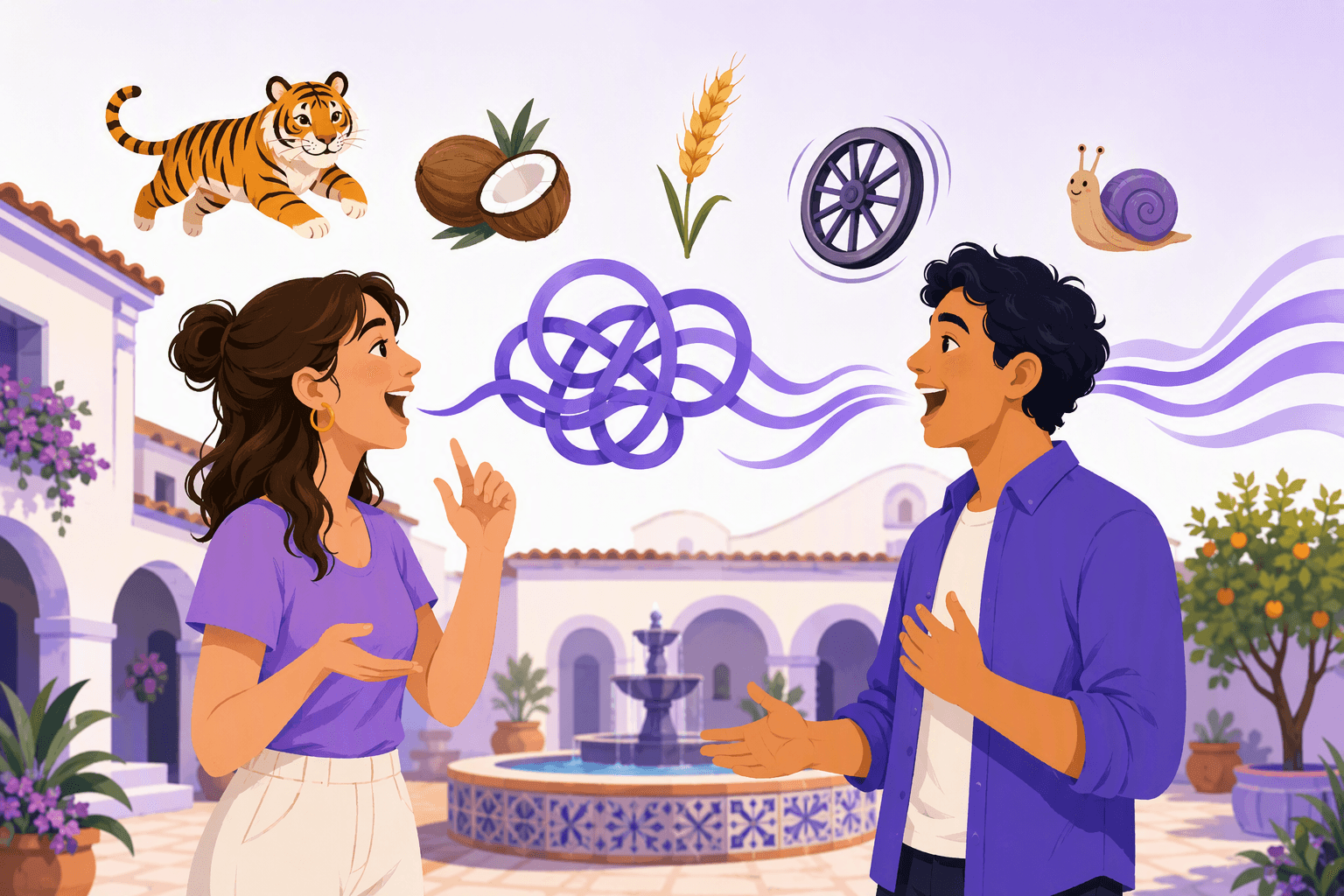
Spanish tongue twisters are called trabalenguas (trah-bah-LENG-gwahs). They are short, rhythmic phrases designed to challenge pronunciation, especially Spanish sounds like rolled R, trilled RR, and quick syllable changes. Practicing them improves articulation, listening, and accent control in a fun, memorable way.
Spanish tongue twisters are called trabalenguas (trah-bah-LENG-gwahs), and they are one of the fastest, most enjoyable ways to improve Spanish pronunciation because they train your mouth to produce real Spanish sound patterns at speed, especially R, RR, and tricky consonant clusters.
| English | Spanish | Pronunciation | Formality |
|---|---|---|---|
| Tongue twister | trabalenguas | trah-bah-LENG-gwahs | casual |
| Say it slowly | Dilo despacio | DEE-loh dehs-PAH-syoh | polite |
| Again | Otra vez | OH-trah behs | casual |
| Faster | Más rápido | mahs RAH-pee-doh | casual |
| I got stuck | Me trabé | meh trah-BEH | casual |
| Let's practice | Vamos a practicar | VAH-mohs ah prahk-tee-KAHR | polite |
Why trabalenguas work (and why Spanish is perfect for them)
Spanish is spoken across 20 countries as an official language, plus large communities worldwide. Instituto Cervantes estimates over 500 million native speakers, and Ethnologue ranks Spanish among the most widely spoken languages by total speakers.
Tongue twisters work because pronunciation is a motor skill, not just knowledge. You can understand a rule like "RR is trilled" and still be unable to do it quickly in conversation.
"Fluent speech depends on highly practiced routines that translate linguistic plans into coordinated movements."
Willem J. M. Levelt, psycholinguist, Speaking: From Intention to Articulation (1989)
That is exactly what a trabalenguas gives you: a repeatable routine that forces coordination. If you are building your accent through authentic dialogue, pair this with our Spanish pronunciation guide for the sound system behind what you are practicing.
How to practice Spanish tongue twisters correctly
Step 1: Choose one sound target
Do not treat a trabalenguas like a party trick. Pick one that trains a specific sound: RR, R vs RR, S, LL/Y, or consonant clusters like tr, pr, and br.
This keeps practice measurable. You should know what you are trying to improve before you start.
Step 2: Use a slow-to-fast ladder
Say it at three speeds:
- Slow: perfect clarity, full vowels
- Medium: natural rhythm
- Fast: only after accuracy is stable
If you rush early, you train mistakes. Your mouth learns whatever you repeat.
Step 3: Record yourself for 20 seconds
Your brain auto-corrects what you think you said. Recording reveals whether your RR is actually trilling, whether vowels are collapsing, and whether you are dropping consonants.
Try one recording at the start of the week and one at the end. The difference is usually bigger than you expect.
💡 A simple rule that prevents frustration
If you stumble, do not restart from the beginning. Restart from the last clean word and continue. This keeps practice focused on the hard transition, not on repeating the easy part.
Step 4: Match the accent you are learning
Spanish has real regional variation in pronunciation. In much of Spain, many speakers have distinción, pronouncing "c" (before e/i) and "z" with a "th" sound, while most of Latin America uses seseo, pronouncing them like "s" (Moreno Fernández, 2020).
Pick one model and stick with it for a month. Consistency builds muscle memory faster than switching accents daily.
For polite everyday phrases to pair with your new clarity, see how to say hello in Spanish and how to say goodbye in Spanish.
What "trabalenguas" literally means
The word trabalenguas comes from trabar (trah-BAHR), "to jam" or "to tangle," and lenguas (LEN-gwahs), "tongues." The idea is that the phrase "tangles" your tongue so you trip over sounds.
The RAE includes trabalenguas as a term for a phrase that is hard to pronounce, especially when repeated quickly (RAE DLE, accessed 2026). In other words, Spanish speakers treat it as a real category of speech play, not just a classroom exercise.
25 Spanish tongue twisters (trabalenguas) with pronunciation
These are classic trabalenguas that native speakers actually use, especially in school, theater warmups, and family games. Pronunciations are approximations in English spelling, not perfect phonetics.
Tres tristes tigres
Trabalenguas: "Tres tristes tigres tragan trigo en un trigal."
Pronunciation: trehs TREES-tehs TEE-grehs TRAH-gahn TREE-goh ehn oon tree-GAHL
What it trains: tr cluster, rolled R in "tragan/trigal", fast i vowels
Say "tr" as one unit. Do not insert an extra vowel like "tuh-r."
Pablito clavó un clavito
Trabalenguas: "Pablito clavó un clavito. ¿Qué clavito clavó Pablito?"
Pronunciation: pah-BLEE-toh klah-VOH oon klah-BEE-toh, keh klah-BEE-toh klah-VOH pah-BLEE-toh
What it trains: cl cluster, stress control, question rhythm
This one is great for learners who over-stress every syllable. Spanish stress is selective.
El cielo está enladrillado
Trabalenguas: "El cielo está enladrillado, ¿quién lo desenladrillará? El desenladrillador que lo desenladrille, buen desenladrillador será."
Pronunciation: ehl SYEH-loh ehs-TAH ehn-lah-dree-YAH-doh, kyen loh dehs-ehn-lah-dree-yah-RAH, ehl dehs-ehn-lah-dree-yah-dohR keh loh dehs-ehn-lah-DREE-yeh, bwen dehs-ehn-lah-dree-yah-DOHR seh-RAH
What it trains: LL/Y flow, long-word stamina, syllable timing
Keep vowels clear even when the word gets long. Spanish rewards steady rhythm.
Erre con erre cigarro
Trabalenguas: "Erre con erre cigarro, erre con erre barril, rápido ruedan los carros cargados de azúcar del ferrocarril."
Pronunciation: EH-rreh kohn EH-rreh see-GAH-rroh, EH-rreh kohn EH-rreh bah-RREEL, RAH-pee-doh RWEH-dahn lohs KAH-rrohs kahr-GAH-dohs deh AH-soo-kahr dehl feh-rroh-kah-RREEL
What it trains: trilled RR, R vs RR contrast, rr in different positions
If you cannot trill yet, aim for a clean single tap first. Then push for vibration on the double R.
Rápido ruedan las ruedas
Trabalenguas: "Rápido ruedan las ruedas del ferrocarril."
Pronunciation: RAH-pee-doh RWEH-dahn lahs RWEH-dahs dehl feh-rroh-kah-RREEL
What it trains: RR plus "rue" glide, speed without slurring
This is a compact RR workout. Repeat it in sets of five.
Pepe Pecas pica papas
Trabalenguas: "Pepe Pecas pica papas con un pico. Con un pico pica papas Pepe Pecas."
Pronunciation: PEH-peh PEH-kahs PEE-kah PAH-pahs kohn oon PEE-koh, kohn oon PEE-koh PEE-kah PAH-pahs PEH-peh PEH-kahs
What it trains: p and k alternation, crisp stops
Do not soften the p. Spanish p is unaspirated, meaning less "puff of air" than English.
El perro de San Roque
Trabalenguas: "El perro de San Roque no tiene rabo porque Ramón Ramírez se lo ha robado."
Pronunciation: ehl PEH-rroh deh sahn ROH-keh noh TYEH-neh RAH-boh POHR-keh rah-MOHN rah-MEE-rehs seh loh ah rroh-BAH-doh
What it trains: r sounds, sentence rhythm, linking words
Keep "porque" (POHR-keh) short. Many learners over-lengthen it.
Compadre, cómprame un coco
Trabalenguas: "Compadre, cómprame un coco. Compadre, no compro coco, porque el coco que tú compras no es coco, y el coco que yo compro es poco coco."
Pronunciation: kohm-PAH-dreh, KOM-prah-meh oon KOH-koh, kohm-PAH-dreh, noh KOM-proh KOH-koh, POHR-keh ehl KOH-koh keh too KOM-prahs noh ehs KOH-koh, ee ehl KOH-koh keh yoh KOM-proh ehs POH-koh KOH-koh
What it trains: co-ko alternation, vowel clarity, breath control
Mark commas with tiny pauses. It keeps you from racing and collapsing vowels.
Si tu gusto gustara del gusto
Trabalenguas: "Si tu gusto gustara del gusto que gusta mi gusto, mi gusto gustaría del gusto que gusta tu gusto."
Pronunciation: see too GOOS-toh goos-TAH-rah dehl GOOS-toh keh GOOS-tah mee GOOS-toh, mee GOOS-toh goos-tah-REE-ah dehl GOOS-toh keh GOOS-tah too GOOS-toh
What it trains: g and s coordination, stress placement
This is a stress drill disguised as a tongue twister. Keep the accents on gus-TAH, gus-ta-REE-ah.
Tres tristes trastos
Trabalenguas: "Tres tristes trastos tragaban trigo en un trigal."
Pronunciation: trehs TREES-tehs TRAHS-tohs trah-GAH-bahn TREE-goh ehn oon tree-GAHL
What it trains: tr plus st cluster, consonant precision
If "trastos" trips you up, isolate it: TRAS-tohs, then speed up.
El hipopótamo Hipo
Trabalenguas: "El hipopótamo Hipo está con hipo. ¿Quién le quita el hipo al hipopótamo Hipo?"
Pronunciation: ehl ee-poh-POH-tah-moh EE-poh ehs-TAH kohn EE-poh, kyen leh KEE-tah ehl EE-poh ahl ee-poh-POH-tah-moh EE-poh
What it trains: h is silent, vowel timing, question intonation
Remember: Spanish "h" is silent. Do not pronounce it like English.
Me han dicho que has dicho
Trabalenguas: "Me han dicho que has dicho un dicho. Ese dicho que te han dicho que has dicho, no lo he dicho."
Pronunciation: meh ahn DEE-choh keh ahs DEE-choh oon DEE-choh, EH-seh DEE-choh keh teh ahn DEE-choh keh ahs DEE-choh, noh loh eh DEE-choh
What it trains: d vs t clarity, linking, repeated structure
Keep "dicho" consistent. Many learners drift into "dee-shoh."
El otorrinolaringólogo
Trabalenguas: "El otorrinolaringólogo de Parangaricutirimícuaro se quiere desotorrinolaringologizar."
Pronunciation: ehl oh-toh-rree-noh-lah-reen-GOH-loh-goh deh pah-rahn-gah-ree-koo-tee-ree-MEE-kwah-roh seh KYEH-reh dehs-oh-toh-rree-noh-lah-reen-goh-loh-gee-SAR
What it trains: long-word pacing, syllable segmentation
Do it syllable by syllable first. This is a stamina test, not a speed test.
Parra tenía una perra
Trabalenguas: "Parra tenía una perra y Guerra tenía una parra. La perra de Parra subió a la parra de Guerra."
Pronunciation: PAH-rrah teh-NEE-ah OO-nah PEH-rrah ee GWEH-rrah teh-NEE-ah OO-nah PAH-rrah, lah PEH-rrah deh PAH-rrah soo-BYOH ah lah PAH-rrah deh GWEH-rrah
What it trains: rr in names, r vs rr, vowel consistency
Names are pronunciation traps because you stop paying attention. Treat them like any other word.
La bruja Maruja
Trabalenguas: "La bruja Maruja prepara un brebaje con burbujas."
Pronunciation: lah BROO-hah mah-ROO-hah preh-PAH-rah oon breh-BAH-heh kohn boor-BOO-hahs
What it trains: br cluster, j sound (like a strong h), u vowels
Spanish j is throaty, like "h" in "hat" but stronger: breh-BAH-heh.
El volcán de Parangaricutirimícuaro
Trabalenguas: "Parangaricutirimícuaro es un pueblo muy largo, y el que lo desparangaricutirimicuarice, buen desparangaricutirimicuarizador será."
Pronunciation: pah-rahn-gah-ree-koo-tee-ree-MEE-kwah-roh ehs oon PWEH-bloh moo-ee LAHR-goh, ee ehl keh loh dehs-pah-rahn-gah-ree-koo-tee-ree-mee-kwah-REE-seh, bwen dehs-pah-rahn-gah-ree-koo-tee-ree-mee-kwah-ree-sah-DOHR seh-RAH
What it trains: syllable timing, r clusters, endurance
This is common in Mexico. Treat it like a rap verse: steady beat first, speed later.
A cuestas cuesta
Trabalenguas: "A cuestas cuesta subir la cuesta, y en medio de la cuesta, cuesta mucho más."
Pronunciation: ah KWEHS-tahs KWEHS-tah soo-BEER lah KWEHS-tah, ee ehn MEH-dyoh deh lah KWEHS-tah, KWEHS-tah MOO-choh mahs
What it trains: cue/que alternation, diphthongs
Do not flatten "cues" into "kes." Keep the "weh" glide.
El rey de Constantinopla
Trabalenguas: "El rey de Constantinopla está constantinoplizado. El que lo desconstantinoplizare, buen desconstantinoplizador será."
Pronunciation: ehl ray deh kohn-stahn-tee-NOH-plah ehs-TAH kohn-stahn-tee-noh-plee-SAH-doh, ehl keh loh dehs-kohn-stahn-tee-noh-plee-SAH-reh, bwen dehs-kohn-stahn-tee-noh-plee-sah-DOHR seh-RAH
What it trains: stress consistency, long-word control
Keep the stress on NOH in -NOH-pla. Stress drift is the main failure mode here.
Cuando cuentes cuentos
Trabalenguas: "Cuando cuentes cuentos, cuenta cuántos cuentos cuentas."
Pronunciation: KWAHN-doh KWEHN-tehs KWEHN-tohs, KWEHN-tah KWAHN-tohs KWEHN-tohs KWEHN-tahs
What it trains: cue/que, nasal n, clean t
This is a clean articulation drill. It exposes sloppy t sounds fast.
Pancha plancha con cuatro planchas
Trabalenguas: "Pancha plancha con cuatro planchas. ¿Con cuántas planchas plancha Pancha?"
Pronunciation: PAHN-chah PLAHN-chah kohn KWAH-troh PLAHN-chahs, kohn KWAHN-tahs PLAHN-chahs PLAHN-chah PAHN-chah
What it trains: pl cluster, ch clarity, question rhythm
Keep "pl" tight. Do not split it into "puh-l."
El amor es una locura
Trabalenguas: "El amor es una locura que solo el cura lo cura."
Pronunciation: ehl ah-MOHR ehs OO-nah loh-KOO-rah keh SOH-loh ehl KOO-rah loh KOO-rah
What it trains: r sounds, vowel purity, rhythm
This one is short and musical. Use it as a warmup before longer drills.
El cielo se está encapotando
Trabalenguas: "El cielo se está encapotando. ¿Quién lo desencapotará? El desencapotador que lo desencapote, buen desencapotador será."
Pronunciation: ehl SYEH-loh seh ehs-TAH ehn-kah-poh-TAHN-doh, kyen loh dehs-ehn-kah-poh-tah-RAH, ehl dehs-ehn-kah-poh-tah-DOHR keh loh dehs-ehn-kah-POH-teh, bwen dehs-ehn-kah-poh-tah-DOHR seh-RAH
What it trains: k and p timing, long-word rhythm
Notice how Spanish keeps vowels stable even in long words. That is the goal.
El que poco coco come
Trabalenguas: "El que poco coco come, poco coco compra. Como poco coco come, poco coco compra."
Pronunciation: ehl keh POH-koh KOH-koh KOH-meh, POH-koh KOH-koh KOHM-prah, KOH-moh POH-koh KOH-koh KOH-meh, POH-koh KOH-koh KOHM-prah
What it trains: o vowels, k sound, repetition without drifting
This is excellent for learners who turn Spanish "o" into an English-style diphthong.
El tomate mata
Trabalenguas: "El tomate mata, y el matón mata al tomate."
Pronunciation: ehl toh-MAH-teh MAH-tah, ee ehl mah-TOHN MAH-tah ahl toh-MAH-teh
What it trains: t clarity, stress, short sentences at speed
Keep it punchy. It should sound like quick dialogue.
Trigo, trigal, triguero
Trabalenguas: "Trigo, trigal, triguero, trigal, trigo."
Pronunciation: TREE-goh, tree-GAHL, tree-GEH-roh, tree-GAHL, TREE-goh
What it trains: tr plus g, vowel consistency, clean pauses
Say each word cleanly, then remove the pauses. That is your speed ladder.
La salsa sala
Trabalenguas: "La salsa sala si la salsa es sosa."
Pronunciation: lah SAHL-sah SAH-lah see lah SAHL-sah ehs SOH-sah
What it trains: s clarity, l vs s contrast, vowel timing
If you speak a variety with aspirated or dropped final s, do one version with full s first for control.
Common pronunciation traps these twisters expose
Tongue twisters are diagnostic tools. When you trip, it usually points to one of these issues.
R vs RR confusion
Spanish has a single tap r (like in "pero") and a trill rr (like in "perro"). Many learners either trill everything or trill nothing.
Use "Erre con erre cigarro" to isolate the trill, then move to a mixed sentence like "El perro de San Roque" for contrast.
Vowel drift
Spanish vowels are stable: a, e, i, o, u. English vowels often glide, which makes Spanish sound "mushy" at speed.
Twisters with lots of "o" (coco) or "i" (trigo, trigal) force you to keep vowels pure.
Consonant cluster splitting
Clusters like tr, pr, br, cl, pl should stay together. English speakers often insert an extra vowel, turning "tr" into "tuh-r."
The "Tres tristes tigres" family is the fastest way to catch and fix this.
🌍 Why you hear trabalenguas in Spanish-speaking schools
Many Spanish-speaking classrooms use trabalenguas as quick warmups for reading aloud and public speaking. They are also common in family settings because they are easy to memorize, competitive, and funny when someone slips, which makes them sticky in cultural memory.
How to use movie and TV clips to make trabalenguas stick
A trabalenguas builds the mechanics. A clip gives you timing, emotion, and real conversational speed.
Use this three-step loop:
- Pick a clip with one target sound (RR, s, or tr).
- Shadow the clip for 30 seconds, copying rhythm and stress.
- Do a matching trabalenguas for 2 minutes, then return to the clip.
This is the same principle behind learning slang and set phrases from context. If you like that style, compare how English learners do it with English slang and how Spanish learners do it with Spanish slang.
A 10-minute daily routine (the one that actually works)
Use this structure for consistent progress without burnout:
- 2 minutes: warmup with a short twister (for example, "La salsa sala")
- 6 minutes: one main twister, slow to medium to fast ladder
- 2 minutes: record yourself once, then do one clean final take
After two weeks, rotate to a new target sound. If you want a broader plan, start at the Spanish learning page and build a simple weekly schedule around listening plus pronunciation.

⚠️ Do not chase speed at the expense of clarity
Native speakers do not sound fast because they rush consonants. They sound fast because their syllables are consistent and their stress is predictable. Train clean syllables first, then speed appears naturally.
Key takeaways
Trabalenguas are not just for fun. They are a structured way to train Spanish articulation, especially R and RR, vowels, and consonant clusters, using short phrases you can repeat daily.
Pick one target sound, practice slow to fast, record yourself, and anchor the skill in real listening. For next steps, keep your pronunciation foundation solid with our Spanish pronunciation guide.
Frequently Asked Questions
What are Spanish tongue twisters called?
Do tongue twisters actually help your Spanish accent?
Which Spanish tongue twisters are best for rolling the R?
Are trabalenguas the same in Spain and Latin America?
How long should I practice tongue twisters each day?
Sources & References
- Instituto Cervantes, El español: una lengua viva (Annual report), 2023
- Ethnologue, Spanish (27th edition), 2024
- Routledge, Moreno Fernández, Variedades de la lengua española, 2nd ed., 2020
- Cambridge University Press, Levelt, Speaking: From Intention to Articulation, 1989
- Real Academia Española (RAE), Diccionario de la lengua española (DLE), online edition, accessed 2026
Start learning with Wordy
Watch real movie clips and build your vocabulary as you go. Free to download.


