Quick Answer
To talk about sports in Spanish, learn practical phrases for cheering, discussing the score, reacting to a great play, and encouraging teammates. Spanish-speaking fans use energetic expressions such as ¡Vamos!, golazo, and ¡qué partidazo! across football stadiums, courts, and everyday conversations.
| English | Spanish | Pronunciation | Formality |
|---|---|---|---|
| Let's go! | ¡Vamos! | BAH-mohs | casual |
| What a goal! | ¡Qué golazo! | keh goh-LAH-soh | casual |
| Good luck! | ¡Mucha suerte! | MOO-chah SWEHR-teh | polite |
| Good game! | ¡Buen partido! | bwen par-TEE-doh | casual |
| Congratulations on the win! | ¡Felicidades por la victoria! | feh-lee-see-DAH-dehs por lah beek-TOH-ryah | polite |
| We can do it! | ¡Sí se puede! | see seh PWEH-deh | casual |
Spanish sports phrases help you cheer at a match, understand commentators, encourage teammates, and make friendly conversation with fans. Start with ¡Vamos! /ˈba.mos/, ¡qué golazo! /ke ɣoˈla.so/, and ¡buen partido! /bwen paɾˈti.ðo/, then build toward phrases for scores, tactics, and post-match reactions.
Spanish has more than 500 million native speakers and around 600 million potential speakers worldwide, according to Instituto Cervantes. It is official at the national level in 20 countries, so football language naturally varies, but the core expressions in this guide travel extremely well from Madrid to Mexico City, Bogotá, Buenos Aires, and beyond.
Football, called fútbol /ˈfuð.bol/ in Spanish, is the shared reference point for much sports language. FIFA reported that the Qatar 2022 World Cup engaged roughly five billion people globally, which helps explain why match commentary, chants, and football metaphors carry into daily Spanish conversation.
If you are learning for travel, start with essential Spanish travel phrases. If your goal is following films, shows, or live sports clips, these expressions give you the emotional vocabulary that subtitles often flatten.
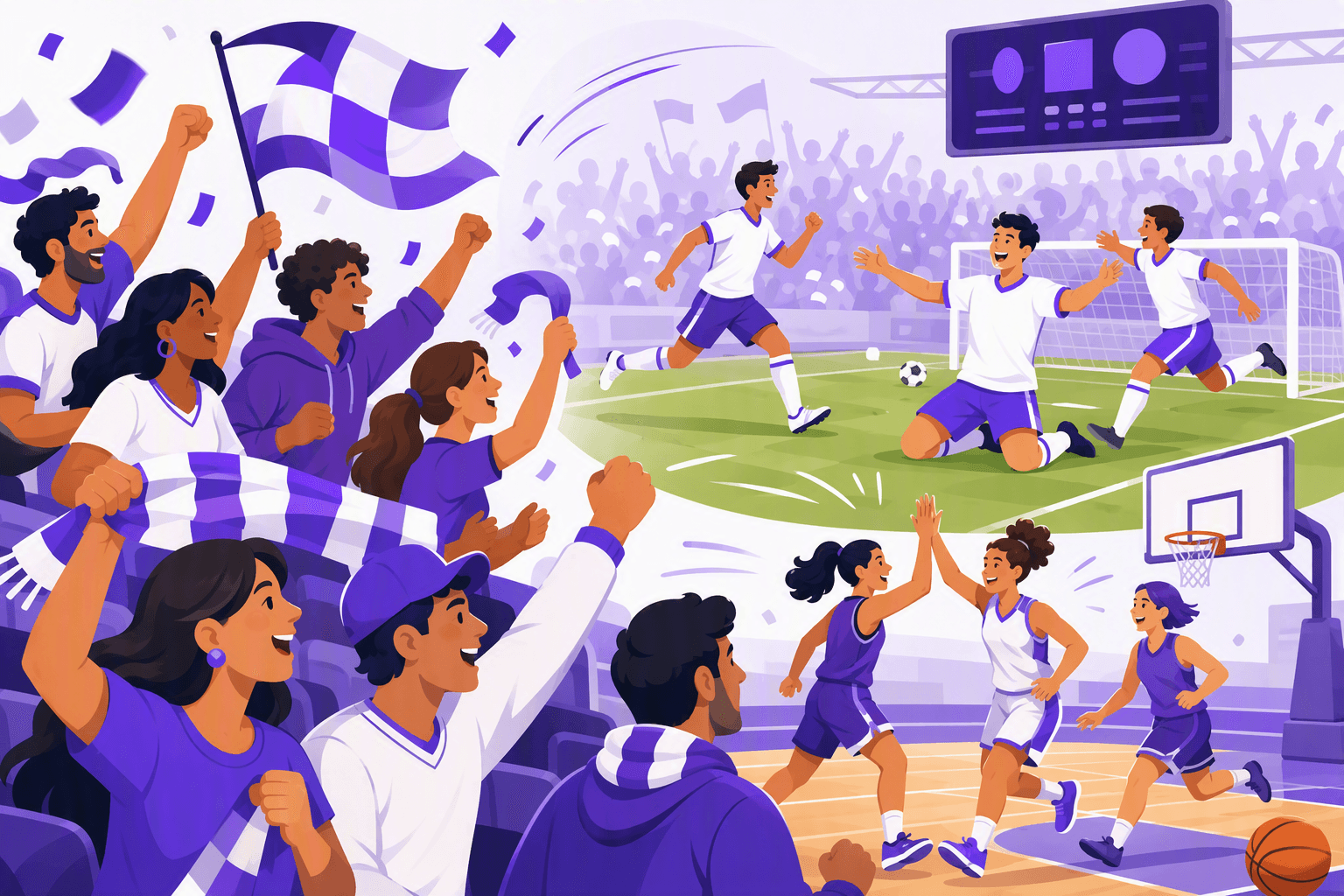
Essential Spanish sports phrases for fans
¡Vamos!
¡Vamos! /ˈba.mos/ literally means “we go,” but in sport it means “come on!” or “let’s go!” It is the phrase you will hear most often in stadiums, gyms, school matches, and living rooms during a close game.
You can shout it alone, repeat it for emphasis, or add a person or team: ¡Vamos, equipo! /ˈba.mos eˈki.po/, “Come on, team!” The tone is supportive, urgent, and energetic.
/BAH-mohs/
Literal meaning: We go
“¡Vamos, vamos! ¡Todavía podemos ganar!”
Come on, come on! We can still win!
The standard all-purpose cheer in Spanish. Use it for a friend, a team, or yourself before a challenge.
¡Qué golazo!
¡Qué golazo! /ke ɣoˈla.so/ means “What an amazing goal!” The noun gol /ɡol/ means “goal,” while the suffix -azo /ˈa.so/ makes it more powerful or impressive.
Use it for a curling shot into the top corner, a long-range strike, or any goal that makes spectators erupt. Do not use it for an ordinary tap-in unless you are clearly joking.
/keh goh-LAH-soh/
Literal meaning: What a big or great goal
“¡Qué golazo de Marta desde fuera del área!”
What a fantastic goal by Marta from outside the penalty area!
Golazo is one of the most recognizable words in Spanish-language football commentary and fan talk.
¡Sí se puede!
¡Sí se puede! /si se ˈpwe.ðe/ means “Yes, it can be done!” or “We can do it!” It is a collective chant of determination, used when a team is behind or facing a difficult opponent.
The phrase also has a wider public history in labor and political movements, especially in the United States and Latin America. In sport, its meaning is straightforward encouragement: do not give up.
/see seh PWEH-deh/
Literal meaning: Yes, it can be done
“Vamos perdiendo por uno, pero ¡sí se puede!”
We're down by one, but we can do it!
A strong group chant for a comeback. It sounds more determined than a simple ¡vamos!.
¡Dale!
¡Dale! /ˈda.le/ can mean “go for it,” “come on,” “do it,” or simply “okay,” depending on context. It is especially common in Argentina, Uruguay, and several other parts of Latin America.
At a match, ¡dale! /ˈda.le/ urges a player forward. In conversation, ¡dale! /ˈda.le/ can also accept a plan, similar to “sure” or “sounds good.”
/DAH-leh/
Literal meaning: Give it
“¡Dale, Sofía! Tú puedes meter el punto.”
Go for it, Sofía! You can score the point.
Very common in the Río de la Plata region. In neutral international Spanish, ¡vamos! is the safer choice.
¡Bien jugado!
¡Bien jugado! /bjem xuˈɣa.ðo/ means “Well played!” Say it after a smart move, a difficult point, or a match in which someone performed well, even if they lost.
The form changes when speaking directly about a woman: ¡bien jugada! /bjem xuˈɣa.ða/. In a noisy stadium, people also say the shorter ¡bien! /bjen/, “Good!”
/byen hoo-GAH-doh/
Literal meaning: Well played
“No ganamos, pero fue un partido muy bien jugado.”
We didn't win, but it was a very well-played match.
A respectful phrase after a match. It works in football, tennis, basketball, video games, and many other competitive settings.
Talking about the match
Spanish speakers often use partido /paɾˈti.ðo/ for a match or game, especially in football, basketball, tennis, and volleyball. The word juego /ˈxwe.ɣo/ also means game, but partido /paɾˈti.ðo/ is more natural when discussing a scheduled sporting contest.
Use the following sentences to keep up with a match without needing advanced tactical vocabulary:
- ¿Quién va ganando? /kjen βa ɣaˈnan.do/, “Who is winning?”
- Vamos empatados. /ˈba.mos em.paˈta.ðos/, “We are tied.”
- Van dos a uno. /ban दोस a ˈu.no/, “They are winning two to one.”
- Queda poco tiempo. /ˈke.ða ˈpo.ko ˈtjem.po/, “There is little time left.”
- Falta un minuto. /ˈfal.ta un miˈnu.to/, “One minute remains.”
- El árbitro pitó el final. /el ˈaɾ.bi.tɾo piˈto el fiˈnal/, “The referee blew the final whistle.”
- Estamos en tiempo extra. /esˈta.mos en ˈtjem.po ˈeks.tɾa/, “We are in extra time.”
- Habrá penaltis. /aˈβɾa peˈnal.tis/, “There will be a penalty shootout.”
A spelling note matters here: in Spain, the shootout is often penaltis /peˈnal.tis/, while much of Latin America also uses penales /peˈna.les/. Both are widely understood.
💡 Use the score naturally
Spanish typically says the score with the winning side first. Vamos dos a cero /ˈba.mos dos a ˈse.ɾo/ means “we are up two to zero.” For a tie, use vamos empate /ˈba.mos emˈpa.te/ or vamos uno a uno /ˈba.mos ˈu.no a ˈu.no/.
Football phrases you will hear in Spanish commentary
Está en racha
Está en racha /esˈta en ˈra.tʃa/ means “is on a streak” or “is in great form.” A player who has scored in several matches, or a team that keeps winning, can be en racha /en ˈra.tʃa/.
This phrase is useful beyond sport. Someone getting excellent grades or succeeding repeatedly at work can also be en racha /en ˈra.tʃa/.
Se la juega
Se la juega /se la ˈxwe.ɣa/ means “he or she is taking a risk” or “it all comes down to this.” It comes from jugarse /xuˈɣaɾ.se/, literally to put something at stake.
A commentator may say se la juega en este penalti /se la ˈxwe.ɣa en ˈes.te peˈnal.ti/, meaning the player’s result depends on this penalty. It can sound dramatic, which makes it common in sports broadcasts.
Está fuera de juego
Está fuera de juego /esˈta ˈfwe.ɾa ðe ˈxwe.ɣo/ means “is offside” in football. You may hear fuera de juego /ˈfwe.ɾa ðe ˈxwe.ɣo/ rather than the English loanword “offside.”
Outside football, it can figuratively mean someone is out of the loop or unable to participate. Context makes the meaning clear.
¡Qué partidazo!
¡Qué partidazo! /ke paɾ.tiˈða.so/ means “What a match!” The ending -azo /ˈa.so/ works as it does in golazo /ɣoˈla.so/: it expresses admiration and intensity.
A partidazo /paɾ.tiˈða.so/ may be a high-scoring thriller, a final between major rivals, or simply an exceptionally well-played contest. It does not have to involve football.
La afición
La afición /la afiˈsjon/ means “the fans” or “supporters,” particularly in Spain. In much of Latin America, la hinchada /la inˈtʃa.ða/ is also common, especially for a club’s organized supporters.
The Real Academia Española records both words, but their regional feel differs. Saying la afición /la afiˈsjon/ in Madrid sounds ordinary; saying la hinchada /la inˈtʃa.ða/ can evoke the more passionate, collective fan culture associated with South American football.
🌍 Football language is regional
Spanish football has shared rules but not one uniform fan vocabulary. Spain often uses portería /poɾ.teˈɾi.a/ for goalmouth, while Latin American broadcasts may favor arco /ˈaɾ.ko/. A goalkeeper can be portero /poɾˈte.ɾo/, arquero /aɾˈke.ɾo/, or guardameta /ɡwaɾ.ðaˈme.ta/. Listen for the local word rather than treating one version as universally correct.
Phrases for players and teammates
You do not need to be a professional athlete to use Spanish team language. These phrases work at a casual football game, a running club, a school tournament, or even during a cooperative video game.
- Pásame la pelota. /ˈpa.sa.me la peˈlo.ta/, “Pass me the ball.”
- Estoy libre. /esˈtoj ˈli.βɾe/, “I’m open.”
- Marca a ese jugador. /ˈmaɾ.ka a ˈe.se xu.ɣaˈðoɾ/, “Mark that player.”
- Defiende. /deˈfjen.de/, “Defend.”
- Sube. /ˈsu.βe/, “Move up.”
- Baja. /ˈba.xa/, “Drop back.”
- Cambia de lado. /ˈkam.bja ðe ˈla.ðo/, “Switch sides.”
- No te rindas. /no te ˈrin.das/, “Don’t give up.”
- Juega en equipo. /ˈxwe.ɣa en eˈki.po/, “Play as a team.”
- Buen intento. /bwen inˈten.to/, “Good try.”
The imperative can sound direct, but on a field it is normal. Tone matters more than grammar. A sharp ¡marca! /ˈmaɾ.ka/ during a fast attack is practical instruction, not necessarily rudeness.
For broader everyday interaction, learn how Spanish politeness changes between tú and usted in our guide to Spanish greetings. With teammates you know, informal tú commands are the default.
Winning, losing, and showing respect
Ganamos
Ganamos /ɣaˈna.mos/ means “we won.” Spanish often uses “we” when speaking as a fan, even if the speaker never entered the field.
That identification is central to fan talk. Someone may say ganamos tres a cero /ɣaˈna.mos tres a ˈse.ɾo/ after watching from home, because they see themselves as part of the club community.
Perdimos
Perdimos /peɾˈði.mos/ means “we lost.” It is common to soften disappointment with por poco /poɾ ˈpo.ko/, “by a little,” as in perdimos por poco /peɾˈði.mos poɾ ˈpo.ko/.
Avoid blaming someone immediately after a match if you are not close to the group. A neutral response such as bueno, será la próxima /ˈbwe.no seˈɾa la ˈpɾok.si.ma/, “Well, there will be a next time,” is safer.
Felicidades por la victoria
Felicidades por la victoria /fe.li.siˈða.des poɾ la βikˈto.ɾja/ means “Congratulations on the victory.” It is warmer and more formal than a shouted cheer, making it ideal after a tournament, race, or school competition.
The word victoria /βikˈto.ɾja/ is slightly more ceremonial than triunfo /ˈtɾjun.fo/, another word for victory. Use it when the result deserves clear recognition.
Research on Spanish varieties by Francisco Moreno Fernández shows why broad, neutral vocabulary matters for learners: Spanish is a shared language with strong regional identities. Sports language makes that diversity audible, especially in commentary and chants.
Sports metaphors in everyday Spanish
Spanish sports phrases frequently move into work, relationships, and school. Understanding this figurative language helps you follow conversations that have nothing to do with a stadium.
Estar en forma /esˈtaɾ em ˈfoɾ.ma/ means to be fit, but it can also mean mentally sharp or well prepared. Jugar en equipo /xuˈɣaɾ en eˈki.po/ means to cooperate, making it common in job interviews and workplace feedback.
Tirar la toalla /tiˈɾaɾ la toˈa.ʎa/, literally “to throw in the towel,” means to give up. It comes from boxing and is close to the English phrase, although Spanish speakers use it in many non-sport situations.
Pragmatics scholar Anna María Escandell Vidal emphasizes that meaning depends on speaker intention and context, not isolated dictionary definitions. When a colleague says estamos en la recta final /esˈta.mos en la ˈrek.ta fiˈnal/, “we are in the final stretch,” they are almost certainly talking about a deadline, not a race.
How to learn Spanish through sports clips
Sports clips are excellent listening practice because the visual action supports the language. You can see a goal, foul, save, or celebration while hearing the relevant words, which makes meaning easier to retain.
Start with a 30 to 60 second highlight. Watch once without pausing, then replay it and write down every phrase you recognize, especially repeated reactions such as ¡vamos! /ˈba.mos/ and ¡qué golazo! /ke ɣoˈla.so/.
Next, shadow one commentator sentence at a time. Do not imitate only the words, imitate the pace and emotional rise of the delivery. Spanish sports commentary often speeds up as an attack develops, then stretches vowels at the decisive moment.
🌍 Keep rivalry language friendly
Fans may use teasing, chants, and strong language during rival matches. Learn neutral phrases first, and avoid repeating insults you hear in a stadium until you understand the relationship and local context. For vocabulary that needs special care, see our Spanish swear words guide.
Sports Spanish is memorable because it is emotional, repetitive, and tied to visible action. Use ¡vamos! /ˈba.mos/ to encourage, ¡qué golazo! /ke ɣoˈla.so/ to celebrate, and ¡bien jugado! /bjem xuˈɣa.ðo/ to show respect, then keep listening for regional choices in real matches.
For a natural closing after a game or watch party, review ways to say goodbye in Spanish. Then make your next Spanish practice session a real match, scene, or highlight clip where the language has something immediate to react to.
Frequently Asked Questions
What is the most common Spanish phrase to cheer for a team?
How do you say soccer in Spanish?
What does golazo mean in Spanish?
Can I use Spanish sports phrases outside sports?
Do Spanish sports phrases change by country?
Sources & References
- Instituto Cervantes, El español: una lengua viva, 2024
- Real Academia Española, Diccionario de la lengua española, accessed 2026
- FundéuRAE, recommendations on sports language, accessed 2026
- FIFA, FIFA World Cup Qatar 2022 post-event report, 2023
Start learning with Wordy
Watch real movie clips and build your vocabulary as you go. Free to download.


