Quick Answer
There are 21 countries where Spanish is an official language, plus the United States where Spanish is widely spoken. This guide lists every Spanish-speaking country, explains key regional differences (pronunciation, vocabulary, and formality), and shows what to learn first so you can understand real conversations across Latin America and Spain.
There are 21 Spanish-speaking countries where Spanish is an official language (20 in the Americas plus Spain), and Spanish is also widely spoken in the United States. If you learn a core, widely understood Spanish and train your ear on a few regional accents, you can communicate comfortably across the Spanish-speaking world.
Spanish is one of the most widely used languages on Earth. Ethnologue lists it among the top languages by total speakers, and Instituto Cervantes tracks its global growth and presence in education and media.
If you are starting from zero, begin with high-frequency basics and real listening. Our guide to saying hello in Spanish is a good first step, then build from there.
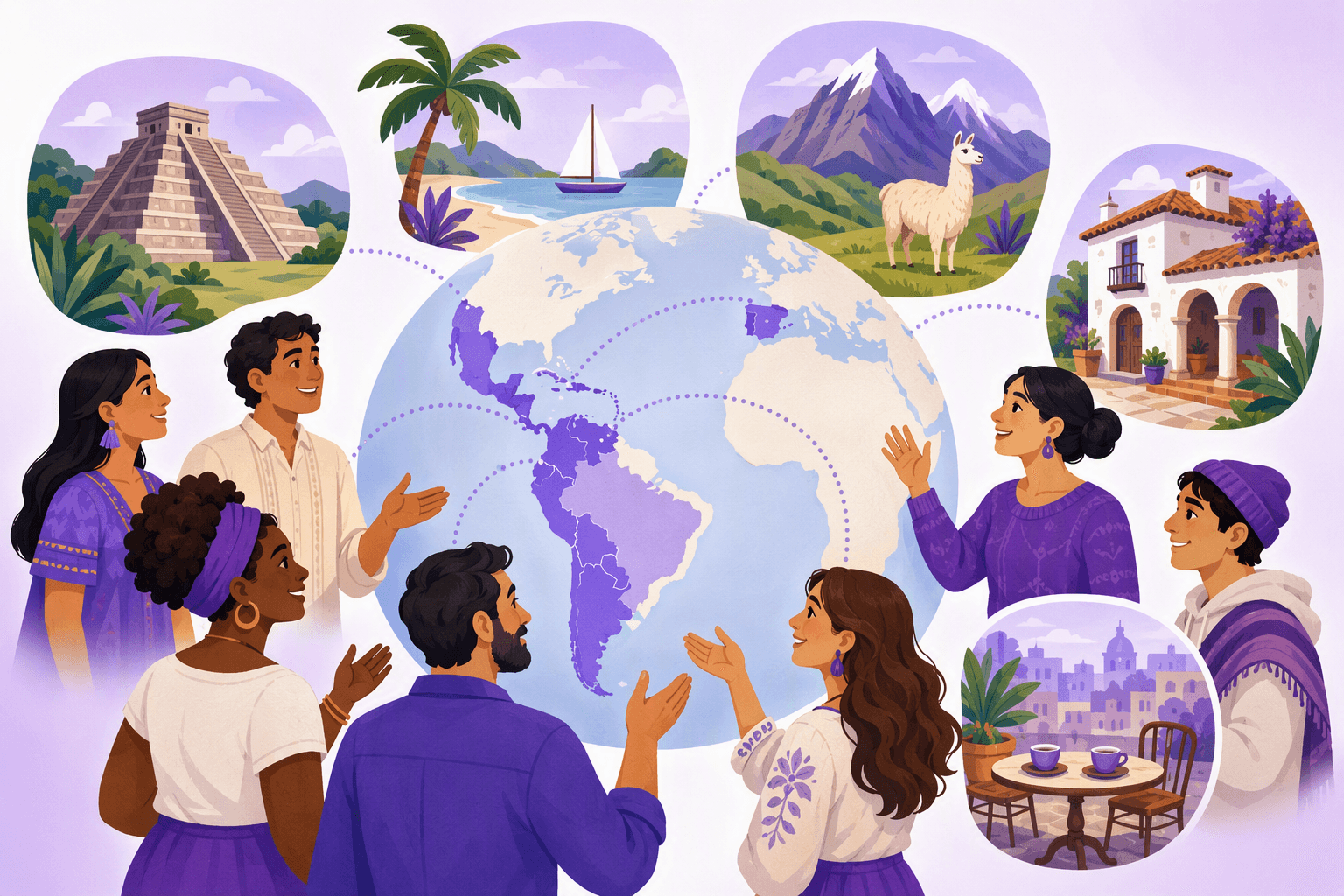
What counts as a "Spanish-speaking country"?
A Spanish-speaking country usually means a sovereign state where Spanish is an official language and used in government, education, and national media. By that definition, the list is stable: 21 countries.
There is a second, practical definition: places where Spanish is widely used in daily life even without nationwide official status. The United States is the clearest example, with tens of millions of Spanish speakers and strong regional concentrations.
💡 A useful shortcut for learners
If a country has Spanish as an official language, you can expect Spanish-language signage, services, and schooling. If Spanish is only widely spoken, you can still use it, but availability varies by region and city.
The 21 countries where Spanish is official
Below is the full list, grouped by region so you can see patterns in accent and vocabulary. The goal is not to memorize flags, it is to know what changes when you travel or watch shows from different places.
Spain (Europe)
Spain is the only Spanish-speaking country in Europe. Spanish is nationwide, but Spain is also multilingual: Catalan, Basque, and Galician are co-official in their regions.
Spain Spanish is known for two features many learners notice fast: the "th" sound in parts of Spain for c and z (distinción), and the use of vosotros for informal plural "you". The RAE’s panhispanic guidance is helpful here because it describes usage across regions rather than treating one variety as the only "correct" one.
Mexico (North America)
Mexico has the largest number of native Spanish speakers of any country. Mexican Spanish is also one of the most represented varieties in international media, dubbing, and music.
Pronunciation is generally clear and syllable-timed, and tú is the default informal "you". You will also hear a rich set of discourse markers like pues and o sea in casual speech.
Central America (7 countries)
Central America has strong internal diversity, but there are shared patterns: widespread voseo in many areas, and vocabulary that differs from Mexico in small everyday items.
The Spanish-speaking Central American countries are:
- Guatemala
- Honduras
- El Salvador
- Nicaragua
- Costa Rica
- Panama
- Belize is not on this list because its official language is English, even though Spanish is widely used in parts of the country.
A practical learner note: if you learn to recognize vos and a few common voseo verb shapes, you will understand a lot more content from this region without needing to "switch" your Spanish.
The Caribbean (3 countries)
Caribbean Spanish is famous for fast rhythm, consonant weakening in casual speech, and strong local slang. It is fully learnable, but it rewards lots of listening.
The Spanish-speaking Caribbean countries are:
- Cuba
- Dominican Republic
- Puerto Rico is not a country, it is a US territory, but it is a major Spanish-speaking place and a huge source of music and pop culture.
Caribbean Spanish often drops or softens final s in informal speech, and you may hear r and l sounds shift in some contexts. In terms of politeness, usted can be used more broadly in some communities than learners expect.
South America (10 countries)
South America contains some of the most distinct and recognizable accents, from River Plate Spanish to Andean varieties. It is also where voseo is most visible in mainstream media.
The Spanish-speaking countries in South America are:
- Argentina
- Bolivia
- Chile
- Colombia
- Ecuador
- Paraguay
- Peru
- Uruguay
- Venezuela
- Spain is not in South America, but learners often group it mentally with "non-Latin American" Spanish, so it helps to keep the geography clear.
Brazil is not Spanish-speaking nationally (Portuguese is official), but Spanish is common near borders and in tourism.
Spanish in the United States (widely spoken, not federally official)
The United States is not one of the 21 official-status countries, but it is one of the most important Spanish-speaking environments in the world. The US Census Bureau’s American Community Survey tracks language use at home and consistently shows Spanish as the most common non-English language in the country.
In practice, US Spanish is not one single dialect. It is a contact zone where Mexican, Caribbean, Central American, and South American varieties meet, plus English influence in vocabulary and code-switching.
🌍 Why US Spanish matters for learners
If you live in the US, you may hear more Spanish in daily life than in many parts of Spain. Learning Spanish for your city often means learning the dominant community variety, not an abstract "Latin American Spanish."
The biggest differences you will actually notice (and how to handle them)
Most "dialect differences" lists focus on trivia. For learners, three areas create most misunderstandings: pronunciation, second-person choices, and everyday nouns.

Pronunciation: seseo vs distinción
In most of Latin America, c (before e/i) and z are pronounced like s. This is called seseo. In much of Spain, those letters are pronounced with a "th" sound, and s stays s, which is called distinción.
Neither is more correct. They are regional standards, and you can understand both with exposure.
Tú, vos, usted, and vosotros
Second-person forms are where learners feel lost, but the system is consistent.
- tú: informal singular in most places
- vos: informal singular in many countries (voseo)
- usted: formal singular, and sometimes a respectful default even with family in certain communities
- vosotros: informal plural mainly in Spain
- ustedes: plural "you" everywhere, and the only option in most of Latin America
If you want to sound broadly neutral, use tú for informal singular and ustedes for plural. Learn to recognize vos and vosotros so you can understand content.
For a deeper look at formality choices, our Tú vs Usted guide pairs well with this article.
Vocabulary: the small words that cause big confusion
Vocabulary differences are usually about daily objects: computer, car, straw, juice, beans. This is where travel gets funny, because you can be "correct" and still not be understood.
Linguist Francisco Moreno Fernández, in Variedades de la lengua española, emphasizes that Spanish is pluricentric: multiple national standards coexist. For learners, that means you should expect variation and treat it as normal, not as mistakes.
⚠️ Avoid the 'one true Spanish' trap
If you correct a native speaker’s everyday word choice because your textbook used a different country’s term, you will sound unnatural. Instead, learn synonyms and ask "How do you say this here?"
Country-by-country notes that help learners fast
You do not need a separate Spanish for every country. You do need a few "heads-up" notes so your ear and expectations are ready.
Argentina and Uruguay
River Plate Spanish is strongly associated with voseo and a distinctive pronunciation of ll and y that can sound like "sh" or "zh" to learners. If you watch Argentine films, you will hear vos constantly.
It is also a region where intonation can feel Italian-influenced to some listeners, reflecting historical immigration patterns.
Chile
Chile is often described as challenging for learners because casual speech can be very reduced and local slang is dense. The solution is not to avoid it, it is to start with clearer sources and work up.
If you are curious about how slang and taboo language vary, see our Spanish swear words guide, which includes context and severity notes.
Colombia
Colombia has multiple well-known regional accents. Some learners find Bogotá Spanish relatively clear, while coastal varieties share some Caribbean-like features.
Colombia is also a good example of how usted can be used in friendly contexts in some regions, not only in formal ones.
Peru, Bolivia, Ecuador (Andean region)
Andean Spanish often has clear vowel articulation. In some areas, you may hear influence from indigenous languages in rhythm and vocabulary.
Learners sometimes notice more careful consonant pronunciation in formal contexts, which can make news and interviews easier to follow.
Paraguay
Paraguay is a special case because Guaraní is also an official language and widely spoken. Many Paraguayans are bilingual, and code-switching can appear in casual conversation.
This is a reminder that "Spanish-speaking country" does not mean "Spanish-only country".
Mexico
Mexico’s internal diversity is huge, but media exposure makes many learners comfortable with Mexican Spanish early. It is a strong base for international comprehension.
If you are learning for travel, combine this guide with Spanish travel phrases so you can handle real situations beyond greetings.
Spain
Spain’s use of vosotros is the main grammar difference learners feel. You can still be understood in Spain using ustedes, but you will hear vosotros constantly in casual group settings.
Spain is also a place where regional languages shape signage and identity. Knowing that castellano can be a politically neutral label in some contexts helps you sound culturally aware.
What Spanish should you learn if you want to understand movies and TV?
If your goal is comprehension across countries, prioritize three things:
- High-frequency vocabulary and verbs
- Listening to multiple accents early
- Comfort with tú, usted, and recognizing vos and vosotros
Applied linguist Paul Nation’s work on vocabulary size and coverage is a useful mental model here: you get disproportionate comprehension gains from the most frequent words. That is why building a core lexicon first matters more than collecting rare regional slang.
A practical path is: learn a neutral base, then add accent exposure. Watch one Mexican show, one Spanish show, and one Argentine show, and your ear will adapt quickly.
For ideas, start with best movies to learn Spanish. If you want a faster loop between listening and vocabulary, Wordy’s clip format is designed for exactly this kind of accent-hopping.
Politeness and "sounding rude" across countries
Politeness is not only about words like por favor (por fah-BOR) and gracias (GRAH-syahs). It is also about directness, tone, and how you soften requests.
Research on politeness strategies in interaction, especially the framework in Brown and Levinson’s Politeness: Some Universals in Language Usage, helps explain why the same sentence can feel blunt in one context and normal in another. Spanish varieties differ in how often they use diminutives, indirect questions, or formal address to manage social distance.
A safe, universal polite pattern
If you are unsure, this structure works almost everywhere:
- Disculpe / Perdón
- ¿Podría...?
- por favor
- gracias
It is not the only way to speak, but it rarely sounds wrong.
If you want more "real-life" options, our how to say goodbye in Spanish guide includes polite exits that fit both formal and casual settings.
Spanish names for countries and nationalities (quick pronunciation help)
Learners often know the country name in English but hesitate in Spanish. Here are a few that frequently appear in conversation, with simple pronunciation approximations.
México
Pronunciation: MEH-hee-koh
In Spanish, the x is pronounced like an English h in this word for most speakers.
España
Pronunciation: ehs-PAH-nyah
The ñ is like "ny" in canyon.
Argentina
Pronunciation: ahr-hen-TEE-nah
The g is soft before e/i.
Colombia
Pronunciation: koh-LOHM-byah
Stress is on the second syllable.
República Dominicana
Pronunciation: reh-POO-blee-kah doh-mee-nee-KAH-nah
In fast speech, some syllables compress, but the stress pattern stays.
Common learner mistakes when talking about Spanish-speaking countries
Mixing up "Latino" and "Spanish-speaking"
Not all Latinos are Spanish-speaking, and not all Spanish-speakers are Latino. Spain is Spanish-speaking but not Latin American. Brazil is Latin American but not Spanish-speaking.
If you are describing language, say "Spanish-speaking". If you are describing region or identity, be more specific.
Assuming one accent is "neutral"
"Neutral Spanish" is usually a media standard, not a real local accent. It is useful for learners, but it is not a single country’s speech.
Treat it as a starting point, then add real regional input.
Treating regional words as jokes
Some cross-country vocabulary differences are meme material online, but in real life they are normal. If you laugh at a word because it means something else in your country, you can accidentally embarrass someone.
When in doubt, ask with curiosity: "¿Cómo le dicen aquí?"
A simple study plan for understanding Spanish across countries
Step 1: Build a core base
Start with the most frequent words and verbs. If you want a structured list, our 100 most common Spanish words is designed for practical conversation.
Step 2: Lock in greetings and exits
Greetings and goodbyes are where formality shows up immediately. Use:
Step 3: Add one new accent per month
Pick one country and focus for 2 to 4 weeks. Watch interviews, a series, or YouTube street conversations. Keep a small list of recurring words and pronunciation patterns.
Step 4: Learn the "high-impact" regional features
You do not need to speak voseo to understand it, but you should recognize it. The same is true for vosotros if you plan to consume Spain content.
Step 5: Keep your Spanish socially safe
Learn polite request frames and avoid copying strong slang too early. If you are curious about intensity and context, our Spanish swear words guide is written for learners who want to understand without accidentally escalating a situation.
💡 The fastest way to sound natural
Copy whole phrases from real scenes, not single words from lists. You learn rhythm, filler words, and what people actually say when they hesitate, agree, or change topics.
Why Spanish varies so much (and why that is good news)
Spanish is spoken across multiple continents, with long histories of migration, education policy, media influence, and contact with other languages. Variation is the normal outcome of a global language.
Instituto Cervantes documents Spanish as a global language with major demographic weight, and Ethnologue’s country-by-country profiles show how speaker communities are distributed. For learners, this means your Spanish is not "wrong" if it matches one standard more than another.
The best mindset is: learn a stable core, then treat variation as extra listening practice, not as a problem.
Learn Spanish the way you will actually hear it
If your goal is to understand Spanish across countries, prioritize listening to real speech from multiple regions. Wordy is built around short movie and TV clips, so you can hear accents in context, save the vocabulary you meet, and review it with spaced repetition.
For more Spanish learning guides, browse the Wordy blog and pick one country or topic to focus on next.
Frequently Asked Questions
How many Spanish-speaking countries are there?
Is Spanish the same in every Spanish-speaking country?
Which Spanish should I learn first: Spain or Latin America?
What is the difference between español and castellano?
What is voseo, and where is it used?
Sources & References
- Instituto Cervantes, El español: una lengua viva (annual report, accessed 2026)
- Ethnologue, 27th edition, 2024
- Real Academia Española (RAE), Diccionario panhispánico de dudas (accessed 2026)
- United States Census Bureau, American Community Survey language data (accessed 2026)
- Moreno Fernández, *Variedades de la lengua española*, Routledge
Start learning with Wordy
Watch real movie clips and build your vocabulary as you go. Free to download.


