Quick Answer
A Spanish siesta is a short early-afternoon rest, but it is not a daily national ritual and most working adults in Spain do not sleep every afternoon. The idea survives most strongly in smaller towns, hot regions, family businesses, and summer routines, while Spain's late meals and split schedules explain why the tradition remains culturally recognizable.
Spanish Siesta Culture: What It Really Means in Spain
A Spanish siesta, pronounced /ˈsjesta/, is an early-afternoon rest or nap, but the popular image of every person in Spain sleeping after lunch is a myth. Many Spaniards work, commute, shop, or collect children during the afternoon; the siesta survives more as a flexible habit and a symbol of Spanish daily rhythm than as a universal rule.
The word matters because it helps explain why some small businesses close in mid-afternoon, why lunch can be long, and why dinner may begin after 9:00 p.m. Yet a visitor who expects Spain to shut down every day will be surprised, especially in Madrid, Barcelona, Valencia, and other large cities.
Spanish is spoken by roughly 600 million potential speakers worldwide, according to the Instituto Cervantes, across 20 countries where it has official status. That scale means the word siesta /ˈsjesta/ travels widely, but its cultural meaning changes from Spain to Latin America and from one Spanish region to another.
If you are planning a trip, start with a few essential Spanish greetings. A warm hello and a patient question about opening hours will get you much further than treating the afternoon break as an inconvenience.
| English | Spanish | Pronunciation | Formality |
|---|---|---|---|
| I am going to take a nap | Voy a echar una siesta | boy ah eh-CHAR OO-nah SYES-tah | casual |
| The shop is closed this afternoon | La tienda está cerrada esta tarde | lah TYEHN-dah ehs-TAH seh-RRAH-dah EHS-tah TAR-deh | polite |
| What time do you reopen? | ¿A qué hora vuelven a abrir? | ah keh OH-rah BWEHL-ben ah ah-BREER | polite |
| See you later | Hasta luego | AHS-tah LWEH-goh | casual |
| Please keep the noise down | Por favor, hagan menos ruido | por fah-BOR AH-gahn MEH-nohs RROO-ee-doh | polite |
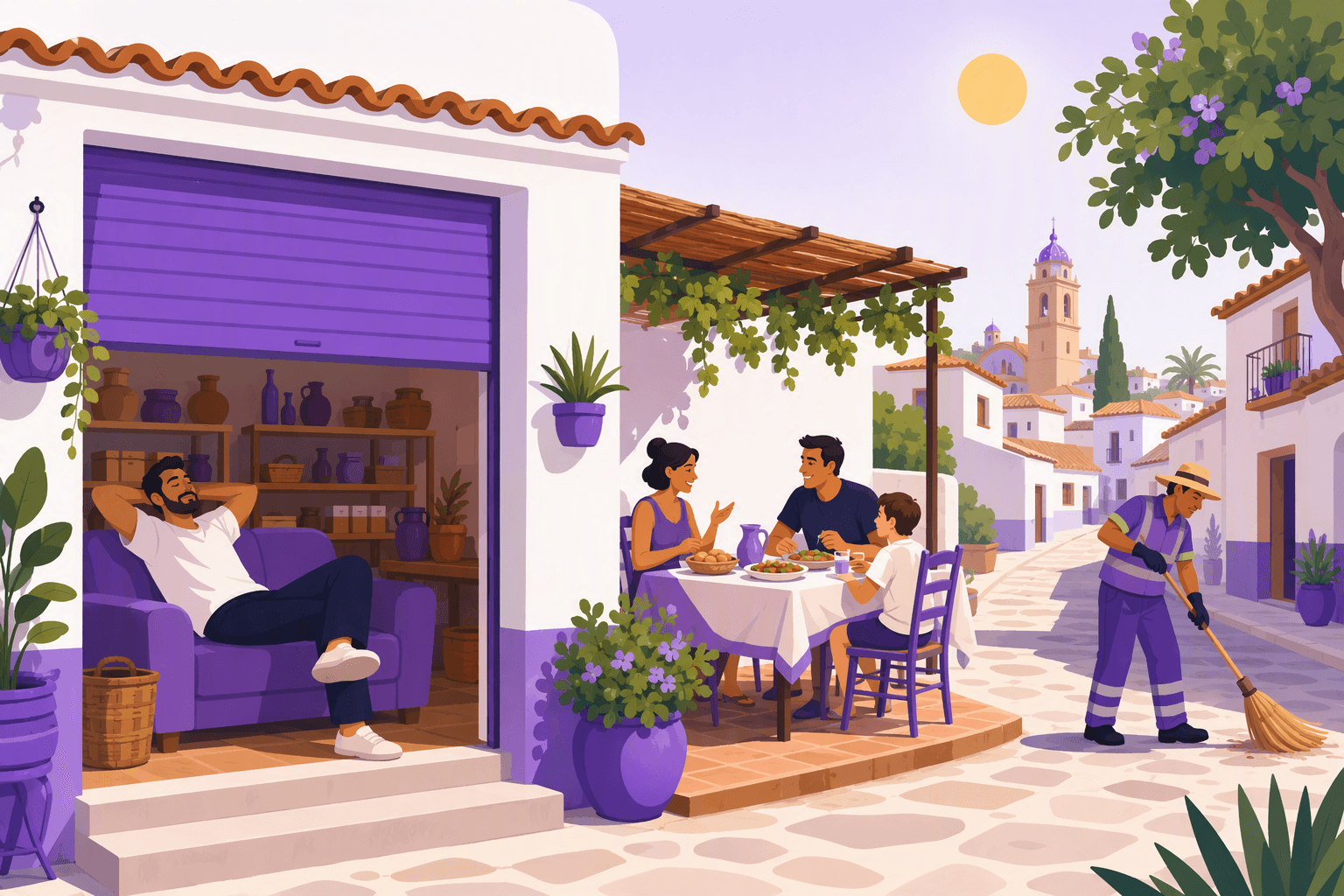
What does siesta actually mean?
The Real Academia Española defines siesta /ˈsjesta/ as sleep taken after eating. In ordinary use, though, it can mean either the nap itself or the part of the day associated with rest, lunch, heat, and a slower pace.
The expression echar una siesta /eˈtʃaɾ una ˈsjesta/ means to take a nap. The verb echar /eˈtʃaɾ/ literally has many meanings, including to throw or put, but it commonly appears in everyday expressions such as this one.
A siesta does not need to last two or three hours. In reality, a brief nap of 20 to 30 minutes is the most practical version for someone who wants to recover energy without disrupting nighttime sleep.
Siesta
The familiar English word comes directly from Spanish siesta /ˈsjesta/, which ultimately relates to the Latin idea of the sixth hour of daylight. Historically, that was around midday, when outdoor work in a hot climate could be physically demanding.
The word therefore describes more than sleep. It points to a timetable organized around the middle of the day, a substantial lunch, and, in some settings, a pause before late-afternoon activity resumes.
Does everyone in Spain take a siesta?
No. The daily nap is not a reliable measure of whether someone is Spanish, relaxed, traditional, or living in a particular region. Plenty of people never take one on a working day.
The Instituto Nacional de Estadística's time-use survey shows the value of looking at actual routines rather than stereotypes: Spanish daily life includes paid work, education, domestic tasks, commuting, care work, television, and social time, all of which compete with an afternoon nap. A person with a standard office schedule is unlikely to get home, eat lunch, sleep, and return to work in the way travel clichés suggest.
Children and older adults may be more likely to rest. So may people who work early, have flexible hours, live in very hot areas, or work from home. In rural communities, agricultural contexts, and family-run businesses, the afternoon pause can remain more visible than it is in a corporate district.
🌍 The key distinction
A long lunch break does not prove that people are sleeping. A business may close because the owner goes home to eat, handles deliveries, avoids the hottest hours, or follows local trading patterns. The word siesta /ˈsjesta/ is often used loosely by visitors for all of these situations.
Why Spain's daily schedule feels late
The siesta stereotype is linked to a real feature of Spanish life: schedules can run later than visitors from northern Europe or North America expect. Lunch often begins around 2:00 p.m., and dinner commonly starts around 9:00 p.m. or later.
This rhythm is especially noticeable in summer, when heat and long evenings encourage people to spend time outdoors after sunset. Children play in plazas, families meet for dinner, and terraces remain lively well into the night.
Spain also operates on Central European Time, despite lying geographically farther west than countries such as France and Germany. The relationship between clock time, daylight, work hours, and meals is one reason a Spanish evening can feel unexpectedly late.
Chronobiologist Till Roenneberg, in Internal Time, distinguishes biological timing from socially imposed schedules. That framework is useful here: Spain's routines are not simply a national preference for sleep, but a result of daylight, work organization, family life, and social expectations.
Sobremesa
One of the most useful cultural words is sobremesa /soβɾeˈmesa/. It means the relaxed conversation that continues at the table after a meal, often after lunch or dinner.
A sobremesa /soβɾeˈmesa/ can last ten minutes or much longer. People may drink coffee, discuss family news, debate politics, or simply remain together. It is not the same as a siesta, but outsiders often confuse the two because both extend the middle of the day.
In a family home, a long lunch may lead to a sobremesa /soβɾeˈmesa/, then perhaps a nap. In a city office, colleagues may have lunch together and return to work. Context decides the pattern.
Where businesses close in the afternoon
Independent shops in smaller towns may close from approximately 2:00 p.m. until 5:00 p.m. Some businesses use signs reading cerrado /seˈraðo/, meaning closed, and abierto /aˈβjeɾto/, meaning open.
Do not assume those hours apply everywhere. Large shopping centres, department stores, supermarkets, museums, pharmacies on duty, transport hubs, and tourist-oriented businesses may operate continuously.
In Madrid and Barcelona, many visitors can go through an entire trip without encountering a meaningful afternoon closure. In a small inland town, however, arriving at 3:00 p.m. may mean waiting until later to buy shoes, visit a local shop, or speak to a business owner.
🌍 Plan around local hours
Check the exact hours on the business website, map listing, or door sign on the same day. Summer, public holidays, local festivals, and Sundays can affect schedules more than siesta customs do. If you need medicine, look for the local farmacia de guardia /faɾˈmasja ðe ɣwaɾˈðja/, the pharmacy assigned to provide out-of-hours service.
The connection between heat and rest
A siesta makes intuitive sense in hot weather. Before air conditioning and modern labor rules, avoiding heavy physical work during the hottest part of the day could be practical, particularly in farming and construction.
But heat is not the sole explanation. Not every hot country has the same daily schedule, and not every Spanish region experiences the same climate. Social routines, school hours, commerce, transport, and regional customs all matter.
Sociologist Eviatar Zerubavel's Hidden Rhythms: Schedules and Calendars in Social Life examines how timetables organize social life. Spanish siesta culture is a clear example: a shared expectation about when to eat, rest, or close can shape a community even when individuals do not follow it every day.
The afternoon is also changing. Remote work, international companies, tourism, continuous retail hours, and commuting have reduced the practical space for a long break in many cities. The cultural association remains strong because it is visible in language, travel marketing, family memories, and local business patterns.
How to behave during siesta hours
Visitors do not need to whisper across Spain from 2:00 p.m. onward. Cafes remain open, children may be playing, traffic continues, and city life does not stop.
Still, noise carries in apartment buildings. Avoid drilling, loud music, shouting in stairwells, or dragging furniture during a quiet early afternoon, especially in residential neighborhoods. Spanish apartment living often involves close proximity, and consideration matters more than guessing a formal national rule.
If you are staying in a hotel or apartment rental, check the house rules. Some buildings specify horas de descanso /ˈoɾas ðe ðesˈkanso/, meaning quiet or rest hours, which may include both afternoon and nighttime periods.
A polite request is Por favor, hagan menos ruido /poɾ faˈβoɾ ˈaɣan ˈmenos ˈrwiðo/, meaning please make less noise. Use it calmly, not as an accusation.
Useful Spanish for afternoon closures
If a door is shut, the simplest question is ¿A qué hora vuelven a abrir? /a ke ˈoɾa ˈβwelβen a aˈβɾiɾ/, meaning what time do you reopen? This is more natural and less presumptuous than asking whether the owner is taking a siesta.
You might hear volvemos a las cinco /bolˈβemos a las ˈsiŋko/, meaning we return at five. You may also see abrimos por la tarde /aˈβɾimos poɾ la ˈtaɾðe/, meaning we open in the afternoon.
For a friendly departure, say hasta luego /ˈasta ˈlweɣo/, literally until later. See more options in our guide to saying goodbye in Spanish.
Cerrado
Cerrado /seˈraðo/ means closed, while cerrada /seˈraða/ is used when the noun is grammatically feminine, such as la tienda está cerrada /la ˈtjenda esˈta seˈraða/, the shop is closed.
The distinction is grammatical, not a different degree of closure. Spanish adjectives often change their ending to agree with the gender of the noun, a pattern you will see constantly on signs and in speech.
Abierto
Abierto /aˈβjeɾto/ means open, and abierta /aˈβjeɾta/ is its feminine form. A sign saying abierto /aˈβjeɾto/ usually means a business is currently welcoming customers.
Knowing these two words saves time when hours are unclear. For wider travel language, our Spanish travel phrases guide covers restaurants, hotels, directions, and everyday requests.
Siesta in Latin America
The word siesta /ˈsjesta/ is understood throughout the Spanish-speaking world, but do not assume that Spain's schedules apply in Mexico, Colombia, Argentina, Peru, or any other country. Spanish is a global language, and daily routines are local.
Some Latin American towns and hot regions also have strong midday-rest traditions. Major cities, however, usually follow schedules shaped by local work patterns, transport, school systems, and commerce rather than a single pan-Hispanic custom.
This is one reason cultural labels need care. Saying that every Spanish speaker takes a siesta is as misleading as assuming all English speakers share the same meal times, holidays, or social rules.
The real lesson from siesta culture
The siesta is real, but it is not a command, an all-day shutdown, or proof that Spain moves slowly. It is a flexible tradition tied to rest, meals, climate, and local schedules, now adapted to modern urban life.
Treat the afternoon as a period worth planning around, especially outside large cities. Check hours, make lunch reservations at Spanish times, leave room for late dinners, and respect quieter residential spaces.
Most importantly, use the culture as an invitation to notice how people organize time together. A long meal, a sobremesa /soβɾeˈmesa/, or a simple hasta luego /ˈasta ˈlweɣo/ can reveal far more about daily Spanish life than the stereotype of a nation asleep at 3:00 p.m.
To build confidence for those real interactions, practice common phrases through Spanish movies and TV clips, then listen for how greetings, meals, and goodbyes change with the setting.
Frequently Asked Questions
Do people in Spain still take siestas every day?
How long is a traditional Spanish siesta?
Do shops close for siesta in Spain?
Why do Spaniards eat dinner so late?
Is it rude to make noise during siesta time in Spain?
Sources & References
- Real Academia Española, Diccionario de la lengua española, siesta entry, accessed 2026
- Instituto Cervantes, El español: una lengua viva, 2024
- Instituto Nacional de Estadística, Encuesta de Empleo del Tiempo 2009-2010
- Till Roenneberg, Internal Time, Harvard University Press
- Eviatar Zerubavel, Hidden Rhythms: Schedules and Calendars in Social Life, University of California Press
Start learning with Wordy
Watch real movie clips and build your vocabulary as you go. Free to download.


