Quick Answer
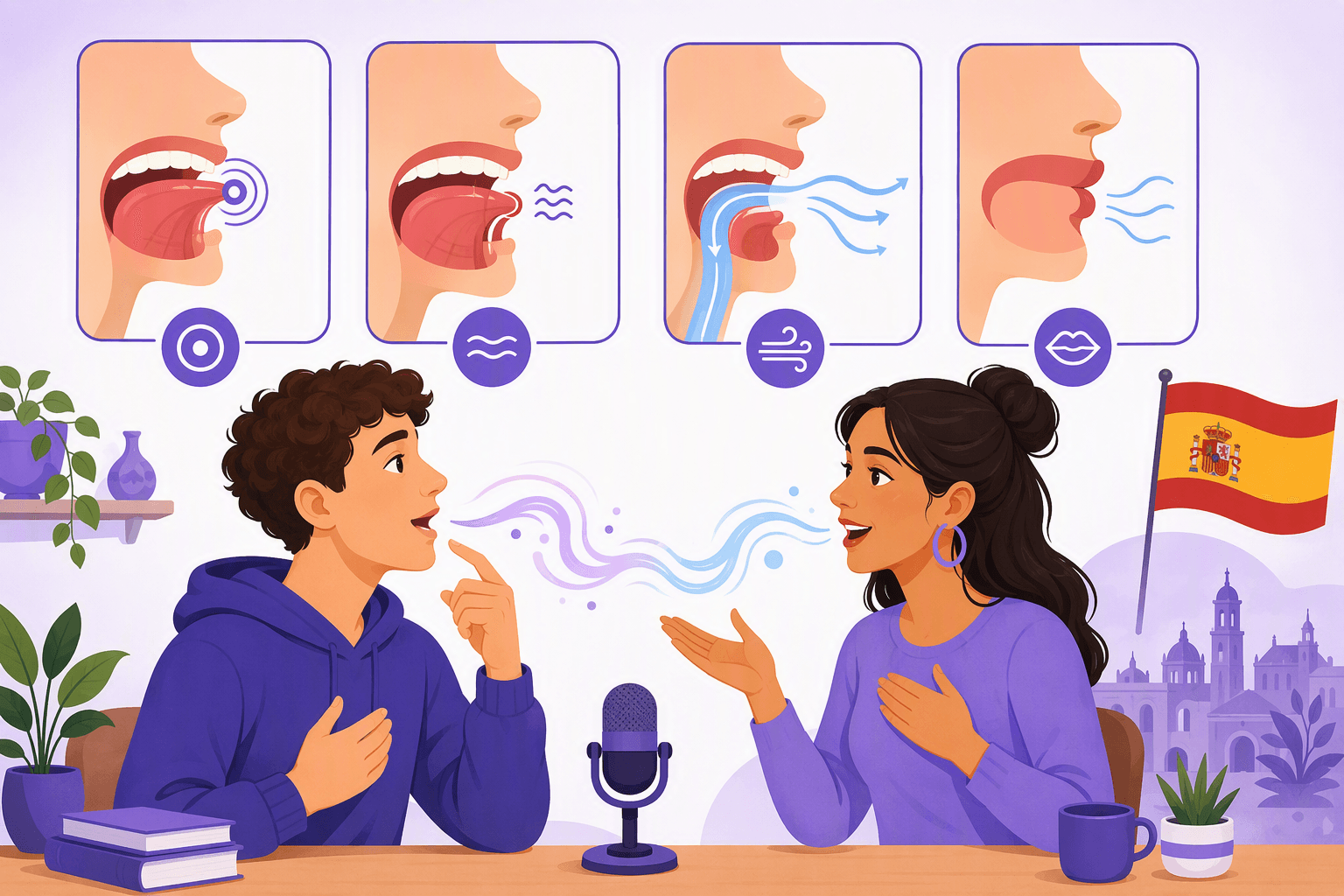
The hardest Spanish sounds for English speakers are usually the tapped and rolled r, the Spanish j, pure vowels, and consonants such as b, v, d, and ll. The key is not copying English pronunciation, but learning the mouth position, airflow, and rhythm Spanish uses.
The most difficult Spanish sounds for English speakers are usually the single r /ɾ/, the rolled rr /r/, the harsh j /x/, the pure vowels /a e i o u/, and several consonants that are softer than their English-looking equivalents. You can fix them by learning where the tongue and lips go, keeping Spanish vowels steady, and practicing short real phrases rather than isolated letters.
Spanish is spoken by more than 600 million potential speakers worldwide, according to Instituto Cervantes estimates, and it is an official language in 20 countries. That range means there is no single universal accent, but the core sound system is remarkably consistent across regions.
A speaker from Madrid, Mexico City, Bogotá, Buenos Aires, or San Juan may sound different, yet all use the same basic vowel structure and many of the same consonant contrasts. For a foundation in real-world pronunciation, pair this guide with our Spanish pronunciation guide, then listen for these sounds in dialogue.
Why Spanish pronunciation feels different
Spanish spelling is more predictable than English spelling, but predictable does not mean effortless. English speakers often recognize a Spanish letter and automatically apply an English sound to it. That habit causes most early pronunciation problems.
José Ignacio Hualde, in The Sounds of Spanish, describes Spanish as having a relatively compact vowel system and a set of consonant patterns that change with position. In practice, this means Spanish rewards precise, repeatable mouth movements more than dramatic stress or vowel stretching.
English also uses many reduced vowels, especially the weak central vowel /ə/. Spanish generally does not. Each written vowel needs to remain audible, even in fast conversation.
💡 A better pronunciation goal
Aim for understandable, stable Spanish, not a borrowed accent from one country. A clear /a e i o u/, a reliable distinction between /ɾ/ and /r/, and natural rhythm will help listeners far more than copying every regional detail.
The five Spanish vowels
Spanish vowels are often the first sounds learners underestimate. They are simple in number, but they must stay pure. English speakers commonly glide through vowels, creating two sounds where Spanish expects one.
| Letter | IPA | Example | Common English-speaker mistake |
|---|---|---|---|
| a | /a/ | casa /ˈkasa/ | Turning it into the vowel in English “cat” |
| e | /e/ | mesa /ˈmesa/ | Turning it into /eɪ/ |
| i | /i/ | vino /ˈbino/ | Relaxing it toward /ɪ/ |
| o | /o/ | loco /ˈloko/ | Turning it into /oʊ/ |
| u | /u/ | luna /ˈluna/ | Adding a glide such as /ju/ |
a
The Spanish a /a/ is open and steady. Drop the jaw slightly and keep the tongue low and forward. It appears in casa /ˈkasa/, mamá /maˈma/, and gracias /ˈɡɾasjas/.
Do not use the wide, fronted English vowel from “cat.” The Spanish /a/ is closer to the vowel many English speakers use in “father,” though its exact quality varies by accent.
e
The Spanish e /e/ is a single sound, as in mesa /ˈmesa/ and café /kaˈfe/. English speakers often pronounce it like the vowel in “say,” which moves from /e/ toward /ɪ/.
Hold the tongue position still. Say café /kaˈfe/ slowly, then speed it up without adding a second vowel at the end.
i
The Spanish i /i/ is tense and clear, as in vino /ˈbino/, sí /si/, and amigo /aˈmiɡo/. It is closer to the vowel in “machine” than the relaxed vowel in “sit.”
A useful drill is alternating sí /si/ and se /se/. Keep the lips relaxed and make the change with your tongue, not by adding extra movement.
o
The Spanish o /o/ in loco /ˈloko/ and todo /ˈtoðo/ should not drift into the English vowel in “go.” English often ends that vowel with a glide, /oʊ/, but Spanish /o/ stays in one position.
Practice no /no/ as one compact sound. If it feels too short at first, that is usually a sign you are moving in the right direction.
u
The Spanish u /u/ is heard in luna /ˈluna/, tú /tu/, and mucho /ˈmutʃo/. Round your lips, but do not begin with the English /j/ sound found in “you.”
The word tú /tu/ has one clean vowel. It should not sound like an English-style /tju/.
The Spanish r sounds
Spanish has two different r sounds. This contrast can change meaning, so it deserves focused practice. The single r /ɾ/ is a quick tap, while rr /r/ is a sustained trill.
The Real Academia Española identifies this distinction as a central feature of Spanish phonology. Learners do not need to exaggerate either sound, but they do need to hear and produce the difference.
r
A single r between vowels is usually the tap /ɾ/. In pero /ˈpeɾo/, caro /ˈkaɾo/, and mira /ˈmiɾa/, the tongue touches the ridge behind the upper teeth once and immediately releases.
Do not use the English r /ɹ/. English r pulls the tongue backward without touching the roof of the mouth. Spanish /ɾ/ is forward, fast, and physical.
Try saying the middle sound in the American English pronunciation of “butter.” For many speakers, that quick flap is close to Spanish /ɾ/. Then practice pero /ˈpeɾo/ and caro /ˈkaɾo/.
rr
The written rr /r/ is a trill, as in perro /ˈpero/, carro /ˈkaro/, and arriba /aˈriba/. It also appears at the start of a word in rojo /ˈroxo/ and rápido /ˈrapiðo/, even though the spelling has one r.
For the trill, place the tip of your tongue lightly near the alveolar ridge, just behind your upper teeth. Blow a narrow, steady stream of air. The tongue vibrates because of airflow, not because you repeatedly force it upward.
Do not press the tongue hard against the roof of the mouth. Tension blocks the vibration. Start with combinations such as tra /tɾa/, dra /dɾa/, and ara /ˈaɾa/, which help position the tongue correctly before moving to rr /r/.
🌍 The r is not equally strong everywhere
The trill /r/ remains part of standard Spanish, but its exact sound differs by region and speaker. In parts of the Caribbean, Puerto Rico, and coastal Latin America, r sounds may weaken or shift in certain positions. For learners, a clear tap /ɾ/ and trill /r/ remain useful reference targets.
The Spanish j and g before e or i
The Spanish j /x/ in jota /ˈxota/, José /xoˈse/, and trabajo /tɾaˈbaxo/ has no exact English equivalent. It is made at the back of the mouth, with the rear of the tongue raised toward the soft palate.
The same sound appears in gente /ˈxente/ and girar /xiˈɾaɾ/, where g comes before e or i. Air passes through a narrow space, creating friction.
English speakers often replace /x/ with English h /h/, making José /xoˈse/ sound too breathy. In many Latin American accents, /x/ may be softer and closer to /h/, so a gentle version is widely understood. In much of Spain, it can sound stronger and raspier.
j
To practice j /x/, begin with a quiet, breathy sound at the back of your throat. Then say ajo /ˈaxo/, jugo /ˈxuɣo/, and ojos /ˈoxos/.
Avoid making the English /dʒ/ sound from “job.” Spanish j /x/ is never the initial sound in English “judge.”
The soft b, v, d, g, and y
Some Spanish consonants change depending on their position. This is one reason Spanish can sound smoother and more connected than learners expect.
After a pause, or after certain nasal sounds, b /b/, d /d/, and g /ɡ/ are more stop-like. Between vowels, they often soften into approximant sounds /β ð ɣ/, where the mouth narrows but does not fully block the air.
| Spelling | Stronger position | Softer position | Example |
|---|---|---|---|
| b, v | /b/ | /β/ | beber /beˈβeɾ/ |
| d | /d/ | /ð/ | todo /ˈtoðo/ |
| g | /ɡ/ | /ɣ/ | amigo /aˈmiɣo/ |
| y | /ɟʝ/ or /ʝ/ | /ʝ/ | ayer /aˈʝeɾ/ |
b y v
Spanish b /b/ and v /b/ do not normally contrast. Baca /ˈbaka/ and vaca /ˈbaka/ are pronounced alike in standard Spanish, even though they have different meanings.
Between vowels, soften the sound. In beber /beˈβeɾ/, bring the lips close but do not seal them as firmly as for English b. The sound should flow.
Do not make English v /v/ by touching your upper teeth to your lower lip. That sound is not part of standard Spanish pronunciation.
d
Spanish d /d/ is dental, meaning the tongue touches the back of the upper teeth rather than the ridge behind them. In día /ˈdia/, make a light contact farther forward than you would in English.
Between vowels, d becomes /ð/, as in todo /ˈtoðo/ and nada /ˈnaða/. This resembles the voiced th in English “this,” but Spanish /ð/ is often softer and less forceful.
A common learner error is pronouncing every d as a hard English d. That is understandable, but it makes connected speech sound choppy.
g
Spanish g /ɡ/ is hard before a, o, and u, as in gato /ˈɡato/, amigo /aˈmiɣo/, and gusto /ˈɡusto/. Between vowels, it often softens to /ɣ/.
Do not confuse this with g before e or i, which becomes /x/, as in gente /ˈxente/. The spelling rule is dependable once you learn it.
ll y
In most Spanish-speaking regions, ll and y share a pronunciation, a pattern called yeísmo. You may hear llave /ˈʝaβe/ and yo /ʝo/ with a sound between English y and the sound in “measure.”
In Argentina and Uruguay, many speakers use /ʃ/ or /ʒ/, so yo may sound like /ʃo/ or /ʒo/. In a smaller number of regions, ll retains a distinct palatal lateral /ʎ/.
This is a regional choice, not a correctness test. Pick a pronunciation model based on the Spanish you hear most often. If you are learning through Mexican television, Colombian podcasts, or Spanish films, imitate the consistent patterns in that material.
c, z, and the two Spanish s patterns
In most of Latin America, s, z, and c before e or i are pronounced /s/. So casa /ˈkasa/, cena /ˈsena/, and zapato /saˈpato/ all use an s-like sound.
In much of central and northern Spain, z and c before e or i are pronounced /θ/, similar to English th in “think.” There, cena /ˈθena/ and zapato /θaˈpato/ differ from s /s/.
Neither pattern is more correct. The first is called seseo, and it is used by the large majority of Spanish speakers globally. The second, distinción, is a standard regional feature in Spain.
🌍 Choose one model, but understand both
If your goal is Latin American Spanish, use /s/ for cena /ˈsena/ and zapato /saˈpato/. If you are focused on Spain, learn to recognize /θ/. Your priority should be recognizing both patterns when watching films, series, and travel content.
The ñ sound
Spanish ñ /ɲ/ is a palatal nasal sound, as in niño /ˈniɲo/, año /ˈaɲo/, and España /esˈpaɲa/. It is close to the sound in the middle of English “canyon” for many speakers.
Keep your tongue against the hard palate, farther back than for n /n/. The sound is one consonant, not n plus y.
Compare año /ˈaɲo/ with ano /ˈano/. The first means year, while the second is an anatomical word. That makes accurate pronunciation useful far beyond sounding polished.
Spanish rhythm and word stress
Even accurate individual sounds can feel unnatural if English rhythm takes over. English is stress-timed, so unstressed syllables often compress or reduce. Spanish gives syllables more even timing and keeps vowels clearer.
Say hola /ˈola/ as two equal, audible syllables, not as a blurred English-style “oh-luh.” The canonical learner pronunciation is OH-lah, but the real goal is the IPA pattern /ˈola/: a stable /o/ followed by a stable /a/.
Spanish stress is also predictable. Words ending in a vowel, n, or s usually stress the second-to-last syllable, as in casa /ˈkasa/ and hablan /ˈaβlan/. Other endings usually stress the final syllable, as in hotel /oˈtel/.
Written accent marks show exceptions, including café /kaˈfe/, inglés /iŋˈɡles/, and rápido /ˈrapiðo/. Learn stress with every new word, especially when practicing everyday phrases such as hello in Spanish or goodbye in Spanish.
A 10-minute daily practice routine
Pronunciation improves through frequent, focused repetition. One long session each week is less useful than ten minutes a day with careful listening and recording.
Minute 1 to 2: Hear the contrast
Listen to minimal or near-minimal pairs: pero /ˈpeɾo/ and perro /ˈpero/, casa /ˈkasa/ and caza /ˈkasa/ or /ˈkaθa/, año /ˈaɲo/ and ano /ˈano/.
Do not repeat immediately. First identify what changes. Your ear needs to recognize the contrast before your mouth can produce it reliably.
Minute 3 to 5: Slow mouth-position practice
Practice five repetitions each of café /kaˈfe/, luna /ˈluna/, pero /ˈpeɾo/, perro /ˈpero/, and José /xoˈse/. Keep your voice relaxed and your vowels short.
Record one attempt. Compare it with a native reference, focusing on one feature only, such as whether your /e/ glides or whether your r is too English-like.
Minute 6 to 8: Use complete phrases
Move from isolated words into phrases: Hola, ¿cómo estás? /ˈola ˈkomo esˈtas/, Muchas gracias /ˈmutʃas ˈɡɾasjas/, and Hasta luego /ˈasta ˈlweɣo/.
Connected phrases reveal whether you can preserve the target sound while speaking naturally. They also prepare you for social language, including affectionate expressions from our guide to saying I love you in Spanish.
Minute 9 to 10: Shadow a short clip
Choose one sentence from a Spanish show, interview, or song. Listen once, pause, repeat with the speaker, then repeat again without the audio.
The goal is not to mimic every feature instantly. Notice one sound pattern, such as soft /β/ in saber /saˈβeɾ/ or the rhythm of no lo sé /no lo se/, and reproduce it more accurately on the next attempt.
What matters most for being understood
Not every pronunciation issue has equal weight. A foreign accent is normal, and Spanish speakers are accustomed to hearing regional and international variation.
Prioritize the sounds that distinguish words or make a word hard to recognize: the contrast between /ɾ/ and /r/, stable vowels, word stress, and the basic difference between /s/ and /θ/ if you interact with speakers from Spain. Then work on softer consonants and fine regional details.
Avoid practicing only dramatic words or profanity. You may encounter strong language in films, but it is better to understand it than use it casually. Our Spanish swear words guide explains the meanings and social weight of common expressions.
The practical rule is simple: listen closely, make one physical adjustment at a time, and repeat real sentences. Spanish pronunciation becomes much easier once you stop treating the letters as English letters with different spelling.
Frequently Asked Questions
What is the hardest Spanish sound for English speakers?
Can everyone learn to roll their r's in Spanish?
Why do Spanish vowels sound different from English vowels?
Is Spanish b pronounced like English b?
Do all Spanish speakers pronounce ll and y the same way?
Sources & References
- Real Academia Española and Asociación de Academias de la Lengua Española, Nueva gramática de la lengua española: Fonética y fonología
- Instituto Cervantes, El español: una lengua viva, accessed 2026
- José Ignacio Hualde, The Sounds of Spanish, Cambridge University Press
- Instituto Cervantes, Centro Virtual Cervantes: Fonética y pronunciación del español, accessed 2026
- International Phonetic Association, International Phonetic Alphabet, accessed 2026
Start learning with Wordy
Watch real movie clips and build your vocabulary as you go. Free to download.


