Quick Answer
The most universal Spanish greeting is 'Hola' (OH-lah): it works in every Spanish-speaking country and in both casual and formal situations. From there, native speakers choose greetings based on time of day (Buenos días), relationship (¿Qué tal?), and setting (Mucho gusto, Encantado/a). This guide gives you practical options with pronunciation and cultural context.
The most reliable Spanish greeting is Hola (OH-lah): it works in every Spanish-speaking country, in both casual and formal situations, and at any time of day. To sound natural beyond Hola, choose greetings by context: time-of-day phrases like Buenos días, quick check-ins like ¿Qué tal?, and polite openers like Mucho gusto when meeting someone.
Spanish is a global language with roughly 500 million native speakers and well over 20 countries where it is an official language, depending on how territories are counted (Instituto Cervantes; Ethnologue). That reach creates real variety, but the core greeting system is shared enough that you can learn a small set and use it everywhere.

| English | Spanish | Pronunciation | Formality |
|---|---|---|---|
| Hello | Hola | OH-lah | casual |
| Good morning | Buenos días | BWEH-nohs DEE-ahs | polite |
| Good afternoon | Buenas tardes | BWEH-nahs TAR-dehs | polite |
| Good evening | Buenas noches | BWEH-nahs NOH-chehs | polite |
| How's it going? | ¿Qué tal? | keh TAHL | casual |
| How are you? (formal) | ¿Cómo está usted? | KOH-moh ehs-TAH oos-TEHD | formal |
| Nice to meet you | Mucho gusto | MOO-choh GOOSS-toh | polite |
| Pleased to meet you | Encantado/a | ehn-kahn-TAH-doh/dah | polite |
| Welcome | Bienvenido/a | byen-beh-NEE-doh/dah | polite |
| Long time no see | ¡Cuánto tiempo! | KWAN-toh TYEM-poh | casual |
| Hey (slang) | ¿Qué onda? | keh ON-dah | slang |
| Hi (Spain, casual) | Buenas | BWEH-nahs | casual |
Why Spanish greetings feel different from English
Spanish greetings often do more social work than English ones. In many places, a greeting is not just a word, it is the start of a mini-ritual: eye contact, a tone that signals warmth, and sometimes a follow-up question even if the answer is brief.
Politeness research (Brown & Levinson, Politeness: Some Universals in Language Usage) frames greetings as part of “face-work”, the small moves that show respect and connection. In Spanish, that face-work often shows up as extra courtesy words (buenos, gusto) and more frequent check-ins.
If you want a deeper foundation for everyday Spanish, pair this guide with the core vocabulary in 100 most common Spanish words. Greetings reuse those high-frequency building blocks constantly.
The universal greetings (safe everywhere)
Hola
Hola (OH-lah) is the all-purpose hello. It is neutral enough for a shop, a neighbor, or a first email opener when paired with a name.
Use it alone with friends, or pair it with a time-of-day greeting for extra politeness: “Hola, buenos días”.
/OH-lah/
Literal meaning: A direct 'hello'.
“Hola, ¿cómo estás?”
Hi, how are you?
Works in every Spanish-speaking region. In formal contexts, it often comes with a second greeting like 'buenos días' or a title.
Buenos días
Buenos días (BWEH-nohs DEE-ahs) is “good morning”, and it is also a polite way to start an interaction. In many places it is used until around midday, but the exact switch time varies with local schedules.
In Spain, you may hear it later than you expect because lunch and the workday rhythm can run later than in the US.
/BWEH-nohs DEE-ahs/
Literal meaning: 'Good days'.
“Buenos días, ¿me puede ayudar?”
Good morning, can you help me?
A default polite opener in shops, offices, and when speaking to strangers. It can soften a request immediately.
Buenas tardes
Buenas tardes (BWEH-nahs TAR-dehs) covers “good afternoon”. It is common in customer service settings and when arriving somewhere after midday.
If you are unsure whether it is still “morning”, using Buenas tardes is rarely offensive. It just signals you think the day is past the morning phase.
Buenas noches
Buenas noches (BWEH-nahs NOH-chehs) is used for “good evening” and also “good night”. Context does the work: arriving somewhere at night vs leaving to go to sleep.
If you want a dedicated bedtime phrase set, see good night in Spanish. In real life, Buenas noches often does double duty.
Casual check-ins (what people actually say after Hola)
¿Qué tal?
¿Qué tal? (keh TAHL) is one of the most useful greetings because it is both a hello and a quick check-in. It is closer to “How’s it going?” than “How are you (health-wise)?”
Common short replies:
- Bien. (byen) = “Good.”
- Todo bien. (TOH-doh byen) = “All good.”
- Ahí vamos. (ah-EE BAH-mohs) = “We’re getting by.”
💡 A natural combo
In everyday speech, people often stack greetings: "Hola, ¿qué tal?" or "Buenas, ¿qué tal?" It sounds friendly and gives the other person an easy opening to respond.
¿Cómo estás?
¿Cómo estás? (KOH-moh ehs-TAHS) is direct and common among friends, classmates, and coworkers you are on “tú” terms with. It expects a response, even if it is short.
If you are still deciding between tú and usted, read tú vs usted in Spanish. Getting this choice right matters more than using a fancy greeting.
¿Qué pasa?
¿Qué pasa? (keh PAH-sah) is “what’s happening?” It can be friendly, but tone matters. Said warmly, it is like “what’s up?” Said sharply, it can sound like “what’s your problem?”
If you are not confident with tone yet, prefer ¿Qué tal? as your default.
¿Qué onda?
¿Qué onda? (keh ON-dah) is a very common Mexican Spanish greeting, and you will also hear it beyond Mexico. It is slangy and friendly, best for peers.
It is a good example of why learning from real clips helps. In a movie scene, you can hear whether it is playful, flirty, or annoyed, even when the words are the same.
Formal greetings (work, elders, first meetings)
¿Cómo está usted?
¿Cómo está usted? (KOH-moh ehs-TAH oos-TEHD) is a safe formal check-in. It is useful in customer service, with older strangers, or in professional contexts where you want to show respect.
In many workplaces across Latin America, people shift to tú fairly quickly. In others, usted can remain the default for a long time. Watch what locals do.
Mucho gusto
Mucho gusto (MOO-choh GOOSS-toh) is “nice to meet you”. It is common, polite, and simple.
A typical first-meeting exchange:
- “Hola, soy Ana. Mucho gusto.”
- “Mucho gusto, Ana. Soy Luis.”
/MOO-choh GOOSS-toh/
Literal meaning: 'Much pleasure'.
“Mucho gusto, soy Camila.”
Nice to meet you, I'm Camila.
A standard first-meeting phrase across regions. It is polite without being stiff, and it works with both tú and usted contexts.
Encantado/a
Encantado (ehn-kahn-TAH-doh) if you identify as male, Encantada (ehn-kahn-TAH-dah) if you identify as female. It is similar to “pleased to meet you”.
It can feel slightly more formal than Mucho gusto in some contexts, but both are widely used.
Un placer
Un placer (oon plah-SEHR) is “a pleasure”. It is common in professional settings, networking, or when you want a slightly more polished tone.
If you are writing an email, “Un placer saludarle” can sound natural, but keep in mind that email style varies by country and workplace.
Greetings for specific moments (reunions, arrivals, welcoming)
¡Cuánto tiempo!
¡Cuánto tiempo! (KWAN-toh TYEM-poh) is what you say when you have not seen someone in a while. It is often followed by a hug, cheek kiss, or a quick update question.
You can extend it:
- “¡Cuánto tiempo! ¿Cómo has estado?”
Bienvenido/a
Bienvenido (byen-beh-NEE-doh) and Bienvenida (byen-beh-NEE-doh) mean “welcome”. You will hear it at homes, events, and sometimes in customer service.
It is also common in plural:
- Bienvenidos (byen-beh-NEE-dohs) for a mixed group or all men
- Bienvenidas (byen-beh-NEE-dahs) for all women
Pasa / Pase
Pasa (PAH-sah) is “come in” (informal). Pase (PAH-seh) is the more formal version, often used with usted.
These are not greetings by themselves, but they are part of the greeting moment when someone arrives at your home or office.
🌍 Warmth vs distance
In many Spanish-speaking cultures, greeting rituals can be physically closer than in the US or Northern Europe. A cheek kiss is common in some places, but not universal. If you are unsure, start with a friendly verbal greeting and follow the other person's lead on handshakes, hugs, or cheek kisses.
Regional flavor without getting yourself in trouble
You can sound more local by borrowing regional greetings, but do it carefully. A phrase can signal age, social group, or even neighborhood identity.
A practical rule: use regional slang after you have heard it used naturally by people like you, in the same setting. Until then, stick to neutral options.
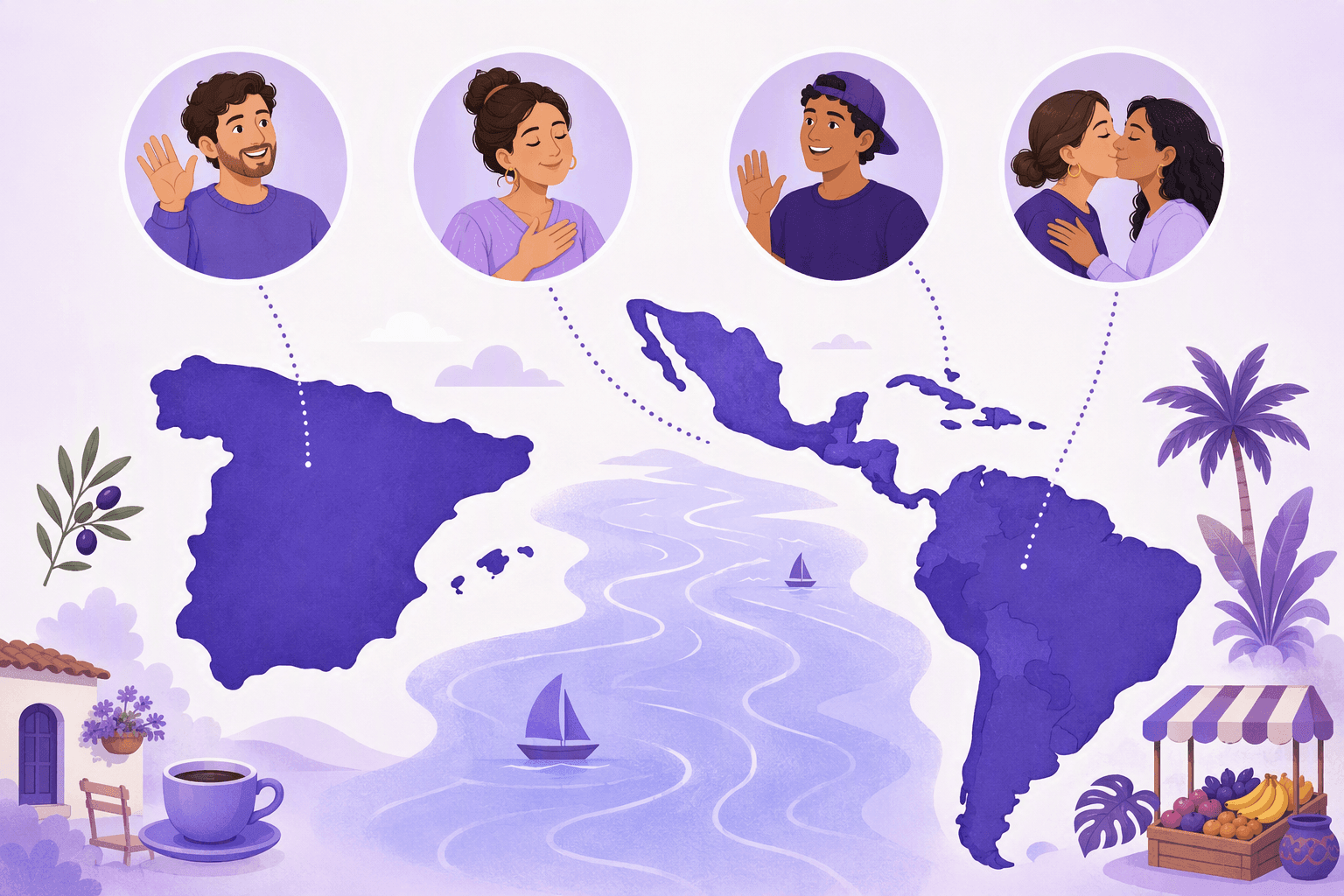
Spain: Buenas
In Spain, Buenas (BWEH-nahs) is a very common shortened greeting, especially in casual settings like small shops, bars, and among neighbors.
It can stand alone, or it can be followed by a check-in:
- “Buenas, ¿qué tal?”
Caribbean: rapid-fire greetings
In parts of the Caribbean, greetings can be fast and rhythmic, with lots of friendly repetition. You may hear shortened forms and playful intonation more than long phrases.
If you are learning Caribbean Spanish, training your ear matters as much as memorizing words. Start with how to learn a language with movies and focus on short, repeatable scenes.
Mexico: ¿Qué onda? and beyond
Mexico has a rich greeting ecosystem, from ¿Qué onda? to region-specific options. If you want to go deeper into Mexico-specific usage, compare it with the broader differences in Latin American vs Spain Spanish.
Common mistakes that make greetings sound unnatural
Overusing “¿Cómo estás?” with strangers
In English, “How are you?” can be a default with almost anyone. In Spanish, ¿Cómo estás? is usually for people you are familiar with, or at least people you are addressing with tú.
With strangers, prefer Buenos días or ¿Qué tal? depending on the vibe, or go formal with ¿Cómo está usted?
Translating “Nice to meet you” too literally
Learners sometimes try to build a direct translation and end up with something awkward. Spanish already has strong defaults: Mucho gusto, Encantado/a, Un placer.
Use the defaults and you will sound more natural immediately.
Forgetting that “Buenas noches” is both evening and night
English separates “good evening” and “good night”. Spanish often uses Buenas noches for both arriving at night and leaving at night.
If you want to be extra clear at bedtime, you can add something like “Que descanses”, but Buenas noches is still the core.
How to practice greetings with movie and TV clips
Greetings are short, high-frequency, and emotionally loaded, which makes them perfect for clip-based learning. You can practice the same line dozens of times without it feeling like homework.
Step 1: learn the “stack”
Native speakers stack greetings, especially when being polite:
- “Hola, buenos días.”
- “Buenas tardes, ¿qué tal?”
- “Hola, mucho gusto.”
Pick two stacks and make them automatic.
Step 2: copy the rhythm, not just the words
Spanish greeting rhythm is often smoother and faster than learners expect. Linguist John Lipski’s work on Spanish dialects highlights how pronunciation and rhythm shift across regions, and greetings are one of the first places you hear it.
When you repeat a clip, focus on:
- where the voice rises (friendly openness)
- where it falls (confidence, closure)
- how quickly vowels connect between words
Step 3: choose one “home base” variety
You do not need to sound like every country. Choose a base (Mexico, Spain, Colombia, etc.), then keep your greetings consistent.
If you mix “Buenas” from Spain with “¿Qué onda?” from Mexico in the same conversation, it can sound like costume language. Not wrong, just socially marked.
⚠️ Greetings and profanity
Some greetings blend into slang that can include profanity, especially among close friends. If you are curious, learn the boundaries first with Spanish swear words. Knowing what not to repeat is part of sounding natural.
A practical greeting script for real life
Use this like a template and swap pieces based on formality.
In a shop or cafe (polite, neutral)
- “Hola, buenos días.”
- “Hola, buenas tardes.”
If you need help:
- “Buenos días, ¿me puede ayudar?”
Meeting someone new (polite)
- “Hola, mucho gusto.”
- “Encantado/a.”
Follow-up:
- “¿De dónde eres?” (deh DON-deh EH-rehs) if it is socially appropriate
Greeting a friend (casual)
- “¡Hola! ¿Qué tal?”
- “¿Cómo estás?”
If it has been a while:
- “¡Cuánto tiempo!”
Leaving is part of greeting culture too
In Spanish, the greeting and the goodbye often mirror each other in politeness. If you want the full set of natural exits, see how to say goodbye in Spanish. Pairing a warm hello with a clean goodbye is a fast way to sound socially fluent.
Mini pronunciation notes that pay off fast
Spanish pronunciation is more consistent than English, but greetings still have a few traps.
Días
In días, the accent mark shows stress: DEE-ahs, not “dee-AHS”. Accent marks are not decoration, they change how the word is said (RAE).
Gusto
In gusto, the “u” is a clear OO sound: GOOSS-toh, not “gyoo-stoh”.
Usted
In usted, the stress is on the last syllable: oos-TEHD. In fast speech, it can shorten, but you should learn the clear form first.
If you want a structured approach to sound, combine this guide with Spanish pronunciation tips after you have your core greetings memorized.
One last cultural detail: greetings are relationship management
A greeting in Spanish often signals whether you are “in” or “out” of a social circle. Saying Buenos días to the building doorman every morning, or greeting coworkers individually, can matter more than perfect grammar.
Claire Kramsch’s work in language and culture emphasizes that language learning is also learning social meaning. Greetings are the easiest place to start because the feedback is immediate: people smile, relax, and respond.
If you want to keep building from greetings into real conversation, start with a short scene, repeat it, and then expand outward. Wordy’s clip method is built for exactly that: you learn what people actually say, in the moments they actually say it.
For your next step, add a few warm closings from how to say goodbye in Spanish, and if you are learning romantic Spanish, keep how to say I love you in Spanish bookmarked for when the context is right.
Frequently Asked Questions
What is the most common greeting in Spanish?
Is '¿Qué tal?' the same as 'How are you?'
How do you greet someone formally in Spanish?
Do Spanish greetings change by country?
What should I say when I meet someone for the first time in Spanish?
Sources & References
- Instituto Cervantes, El español en el mundo, 2024 annual report
- Ethnologue: Languages of the World, Spanish language entry (27th edition, 2024)
- Real Academia Española (RAE), Diccionario de la lengua española, 23rd edition
- FundéuRAE, recommendations on greetings and courtesy formulas (accessed 2026)
- Brown, P. & Levinson, S. C., Politeness: Some Universals in Language Usage, Cambridge University Press
Start learning with Wordy
Watch real movie clips and build your vocabulary as you go. Free to download.


