Quick Answer
Spanish food expressions turn everyday ingredients into vivid ways to talk about attraction, difficulty, gossip, luck, and personality. Learn the most useful idioms, what they mean, and when they sound natural in Spain and Latin America.
| English | Spanish | Pronunciation | Formality |
|---|---|---|---|
| Very easy | Pan comido | pahn koh-MEE-doh | casual |
| To overthink | Comerse el coco | koh-MEHR-seh el KOH-koh | slang |
| To be very attractive | Estar como un queso | ehs-TAHR KOH-moh oon KEH-soh | slang |
| To be very lucky | Tener mucha suerte | teh-NEHR MOO-chah SWEHR-teh | polite |
| To be very direct | No tener pelos en la lengua | noh teh-NEHR PEH-lohs en lah LEHNG-gwah | casual |
| To be very calm | Estar como una lechuga | ehs-TAHR KOH-moh OO-nah leh-CHOO-gah | casual |
Spanish expressions about food are everyday idioms that use bread, cheese, tomatoes, soup, and other ingredients to describe real life. If something is easy, it can be pan comido /pan koˈmi.ðo/. If you are overthinking, you may be comiéndote el coco /koˈmjendo.te el ˈkoko/. Learning these phrases helps you understand the humor, emotion, and casual rhythm of real Spanish conversations.
Spanish has more than 500 million native speakers, according to Instituto Cervantes estimates, and it is an official language in 20 countries. That scale means food idioms vary by region, but the expressions below are broadly understood or clearly marked when they are regional.
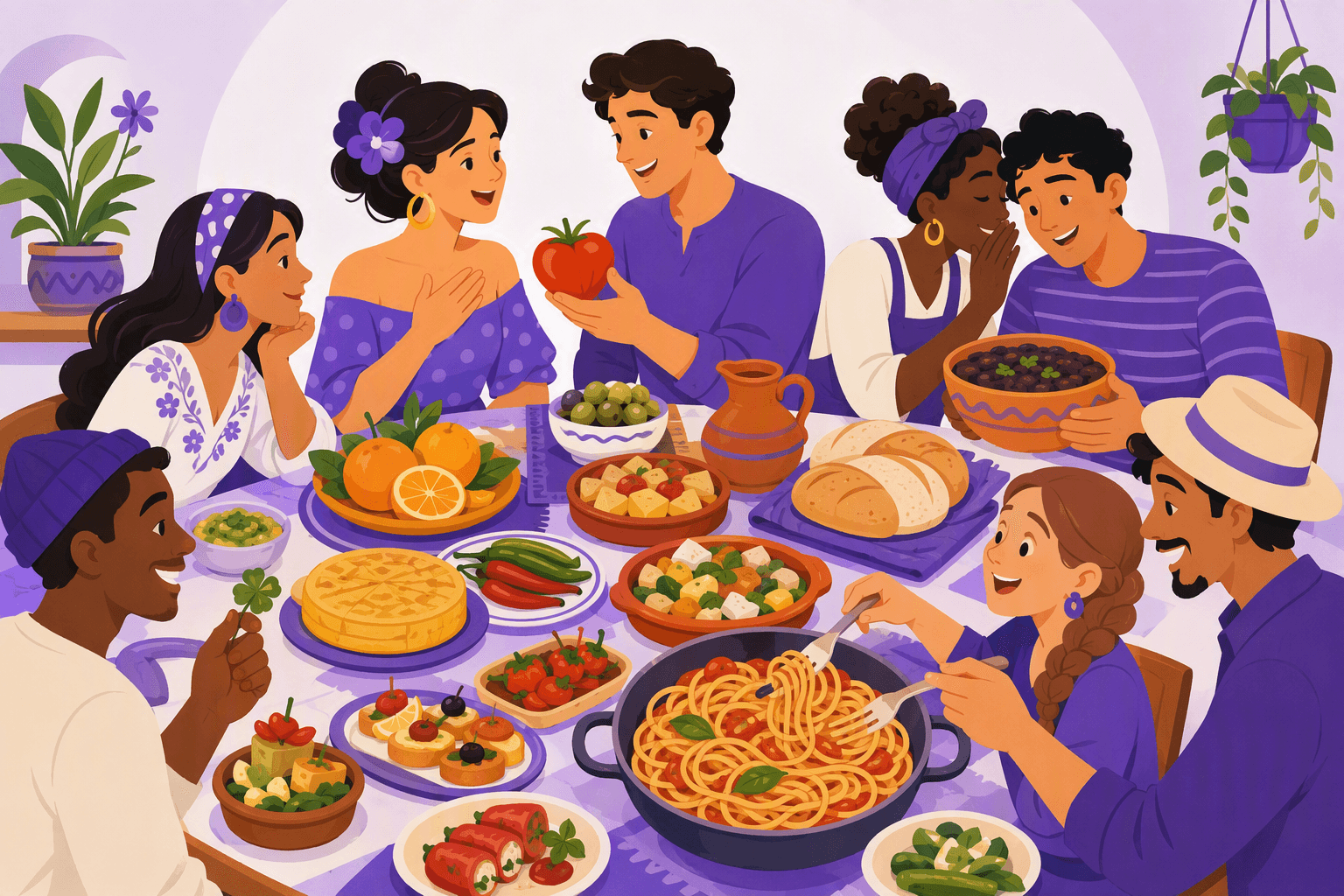
Food is especially productive in informal Spanish because meals are social events. A phrase about bread or cooking can signal warmth, teasing, frustration, admiration, or friendship in only a few words. You will hear many of these expressions in series, family conversations, and the kind of fast dialogue that makes Spanish movies worth watching so useful for learners.
Why food appears so often in Spanish idioms
Food is concrete, sensory, and shared. Everyone knows what stale bread, hot soup, ripe tomatoes, and a difficult recipe feel like, so they make memorable metaphors.
The Diccionario fraseológico documentado del español actual by Manuel Seco, Olimpia Andrés, and Gabino Ramos documents how fixed expressions preserve meanings that cannot be worked out word by word. That is the central rule for idioms: recognize the image, but learn the social meaning as a whole.
The Real Academia Española records many of these expressions in its dictionary, while the Asociación de Academias de la Lengua Española shows how vocabulary and usage shift across the Americas. Do not expect one food phrase to sound equally common in Madrid, Mexico City, Buenos Aires, and Bogotá.
🌍 Food idioms are social language
In Spanish-speaking families, food is often connected with hospitality, care, celebration, and opinion. That is why food expressions can feel playful and emotionally vivid rather than merely decorative.
Essential Spanish expressions about food
Pan comido
Pan comido /pan koˈmi.ðo/ literally means eaten bread, but its real meaning is very easy. It is one of the safest food idioms for learners because it is widely understood and rarely sounds rude.
You can use it after completing a task or to reassure someone before one. It often follows the verb ser /seɾ/: El examen fue pan comido /el ekˈsamen fwe pan koˈmi.ðo/, meaning the exam was a piece of cake.
The English equivalent is close in spirit, but the Spanish image is different. Bread is not a special dessert here, it is simply something easily eaten.
Estar como un queso
Estar como un queso /esˈtaɾ ˈkomo un ˈkeso/ means to be extremely attractive. The expression is informal and commonly used when talking about a celebrity, a crush, or someone a friend finds good-looking.
For example: Ese actor está como un queso /ˈese akˈtoɾ esˈta ˈkomo un ˈkeso/. It means that actor is very attractive.
⚠️ Use this one carefully
Estar como un queso comments on physical appearance. It can sound playful among friends, but saying it directly to someone you do not know can be awkward or objectifying. A warmer direct compliment is often Qué guapo /ke ˈɣwapo/ or Qué guapa /ke ˈɣwapa/.
For romantic language that is more personal and less appearance-focused, see how to say I love you in Spanish.
Comerse el coco
Comerse el coco /koˈmeɾse el ˈkoko/ means to overthink, worry intensely, or mentally exhaust yourself over a problem. The literal image is eating your own coconut, but coco is also an informal word for head or mind in Spain.
A friend might say: No te comas el coco por eso /no te ˈkomas el ˈkoko poɾ ˈeso/. The natural translation is do not stress yourself out about it.
This phrase is especially common in Spain. It is casual, so avoid it in a formal report or a serious workplace conversation unless the tone is clearly relaxed.
Importar un pepino
Importar un pepino /impoɾˈtaɾ un peˈpino/ means to matter very little or not at all. A pepino is a cucumber, and the phrase treats it as something trivial.
Me importa un pepino lo que diga /me imˈpoɾta un peˈpino lo ke ˈdiɣa/ means I do not care what he or she says. It can sound dismissive, so use it with people who understand your tone.
The phrase has stronger cousins, including importar un pimiento /impoɾˈtaɾ un piˈmjento/ and more vulgar options. If you want to understand stronger language without accidentally using it, read our guide to Spanish swear words.
Ser la leche
Ser la leche /seɾ la ˈletʃe/ is a famously flexible expression from Spain. Depending on intonation and context, it can mean something is brilliant, astonishing, outrageous, or unbelievable.
Esta película es la leche /ˈesta peˈlikula es la ˈletʃe/ is usually praise: this movie is amazing. Eres la leche /ˈeɾes la ˈletʃe/ can mean you are incredible, but a sarcastic voice can reverse the compliment.
The key is context. Facial expression, timing, and tone decide whether the speaker is impressed or irritated. This is exactly why watching scenes repeatedly, rather than memorizing isolated definitions, builds stronger listening skills.
Estar como una lechuga
Estar como una lechuga /esˈtaɾ ˈkomo una leˈtʃuɣa/ means to be very fresh, alert, or well-rested. A person who slept well may say: Hoy estoy como una lechuga /oi esˈtoi ˈkomo una leˈtʃuɣa/.
It can also be used ironically. If someone says it after a sleepless night, they probably mean the opposite.
This expression appears more often in Spain than in many Latin American regions. In Latin America, estar fresco /esˈtaɾ ˈfɾesko/ can be a clearer way to describe feeling fresh, although its meaning also varies by country.
No tener pelos en la lengua
No tener pelos en la lengua /no teˈneɾ ˈpelos en la ˈleŋɡwa/ literally means not to have hairs on your tongue. It describes someone who speaks bluntly, honestly, and without filtering their opinion.
Mi abuela no tiene pelos en la lengua /mi aˈβwela no ˈtj̯ene ˈpelos en la ˈleŋɡwa/ means my grandmother does not mince words. The phrase can be admiring when honesty is valued, or critical when the person is insensitive.
Food is not named in the phrase, but the mouth and eating imagery place it firmly within Spanish bodily and culinary metaphor. The Refranero multilingüe of Centro Virtual Cervantes is useful for seeing how proverbs and idioms carry cultural images across languages.
Ser un bombón
Ser un bombón /seɾ um bomˈbon/ means to be a sweetheart, an adorable person, or someone very attractive. A bombón is a chocolate candy, so the image is affectionate and sweet.
Aww, tu hija es un bombón /tu ˈixa es um bomˈbon/ is usually said warmly about a child. About an adult, it may emphasize attractiveness, depending on context.
Compared with estar como un queso /esˈtaɾ ˈkomo un ˈkeso/, this phrase often feels softer. Still, use it carefully with adults you do not know well.
Dar calabazas
Dar calabazas /daɾ kaˈlaβasas/ means to reject someone romantically. The literal translation is to give pumpkins, but the real message is a clear no.
Le dio calabazas /le ðjo kaˈlaβasas/ means she or he turned that person down. You may hear it in conversations about dating, school crushes, and romantic comedy plots.
The expression is more associated with Spain, although it is understood elsewhere. It is a vivid phrase to recognize in films, particularly when the plot includes a rejected invitation or confession.
Estar hasta en la sopa
Estar hasta en la sopa /esˈtaɾ ˈasta en la ˈsopa/ means to be everywhere, often to an annoying degree. If a singer dominates every advertisement, playlist, and conversation, you can say that they are hasta en la sopa.
For example: Ese anuncio está hasta en la sopa /ˈese aˈnunsjo esˈta ˈasta en la ˈsopa/. That advertisement is everywhere.
This is a useful complaint phrase, but it need not be hostile. People also use it humorously about a friend who appears in every photo or a topic that dominates the news.
Ser más bueno que el pan
Ser más bueno que el pan /seɾ mas ˈβweno ke el pan/ means to be exceptionally kind. Bread represents basic goodness and reliability, not physical attractiveness.
Mi vecino es más bueno que el pan /mi βeˈsino es mas ˈβweno ke el pan/ means my neighbor is incredibly kind. It is affectionate, natural, and suitable for describing someone you know.
Be careful with bueno /ˈβweno/. In Spanish, it can mean good, kind, tasty, or attractive depending on context. The surrounding words show which meaning is intended.
Food expressions that change by region
Regional variety is part of Spanish, not a problem to solve. Instituto Cervantes reports Spanish as a language with hundreds of millions of speakers across multiple continents, so locally meaningful phrases will always exist alongside international ones.
In Mexico, echarle mucha crema a tus tacos /eˈtʃaɾle ˈmutʃa ˈkɾema a tus ˈtakos/ means to boast or exaggerate your achievements. It evokes adding too much cream to tacos, making something richer than necessary.
In Argentina and Uruguay, ser un banana /seɾ um baˈnana/ can describe a foolish, showy, or unserious person. It is informal and can be insulting, so treat it as recognition vocabulary before trying it yourself.
In several countries, ser pan comido /seɾ pan koˈmi.ðo/ remains easy to understand, while the intensity of phrases such as ser la leche /seɾ la ˈletʃe/ changes sharply. Learners should choose broadly understood expressions first, then add local ones after hearing them used by people in that region.
💡 Learn the whole scene, not just the idiom
When you hear an expression in a show, note who says it, who they say it to, and whether the scene is teasing, romantic, angry, or ironic. The same words can change meaning through tone.
For broader context on regional differences, compare Spanish in Spain and Latin America. Even a basic greeting can shift in frequency and tone, as you can see in Spanish hello expressions.
How to remember Spanish food idioms
Start with the image. Bread is easy, a soup appears everywhere, cheese can be tempting, and a pumpkin can represent rejection. A memorable mental picture makes an idiom far easier to recall than a word-for-word translation.
Next, make one sentence about your own life. Say Este ejercicio es pan comido /ˈeste exeɾˈsisjo es pan koˈmi.ðo/ after an easy task, or No me voy a comer el coco /no me βoi a koˈmeɾ el ˈkoko/ when you decide to stop worrying.
Finally, listen for them in context. Spanish dialogue often moves quickly, but recurring fixed phrases stand out once you know them. Pair idioms with useful everyday phrases, including natural Spanish goodbyes, and you will sound more connected to the conversation rather than limited to textbook Spanish.
The practical takeaway
The best Spanish food expressions are not decorative extras. They are efficient, culturally familiar shortcuts for saying something is easy, someone is attractive, a person is direct, or a problem is taking up too much mental space.
Learn pan comido /pan koˈmi.ðo/ first, then add comerse el coco /koˈmeɾse el ˈkoko/ and estar hasta en la sopa /esˈtaɾ ˈasta en la ˈsopa/. Once you can recognize their tone in real scenes, these idioms become natural tools for understanding Spanish humor and everyday speech.
Frequently Asked Questions
What are Spanish food expressions?
What does estar como un queso mean in Spanish?
Is pan comido used in all Spanish-speaking countries?
What does no tener pelos en la lengua mean?
Can I use Spanish food idioms in formal situations?
Sources & References
- Real Academia Española, Diccionario de la lengua española, accessed 2026
- Asociación de Academias de la Lengua Española, Diccionario de americanismos, accessed 2026
- Instituto Cervantes, El español: una lengua viva, 2024
- Manuel Seco, Olimpia Andrés and Gabino Ramos, Diccionario fraseológico documentado del español actual, Aguilar
- Centro Virtual Cervantes, Refranero multilingüe, accessed 2026
Start learning with Wordy
Watch real movie clips and build your vocabulary as you go. Free to download.


