Quick Answer
In a Spanish-speaking emergency, say '¡Ayuda!' or '¡Auxilio!', call the local emergency number, state your location, and clearly explain what happened. Learn the phrases for police, medical help, fire, theft, allergies, and urgent travel situations below.
If you need emergency help in Spanish, say ¡Ayuda! /aˈʝu.ða/ or ¡Auxilio! /awkˈsi.ljo/, call the local emergency number, give your exact location, and state what happened in short sentences. The most useful line is Necesito ayuda /ne.seˈsi.to aˈʝu.ða/, meaning “I need help.” For an ambulance, say Necesito una ambulancia /ne.seˈsi.to u.na am.buˈlan.sja/.
Spanish is spoken by more than 600 million people worldwide, according to the Instituto Cervantes, including more than 500 million native speakers. It is an official language in 20 countries, so emergency numbers and local procedures vary, but the core phrases in this guide work across the Spanish-speaking world.
For everyday confidence before a trip, begin with our guide to saying hello in Spanish. In an emergency, though, clarity matters more than sounding polished.
| English | Spanish | Pronunciation | Formality |
|---|---|---|---|
| Help! | ¡Ayuda! | ah-YOO-dah | casual |
| Help! / Emergency! | ¡Auxilio! | owk-SEE-lyoh | formal |
| I need help. | Necesito ayuda. | neh-seh-SEE-toh ah-YOO-dah | polite |
| Call the police! | ¡Llame a la policía! | YAH-meh ah lah poh-lee-SEE-ah | formal |
| I need an ambulance. | Necesito una ambulancia. | neh-seh-SEE-toh OO-nah ahm-boo-LAHN-syah | polite |
| There is a fire. | Hay un incendio. | eye oon een-SEN-dyoh | formal |
| Please help me. | Por favor, ayúdeme. | por fah-BOR, ah-YOO-deh-meh | polite |
| I do not understand. | No entiendo. | noh en-TYEN-doh | polite |
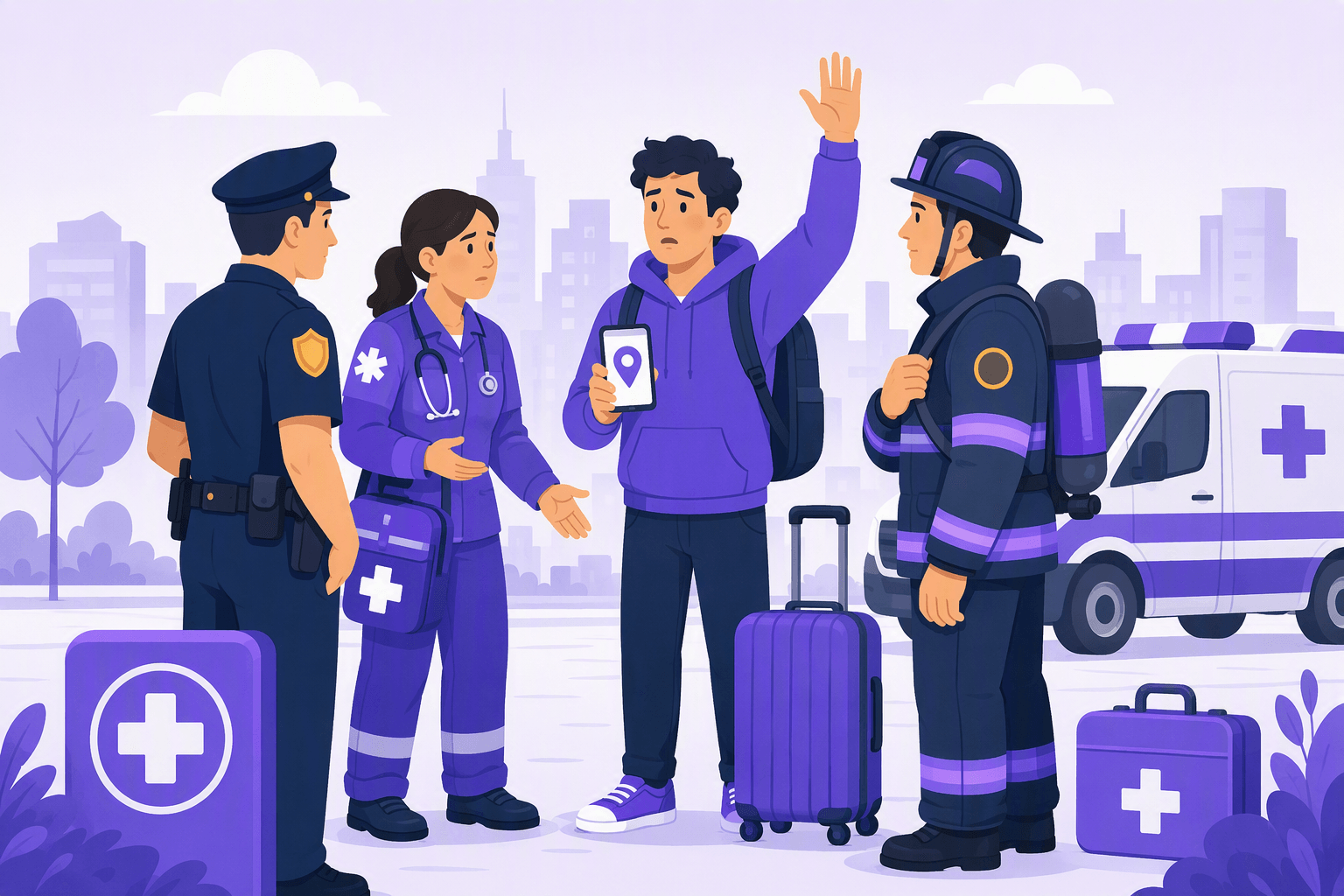
Start with the emergency number and your location
In Spain and throughout the European Union, 112 connects callers to emergency services free of charge. The European Commission states that 112 works across all EU member states, although local language support differs. Spain also uses 091 for Policía Nacional, 092 for local police in many municipalities, and 061 for some medical emergency systems, but 112 is the safest general number to remember.
In Mexico, Colombia, Argentina, Chile, Peru, and several other countries, 911 is the primary general emergency number. Procedures can change locally, especially in rural areas. Save the official number for your destination before you fly, and ask your hotel or host which service applies nearby.
When someone answers, lead with where you are. Say Estoy en... /esˈtoj en/, “I am at...” followed by a street, building, landmark, transit station, or hotel name. If you are unsure of the address, say No sé la dirección /no se la ði.ɾekˈsjon/, “I do not know the address,” and give visible details.
/es-TOY en/
Literal meaning: I am in or at...
“Estoy en el Hotel Central, en la calle Mayor.”
I am at the Hotel Central, on Calle Mayor.
Give a street, landmark, hotel, store, train station, or neighborhood first. Dispatchers need a location before they can send help.
Use a simple sequence:
- Estoy en... /esˈtoj en/, “I am at...”
- Necesito ayuda /ne.seˈsi.to aˈʝu.ða/, “I need help.”
- Hay un problema /aj um pɾoˈble.ma/, “There is a problem.”
- Una persona está herida /u.na peɾˈso.na esˈta eˈɾi.ða/, “A person is injured.”
Do not spend valuable time trying to explain every background detail. Emergency call operators need location, danger, number of people affected, and the most urgent symptom or threat.
Call for immediate help
¡Ayuda!
¡Ayuda! /aˈʝu.ða/ is the everyday cry for help. Use it when you need attention from people nearby, whether you have fallen, feel unsafe, have lost a child, or see someone who needs assistance.
Unlike English “help,” ayuda /aˈʝu.ða/ can also be a regular noun. You can ask ¿Me puede ayudar? /me ˈpwe.ðe a.ʝuˈðaɾ/, “Can you help me?” when the situation is serious but not immediately life-threatening.
¡Auxilio!
¡Auxilio! /awkˈsi.ljo/ is more urgent and dramatic. It signals immediate danger, such as an assault, a fire, or being trapped. You may hear it in films, news reports, and public warnings.
In real public spaces, shouting ¡Ayuda! /aˈʝu.ða/ can be more instantly recognizable to a wider group. Use ¡Auxilio! /awkˈsi.ljo/ when you need to communicate that the threat is immediate.
Socorro
Socorro /soˈko.ro/ also means urgent help or rescue. It remains widely understood but can sound more formal, old-fashioned, or theatrical than ¡Ayuda! /aˈʝu.ða/ in many everyday situations.
You may see socorro /soˈko.ro/ in names of rescue organizations or hear it in dramatic dialogue. Learn it for recognition, but use ¡Ayuda! /aˈʝu.ða/ or Necesito ayuda /ne.seˈsi.to aˈʝu.ða/ as your default.
⚠️ Do not wait for perfect Spanish
If someone is in immediate danger, call first. Say your location, use the words you know, and speak slowly. Pointing, showing an address on your phone, or asking a nearby person to speak can be more useful than trying to build a long sentence.
Police, theft, and personal safety
If you need police assistance, say Necesito a la policía /ne.seˈsi.to a la po.liˈsi.a/, “I need the police.” To tell someone else to call, use Llame a la policía /ˈʝa.me a la po.liˈsi.a/, the formal command “Call the police.”
For a theft, say Me robaron /me roˈβa.ɾon/, “I was robbed,” or Me han robado /me an roˈβa.ðo/, “I have been robbed.” If your documents are missing, say Me robaron el pasaporte /me roˈβa.ɾon el pa.saˈpoɾ.te/.
If you have lost rather than had something stolen, use He perdido mi pasaporte /e peɾˈði.ðo mi pa.saˈpoɾ.te/, “I have lost my passport.” The distinction matters for police reports and travel insurance.
| English | Spanish | Pronunciation | Note |
|---|---|---|---|
| Police | la policía | lah poh-lee-SEE-ah | Usually treated as a singular institution. |
| Thief | un ladrón | oon lah-DRON | Use una ladrona for a female thief. |
| I was robbed | Me robaron | meh roh-BAH-rohn | Useful for reporting theft or mugging. |
| My passport | mi pasaporte | mee pah-sah-POR-teh | Bring a copy of your passport when traveling. |
| I feel unsafe | No me siento seguro | noh meh SYEN-toh seh-GOO-roh | A female speaker says segura. |
| I am lost | Estoy perdido | es-TOY pehr-DEE-doh | A female speaker says perdida. |
Say No me siento seguro /no me ˈsjen.to seˈɣu.ɾo/ if you are male, or No me siento segura /no me ˈsjen.to seˈɣu.ɾa/ if you are female, for “I do not feel safe.” If someone is following you, say Me están siguiendo /me esˈtan siˈɣjen.do/, “They are following me.”
For a threat, Me está amenazando /me esˈta a.me.naˈsan.do/ means “He or she is threatening me.” Avoid confronting a thief or aggressor to retrieve property. Move toward a staffed business, hotel lobby, transit employee, or group of people, then call for help.
🌍 Police terminology changes by country
Spanish-speaking countries use different names for police forces. You may hear policía /po.liˈsi.a/, Guardia Civil /ˈɡwaɾ.ðja siˈβil/ in Spain, carabineros /ka.ɾa.biˈne.ɾos/ in Chile, or policía municipal /po.liˈsi.a mu.ni.siˈpal/ in local contexts. Saying la policía /la po.liˈsi.a/ is understood everywhere.
Medical emergencies and symptoms
For an ambulance, say Necesito una ambulancia /ne.seˈsi.to u.na am.buˈlan.sja/. If someone else needs one, say Necesita una ambulancia /ne.seˈsi.ta u.na am.buˈlan.sja/.
The phrase Es una emergencia médica /es u.na e.meɾˈxen.sja ˈme.ði.ka/ means “It is a medical emergency.” Spanish uses emergencia /e.meɾˈxen.sja/ for life-threatening or urgent situations. Urgencia /uɾˈxen.sja/ often refers to urgent care, including a hospital emergency department, commonly called urgencias /uɾˈxen.sjas/.
No puede respirar
No puede respirar /no ˈpwe.ðe res.piˈɾaɾ/ means “He or she cannot breathe.” This is one of the highest-priority phrases to communicate. Point to the person and state it clearly.
You can also say Le duele el pecho /le ˈdwe.le el ˈpe.tʃo/, “His or her chest hurts,” and Está inconsciente /esˈta iŋ.konˈsjen.te/, “He or she is unconscious.”
Está herido
Está herido /esˈta eˈɾi.ðo/ means “He is injured.” For a woman, say Está herida /esˈta eˈɾi.ða/. You can use Está sangrando /esˈta saŋˈɡɾan.do/, “He or she is bleeding,” for visible bleeding.
Say Ha tenido un accidente /a teˈni.ðo un ak.siˈðen.te/ for “He or she has had an accident.” If it was a traffic crash, Hay un accidente de coche /aj un ak.siˈðen.te ðe ˈko.tʃe/ is clear in Spain. In much of Latin America, carro /ˈka.ro/ or auto /ˈaw.to/ may be more common than coche /ˈko.tʃe/.
Tengo una alergia
Tengo una alergia /ˈteŋ.ɡo u.na aˈleɾ.xja/ means “I have an allergy.” If the reaction is serious, say Tengo una reacción alérgica /ˈteŋ.ɡo u.na re.akˈsjon aˈleɾ.xi.ka/ and name the trigger if you know it.
For medication needs, use Necesito mi medicamento /ne.seˈsi.to mi me.ði.kaˈmen.to/. Keep a written note in Spanish listing severe allergies, current medications, blood type if known, and emergency contact details.
The Pan American Health Organization emphasizes coordinated emergency care and clear communication between callers, dispatchers, and medical teams. That is why concrete facts beat elaborate grammar: symptom, timing, location, and number of patients.
Fire, accidents, and public danger
For a fire, say Hay un incendio /aj un inˈsen.djo/. If a building is burning, say El edificio está en llamas /el e.ðiˈfi.sjo esˈta en ˈʝa.mas/, “The building is on fire.”
Hay humo /aj ˈu.mo/ means “There is smoke,” while Hay una fuga de gas /aj u.na ˈfu.ɣa ðe ɣas/ means “There is a gas leak.” Leave the area before making a call if remaining inside is dangerous.
To warn people, shout ¡Cuidado! /kwiˈða.ðo/, “Careful!” or ¡Aléjense! /aˈle.xen.se/, “Move away!” In a crowd, direct commands can be useful, but do not put yourself at risk to manage the scene.
🌍 Use usted with emergency staff
In an emergency, use the respectful form usted /usˈteð/ with police, doctors, dispatchers, and unfamiliar adults. Say ¿Puede ayudarme? /ˈpwe.ðe a.ʝuˈðaɾ.me/ rather than a casual command. Direct, brief language is not rude when safety is at stake.
Tell people what you need
Spanish emergency communication relies heavily on a few flexible verbs. Necesito /ne.seˈsi.to/, “I need,” is the most valuable. Add a noun or action after it:
- Necesito un médico /ne.seˈsi.to um ˈme.ði.ko/, “I need a doctor.”
- Necesito un intérprete /ne.seˈsi.to un inˈteɾ.pɾe.te/, “I need an interpreter.”
- Necesito mi medicina /ne.seˈsi.to mi me.ðiˈsi.na/, “I need my medicine.”
- Necesito contactar a mi familia /ne.seˈsi.to kon.takˈtaɾ a mi faˈmi.lja/, “I need to contact my family.”
- Necesito ir al hospital /ne.seˈsi.to iɾ al os.piˈtal/, “I need to go to the hospital.”
If you do not understand, say No entiendo /no enˈtjen.do/. Then ask ¿Puede hablar más despacio? /ˈpwe.ðe aˈβlaɾ mas ðesˈpa.sjo/, “Can you speak more slowly?” and ¿Habla inglés? /ˈa.βla iŋˈɡles/, “Do you speak English?”
The Real Academia Española records both emergencia /e.meɾˈxen.sja/ and urgencia /uɾˈxen.sja/, but their everyday use differs by context. In hospitals, signs for urgencias /uɾˈxen.sjas/ often point to emergency treatment. On a call, emergencia /e.meɾˈxen.sja/ clearly communicates urgency.
A practical emergency script
Memorize this short script and adapt the blanks:
Hola, necesito ayuda. Estoy en [location]. Hay una emergencia. Una persona está [injured / unconscious / unable to breathe]. Por favor, mande una ambulancia.
The key Spanish is Hola /ˈo.la/, Necesito ayuda /ne.seˈsi.to aˈʝu.ða/, Estoy en /esˈtoj en/, Hay una emergencia /aj u.na e.meɾˈxen.sja/, and Mande una ambulancia /ˈman.de u.na am.buˈlan.sja/. Use mande /ˈman.de/ as a polite formal request to the dispatcher.
Researchers in emergency communication consistently stress the importance of exact location information and concise event descriptions. Linguist Francisco Moreno Fernández, in Variedades de la lengua española, also documents the wide regional diversity of Spanish. That diversity is real, but these core nouns and verbs remain broadly understandable from Madrid to Medellín and Mexico City.
Before travel, practice these lines aloud with a map open on your phone. For broader practical preparation, review Spanish travel phrases, learn Spanish medical vocabulary, and build confidence with Spanish pronunciation basics.
Stay calm, be specific, and get local help
The goal of emergency Spanish is not elegant conversation. It is getting the right person to the right place quickly. Use ¡Ayuda! /aˈʝu.ða/ to attract attention, Necesito una ambulancia /ne.seˈsi.to u.na am.buˈlan.sja/ for medical help, Llame a la policía /ˈʝa.me a la po.liˈsi.a/ for police, and Estoy en... /esˈtoj en/ to give your location.
Save these phrases offline before you travel. A greeting and a polite closing can still help when stress is high, so keep our guides to hello in Spanish and goodbye in Spanish nearby too.
Frequently Asked Questions
What number should I call in an emergency in Spanish-speaking countries?
How do I ask for an ambulance in Spanish?
What is the difference between ayuda and auxilio in Spanish?
Can I use English with Spanish emergency services?
How can I say that I do not understand Spanish during an emergency?
Sources & References
- Real Academia Española, Diccionario de la lengua española, accessed 2026
- Instituto Cervantes, El español una lengua viva, 2025
- European Commission, 112 Single European Emergency Number, accessed 2026
- Pan American Health Organization, Emergency Medical Services resources, accessed 2026
- FundéuRAE, recommendations on clear language and emergency communication, accessed 2026
Start learning with Wordy
Watch real movie clips and build your vocabulary as you go. Free to download.


