Quick Answer
Día de Muertos (DEE-ah deh MWEHR-tohs) is a Mexican tradition honoring deceased loved ones with altars (ofrendas), marigolds, food, photos, and visits to cemeteries, typically on November 1 and 2. In Spanish, you’ll hear phrases like 'Feliz Día de Muertos,' 'ofrenda,' 'calaverita,' and 'pan de muerto,' plus respectful ways to talk about someone who passed away.
Día de Muertos (DEE-ah deh MWEHR-tohs) is a Mexican tradition of honoring deceased loved ones through altars (ofrendas), offerings like food and drink, marigolds, candles, and visits to cemeteries, mainly on November 1 and 2. If you want to understand it in Spanish, focus on the everyday words people use, like ofrenda, cempasúchil, calavera, and respectful verbs like fallecer, because the language reflects the holiday’s tone: affectionate, intimate, and family-centered.
To build your Spanish for real conversations, pair this with practical basics like how to say hello in Spanish and how to say goodbye in Spanish, since many Día de Muertos moments are about greeting relatives, welcoming visitors, and saying farewell.
What Día de Muertos is (and what it is not)
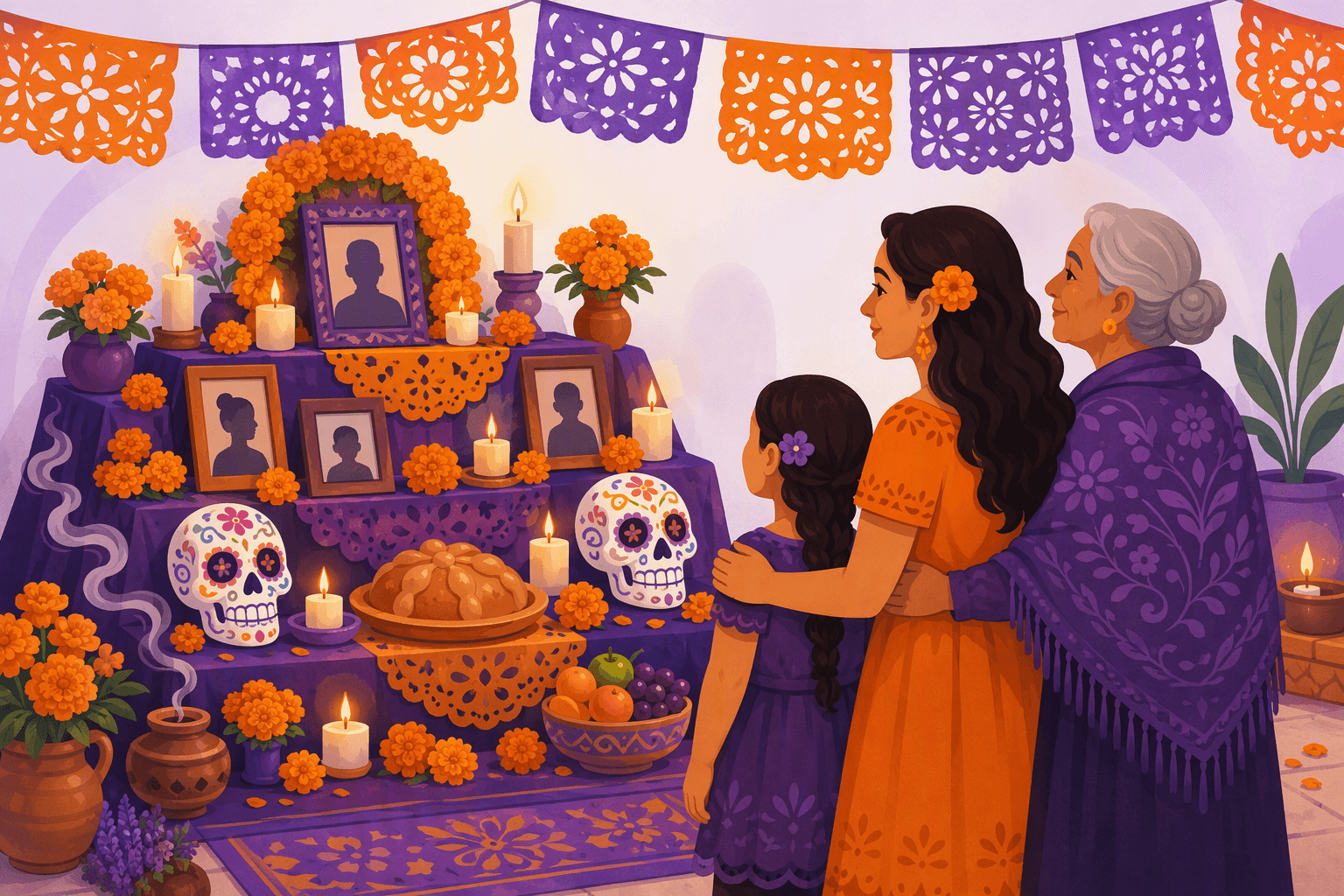
Día de Muertos is often described as a celebration of life through remembrance of the dead. UNESCO recognizes Mexico’s Indigenous festivity dedicated to the dead as Intangible Cultural Heritage, highlighting its community and family practices rather than a single “event” you attend once.
It is not simply “Mexican Halloween.” Halloween is a different tradition with different origins, and in Mexico the two can overlap in calendar time without being the same thing.
Dates: November 1 and November 2
In many places, November 1 is associated with Día de los Inocentes or Día de los Angelitos (children who died), and November 2 with adults. You will also hear people say the celebration lasts “from late October through November 2,” because families prepare early.
The exact rhythm depends on region, family, and whether the celebration is home-based, cemetery-based, or part of a public festival.
Why the Spanish words matter
Spanish is spoken by hundreds of millions of people worldwide, and it is the official language in 20 countries. Ethnologue estimates Spanish has over 500 million native speakers (Ethnologue, 27th ed., 2024), but Día de Muertos vocabulary is especially tied to Mexico and Mexican communities abroad.
The key point for learners is register. Many words around death have softer, respectful alternatives, and people choose them intentionally in family settings.
Linguist Claudio Lomnitz, in his work on death and Mexican culture, emphasizes that public symbols and private family practices can coexist. That’s exactly what you see in the language: playful imagery like calaveras alongside careful phrases like mi abuelita ya falleció.
Core traditions you’ll see and hear
The ofrenda (home altar)
An ofrenda (oh-FREHN-dah) is an altar or offering table. Families place photos, candles, flowers, food, and objects connected to the person being remembered.
You’ll often hear: poner la ofrenda (poh-NEHR lah oh-FREHN-dah), meaning “to set up the altar.”
The cemetery visit
Many families visit the cemetery to clean graves, bring flowers, and spend time together. In Spanish, this is often described simply and directly: vamos al panteón (VAH-mohs ahl pahn-teh-OHN).
In some regions, people say cementerio (seh-mehn-TEH-ryoh), but panteón is extremely common in Mexico.
Food and drink offerings
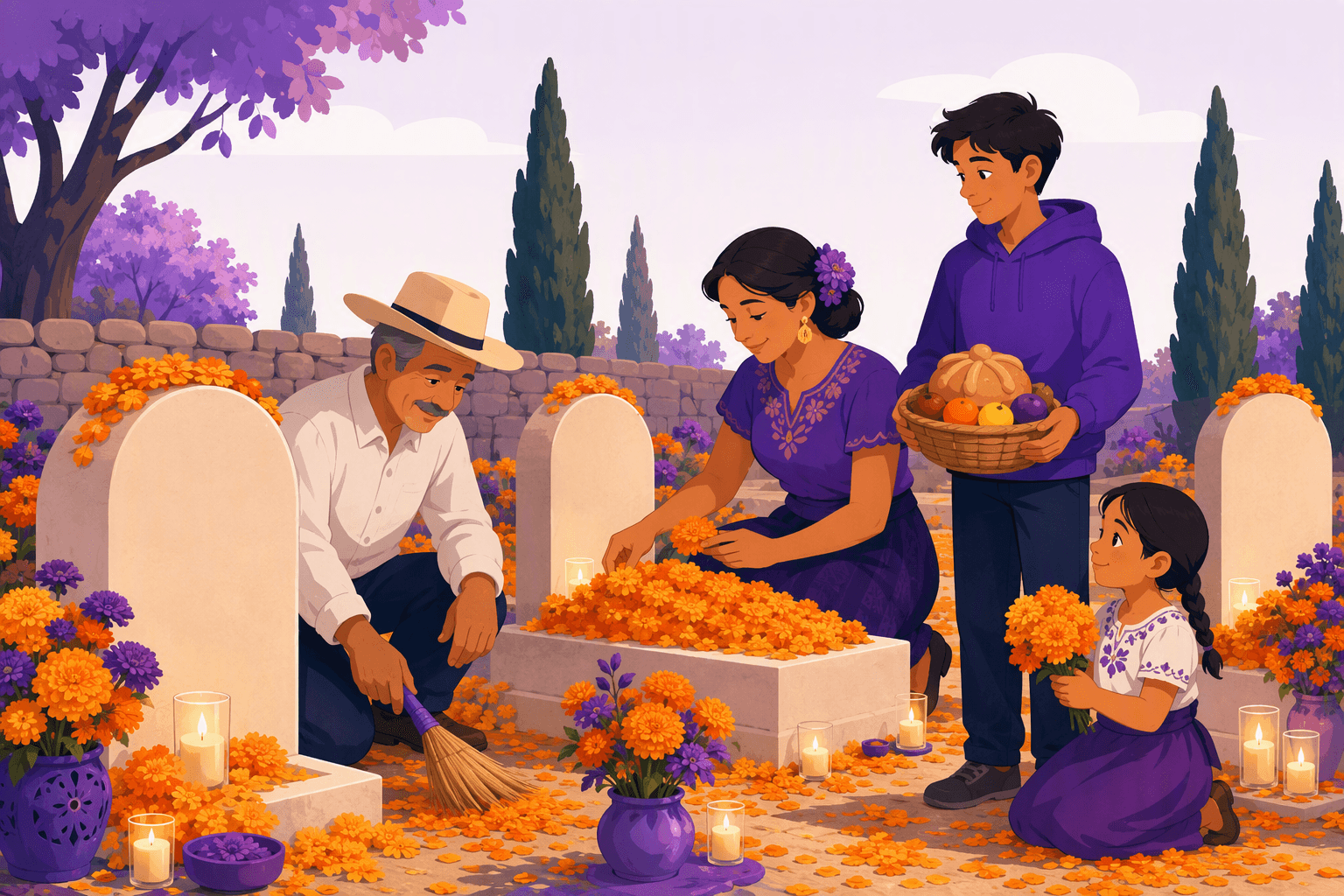
Offerings are not random. They are chosen because they were loved by the person being remembered, or because they are traditional to the season.
Two words you will hear constantly are pan de muerto (pahn deh MWEHR-toh) and calaveras de azúcar (kah-lah-VEH-rahs deh ah-SOO-kahr).
Flowers and scent
The iconic flower is cempasúchil (sehm-pah-SOO-cheel), the marigold used to guide and decorate. Many people talk about the scent as much as the color.
If you forget the word, you can still communicate by saying flor de muerto (flohr deh MWEHR-toh), which some people use as a descriptive label.
Calaveras: skulls, poems, and humor
Calavera (kah-lah-VEH-rah) can mean a skull image, a sugar skull, or even a short satirical poem, depending on context. Those poems are often called calaveritas (kah-lah-veh-REE-tahs).
The humor is usually affectionate and social, not cruel. Think “teasing the inevitability of death,” not “mocking someone’s loss.”
Spanish phrases you can actually use (with pronunciation)
Below are phrases that show up in greetings, invitations, and respectful conversation. Use them as building blocks, then adapt them to your situation.
| English | Spanish | Pronunciation | Formality |
|---|---|---|---|
| Happy Day of the Dead. | Feliz Día de Muertos. | feh-LEES DEE-ah deh MWEHR-tohs | polite |
| We're setting up the altar. | Estamos poniendo la ofrenda. | eh-STAH-mohs poh-NYEHN-doh lah oh-FREHN-dah | casual |
| We're going to the cemetery. | Vamos al panteón. | VAH-mohs ahl pahn-teh-OHN | casual |
| May they rest in peace. | Que descanse en paz. | keh dehs-KAHN-seh ehn pahss | formal |
| My grandma passed away. | Mi abuela falleció. | mee ah-BWEH-lah fah-yeh-SYOH | polite |
| We remember them with love. | Lo recordamos con cariño. | loh reh-kor-DAH-mohs kohn kah-REE-nyoh | polite |
| Do you want to come with us? | ¿Quieres venir con nosotros? | KYEH-rehs beh-NEER kohn noh-SOH-trohs | casual |
| Thank you for sharing that. | Gracias por compartirlo. | GRAH-syahs por kohm-par-TEER-loh | polite |
🌍 A tone check that matters
In many families, Día de Muertos talk is warm and even funny, but it is still respectful. If someone is sharing a story about a person who died, simple responses like "Gracias por compartirlo" can be more appropriate than jokes, especially if you are not close.
The vocabulary that unlocks most conversations
These words are more useful than memorizing long speeches. If you can recognize them, you can follow most Día de Muertos scenes in movies and TV.
| English | Spanish | Pronunciation | Note |
|---|---|---|---|
| altar, offering table | ofrenda | oh-FREHN-dah | Home or public altar with offerings and photos. |
| marigold (Mexican) | cempasúchil | sehm-pah-SOO-cheel | Iconic flower used to decorate and guide. |
| candle | vela | VEH-lah | Often placed on the ofrenda, symbol of light and remembrance. |
| incense | incienso | een-SYEHN-soh | Often copal in Mexico. |
| copal (resin incense) | copal | koh-PAHL | Traditional aromatic resin burned as incense. |
| skull | calavera | kah-lah-VEH-rah | Also used for sugar skulls and satirical poems. |
| little satirical skull poem | calaverita | kah-lah-veh-REE-tah | Short humorous verse, often written for friends. |
| cemetery (Mexico) | panteón | pahn-teh-OHN | Very common in Mexican Spanish. |
| grave | tumba | TOOM-bah | Also used in phrases like 'visitar la tumba'. |
| to pass away | fallecer | fah-yeh-SEHR | More formal and respectful than blunt alternatives. |
| to remember | recordar | reh-kor-DAHR | Often used with 'con cariño' or 'con amor'. |
| bread of the dead | pan de muerto | pahn deh MWEHR-toh | Sweet bread associated with the season. |
How to talk about death respectfully in Spanish
Spanish offers multiple ways to refer to death, and the choice signals empathy. This is not about being “correct,” it’s about matching the moment.
Fallecer vs morir
Fallecer (fah-yeh-SEHR) is a common respectful verb, especially when speaking to someone you do not know well. Morir (moh-REER) is neutral and direct, and it can be fine, but it can also feel blunt in sensitive contexts.
If you are unsure, choose fallecer.
Se nos fue, ya no está
You may hear softer, indirect expressions like se nos fue (seh nohs FWEH), “they’re gone,” or ya no está (yah noh eh-STAH), “they’re not here anymore.” These can sound very natural in family conversations.
This is a good place to remember a principle from Deborah Tannen’s work on conversational style: people often use indirectness to manage closeness and emotion. In Spanish, that indirectness can be a form of care.
A simple, safe condolence
If someone mentions a loss, you do not need a long response. Two short options:
- Lo siento mucho. (loh SYEHN-toh MOO-choh), “I’m very sorry.”
- Mis condolencias. (mees kohn-doh-LEHN-syahs), “My condolences.”
If you want more apology language, our excuse me and sorry in Spanish guide goes deeper into tone and context.
Regional variation inside Mexico (and why it matters)
Mexico is culturally diverse, and Día de Muertos looks different across regions. Public parades and large city events can be very visible, but many families experience the holiday primarily at home and in cemeteries.
INAH and Mexico’s Secretaría de Cultura regularly highlight local practices, from specific foods to local cemetery customs. When you learn the vocabulary, you can notice these differences instead of treating the holiday as one fixed script.
🌍 A useful learner mindset
Treat Día de Muertos as a family practice first, and a public festival second. In Spanish, people often talk about it with possessives and family words: "mi mamá," "mi abuelo," "en mi casa," "nuestra ofrenda." That grammar points you to what the tradition centers: relationships.
Día de Muertos in movies and TV: what to listen for
Because Wordy teaches through real clips, here’s what tends to show up in dialogue:
Fast, casual planning language
You’ll hear short present-progressive and near-future planning:
- Estamos haciendo... (eh-STAH-mohs ah-SYEHN-doh), “We’re making…”
- Vamos a comprar... (VAH-mohs ah kohm-PRAHR), “We’re going to buy…”
If you want to get comfortable with this style of speech, it helps to know the most frequent glue words. Our 100 most common Spanish words list is built exactly for that.
Family roles and affection
Día de Muertos scenes are full of kinship terms and affectionate talk. Pair this article with how to say I love you in Spanish if you want natural ways to express warmth that do not sound like a textbook.
Humor that stays inside the family
You may hear playful teasing, nicknames, and jokes, but usually aimed at the living, not at the deceased. If you copy slang from a scene without understanding who is speaking to whom, you can sound rude fast.
If you want a clear boundary line, keep strong slang out of family settings, especially around cemeteries. If you are curious about intensity and context, our Spanish swear words guide explains severity and when not to use it.
Common mistakes learners make (and easy fixes)
Mistake 1: Saying it like a party invite only
Feliz Día de Muertos is fine, but if someone is actively grieving, a “happy” greeting can feel off. In those moments, use empathy language:
- Lo siento mucho.
- Te acompaño en el sentimiento. (teh ah-kohm-PAH-nyoh ehn el seen-tee-MYEHN-toh), a formal condolence.
Mistake 2: Treating calaveras as “spooky”
In many contexts, calaveras are bright, decorative, and playful. If you describe them as “scary,” you might miss the point.
A better description is coloridas (koh-loh-REE-dahs), “colorful,” or llenas de significado (YEH-nahs deh seek-nee-fee-KAH-doh), “full of meaning.”
Mistake 3: Mispronouncing key words
Pronunciation does not need to be perfect, but stress and vowels matter for being understood.
- Día: DEE-ah (two clear vowels)
- Muertos: MWEHR-tohs (the “muer” is one syllable)
- Ofrenda: oh-FREHN-dah (stress on FREHN)
- Cempasúchil: sehm-pah-SOO-cheel (stress on SOO)
A short, respectful script you can borrow
If you’re attending a community event or visiting with a Mexican family, here is a simple Spanish flow that works in many situations:
- Greeting: Hola, mucho gusto. (OH-lah MOO-choh GOOS-toh)
- Interest: Es mi primera vez en Día de Muertos. (ehss mee pree-MEH-rah behss ehn DEE-ah deh MWEHR-tohs)
- Question: ¿Me explicas qué significa esta ofrenda? (meh ehk-SPLEE-kahs keh seeg-NEE-fee-kah EHS-tah oh-FREHN-dah)
- Appreciation: Gracias por compartirlo. (GRAH-syahs por kohm-par-TEER-loh)
Short, curious, and not performative is the goal.
If you want to learn Spanish through Día de Muertos scenes
Día de Muertos content is great for Spanish learners because it repeats concrete nouns (flowers, candles, bread, photos) and high-frequency verbs (put, bring, go, remember). It also teaches you cultural pragmatics, how people soften sensitive topics and show warmth through small phrases.
If you want more everyday Spanish you can actually use, keep going with how to say hello in Spanish and how to say goodbye in Spanish, then practice listening with real dialogue on /learn/spanish.
Frequently Asked Questions
What does 'Día de Muertos' mean in English?
Is Día de Muertos celebrated only in Mexico?
How do you say 'Happy Day of the Dead' in Spanish?
What is an 'ofrenda' and how do you pronounce it?
What Spanish words should I avoid using casually during Día de Muertos?
Sources & References
- UNESCO, Intangible Cultural Heritage: Indigenous festivity dedicated to the dead (accessed 2026)
- Instituto Nacional de Antropología e Historia (INAH), Día de Muertos resources (accessed 2026)
- Secretaría de Cultura (México), Día de Muertos materials (accessed 2026)
- Ethnologue, 27th edition, 2024
- Real Academia Española (RAE), Diccionario de la lengua española entries (accessed 2026)
Start learning with Wordy
Watch real movie clips and build your vocabulary as you go. Free to download.


