Quick Answer
To communicate at a hotel in Spanish, start with Tengo una reserva for 'I have a reservation,' then use Quisiera una habitación for polite requests and La cuenta, por favor when checking out. These practical phrases cover arrival, room issues, amenities, and polite interaction with hotel staff.
To speak Spanish at a hotel, learn a few polite, practical sentences: Tengo una reserva /ˈteŋ.ɡo u.na reˈseɾ.βa/ for “I have a reservation,” Quisiera una habitación /kiˈsje.ɾa u.na aβitaˈsjon/ for “I would like a room,” and La cuenta, por favor /la ˈkwen.ta poɾ faˈβoɾ/ for “The bill, please.” These phrases will handle check-in, room requests, problems, breakfast, and checkout in Spain and Latin America.
Spanish is an official language in 20 countries, and Instituto Cervantes estimates that more than 500 million people speak it as a native language. Hotel staff in tourist areas may speak English, but clear Spanish makes every interaction easier, especially at smaller hotels, guesthouses, and family-run properties.
Before arriving, review the basics of how to say hello in Spanish. A simple greeting and a polite request create a much better first impression than opening with a translated sentence from your phone.
| English | Spanish | Pronunciation | Formality |
|---|---|---|---|
| I have a reservation | Tengo una reserva | TEN-goh OO-nah reh-SEHR-bah | polite |
| I would like a room | Quisiera una habitación | kee-SYEH-rah OO-nah ah-bee-tah-SYON | polite |
| What time is check-in? | ¿A qué hora es el check-in? | ah keh OH-rah ess el CHEK-in | polite |
| Can I leave my luggage? | ¿Puedo dejar mi equipaje? | PWEH-doh deh-HAR mee eh-kee-PAH-heh | polite |
| The room key, please | La llave de la habitación, por favor | lah YAH-beh deh lah ah-bee-tah-SYON por fah-BOR | polite |
| I need help | Necesito ayuda | neh-seh-SEE-toh ah-YOO-dah | polite |
| Thank you very much | Muchas gracias | MOO-chahs GRAH-syahs | polite |
| See you later | Hasta luego | AH-stah LWEH-goh | casual |
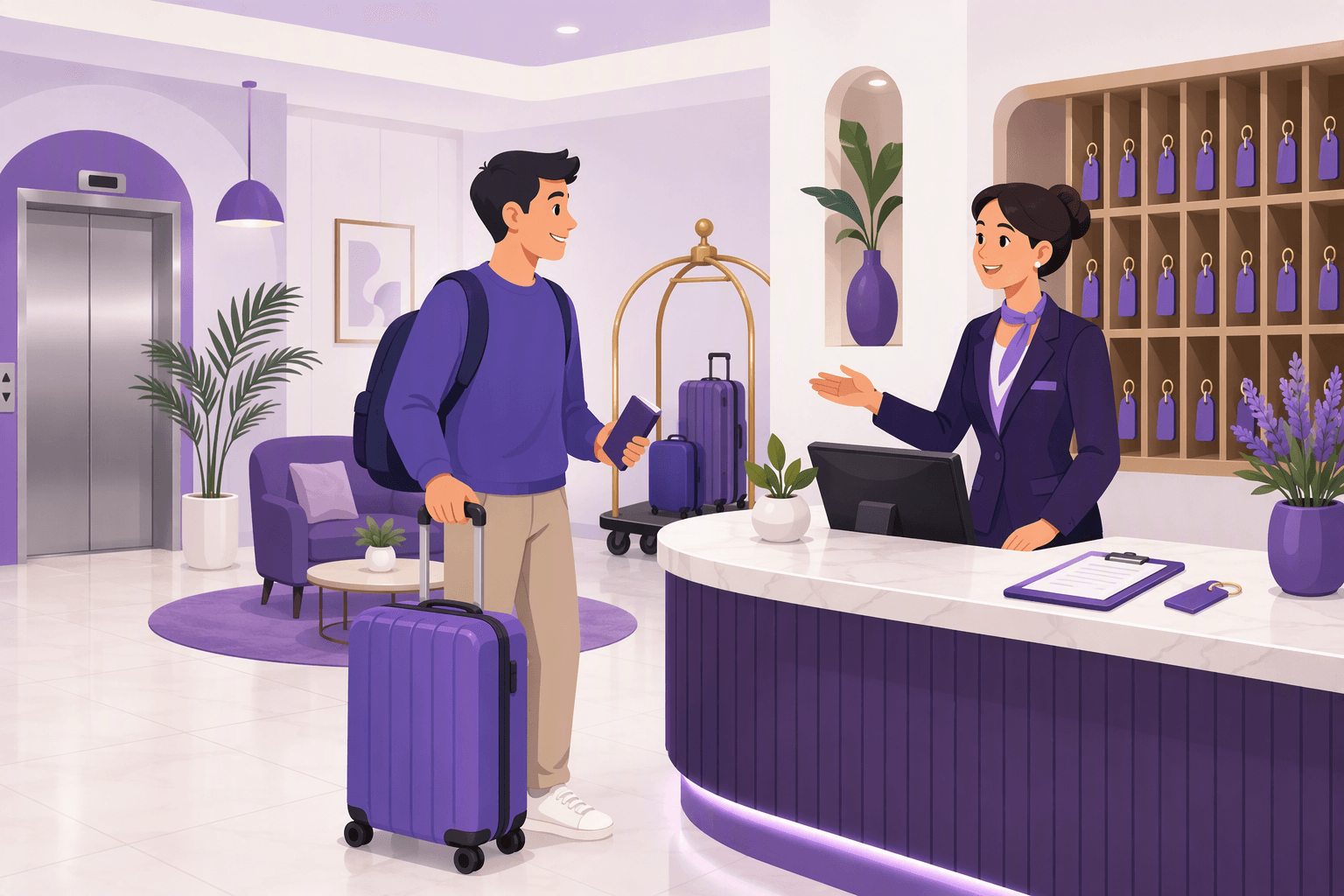
The polite hotel Spanish you need
Spanish hotel conversations are usually built around three useful tools: a greeting, a request with quisiera /kiˈsje.ɾa/, and a closing such as gracias /ˈɡɾa.sjas/. The word quisiera is the conditional form of querer, “to want,” but functions as a courteous “I would like.”
This matters because Spanish has several ways to request something. Quiero /ˈkje.ɾo/, “I want,” is grammatically fine but can sound blunt with staff. Quisiera and me gustaría /me ɣustaˈɾi.a/, “I would like,” are safer choices for visitors.
Research on interactional politeness by Penelope Brown and Stephen Levinson describes how indirect requests reduce social pressure. In practical hotel Spanish, that principle is simple: use por favor /poɾ faˈβoɾ/, frame requests politely, and say gracias /ˈɡɾa.sjas/ after help is offered.
💡 The easiest polite pattern
Use Quisiera + noun for almost anything you need. For example: Quisiera una toalla más /kiˈsje.ɾa u.na toˈa.ʎa mas/, “I would like one more towel.”
Llegada
Tengo una reserva
Tengo una reserva /ˈteŋ.ɡo u.na reˈseɾ.βa/ means “I have a reservation.” It is the core check-in phrase and works at hotels, hostels, rural guesthouses, and vacation rentals with a staffed desk.
Add a nombre de /a ˈnom.bɾe ðe/, “under the name of,” before the name used for booking. Spanish hotels commonly ask for a passport or identity document, so have it ready when you use this sentence.
/TEN-goh OO-nah reh-SEHR-bah ah NOHM-breh deh/
Literal meaning: I have a reservation in the name of...
“Tengo una reserva a nombre de García.”
I have a reservation under the name García.
Use this immediately after greeting the receptionist. Give the surname exactly as it appears on the booking confirmation.
Quisiera hacer el check-in
In many Spanish-speaking hotels, staff use check-in /ˈtʃek.in/ and check-out /ˈtʃek.aut/ as English loanwords. You may also hear registrarse /rex.isˈtɾaɾ.se/, “to register,” especially in more formal settings.
Say Quisiera hacer el check-in /kiˈsje.ɾa aˈseɾ el ˈtʃek.in/ if you are ready to register. If you arrive early, ask ¿Puedo hacer el check-in antes? /ˈpwe.ðo aˈseɾ el ˈtʃek.in ˈan.tes/, “Can I check in earlier?”
¿A qué hora es el check-in?
Ask ¿A qué hora es el check-in? /a ke ˈo.ɾa es el ˈtʃek.in/ to confirm arrival time. A receptionist may answer A partir de las tres /a paɾˈtiɾ ðe las tɾes/, meaning “from three o’clock onward.”
If your room is not ready, try ¿Puedo dejar mi equipaje? /ˈpwe.ðo deˈxaɾ mi ekiˈpaxe/. This means “Can I leave my luggage?” The noun equipaje is uncountable in Spanish, so do not make it plural.
La habitación
¿Tiene una habitación disponible?
¿Tiene una habitación disponible? /ˈtje.ne u.na aβitaˈsjon dispoˈni.βle/ means “Do you have a room available?” Use it when you are walking in without a reservation.
In Spain, habitación doble /aβitaˈsjon ˈðo.βle/ can mean a room for two people, often with one double bed. If bed configuration matters, ask directly whether it has una cama doble /u.na ˈka.ma ˈðo.βle/ or dos camas individuales /dos ˈka.mas indiβiˈðwa.les/, two single beds.
/TYEH-neh OO-nah ah-bee-tah-SYON dees-poh-NEE-bleh/
Literal meaning: Do you have an available room?
“Buenas tardes, ¿tiene una habitación disponible para dos personas?”
Good afternoon, do you have a room available for two people?
Use usted-form tiene with hotel staff. It remains polite throughout Spain and Latin America.
La llave de la habitación
For “room key,” say la llave de la habitación /la ˈʎa.βe ðe la aβitaˈsjon/. Many hotels use key cards, but llave remains the everyday word staff may use.
You might hear Aquí tiene su tarjeta /aˈki ˈtje.ne su taɾˈxe.ta/, “Here is your card.” In that context, tarjeta means card, not necessarily a payment card.
¿Cuál es la contraseña del wifi?
Ask ¿Cuál es la contraseña del wifi? /kwal es la kontɾaˈse.ɲa ðel ˈwi.fi/ for the Wi-Fi password. In Spain, you may also see wifi written as wi-fi, and both forms are familiar in speech.
The Real Academia Española records contraseña as the standard word for password. Avoid relying on English password when staff may be helping several guests quickly.
| English | Spanish | Pronunciation | Note |
|---|---|---|---|
| room | habitación | ah-bee-tah-SYON | Also used for a hotel room. |
| reservation | reserva | reh-SEHR-bah | Booking or reservation. |
| key | llave | YAH-beh | Can refer to a physical room key. |
| key card | tarjeta | tahr-HEH-tah | Context usually makes the meaning clear. |
| luggage | equipaje | eh-kee-PAH-heh | Normally singular as a collective noun. |
| elevator | ascensor | ah-sen-SOR | Common in Spain and much of Latin America. |
| floor | piso | PEE-soh | Also means apartment in Spain. |
| breakfast | desayuno | deh-sah-YOO-noh | Usually included or offered at hotels. |
Problemas en la habitación
Travel problems are easier to solve when you say the issue plainly, then ask for help. Start with Disculpe /disˈkul.pe/, “Excuse me,” or Perdón /peɾˈðon/, “Sorry/excuse me.”
The useful negative structure is no funciona /no fuŋˈsjo.na/, “does not work.” You can attach it to almost any item in the room: the air conditioning, shower, television, light, or safe.
El aire acondicionado no funciona
El aire acondicionado no funciona /el ˈaj.ɾe akondisjoˈnaðo no fuŋˈsjo.na/ means “The air conditioning does not work.” In hot climates, be direct and report it promptly.
For heating, say La calefacción no funciona /la kalefakˈsjon no fuŋˈsjo.na/. Spanish varies by region, as Francisco Moreno Fernández explains in Variedades de la lengua española, but these hotel terms are widely understood.
/el AH-ee-reh ah-kon-dee-syoh-NAH-doh noh foon-SYOH-nah/
Literal meaning: The conditioned air does not function
“Disculpe, el aire acondicionado no funciona en mi habitación.”
Excuse me, the air conditioning does not work in my room.
State the room number after explaining the issue. Reception may send maintenance or offer another room.
No hay agua caliente
No hay agua caliente /no ai ˈa.ɣwa kaˈljen.te/ means “There is no hot water.” The expression no hay literally means “there is not” or “there are not.”
For a plumbing problem, say El baño está inundado /el ˈba.ɲo esˈta inuŋˈda.ðo/, “The bathroom is flooded.” If you need clean towels, ask ¿Me puede traer toallas limpias? /me ˈpwe.ðe tɾaˈeɾ toˈa.ʎas ˈlim.pjas/.
Hay mucho ruido
Hay mucho ruido /ai ˈmu.tʃo ˈrwi.ðo/ means “There is a lot of noise.” If noise is preventing sleep, use No puedo dormir /no ˈpwe.ðo doɾˈmiɾ/, “I cannot sleep.”
Be specific but calm: Hay mucho ruido en el pasillo /ai ˈmu.tʃo ˈrwi.ðo en el paˈsi.ʎo/, “There is a lot of noise in the hallway.” Hotel staff can then identify whether the source is a neighboring room, street noise, or an event.
🌍 Spain and Latin America are not one hotel culture
Service routines, meal times, and forms of address differ across 20 Spanish-speaking countries. In Spain, late dinners and later hotel breakfast hours are common. In many Latin American destinations, warm personal greetings may be more expected. Polite standard Spanish works reliably in all regions.
Desayuno y servicios
¿A qué hora es el desayuno?
¿A qué hora es el desayuno? /a ke ˈo.ɾa es el desaˈʝu.no/ asks what time breakfast is. Ask ¿El desayuno está incluido? /el desaˈʝu.no esˈta iŋˈklu.i.ðo/ if you are unsure whether it is included in your rate.
To find the breakfast room, ask ¿Dónde se sirve el desayuno? /ˈdon.de se ˈsiɾ.βe el desaˈʝu.no/. The verb servir means “to serve,” and is especially useful in restaurants and hotels.
For dietary needs, say Soy vegetariano /soi βexetaˈɾja.no/ if you are male or Soy vegetariana /soi βexetaˈɾja.na/ if you are female. If you have an allergy, say Tengo alergia a... /ˈteŋ.ɡo aleɾˈxia a/, followed by the food.
¿Hay lavandería?
Ask ¿Hay lavandería? /ai laβandeˈɾi.a/ for laundry service or laundry facilities. For a taxi, say ¿Puede llamar un taxi, por favor? /ˈpwe.ðe ʎaˈmaɾ un ˈtak.si poɾ faˈβoɾ/.
Many hotel staff members will ask ¿Necesita algo más? /neseˈsi.ta ˈal.ɣo mas/, “Do you need anything else?” You can reply No, gracias, eso es todo /no ˈɣɾa.sjas ˈe.so es ˈto.ðo/, “No, thank you, that is all.”
Salida
Quisiera hacer el check-out
At departure, say Quisiera hacer el check-out /kiˈsje.ɾa aˈseɾ el ˈtʃek.aut/. If you need to leave luggage after checking out, use ¿Puedo guardar el equipaje hasta esta tarde? /ˈpwe.ðo ɣwaɾˈðaɾ el ekiˈpaxe ˈas.ta ˈes.ta ˈtaɾ.ðe/.
To request the final bill, say La cuenta, por favor /la ˈkwen.ta poɾ faˈβoɾ/. In some hotels, staff may say la factura /la fakˈtu.ɾa/ for an official invoice, particularly if you need documentation for work expenses.
/lah KWEN-tah por fah-BOR/
Literal meaning: The account, please
“Buenos días, quisiera hacer el check-out. La cuenta, por favor.”
Good morning, I would like to check out. The bill, please.
Cuenta is used for a bill in hotels and restaurants. Ask for factura when you specifically need an official invoice.
¿Puedo pagar con tarjeta?
¿Puedo pagar con tarjeta? /ˈpwe.ðo paˈɣaɾ kon taɾˈxe.ta/ means “Can I pay by card?” While card payment is widespread, asking is sensible at independent properties and in areas where a payment terminal may be unavailable.
To leave politely, say Muchas gracias por todo /ˈmu.tʃas ˈɣɾa.sjas poɾ ˈto.ðo/, “Thank you very much for everything.” Follow it with Hasta luego /ˈas.ta ˈlwe.ɣo/ or review more options in our guide to saying goodbye in Spanish.
Practice with real hotel dialogue
Memorizing isolated vocabulary helps, but hotel Spanish becomes automatic when you hear phrases in context. Watch short scenes, pause after a receptionist’s line, repeat it aloud, and then change one detail: the room number, number of guests, or item you need.
This approach supports what Paul Nation’s work on vocabulary learning emphasizes: frequent encounters and meaningful use make words more retrievable. Practice one mini-dialogue until it feels easy, rather than trying to memorize all 35 expressions at once.
Try this short exchange:
Recepcionista: Buenas tardes, ¿en qué puedo ayudarle?
/ˈbwe.nas ˈtaɾ.des en ke ˈpwe.ðo aʝuˈðaɾ.le/
You: Tengo una reserva a nombre de Taylor.
/ˈteŋ.ɡo u.na reˈseɾ.βa a ˈnom.bɾe ðe ˈtei.loɾ/
Recepcionista: Perfecto. Aquí tiene la llave de su habitación.
/peɾˈfek.to aˈki ˈtje.ne la ˈʎa.βe ðe su aβitaˈsjon/
You: Muchas gracias. ¿A qué hora es el desayuno?
/ˈmu.tʃas ˈɣɾa.sjas a ke ˈo.ɾa es el desaˈʝu.no/
If you can confidently complete that conversation, you are prepared for a normal check-in. For broader travel language, use our essential Spanish travel phrases, and practice listening to natural dialogue through Spanish movie and TV clips on Wordy’s Spanish learning page.
Frequently Asked Questions
How do I say I have a reservation in Spanish?
What is the polite way to ask for something at a hotel in Spanish?
Can I use English at hotels in Spain and Latin America?
How do I ask what time breakfast is in Spanish?
What should I say if there is a problem with my hotel room in Spanish?
Sources & References
- Instituto Cervantes, El español: una lengua viva, 2024
- Real Academia Española, Diccionario de la lengua española, accessed 2026
- FundéuRAE, Recomendaciones sobre lenguaje de turismo y hostelería, accessed 2026
- Moreno Fernández, Variedades de la lengua española, Routledge
- Brown and Levinson, Politeness: Some Universals in Language Usage, Cambridge University Press
Start learning with Wordy
Watch real movie clips and build your vocabulary as you go. Free to download.


