Quick Answer
Spanglish is the fluid use of Spanish and English in the same conversation, sentence, or community. It is not broken Spanish or broken English: it is a natural bilingual practice shaped by region, identity, family, media, and the situation.
Spanglish is the flexible mixing of Spanish and English by bilingual speakers, often within one conversation or even one sentence. It can involve switching languages, adapting English words to Spanish grammar, or using expressions that make sense inside a particular bilingual community. It is not simply “bad Spanish”: for millions of speakers, it is a normal part of family life, friendship, humor, work, music, and identity.
You will hear Spanglish most often in the United States, Puerto Rico, and communities with sustained contact between English and Spanish. If you are learning Spanish, the goal is not to replace standard Spanish with Spanglish. The useful skill is knowing what you are hearing, why it works, and when clear standard Spanish is the better choice. Start with everyday basics such as Spanish greetings, then learn how bilingual speakers bend and combine those resources in real life.
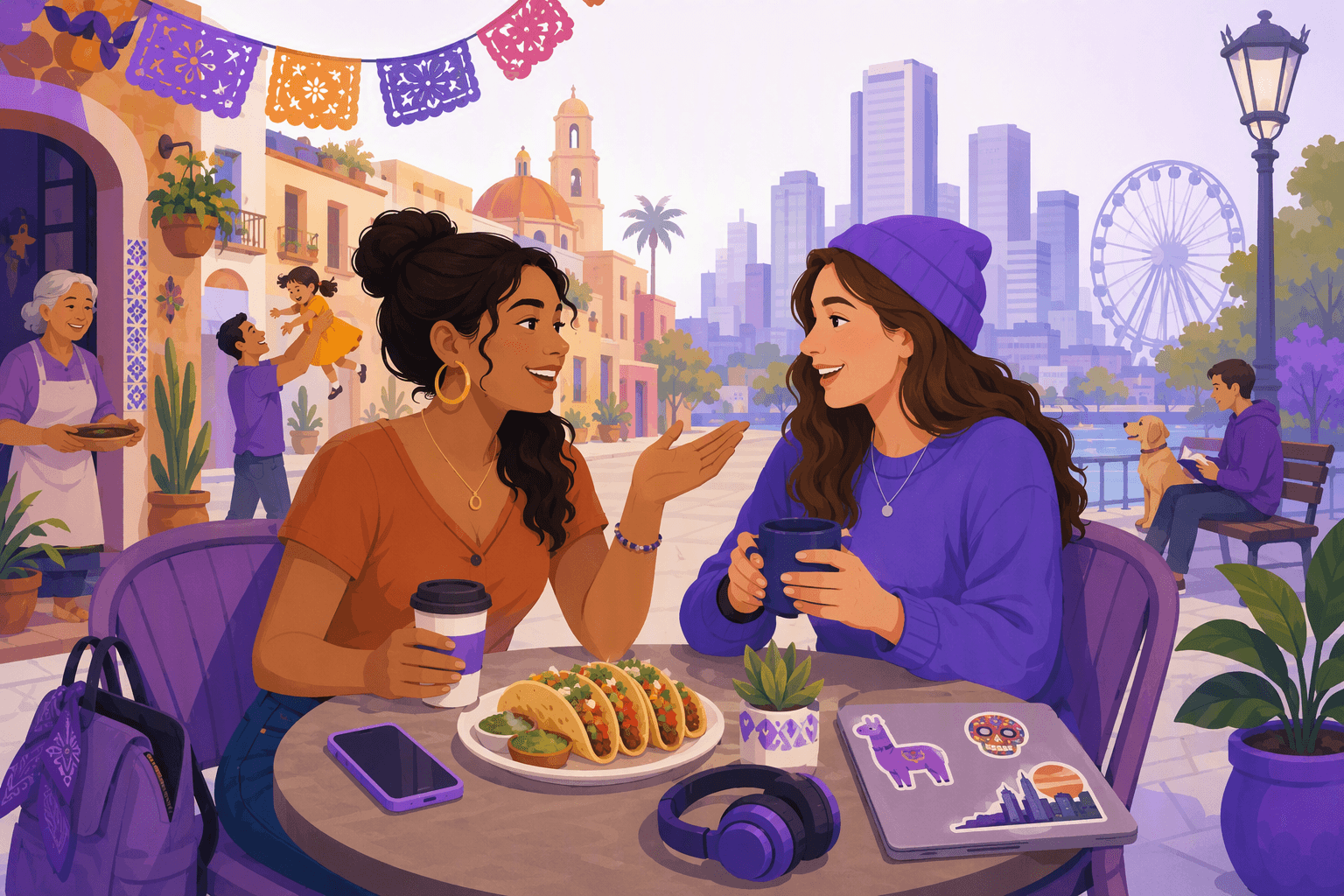
What Spanglish actually means
Spanglish is an umbrella term, not a single fixed dialect. A speaker in Los Angeles, Miami, New York, El Paso, San Juan, or Chicago may all use Spanglish differently because their local histories, family origins, and daily language environments differ.
Some bilingual people switch between complete Spanish and English clauses:
- Llegué tarde because the train stopped.
- I told her que no podía ir.
- Vamos a get coffee después del trabajo.
Others use a Spanish sentence with an English-derived word that has been reshaped to sound and behave like Spanish:
- Voy a parquear el carro.
- Tengo que chequear mi email.
- Ella textea mucho.
In writing, people may spell these forms differently. That is expected. Spanglish is usually learned in conversation rather than through a single official spelling system.
The Instituto Cervantes reports that Spanish has more than 600 million potential speakers worldwide. In the United States, the Census Bureau’s American Community Survey reported that roughly 42 million people aged five and over spoke Spanish at home in 2022. That enormous bilingual population helps explain why Spanish-English contact is not a niche phenomenon.
Spanglish is not one thing
The word gets used loosely, so it helps to separate three related practices: code-switching, borrowing, and calques. All can appear in the same conversation, but they work differently.
Code-switching
Code-switching means moving between Spanish and English. A bilingual person may change language because a phrase fits better in one language, because the listener changed languages, or because the topic has a certain emotional tone.
For example:
- No me gusta that attitude.
- I was so tired que me dormí en el sofá.
- Mi mom dijo que llegara temprano.
The switch is not random. Fluent bilingual speakers follow patterns that make the sentence understandable to others who share both languages. Linguist Ana Celia Zentella documents this kind of patterned bilingual speech in Growing Up Bilingual, her study of Puerto Rican children in New York.
Code-switching can also signal closeness. A joke, affectionate complaint, or family memory may feel more precise in the language where it was first experienced. That social meaning matters as much as grammar.
Borrowed and adapted words
Borrowing happens when a word from English enters Spanish speech and is adjusted to Spanish pronunciation or grammar. The result can sound completely ordinary inside a bilingual community.
Common examples include:
| English source | Spanglish form | IPA | Typical meaning |
|---|---|---|---|
| to park | parquear | /paɾˈkeaɾ/ | to park |
| to check | chequear | /tʃeˈkeaɾ/ | to check |
| to text | textear | /teksˈteaɾ/ | to send text messages |
| lunch | lonche | /ˈlon.tʃe/ | lunch |
| truck | troca | /ˈtɾoka/ | pickup truck |
| bills | biles | /ˈbiles/ | bills or invoices |
| insurance | aseguranza | /aseɣuˈɾansa/ | insurance |
Not every bilingual speaker uses every word. Parquear /paɾˈkeaɾ/, for instance, is widespread in parts of the Caribbean and the United States, but many speakers elsewhere would say estacionar /esta.sjoˈnaɾ/ or aparcar /apaɾˈkaɾ/.
The Asociación de Academias de la Lengua Española records many regional Americanisms, showing that contact-driven vocabulary is not automatically an error. Whether a word belongs in formal writing is a separate question.
Calques and translated patterns
A calque is a phrase or meaning copied from one language into another. These can be harder to notice because every word may look Spanish.
For instance, some U.S. bilingual speakers use aplicar para un trabajo /apliˈkaɾ paɾa un tɾaˈβaxo/ in the English sense of “apply for a job.” In many international Spanish contexts, solicitar un trabajo /solisiˈtaɾ un tɾaˈβaxo/ or postularse a un trabajo /postuˈlaɾse a un tɾaˈβaxo/ will sound more natural.
Likewise, llamar para atrás /ʝaˈmaɾ paɾa aˈtɾas/ reflects English “call back.” Many speakers would instead say volver a llamar /bolˈβeɾ a ʝaˈmaɾ/ or devolver la llamada /deβolˈβeɾ la ʝaˈmaða/.
These forms are not proof that a person lacks Spanish. They show that English is influencing how Spanish is used in a contact setting. Still, learners need to recognize which phrases travel well internationally and which are local.
Why people use Spanglish
Bilingual speech is practical, but it is also personal. Speakers may choose a word because it is faster, because it belongs to school or work, because it makes a joke land, or because it reflects who is in the room.
Ilan Stavans, in Spanglish: The Making of a New American Language, treats Spanglish as a cultural product of migration, media, and life between language communities. That is more accurate than imagining it as a temporary failure to choose one language.
A bilingual family may use Spanish for affection, discipline, food, religion, and older relatives, while English dominates school, technology, and work. A sentence can therefore shift language exactly where the speaker’s life shifts context.
Consider the difference in tone:
- Te quiero /te ˈkjeɾo/ can carry emotional weight shaped by family use.
- “I love you” may feel more natural for another relationship.
- Mándame un text /ˈmande.me un tekst/ may be quicker than choosing a more formal Spanish phrase for a casual digital action.
Neither language is incomplete. The speaker is using their full linguistic repertoire.
🌍 Spanglish can mark belonging
A shared Spanglish expression can tell listeners that someone grew up in a similar neighborhood, school system, family network, or diaspora community. That does not make it secret code, but it does mean outsiders should avoid treating it as a costume or copying expressions they do not understand.
Regional Spanglish is very different
There is no universal Spanglish dictionary because Spanish itself has major regional variation. Spanish is official nationally in 20 sovereign countries, and it is spoken in many more places through migration and diaspora communities. English contact adds another layer of variation.
Mexican American communities
In Mexican American communities, especially across the Southwest, speakers may use terms such as troca /ˈtɾoka/ for a pickup truck, lonche /ˈlon.tʃe/ for lunch, and marqueta /maɾˈketa/ for a market. Some terms have long local histories and may be understood even by people who do not regularly code-switch.
Borderland speech reflects generations of contact, not merely recent English influence. For broader context on regional variation, compare this with our guide to Mexican Spanish.
Puerto Rican and New York communities
Puerto Rican communities have shaped highly visible forms of Spanish-English bilingualism in New York and other U.S. cities. English nouns and verbs may enter Spanish speech easily, while Spanish provides emotional emphasis, family language, and local humor.
The term Nuyorican /nuʝoɾiˈkan/ refers to people and culture connected to Puerto Rican New York. It is an identity label, not a synonym for every Spanish-English bilingual person.
Miami and Caribbean communities
Miami brings together Cuban, Puerto Rican, Colombian, Venezuelan, Dominican, and other Latin American communities. A local speaker may move between English and several national Spanish varieties, sometimes within the same social group.
Words such as janguear /xaŋˈɡeaɾ/, based on English “hang out,” are heard in Caribbean-influenced settings. But a learner should not assume that a phrase heard in a Miami sitcom will be common in Spain or Argentina.
The label can be sensitive
Some people proudly call themselves Spanglish speakers. Others dislike the word because it has been used to suggest that bilingual people speak neither language properly.
Terms such as pocho /ˈpotʃo/ can also be sensitive. Depending on the community and speaker, it may be reclaimed, descriptive, teasing, or insulting. Do not apply identity labels to someone unless they use them for themselves.
Is Spanglish correct Spanish?
That question has two answers.
In a formal setting such as a university essay, a job application for a Spanish-speaking country, a government document, or an international exam, standard Spanish is normally expected. Use estacionar /esta.sjoˈnaɾ/, enviar un mensaje de texto /embjaɾ un menˈsaxe ðe ˈteksto/, and other widely understood forms when clarity matters.
In a bilingual conversation, Spanglish can be entirely correct for the social setting. Grammar is not only about dictionary rules. It also concerns whether listeners understand you and whether your choices fit the relationship, place, and purpose.
💡 Learn standard Spanish first, then recognize local speech
If you are a Spanish learner, build a foundation in forms that work across countries. Then treat Spanglish as valuable listening and cultural knowledge. Films and television are especially useful because they show which characters switch languages, what triggers the switch, and how other characters respond.
This is similar to learning slang: recognition matters before active use. You may understand a casual expression without needing to say it yourself. If you are curious about stronger informal language, read our Spanish swear words guide carefully, since regional tone and audience matter there too.
How to understand Spanglish in movies and TV
Spanglish is often difficult for learners because subtitles may flatten it. English subtitles can erase the Spanish portion, while Spanish subtitles may replace the English phrase with standard Spanish. Listening closely gives you information about character relationships that translation can miss.
Try this method with a short scene:
- Watch once with subtitles in the language you know best.
- Rewatch and mark every language switch.
- Ask what changed at that moment: topic, emotion, listener, joke, or authority?
- Look for adapted words such as chequear /tʃeˈkeaɾ/ rather than only full English phrases.
- Repeat one natural sentence, but do not force its local style into unrelated conversations.
A parent switching into Spanish to scold a child, then returning to English for school logistics, is doing more than translating. The language choice carries social meaning. That is why real clips can teach cultural timing as well as vocabulary.
For standard phrases that work before or after any bilingual chat, practice Spanish goodbyes. For more intimate contexts, learn the difference between te quiero /te ˈkjeɾo/ and te amo /te ˈamo/ in our guide to saying I love you in Spanish.
A respectful way to use Spanglish
Use Spanglish when it is genuinely part of your environment and when your listener understands both languages. Do not assume every Spanish speaker knows English, and do not use English insertions as a shortcut for missing Spanish vocabulary when clear Spanish is available.
The strongest bilingual communicators can adjust. They may speak relaxed Spanglish with siblings, standard Spanish with a grandparent from another country, and English with a monolingual colleague. That flexibility is linguistic skill, not inconsistency.
Spanglish makes most sense when you see it as living evidence of language contact. It captures how people actually speak across homes, borders, generations, and screens, while standard Spanish remains essential for communication across the Spanish-speaking world.
Frequently Asked Questions
Is Spanglish a real language?
Is it rude to speak Spanglish?
What is an example of Spanglish?
Do all Spanish speakers understand Spanglish?
Should Spanish learners use Spanglish?
Sources & References
- Instituto Cervantes, El español: una lengua viva, 2024
- U.S. Census Bureau, American Community Survey, Language Spoken at Home, 2022
- Ana Celia Zentella, Growing Up Bilingual: Puerto Rican Children in New York, Blackwell
- Ilan Stavans, Spanglish: The Making of a New American Language, Rayo
- Asociación de Academias de la Lengua Española, Diccionario de americanismos, accessed 2026
Start learning with Wordy
Watch real movie clips and build your vocabulary as you go. Free to download.


