Quick Answer
The fastest way to understand K-pop Korean is to learn the high-frequency words idols repeat in lyrics and in casual speech: feelings (좋아해, 보고 싶어), hype (대박, 파이팅), relationship talk (사랑해, 우리), and fandom staples (팬, 응원). This guide teaches 60+ of those words with pronunciation, nuance, and where you actually hear them.
K-pop vocabulary is mostly everyday Korean, not secret slang: if you learn the small set of words idols repeat in hooks, fan messages, and live streams, you can understand a surprising amount of meaning even before you master grammar. This guide gives you 60+ high-frequency K-pop words with clear pronunciation, what they imply, and where you actually hear them.
Korean is spoken by roughly 82 million people worldwide (Ethnologue, 27th edition, 2024), and K-pop has turned casual Korean phrases into global catchphrases. If you want a foundation beyond lyrics, pair this with our Korean greetings guide and goodbye phrases, since idols use those constantly in lives and concerts.

| English | Korean | Pronunciation | Note |
|---|---|---|---|
| Hello (formal/polite) | 안녕하세요 | ahn-NYUHNG-hah-seh-yoh | Default greeting in interviews, lives, fan events. |
| Thank you | 감사합니다 | gahm-SAH-hahm-nee-dah | Very common on stage and in acceptance speeches. |
| Please | 제발 | jeh-BAHL | In lyrics: 'please' as an emotional plea. |
| Sorry | 미안해 | mee-AHN-heh | Casual apology, common in lyrics and messages. |
| It's okay | 괜찮아 | gwen-CHAH-nah | Comforting line in lyrics, also everyday speech. |
| Really | 진짜 | jin-JJAH | Reaction word in lives: 'seriously/for real'. |
| A little / kind of | 약간 | yahk-KAHN | Filler word in casual talk, especially on live. |
| Now | 지금 | jee-GEUM | Lyrics and stage talk: 'right now'. |
| Today | 오늘 | OH-neul | Often paired with 'today is...' in lives. |
| Tomorrow | 내일 | neh-EEL | Common in hopeful lyrics. |
| We / our | 우리 | OO-ree | Signals closeness: 'our fans', 'our members'. |
| Everyone | 여러분 | yuh-ruh-BOON | Stage address: 'everyone' (polite). |
Why K-pop Korean sounds different from textbook Korean
K-pop gives you two Korean registers at once: poetic lyric language and casual idol talk. Lyrics compress grammar, repeat key words, and lean on emotion vocabulary, while lives and behind-the-scenes clips are closer to everyday speech.
A useful lens is politeness and in-group language. Research on politeness (Brown & Levinson, Politeness) explains why speakers manage closeness and respect, and you can hear that in K-pop when idols switch between polite -요 speech for the audience and casual speech with members.
💡 The fastest win
Learn a handful of sentence endings and reaction words, then listen for them in context. Even if you miss nouns, endings like -요, -야, and -지 tell you whether the vibe is polite, intimate, or teasing.
Core fan and stage words you will hear everywhere
These are the words that show up in concerts, award speeches, and fan communication. They are not niche, they are the backbone.
| English | Korean | Pronunciation | Note |
|---|---|---|---|
| Fan(s) | 팬 | pehn | Loanword, used constantly. |
| Fandom | 팬덤 | pehn-DEOM | Loanword, often used in media. |
| Support / cheering | 응원 | eung-WOHN | As a noun or in phrases like '응원해'. |
| To support/cheer (casual) | 응원해 | eung-WOHN-heh | Direct to fans or members: 'I'm cheering for you'. |
| Cheer up | 힘내 | heem-NEH | Comforting, common in lyrics. |
| Fighting! (you can do it) | 파이팅 | pah-ee-TEENG | Hype/encouragement, very common. |
| Stage | 무대 | moo-DEH | Concert talk: 'on stage'. |
| Performance | 공연 | gohng-YUHN | More general than '무대'. |
| Comeback | 컴백 | keom-BEHK | Industry term for a new release cycle. |
| Title track | 타이틀곡 | tah-ee-TEUL-gok | Main promoted song. |
| Album | 앨범 | ehl-BEOM | Loanword. |
| Music video | 뮤직비디오 | myoo-jik-bee-dee-oh | Often shortened to '뮤비'. |
| MV (short) | 뮤비 | myoo-BEE | Casual shorthand. |
| Live broadcast | 라이브 | rah-ee-BEU | Lives, live singing, live stream context. |
| Broadcast station | 방송 | bahng-SOHNG | Music shows, TV appearances. |
응원
응원 (eung-WOHN) is one of the most useful K-pop words because it bridges fandom and everyday life. You will hear it in slogans, fan letters, and even in sports contexts.
A common pattern is 응원해 (eung-WOHN-heh), which is casual and warm. For a more polite version to fans, idols may say 응원해요 (eung-WOHN-heh-yoh).
컴백
컴백 (keom-BEHK) is a Koreanized loanword that means a new release and promotion period, not a literal return from retirement. Fans use it as a calendar anchor: teaser schedule, music show stages, and content drops.
If you want more everyday Korean around greetings and closings that idols use around comeback promotions, see how to say hello in Korean and how to say goodbye in Korean.
Emotion words that dominate lyrics
Lyrics lean heavily on feelings, longing, and reassurance. These words are high-frequency across groups and genres.
| English | Korean | Pronunciation | Note |
|---|---|---|---|
| Love (noun) | 사랑 | sah-RANG | In lyrics: love as a theme. |
| I love you (casual) | 사랑해 | sah-RANG-heh | Common to fans and in romantic lyrics. |
| To like (someone/something) | 좋아해 | joh-AH-heh | Softer than '사랑해'. |
| I miss you | 보고 싶어 | boh-goh SHEE-puh | Very common in fan messages. |
| To be happy | 행복해 | hehng-BOHK-heh | Often in gratitude speeches. |
| To be sad | 슬퍼 | seul-PEO | Lyrics and emotional talk. |
| To be tired | 피곤해 | pee-GOHN-heh | Behind-the-scenes talk. |
| To be nervous | 긴장돼 | gin-JAHNG-dweh | Before stages. |
| To be excited / fluttery | 설레 | seol-LEH | Romantic anticipation, common in softer songs. |
| Heart | 마음 | mah-EUM | In lyrics: 마음 is 'heart/mind/feelings'. |
| Tears | 눈물 | noon-MOOL | Ballads and breakup songs. |
| Smile | 미소 | mee-SOH | Poetic word for smile. |
| Promise | 약속 | yahk-SSOK | Fan songs: 'promise' is a staple. |
| Forever | 영원히 | yuhng-WOHN-hee | Often paired with 사랑. |
보고 싶어
보고 싶어 (boh-goh SHEE-puh) literally builds from "to see" plus "want to", but functionally it means "I miss you." It is used for people, and in idol talk it is frequently aimed at fans after time apart.
In more polite speech you may hear 보고 싶어요 (boh-goh SHEE-puh-yoh). That small -요 ending is a big clue that the speaker is addressing the audience respectfully.
마음
마음 (mah-EUM) is a key Korean concept because it covers heart, mind, and intention. Linguist Anna Wierzbicka writes about how emotion words map differently across languages in Emotions Across Languages and Cultures, and 마음 is a good example: it is not just "heart" in the romantic sense.
When you hear 마음 in lyrics, listen for whether it is about sincerity (진심) or longing (그리움). The surrounding verbs usually tell you.
Reaction words and filler you hear in lives and variety
If you watch enough live streams, you will notice a small set of reaction sounds that carry the conversation. These are gold for listening comprehension.
| English | Korean | Pronunciation | Note |
|---|---|---|---|
| Wow / amazing | 대박 | deh-BAHK | Surprise, hype, approval. |
| Oh no / omg (shock) | 헐 | heol | Casual reaction, often playful. |
| Really? / no way | 진짜? | jin-JJAH | Same word as 'really', with questioning intonation. |
| But / however | 근데 | geun-DEH | Conversation pivot, extremely common. |
| So / therefore | 그래서 | geu-REH-seo | Explaining a story. |
| Like / kind of | 막 | mahk | Filler meaning 'just' or 'like' in casual speech. |
| Actually / in fact | 사실 | sah-SIL | Storytelling marker. |
| Wait a second | 잠깐만 | jahm-KKAHN-mahn | Used constantly on live. |
| Okay | 오케이 | oh-KEH-ee | Loanword, casual. |
| Of course | 당연하지 | dahng-YUHN-hah-jee | Casual, confident. |
| Really (emphasis) | 완전 | wahn-JEON | Means 'totally' in casual speech. |
| A bit / slightly | 좀 | jom | Softener: makes requests less blunt. |
근데
근데 (geun-DEH) is the conversational glue of casual Korean. It means "but" or "by the way," and idols use it to shift topics, respond to comments, or start a story.
If you learn only one filler word from this section, make it 근데. It will help you segment speech into chunks.
좀
좀 (jom) is small but powerful. It softens requests and statements, and that matters in Korean interaction. The National Institute of Korean Language (국립국어원) materials on standard usage emphasize how particles and adverbs shape politeness, and 좀 is one of the most common softeners you will hear.
In lives, it often appears with 부탁해요 style requests: "please do this for me" but less direct.
Relationship and identity words: the K-pop "we" feeling
K-pop language often builds closeness: between members, and between idols and fans. These words show up in lyrics, fan songs, and speeches.
| English | Korean | Pronunciation | Note |
|---|---|---|---|
| Friend | 친구 | chin-GOO | Also used casually for peers. |
| Older brother (male speaker) | 형 | hyuhng | Used by men to older men. |
| Older sister (female speaker) | 언니 | uhn-NEE | Used by women to older women. |
| Older brother (female speaker) | 오빠 | OH-ppah | Used by women to older men, also in lyrics. |
| Older sister (male speaker) | 누나 | noo-NAH | Used by men to older women. |
| Senior (in school/work) | 선배 | seon-BEH | Also used in entertainment industry. |
| Junior | 후배 | hoo-BEH | Paired with 선배. |
| Member (of a group) | 멤버 | mehm-BEO | Loanword, constant in idol talk. |
| Team | 팀 | teem | Loanword. |
| Family | 가족 | gah-JOK | Used literally and metaphorically for fandom. |
| Our fans | 우리 팬 | OO-ree pehn | Common phrase, signals belonging. |
| Together | 같이 | gah-CHEE | Lyrics and speeches: 'together'. |
오빠
오빠 (OH-ppah) is widely recognized internationally, but it is easy to misuse. It is used by a woman to an older male she is close to, such as a brother, friend, or boyfriend, and it can be flirtatious depending on context.
In lyrics, it can be playful or romantic, but in real life you should not use it with strangers. If you want safer forms, learn names plus -씨 or just use polite greetings from our hello guide.
Words for music, practice, and idol work life
Behind-the-scenes content is full of work vocabulary. These words also appear in documentaries and interviews.
| English | Korean | Pronunciation | Note |
|---|---|---|---|
| Practice | 연습 | yuhn-SEUP | Noun, very common. |
| To practice | 연습해 | yuhn-SEUP-heh | Casual verb form. |
| Dance | 춤 | choom | Noun. |
| Choreography | 안무 | ahn-MOO | Dance routine, used constantly. |
| Song | 노래 | noh-REH | General word for song. |
| Lyrics | 가사 | gah-SAH | Useful when watching lyric breakdowns. |
| Recording | 녹음 | noh-GEUM | Studio content. |
| Studio | 스튜디오 | seu-tyoo-dee-oh | Loanword. |
| Concert | 콘서트 | kohn-seo-TEU | Loanword. |
| Tour | 투어 | too-UH | Loanword. |
| Schedule | 스케줄 | seu-keh-JOOL | Loanword, constant in idol talk. |
| Camera | 카메라 | kah-meh-RAH | Loanword. |
안무
안무 (ahn-MOO) is the word you will hear whenever idols talk about learning or changing choreography. Fans also use it when comparing dance challenges and performance versions.
If you are learning Korean through performance clips, focus on verbs that attach to it: "learn", "change", "practice", and "match." You will start recognizing whole chunks of meaning.
Polite vs casual: the endings that change the vibe
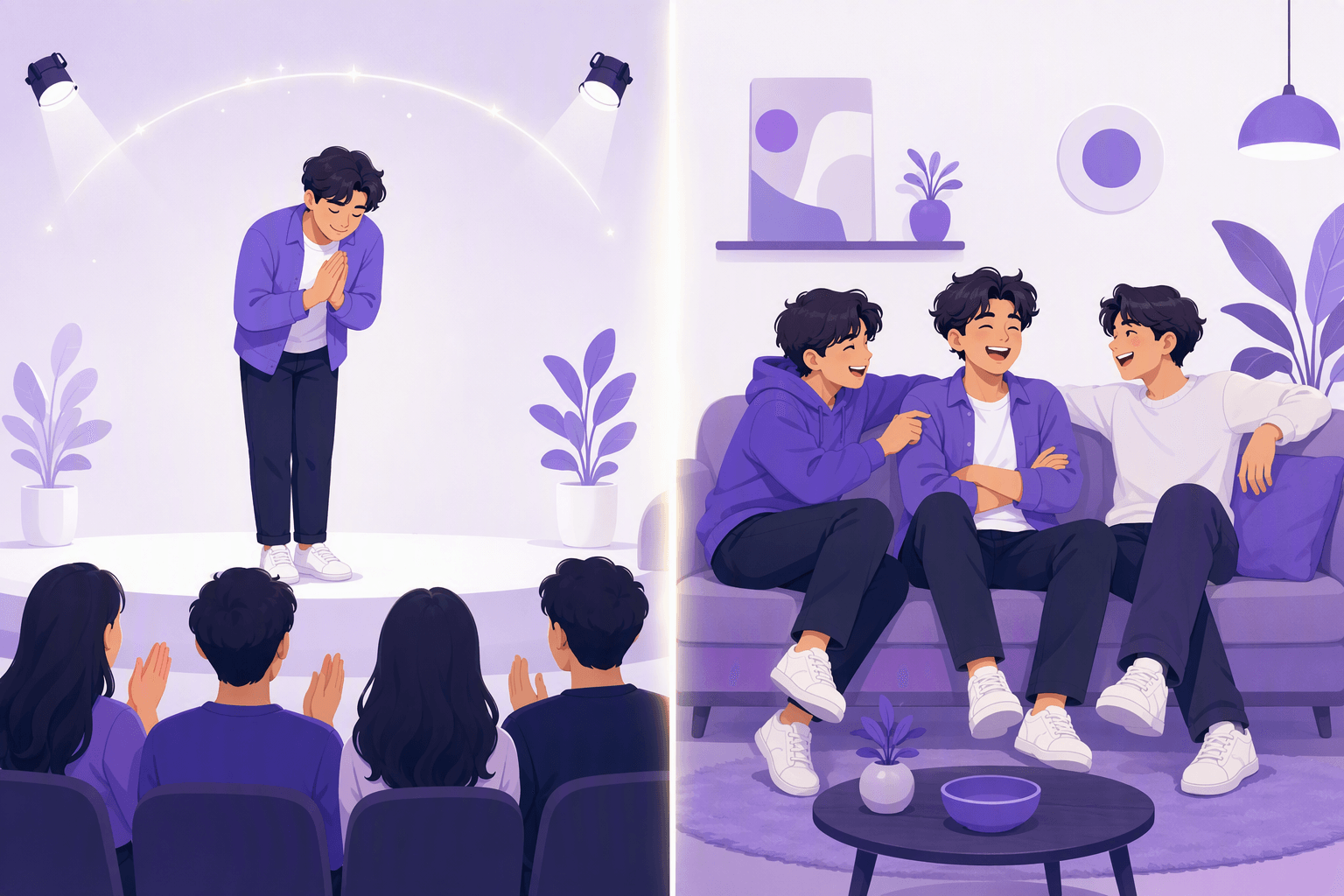
You do not need to master all speech levels to enjoy K-pop, but you do need to recognize the two you will hear most: polite -요 speech and casual speech. The King Sejong Institute materials are especially helpful here because they teach endings as patterns you can spot in real audio.
-요
When you hear -요 at the end of a sentence, the speaker is being polite. Idols use it with fans, hosts, and the general public.
Examples you will hear in lives include short polite statements like 감사해요 (gahm-SAH-heh-yoh) and 보고 싶어요 (boh-goh SHEE-puh-yoh). Even if you only catch the last syllable, you can infer the social stance.
-아/-야
Casual endings like -아/-야 show closeness. You will hear them between members, or in lyrics that aim for intimacy.
This is also why some fan messages feel extra warm: dropping to casual speech can signal "we are close." Claire Kramsch, in Language and Culture, treats this kind of stance-taking as central to how language creates social meaning, and K-pop is a live demonstration.
⚠️ Do not copy everything you hear
Some K-pop talk is intentionally cute, teasing, or role-played for entertainment. Before you use a phrase with real people, check whether it is polite enough for the situation, especially at work or with strangers.
A note on slang and swearing in K-pop
Most mainstream K-pop avoids strong profanity, but you will still hear mild exclamations, censored words, and internet slang. If you are curious, learn it responsibly and understand severity and context.
For a clear, safety-first breakdown, see our Korean swear words guide. It will help you avoid repeating something harsh because it sounded catchy in a clip.
How to learn K-pop vocabulary faster with real clips
Songs are great for repetition, but they are not always clear for pronunciation and spacing. The best workflow is: learn the word, hear it in a spoken sentence, then hear it again in a lyric.
Step 1: Build a "lyrics plus live" playlist
Pick one song you love, then add two spoken clips: a live stream moment and a backstage interview. You will hear the same emotional vocabulary, but with clearer pronunciation and more complete grammar.
If you want more structured listening practice, movie and TV dialogue can fill the gaps that lyrics leave. Our K-drama picks are useful when you want everyday conversations, not just stage talk.
Step 2: Track chunks, not single words
Instead of memorizing 사랑 (sah-RANG) alone, learn a chunk like 사랑해 (sah-RANG-heh) or 사랑해요 (sah-RANG-heh-yoh). Korean is highly pattern-based, and endings carry meaning.
This is also why learning greetings and closings pays off quickly. Review how to say I love you in Korean for the common variants you will actually hear.
Step 3: Shadow short lines for rhythm
Pick a 3 to 5 second line from a live, and repeat it until your mouth can do it smoothly. Korean pronunciation is not just sounds, it is timing and linking, and short shadowing sessions help.
If Hangul still slows you down, start with our guide to reading Hangul. Once you can decode syllable blocks, lyrics videos become study material instead of noise.
Mini glossary: what you will hear in one typical idol live
A typical live stream often follows this arc: greeting, checking comments, reacting, sharing schedule updates, then a warm goodbye. With the vocabulary above, you can often catch the skeleton:
- 안녕하세요, 여러분: opening
- 오늘, 지금, 근데, 사실: storytelling markers
- 대박, 헐, 진짜: reactions to comments
- 스케줄, 연습, 안무: work talk
- 보고 싶어, 사랑해, 응원: fan closeness
- 마지막으로, 감사합니다: closing
Once you can hear that structure, your brain stops treating Korean as one long sound. It becomes predictable sections.
Final practice: 10 words to learn first
If 60+ words feels like too much, start with these 10. They cover greetings, reactions, and the fan relationship tone:
- 안녕하세요 (ahn-NYUHNG-hah-seh-yoh)
- 여러분 (yuh-ruh-BOON)
- 감사합니다 (gahm-SAH-hahm-nee-dah)
- 진짜 (jin-JJAH)
- 근데 (geun-DEH)
- 대박 (deh-BAHK)
- 우리 (OO-ree)
- 응원 (eung-WOHN)
- 보고 싶어 (boh-goh SHEE-puh)
- 사랑해 (sah-RANG-heh)
When you are ready, learn them in context with short native clips. Wordy’s approach is built for that: you hear the phrase, tap for meaning, then review it with spaced repetition so it sticks.
If you want the next step after K-pop, move into conversational basics with how to say hello in Korean and how to say goodbye in Korean, then keep expanding from there.
Frequently Asked Questions
Is K-pop a good way to learn Korean?
Why do idols mix English with Korean in songs?
What Korean words do idols say the most on live streams?
What does 우리 mean in K-pop, and why is it everywhere?
Do I need to learn honorifics to understand K-pop?
Sources & References
- Ethnologue, Korean (27th edition, 2024)
- National Institute of Korean Language (국립국어원), Standard Korean Language resources, accessed 2026
- King Sejong Institute Foundation, Korean language learning materials, accessed 2026
- Korean Foundation, Facts and figures on Korea and Korean language, accessed 2026
- Brown, P. & Levinson, S. C., Politeness: Some Universals in Language Usage, Cambridge University Press
Start learning with Wordy
Watch real movie clips and build your vocabulary as you go. Free to download.


