Quick Answer
Advanced Japanese food vocabulary includes words for seasonal ingredients, cooking methods, texture, menu language, and dining etiquette. Learning terms such as 旬, 出汁, 発酵, and 食感 helps you understand Japanese menus and food scenes far beyond basic sushi vocabulary.
Japanese food vocabulary becomes much more useful once you move beyond sushi and ramen: learn words for seasonality, stock, texture, cooking methods, and menu labels such as 旬 /ɕɯɴ/, 出汁 /da.ɕi/, 食感 /ɕok.kaɴ/, and おすすめ /o.sɯ.sɯ.me/. These terms help you read real menus, follow cooking scenes, shop at markets, and understand why a dish matters to the person serving it.
Japanese has roughly 123 million first-language speakers, primarily in Japan, according to Ethnologue. Food vocabulary matters because meals are one of the most frequent places where learners encounter real Japanese, from an izakaya menu to a family kitchen scene.
Japanese food culture is also internationally recognized. UNESCO inscribed washoku /wa.ɕo.kɯ/, Japan’s traditional dietary culture, on its Intangible Cultural Heritage list in 2013. The recognition is not about one famous dish, but about seasonal ingredients, shared meals, presentation, and culinary knowledge.
If you need everyday basics first, begin with our Japanese food culture guide and Japanese useful travel phrases. Then return here for the vocabulary that makes menus and food dialogue feel much less mysterious.
| English | Japanese | Pronunciation | Note |
|---|---|---|---|
| Seasonal peak | 旬 | SHOON | IPA: /ɕɯɴ/. The period when an ingredient is at its best. |
| Seasonal ingredient | 旬の食材 | SHOON noh shoh-koo-ZYE | IPA: /ɕɯɴ no ɕo.ɯ.dzai/. A menu phrase for ingredients at peak season. |
| Local production for local consumption | 地産地消 | chee-SAHN chee-SHOH | IPA: /tɕi.saɴ tɕi.ɕoː/. Buying and eating food produced locally. |
| Freshly harvested | 採れたて | toh-reh-TAH-teh | IPA: /to.ɾe.ta.te/. Used for vegetables, fruit, and seafood. |
| Freshly caught | 獲れたて | toh-reh-TAH-teh | IPA: /to.ɾe.ta.te/. Usually used for fish and seafood. |
| Direct from the production area | 産地直送 | SAHN-chee choh-koo-SOH | IPA: /saɴ.tɕi tɕo.ku.soː/. Common on menus and product labels. |
| Domestic production | 国産 | koh-koo-SAHN | IPA: /ko.ku.saɴ/. Means produced in Japan. |
| Fresh fish | 鮮魚 | SEHN-gyoh | IPA: /seɴ.ɡʲo/. A fish-counter and menu term. |
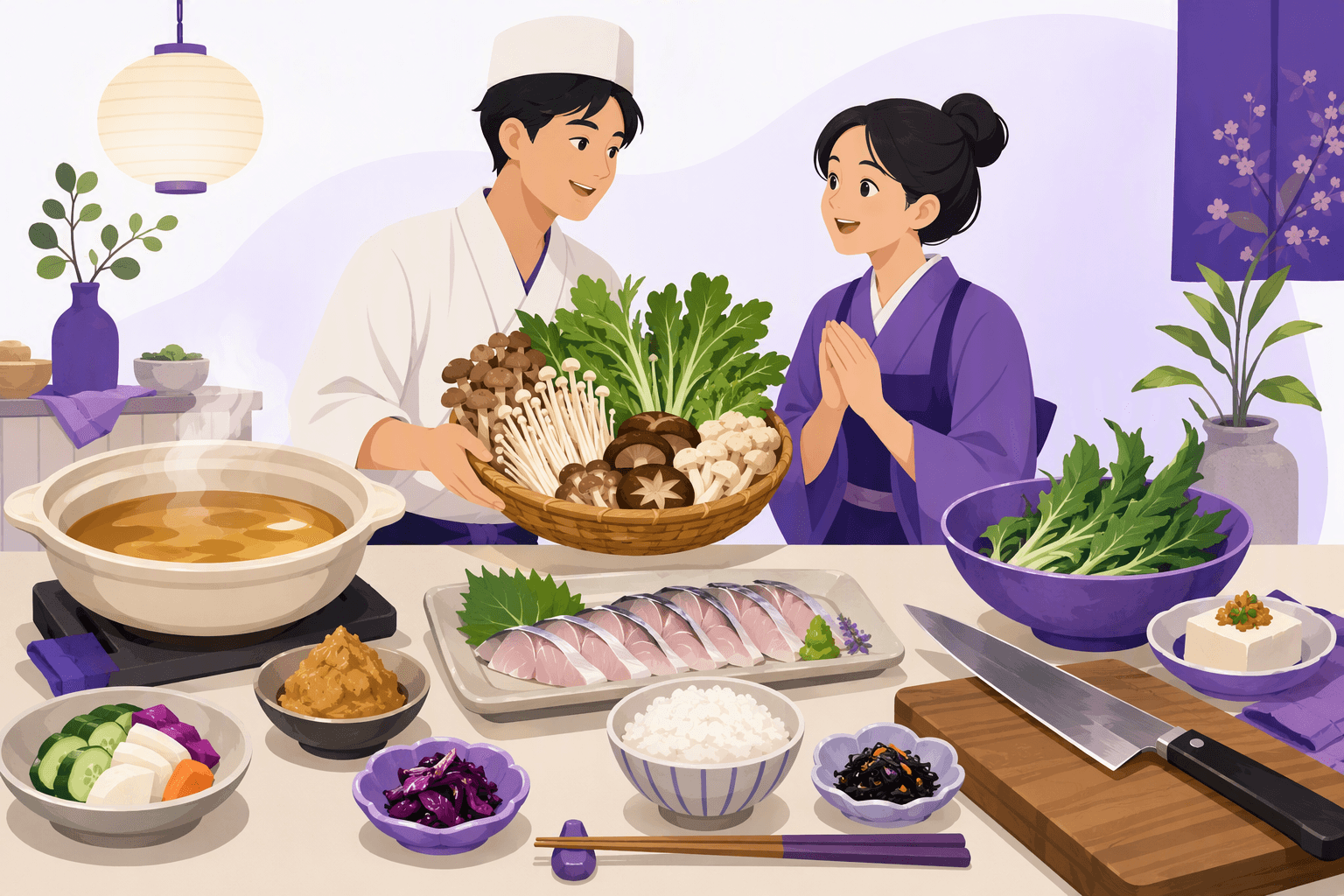
Learn food words as cultural signals
A menu is not only a list of ingredients. Words such as 旬 /ɕɯɴ/ and 産地直送 /saɴ.tɕi tɕo.ku.soː/ signal where food came from, when it is best, and why a restaurant is proud to serve it.
Katarzyna Cwiertka, in Modern Japanese Cuisine: Food, Power and National Identity, examines how Japanese food culture developed alongside modern national identity. That context explains why regional provenance and careful presentation can carry as much meaning as the dish’s price or portion size.
In Japan, spring bamboo shoots, summer eel, autumn mushrooms, and winter crab are not merely ingredients. They are markers of the calendar. A restaurant that changes its menu with the seasons is communicating attentiveness and culinary skill.
Essential menu language
| English | Japanese | Pronunciation | Note |
|---|---|---|---|
| Recommendation | おすすめ | oh-soo-soo-MEH | IPA: /o.sɯ.sɯ.me/. A recommended or signature choice. |
| Chef's choice | おまかせ | oh-mah-KAH-seh | IPA: /o.ma.ka.se/. You leave the selection to the chef. |
| Set meal | 定食 | TEH-shoh-koo | IPA: /teː.ɕo.kɯ/. Usually a main dish with rice, soup, and sides. |
| Course meal | コース料理 | KOH-soo ryoh-REE | IPA: /koː.sɯ ɾʲoː.ɾi/. A multi-course fixed meal. |
| A la carte | 一品料理 | ee-PPIN ryoh-REE | IPA: /ip.piɴ ɾʲoː.ɾi/. Individual dishes ordered separately. |
| Today's special | 本日のおすすめ | hohn-ZEE-tsoo noh oh-soo-soo-MEH | IPA: /hoɴ.dzʲi.tsɯ no o.sɯ.sɯ.me/. Look for it on a board or daily menu. |
| Limited quantity | 数量限定 | soo-ryoh-gehN-TEH | IPA: /sɯː.ɾʲoː ɡeɴ.teː/. It may sell out quickly. |
| Sold out | 売り切れ | oo-ree-KEE-reh | IPA: /ɯ.ɾi.ki.ɾe/. A common sign at popular restaurants. |
| Reservation required | 要予約 | yoh-yoh-YAH-koo | IPA: /joː jo.ja.kɯ/. Book before arriving. |
| Takeout | 持ち帰り | moh-chee-KAH-ree | IPA: /mo.tɕi.ka.e.ɾi/. Literally taking something home. |
おまかせ
おまかせ /o.ma.ka.se/ literally comes from the verb 任せる /ma.ka.se.ɾɯ/, to entrust. At a sushi counter or a small chef-led restaurant, ordering おまかせ means you trust the chef to choose the sequence and ingredients.
This is not always the cheapest choice. It is often the best way to experience ingredients that are especially good that day, particularly fish in season. Tell the staff about allergies, dietary restrictions, or foods you cannot eat before agreeing to an おまかせ /o.ma.ka.se/ meal.
定食
定食 /teː.ɕo.kɯ/ is one of the most practical words for travelers and learners. A typical 定食 /teː.ɕo.kɯ/ includes a main dish, rice, miso soup, pickles, and sometimes small side dishes.
You will encounter it in neighborhood restaurants, cafeteria-style eateries, train-station dining rooms, and chains. It is a dependable way to eat a balanced Japanese-style meal without ordering several separate plates.
🌍 Why set meals matter
A 定食 /teː.ɕo.kɯ/ reflects the idea of balancing staple food, soup, main dish, and side dishes. This does not mean every Japanese person eats the same way, but it remains a recognizable everyday meal format in homes, cafeterias, and casual restaurants.
Stock, fermentation, and deep flavor
| English | Japanese | Pronunciation | Note |
|---|---|---|---|
| Dashi stock | 出汁 | DAH-shee | IPA: /da.ɕi/. Savory stock, often made with kombu or bonito flakes. |
| Umami | 旨味 | oo-MAH-mee | IPA: /ɯ.ma.mi/. Savory taste and depth of flavor. |
| Fermentation | 発酵 | hahk-KOH | IPA: /hak.koː/. A process behind miso, soy sauce, and sake. |
| Malted rice culture | 麹 | KOH-jee | IPA: /koː.dʑi/. Mold culture used in many fermented foods. |
| Miso | 味噌 | MEE-soh | IPA: /mi.so/. Fermented soybean paste. |
| Soy sauce | 醤油 | SHOH-yoo | IPA: /ɕoː.jɯ/. A major seasoning and dipping sauce. |
| Aged or matured | 熟成 | joo-koo-SAY | IPA: /dʑɯ.ku.seː/. Used for aged meat, fish, cheese, and more. |
| Rich and full-bodied | コク | KOH-koo | IPA: /ko.kɯ/. Means depth, body, and lingering richness. |
| Mild flavor | まろやか | mah-roh-YAH-kah | IPA: /ma.ɾo.ja.ka/. Smooth, rounded, and not harsh. |
| Light or refreshing | あっさり | AHSS-sah-ree | IPA: /as.sa.ɾi/. Light in flavor, often not oily. |
出汁
出汁 /da.ɕi/ is one of the foundations of Japanese cooking. It can be made from kombu /koɴ.bɯ/, dried kelp, かつお節 /ka.tsɯ.o.bɯ.ɕi/, bonito flakes, dried shiitake mushrooms, or small dried fish.
The point is not simply saltiness. A good 出汁 /da.ɕi/ gives a dish structure and 旨味 /ɯ.ma.mi/, the savory dimension often called umami in English. You may barely notice it in a clear soup, but you would notice its absence.
Kikunae Ikeda identified glutamate as a source of umami after studying kombu broth. His work is central to the modern scientific understanding of savory taste, although Japanese cooks had long relied on kombu /koɴ.bɯ/ and 出汁 /da.ɕi/ in practice.
麹
麹 /koː.dʑi/ is a key word for understanding Japanese fermentation. It refers to a cultured mold used to convert starches into sugars and support the production of miso, soy sauce, sake, and other fermented foods.
When a menu describes a 麹 /koː.dʑi/ marinade, expect gentle sweetness, aroma, and a tenderizing effect. Fermented seasonings can make food taste richer without relying only on extra salt or fat.
💡 A useful menu question
To ask what a dish is made with, say これは何が入っていますか /ko.ɾe wa na.ni ɡa ha.it.te i.ma.sɯ ka/. It means what is in this? For a recommendation, say おすすめは何ですか /o.sɯ.sɯ.me wa naɴ de.sɯ ka/.
Cooking methods you will see everywhere
| English | Japanese | Pronunciation | Note |
|---|---|---|---|
| Grilled | 焼き | YAH-kee | IPA: /ja.ki/. Appears in dish names and menu categories. |
| Charcoal grilled | 炭火焼き | soom-BEE-bah YAH-kee | IPA: /sɯm.bi.ba ja.ki/. Grilled over charcoal. |
| Pan-fried or sauteed | 炒め | ee-TAH-meh | IPA: /i.ta.me/. Stir-fried or sauteed in a pan. |
| Deep-fried | 揚げ | AH-geh | IPA: /a.ɡe/. Used in tempura and fried dishes. |
| Simmered | 煮込み | nee-KOH-mee | IPA: /ni.ko.mi/. Long-simmered, often in broth. |
| Steamed | 蒸し | MOO-shee | IPA: /mɯ.ɕi/. Steamed food or a steamed preparation. |
| Raw sliced fish | 刺身 | SAH-shee-mee | IPA: /sa.ɕi.mi/. Sashimi, usually served without rice. |
| Lightly seared | 炙り | ah-boo-REE | IPA: /a.bɯ.ɾi/. Briefly seared, often on the surface. |
| Pickled | 漬け | TSOO-keh | IPA: /tsɯ.ke/. Pickled or marinated, depending on context. |
| Dressed with sauce | 和え | ah-EH | IPA: /a.e/. Ingredients mixed with a dressing or sauce. |
炙り
炙り /a.bɯ.ɾi/ means lightly seared. In sushi restaurants, it often refers to fish that has been briefly torched or grilled on the surface while remaining tender or raw inside.
This technique adds aroma and changes the texture without turning the item into a fully cooked dish. If you like smoked, caramelized, or richer flavors, 炙り /a.bɯ.ɾi/ is a useful word to spot.
煮込み
煮込み /ni.ko.mi/ refers to a dish cooked slowly in liquid. You may see it with beef tendon, offal, vegetables, tofu, or winter stews.
The word suggests comfort food and concentrated flavor. A 煮込み /ni.ko.mi/ dish often depends on broth, soy sauce, miso, or sake-based seasoning rather than a thick Western-style sauce.
Texture words that explain the experience
Japanese speakers often describe food through 食感 /ɕok.kaɴ/, meaning mouthfeel or texture. This vocabulary is especially useful in food shows, product advertisements, and casual conversation.
| English | Japanese | Pronunciation | Note |
|---|---|---|---|
| Texture or mouthfeel | 食感 | shohk-KAHN | IPA: /ɕok.kaɴ/. How food feels when eaten. |
| Chewy and springy | もちもち | moh-chee-MOH-chee | IPA: /mo.tɕi.mo.tɕi/. Common for mochi, noodles, and bread. |
| Crispy | サクサク | SAH-koo SAH-koo | IPA: /sa.kɯ.sa.kɯ/. A light crisp texture. |
| Crunchy | カリカリ | KAH-ree KAH-ree | IPA: /ka.ɾi.ka.ɾi/. Harder, drier crunch than サクサク. |
| Soft and fluffy | ふわふわ | foo-wah-FOO-wah | IPA: /ɸɯ.wa.ɸɯ.wa/. Used for pancakes, bread, and eggs. |
| Thick and viscous | とろみ | toh-roh-MEE | IPA: /to.ɾo.mi/. Thickness in soup, sauce, or filling. |
| Meltingly tender | とろける | toh-roh-KEH-roo | IPA: /to.ɾo.ke.ɾɯ/. Often used for rich meat or chocolate. |
| Firm and bouncy | ぷりぷり | poo-ree-POO-ree | IPA: /pɯ.ɾi.pɯ.ɾi/. Often describes shrimp or fresh seafood. |
Food scholar and linguist research often treats onomatopoeia as a distinctive feature of Japanese expression. Terms like もちもち /mo.tɕi.mo.tɕi/ and サクサク /sa.kɯ.sa.kɯ/ do more than label texture: they make the sensation vivid and immediate.
The National Institute for Japanese Language and Linguistics documents Japanese vocabulary and usage through major language resources. Its work is useful for learners because it shows that expressive sound words are not childish extras, but a normal and productive part of everyday Japanese.
How to learn these words from real food scenes
Do not try to memorize every term as an isolated flashcard. Group vocabulary by the situation where you will hear it: menus, restaurant dialogue, cooking shows, supermarket labels, and food-focused anime or dramas.
When a character says これ、おすすめだよ /ko.ɾe o.sɯ.sɯ.me da.jo/, notice whether they recommend a seasonal item, a house specialty, or a personal favorite. When a chef talks about 食感 /ɕok.kaɴ/, pause and connect the word to the food on screen.
Watching short scenes repeatedly is particularly effective for words with context-dependent meaning. A menu word such as 売り切れ /ɯ.ɾi.ki.ɾe/, sold out, becomes memorable when you see someone disappointed at a restaurant counter.
For food etiquette and phrases used before eating, read our Japanese food culture guide. To build broader daily vocabulary, use the 100 most common Japanese words list alongside food-specific study.
A practical restaurant mini-script
At a restaurant, begin with すみません /sɯ.mi.ma.seɴ/, pronounced soo-mee-mah-SEN, to get attention politely. Then say おすすめは何ですか /o.sɯ.sɯ.me wa naɴ de.sɯ ka/ if you want the staff’s recommendation.
If you see a dish you want to understand, ask これは何が入っていますか /ko.ɾe wa na.ni ɡa ha.it.te i.ma.sɯ ka/. If an item is unavailable, staff may say 売り切れです /ɯ.ɾi.ki.ɾe de.sɯ/, meaning it is sold out.
Before eating, say いただきます /i.ta.da.ki.ma.sɯ/, pronounced ee-tah-dah-kee-MAHSS. After the meal, a warm ごちそうさまでした /ɡo.tɕi.soː.sa.ma de.ɕi.ta/ expresses gratitude for the meal and the effort behind it.
Food vocabulary is not just a way to order safely. It helps you recognize the seasonal, regional, and sensory details that Japanese speakers notice in meals. Learn a few terms each week, then listen for them in menus and scenes, and the language will start to sound far more specific and alive.
Frequently Asked Questions
What Japanese food vocabulary should I learn beyond sushi and ramen?
What does 旬 mean in Japanese food culture?
Why is dashi so important in Japanese cooking?
How do I ask for a restaurant recommendation in Japanese?
Do Japanese menus use English loanwords?
Sources & References
- UNESCO, Washoku, traditional dietary cultures of the Japanese, notably for the celebration of New Year, accessed 2026
- Japan Ministry of Agriculture, Forestry and Fisheries, Japanese Food Culture, accessed 2026
- National Institute for Japanese Language and Linguistics, Japanese Language Resources, accessed 2026
- Ethnologue, Japanese, 28th edition, 2025
- Cwiertka, Katarzyna J., Modern Japanese Cuisine: Food, Power and National Identity, Reaktion Books
Start learning with Wordy
Watch real movie clips and build your vocabulary as you go. Free to download.


