How Difficult Is Spanish to Learn? A Realistic Timeline and What Actually Makes It Hard
Quick Answer
Spanish is generally one of the easiest major languages for English speakers because of shared vocabulary, consistent spelling, and simple syllable rhythm. Most learners can reach conversational comfort in months, but real difficulty shows up in fast listening, verb tense choices (preterite vs imperfect), and regional slang. With steady practice and lots of native input, B1 is realistic within a year for many learners.
Spanish is usually one of the easiest major languages for English speakers to learn, and most learners can become conversational within 6 to 12 months if they practice consistently and listen daily. The real challenges are not the basics, they are fast native listening, verb tense choices, and adapting to regional accents and slang.
Spanish is also a high-reward language: Ethnologue estimates roughly 560 million total speakers worldwide (including L2 speakers), and Instituto Cervantes reports Spanish as one of the world’s most widely spoken languages across more than 20 countries. That means you will never run out of content, conversation partners, or reasons to keep going.
Why Spanish feels easier than many languages (for English speakers)
Spanish is categorized by the US Foreign Service Institute as a Category I language for English speakers, meaning it tends to require fewer classroom hours than languages with bigger structural differences. This does not mean Spanish is effortless, it means the path is smoother if you study well.
Shared vocabulary gives you a head start
English contains thousands of words with Latin roots, and Spanish shares many of them directly. Words like importante, diferente, and posible are often recognizable even before you study them.
This is not “free fluency”, but it accelerates reading and basic comprehension early. It also helps you build confidence faster than in a language where almost every word is unfamiliar.
Spelling is consistent, so pronunciation is learnable
Spanish is not perfectly phonetic, but it is far more consistent than English. Once you learn the sound system, you can usually pronounce new words correctly from spelling alone.
Accent marks also help you, because they tell you where stress goes. If you want a clean foundation, pair this article with a focused pronunciation plan like our Spanish pronunciation guide.
Spanish rhythm is syllable-timed
Spanish tends to give each syllable a similar beat, which many learners find easier to imitate than English stress timing. You can often sound “more Spanish” quickly by tightening vowels and keeping syllables crisp.
David Crystal’s work on English rhythm and stress helps explain why English learners often over-stress Spanish. English reduces vowels heavily, Spanish generally does not, so the fix is often simpler than you think: keep vowels clear.
What actually makes Spanish hard
Spanish difficulty is real, it just shows up later than people expect. Beginners often feel great for a few weeks, then hit a wall when native speech speeds up and grammar choices multiply.
Listening: native speed, linking, and dropped sounds
In real speech, Spanish speakers link words and reduce some sounds. You might learn para in class, then hear pa in conversation.
You also hear pronouns and small words at high speed: me, te, se, lo, la, le. These carry meaning, but they are easy to miss.
💡 The fastest way to fix listening
Spend 10 minutes a day with short, repeatable clips. Re-listen until you can hear the small words, not just the big nouns and verbs. This is one reason movie and TV dialogue is so useful: it forces you to process real speed and real reductions.
If you want content designed around that, start with best movies to learn Spanish and pick one show you can tolerate repeating.
Verb conjugation: many forms, high frequency
Spanish verbs are not “hard” because the rules are impossible. They are hard because you must use them constantly, and you must choose quickly.
You will deal with:
- Person and number endings (hablo, hablas, habla, hablamos)
- Multiple past forms
- Mood differences (indicative vs subjunctive)
- Irregular verbs that appear in everyday speech
The good news is that high-frequency verbs repeat so often that spaced repetition works well. The bad news is that you cannot avoid them and still speak naturally.
Preterite vs imperfect: the classic pain point
English often uses one simple past where Spanish uses two common past frames. Many learners understand the rule in isolation, then freeze in conversation.
A practical mental model:
- Pretérito: completed events, sequence, “what happened”
- Imperfecto: background, habitual, “what was going on”
To go deeper, use a dedicated explanation like Spanish preterite vs imperfect.
Subjunctive: not hard, but unfamiliar
The subjunctive is difficult mainly because English speakers do not think of “mood” as a daily grammar choice. Spanish does.
You will see it after triggers like:
- Desire: Quiero que vengas.
- Doubt: No creo que sea verdad.
- Emotion: Me alegra que estés aquí.
Do not try to “master” it in a week. As Stephen Krashen argues in his work on comprehensible input, grammar becomes usable when it is supported by lots of meaningful exposure. Learn the triggers, then reinforce them by seeing hundreds of real examples.
Pronouns: lo, la, le, se
Object pronouns are small but powerful. They also stack, which can feel like a puzzle.
Examples you will hear constantly:
- Lo sé. (I know it.)
- ¿Me lo puedes dar? (Can you give it to me?)
- Se lo dije. (I told it to him/her/you formal.)
This is where reference tools matter. When you are unsure about standard usage, checking RAE’s dictionary and grammar resources can keep you from learning a nonstandard pattern by accident.
How long does it take to learn Spanish? A realistic timeline
Timelines depend on hours, not months. Two people who “study for a year” can differ by 300 hours.
The FSI estimate for Category I languages is often summarized as roughly 600 to 750 hours to reach professional working proficiency. Most learners do not need that level, and you can become socially conversational much earlier.
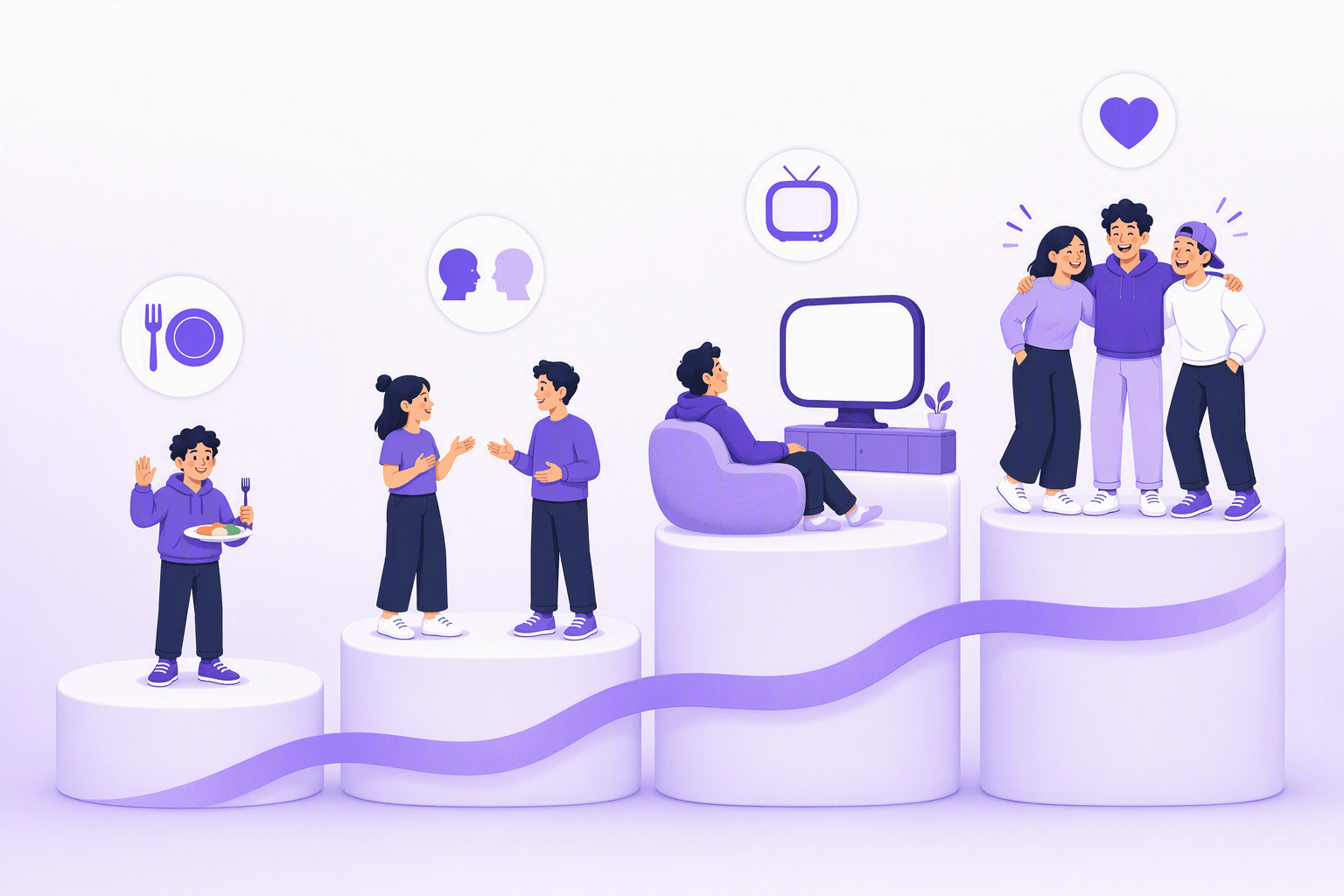
0 to 3 months: survival Spanish and confidence
If you study 30 to 60 minutes a day, you can usually:
- Introduce yourself
- Order food
- Ask for directions
- Handle basic small talk
This is where phrase learning pays off. Build automatic greetings and closings early with guides like how to say hello in Spanish and how to say goodbye in Spanish.
3 to 12 months: conversational, but listening is the limiter
With consistent input, many learners reach A2 to B1. You can talk about daily life, opinions, and plans, but you still miss details in fast speech.
A common pattern is “I can speak better than I can understand.” That is normal. Listening requires thousands of exposures, not just grammar knowledge.
1 to 2 years: real comfort and fewer freezes
At this stage, you can usually:
- Follow most everyday conversations
- Watch easier shows with subtitles
- Tell stories in past tenses with fewer mistakes
Your accent also stabilizes. You may still have errors, but you stop feeling like you are translating every sentence.
2+ years: advanced nuance, humor, and regional flexibility
Advanced Spanish is less about grammar rules and more about:
- Register (formal vs casual)
- Collocations (what sounds natural together)
- Humor, irony, and cultural references
- Regional vocabulary differences
This is also when slang becomes tempting. Learn it carefully, because some “fun” words are socially risky. If you are curious, keep it separate from polite conversation, and be cautious with guides like Spanish swear words.
⚠️ A common advanced mistake
Learners sometimes use strong slang to sound native, but miss the social cost. In Spanish, profanity and teasing can be friendly inside a group, and rude outside it. When in doubt, stay neutral and let locals set the tone.
The hidden difficulty: Spanish is not one accent
Spanish is spoken across more than 20 countries, and variation is real. The grammar core is shared, but pronunciation, vocabulary, and everyday expressions shift.

Spain vs Latin America: what changes most
A few high-impact differences:
- Pronunciation: In much of Spain, c and z can sound like “th” in English, while most of Latin America uses an “s” sound.
- Second person plural: Spain uses vosotros, most of Latin America uses ustedes.
- Vocabulary: Common items can differ (computer, car, juice, etc.).
If you want a clear map of these differences, read Spain vs Latin America Spanish.
“Neutral Spanish” is a learner tool, not a real place
Learners often search for “neutral Spanish.” In practice, neutral means “widely understood and not regionally marked.”
It is a good early strategy: pick one accent to imitate, but keep your listening broad. Your goal is comprehension across accents, not sounding like you are from everywhere.
What makes Spanish easier or harder for you personally
Difficulty is not only about the language. It is about your context and habits.
Your first 1,000 words matter more than your first 10 grammar topics
High-frequency vocabulary unlocks listening. If you want a structured base, use a frequency-focused list like 100 most common Spanish words and then learn them in sentences, not as isolated flashcards.
Paul Nation’s research on vocabulary size and coverage is often discussed in language teaching: comprehension jumps when you know enough high-frequency words to cover most of what you hear. Spanish rewards this quickly because so much everyday speech repeats.
Input quality beats input quantity
Ten minutes of focused re-listening can beat an hour of passive background audio. You need moments where you notice what you missed.
Movie and TV dialogue helps because it is emotional, contextual, and repetitive. You hear the same structures in dozens of scenes, which builds automaticity.
Speaking helps, but only if you keep it simple
Speaking early is useful, but do not force advanced grammar before it is ready. Use short, correct sentences, then expand.
A simple progression:
- Present tense with clear subjects
- Past tense for completed events (pretérito)
- Background past (imperfecto)
- Subjunctive triggers you actually use
The Spanish “hard parts” you can fix with targeted practice
These are common friction points with practical fixes.
Rolled R and the “soft D”
The rolled rr is real, but it is not the gatekeeper of Spanish. Many learners get understood with a weaker trill.
More important is vowel clarity and consonant consistency. Also, in many accents, d between vowels can soften, so cansado may sound closer to “cahn-SAH-oh.” Train your ear to accept variation.
Ser vs estar
This is not just “permanent vs temporary.” It is about how you frame the situation.
If you keep guessing, use a structured guide like ser vs estar. Then collect examples from real speech and label them by meaning, not by rule.
Por vs para
This pair is hard because both can translate to “for.” The fix is to anchor them to functions: purpose and destination for para, cause and exchange for por.
A focused explanation with real examples is in por vs para.
A practical weekly plan that makes Spanish feel easier
You do not need a perfect routine. You need a repeatable one.
5 days a week: short input, high attention
- 10 minutes: one short clip, replayed
- 10 minutes: shadowing (repeat aloud, copying rhythm)
- 10 minutes: review 10 to 20 words from that clip
This builds listening, pronunciation, and vocabulary together, which is how Spanish is used in real life.
2 days a week: speaking or writing for output
- 15 to 30 minutes: tutoring, language exchange, or voice notes
- Keep topics narrow: your day, your plans, one story
Output reveals gaps. Then you return to input and notice those forms more easily.
🌍 Why Spanish feels 'fast' even when it isn't
Spanish often packs meaning into small grammatical pieces: verb endings, pronouns, and short connectors like 'que' and 'se'. Native speakers are not necessarily speaking faster than English speakers, but learners miss these small units, so the sentence feels like a blur. Training your ear for the small words is the unlock.
So, is Spanish hard to learn?
Spanish is not “hard” in the way Japanese or Arabic can be for English speakers, but it is not automatic either. It is easy to start, then challenging to refine.
If you focus on listening, high-frequency verbs, and real sentences, Spanish becomes steadily easier month by month. If you only memorize rules without input, it can feel stuck for years.
If you want a fun way to build daily listening with real dialogue, try learning through short scenes in Wordy, and keep a small set of phrases you can actually use, like the ones in how to say I love you in Spanish.
Frequently Asked Questions
Is Spanish easier than French for English speakers?
How long does it take to become conversational in Spanish?
What is the hardest part of learning Spanish?
Do I need to roll my R to speak Spanish well?
Which Spanish should I learn, Spain or Latin America?
Sources & References
- Foreign Service Institute, Language Difficulty Ranking (accessed 2026)
- Instituto Cervantes, El español: una lengua viva (accessed 2026)
- Ethnologue, 27th edition, 2024
- RAE and ASALE, Diccionario de la lengua española (accessed 2026)
Start learning with Wordy
Watch real movie clips and build your vocabulary as you go. Free to download.


