Quick Answer
Use para (PAH-rah) for purpose, destination, deadlines, and recipients, and use por (por) for causes, exchange, duration, and movement through a place. The fastest way to choose is to ask: is this the goal or endpoint (para), or the reason, path, or “in exchange for” (por)?
Use para (PAH-rah) for goals and endpoints (purpose, destination, recipient, deadline), and use por (por) for causes and paths (reason, exchange, duration, movement through). If you can rephrase with “in order to,” it is para; if you can rephrase with “because of,” “through,” or “in exchange for,” it is por.
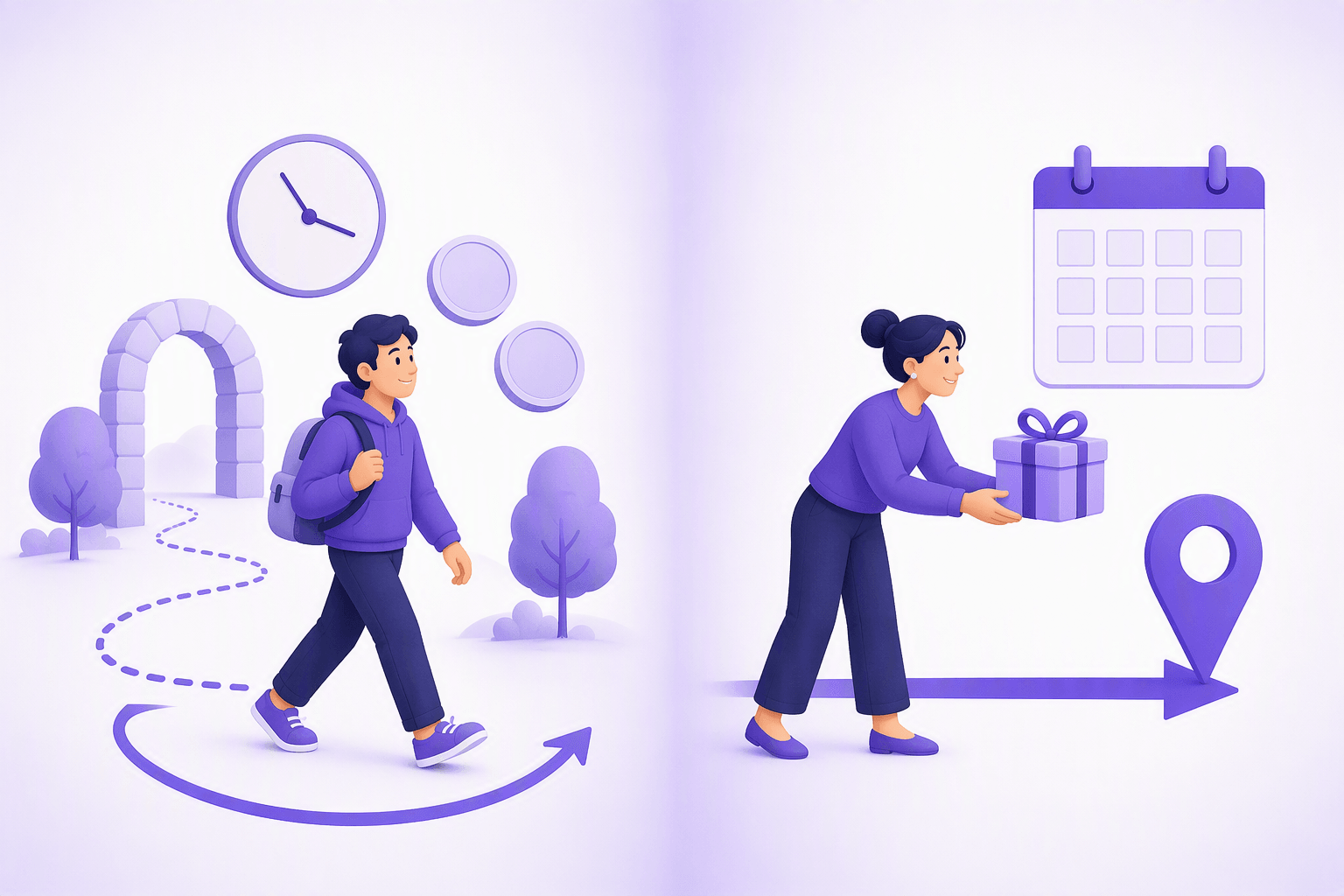
| English | Spanish | Pronunciation | Formality |
|---|---|---|---|
| Purpose / goal | para | PAH-rah | casual |
| Destination / direction | para | PAH-rah | casual |
| Recipient | para | PAH-rah | casual |
| Deadline / due date | para | PAH-rah | casual |
| Cause / reason | por | por | casual |
| Exchange / price | por | por | casual |
| Duration | por | por | casual |
| Through / along (route) | por | por | casual |
| Agent in passive (by) | por | por | casual |
Why this matters (and why it feels hard)
Spanish is spoken by hundreds of millions of people worldwide, and it is official in 20 countries, plus widely used in the US and beyond. Instituto Cervantes estimates over 500 million native speakers, and Ethnologue reports over 550 million total speakers when you include second-language users.
That scale creates a lot of real-world variation in accent and vocabulary, but por vs para is remarkably stable across regions. The confusion comes from English “for,” which covers multiple Spanish functions.
"Prepositions are among the most polysemous and context-dependent elements of grammar, and learners often over-rely on one-to-one translation."
Stephen C. Levinson, linguist (pragmatics), in Pragmatics (Cambridge University Press, 1983)
The fix is to stop translating and start identifying the relationship: endpoint (para) vs cause/path/exchange (por).
💡 A one-question test that works
Ask: is this pointing to a goal, recipient, destination, or deadline? Use para.
Is it pointing to a reason, a path through, a duration, or an exchange? Use por.
Para (PAH-rah): purpose, destination, recipient, deadline
Para is your “aiming at” preposition. It points forward to an endpoint, whether that endpoint is physical (a place) or abstract (a goal).
Purpose and intention
Use para when the phrase answers “what for?” in the sense of purpose.
- Estudio para aprender. (eh-STOO-dyoh PAH-rah ah-pren-DEHR)
“I study in order to learn.” - Lo hice para ayudarte. (loh EE-seh PAH-rah ah-yoo-DAR-teh)
“I did it to help you.”
A reliable substitution test: if “in order to” sounds natural in English, para is usually correct.
Destination and direction
Use para for where someone or something is headed.
- Voy para Madrid. (boy PAH-rah mah-DREED)
- Salimos para casa. (sah-LEE-mohs PAH-rah KAH-sah)
In everyday speech, you will also hear para + acá/allá:
- Ven para acá. (ben PAH-rah ah-KAH) “Come here.”
- Vete para allá. (BEH-teh PAH-rah ah-YAH) “Go over there.”
🌍 A small cultural detail: 'para acá' sounds more physical
In many countries, "ven aquí" is perfectly normal, but "ven para acá" can feel more immediate, like you are pulling someone into your space. In film dialogue, it often shows urgency or closeness, especially in family scenes or arguments.
Recipient (who gets it)
Use para for the person or group receiving something.
- Esto es para ti. (EHS-toh ehs PAH-rah tee)
- Un regalo para mi mamá. (oon reh-GAH-loh PAH-rah mee mah-MAH)
This includes email and messaging contexts:
- Tengo un mensaje para usted. (TEHN-goh oon men-SAH-heh PAH-rah oos-TEHD)
If you are learning formal vs informal address, pair this with tú vs usted.
Deadlines and scheduled points
Use para for “by” a deadline, or “for” a scheduled time.
- La tarea es para mañana. (lah tah-REH-ah ehs PAH-rah mah-NYAH-nah)
- Necesito esto para el viernes. (neh-seh-SEE-toh EHS-toh PAH-rah el BYEHR-nehs)
A key nuance: para + time often implies an expectation. You are aiming to have it done by then.
⚠️ Common mistake: mixing up duration and deadline
"Para dos horas" is usually wrong if you mean duration.
Use "por dos horas" (por dos OH-rahss) for how long, and "para las dos" (PAH-rah lahs dos) for a time on the clock.
Por (por): cause, exchange, duration, route, and agent
Por is the “because of / by means of / through” preposition. It often points backward to an explanation, or sideways to a path.
Cause and reason
Use por for the reason something happens.
- Lo hice por ti. (loh EE-seh por tee) “I did it because of you / for you (as the reason).”
- Gracias por venir. (GRAH-syahs por beh-NEER) “Thanks for coming.”
- Estoy aquí por trabajo. (eh-STOY ah-KEE por trah-BAH-hoh) “I’m here because of work.”
This is why “gracias por” is so fixed: you are naming the cause of gratitude.
If you want more everyday greeting patterns that include these structures, see how to say hello in Spanish.
Exchange, price, and substitution
Use por for trades, prices, and “in exchange for.”
- Pagué diez euros por el libro. (pah-GEH dyehs EH-oo-rohs por el LEE-broh)
- Te lo cambio por este. (teh loh KAHM-byoh por EHS-teh)
This also covers “on behalf of” in many contexts:
- Hablo por mi hermano. (AH-bloh por mee ehr-MAH-noh) “I speak for my brother.”
Duration (how long)
Use por for duration.
- Viví allí por tres años. (bee-BEE ah-YEE por trehs AH-nyohs)
- Esperé por una hora. (eh-speh-REH por OO-nah OH-rah)
In real speech, you will also hear esperar por and esperar without a preposition depending on region and meaning. The duration rule still holds: if you are saying how long, por is the safe choice.
Route and movement through a place
Use por for moving through, along, or around.
- Caminamos por el parque. (kah-mee-NAH-mohs por el PAR-keh)
- Pasé por tu casa. (pah-SEH por too KAH-sah) “I passed by your house.”
This is one of the most “movie-like” uses: characters describe where they went, who they ran into, and which neighborhood they crossed.
Agent in the passive voice (by)
Use por to mark the doer in passive constructions.
- La película fue dirigida por Almodóvar. (lah peh-LEE-koo-lah fweh dee-ree-HEE-dah por al-moh-DOH-bar)
- El libro fue escrito por ella. (el LEE-broh fweh ehs-KREE-toh por EH-yah)
If you are building your grammar foundation, this pairs well with ser vs estar, because passive voice often uses ser + participle.
The pairs that confuse everyone (with fixes)
These are the “same English, different Spanish” situations. Learn them as contrasts.
Por ti vs Para ti
Both can translate to “for you,” but they answer different questions.
| Spanish | Pronunciation | Core idea | Typical meaning |
|---|---|---|---|
| Lo hice por ti. | (loh EE-seh por tee) | reason | “I did it because of you / for your sake.” |
| Lo hice para ti. | (loh EE-seh PAH-rah tee) | recipient | “I did it for you (it’s meant for you).” |
A quick context cue: gifts and intended recipients prefer para. Sacrifice, motivation, and blame often prefer por.

Por qué vs Para qué
| Spanish | Pronunciation | What it asks |
|---|---|---|
| ¿Por qué? | (por KEH) | “Why?” (cause) |
| ¿Para qué? | (PAH-rah KEH) | “What for?” (purpose) |
Example:
- ¿Por qué estudias español? (por KEH ehs-TOO-dyahs ehs-pah-NYOL)
- ¿Para qué estudias español? (PAH-rah KEH ehs-TOO-dyahs ehs-pah-NYOL)
The first asks for a reason (family, work, love). The second asks for a goal (travel, exam, job).
Por + infinitive vs Para + infinitive
- Para + infinitive is purpose: para aprender, para trabajar.
- Por + infinitive is rarer and often appears in set structures like por hacer (“yet to do”) or por decir (“so to speak”), which are advanced.
For most learners: if you see an infinitive and you mean purpose, choose para.
Para siempre vs Por siempre
Both exist, but they are not interchangeable in tone.
- para siempre (PAH-rah SYEHM-preh) is the most neutral “forever.”
- por siempre (por SYEHM-preh) is common in emotional or poetic contexts, and in some regions it is very frequent in music lyrics.
If you are practicing romantic language, you will see both alongside phrases from how to say I love you in Spanish.
Fixed expressions you should memorize
Some combinations are so common that native speakers do not “calculate” them. Memorizing them reduces hesitation.
Para
- para mí (PAH-rah MEE) “for me / in my opinion”
- para nada (PAH-rah NAH-dah) “not at all”
- para que + subjuntivo (PAH-rah keh) “so that” (grammar-heavy, but extremely common)
Examples:
- Para mí, está bien. (PAH-rah MEE, ehs-TAH BYEHN)
- No, para nada. (noh, PAH-rah NAH-dah)
Por
- por favor (por fah-BOR) “please”
- por fin (por FEEN) “finally”
- por lo menos (por loh MEH-nohs) “at least”
- por si acaso (por see ah-KAH-soh) “just in case”
Examples:
- Por favor, siéntate. (por fah-BOR, SYEHN-tah-teh)
- Por fin llegaste. (por FEEN yeh-GAHS-teh)
💡 A pronunciation note that helps listening
In much of Latin America, "por" can sound very short and clipped in fast speech, almost like "pohr" with a quick r. Training with dialogue helps because these prepositions are often unstressed and easy to miss.
A practical decision guide (the one you can use mid-conversation)
When you freeze in a conversation, you do not need ten rules. You need a fast decision tree.
-
Are you talking about a goal, destination, recipient, or deadline?
Choose para (PAH-rah). -
Are you talking about a reason, exchange, duration, route, or the agent in a passive sentence?
Choose por (por). -
Still unsure? Try these substitutions:
- If “in order to” works, pick para.
- If “because of,” “through,” or “in exchange for” works, pick por.
Real examples that sound like TV dialogue
These are the kinds of lines you will hear constantly in Spanish-language shows.
Para
- Tengo que irme para el trabajo. (TEHN-goh keh EER-meh PAH-rah el trah-BAH-hoh)
- Es para hoy. (ehs PAH-rah oy) “It’s for today.”
- Lo guardé para después. (loh gwar-DEH PAH-rah dehs-PWEHS) “I saved it for later.”
Por
- Lo hice por miedo. (loh EE-seh por MYEH-doh) “I did it out of fear.”
- Pasé por aquí y te vi. (pah-SEH por ah-KEE ee teh BEE) “I passed by and saw you.”
- Te doy veinte por eso. (teh doy BEYN-teh por EH-soh) “I’ll give you 20 for that.”
If you want more survival lines for travel and everyday situations, keep Spanish travel phrases bookmarked.
Regional and cultural notes (what changes, what does not)
The grammar does not change, but frequency and preferred phrasing do.
In Spain, you will often hear “¿Por qué?” and “Porque…” in rapid back-and-forth, with por reduced in stress. In Mexico and parts of Central America, “para acá” and “para allá” are extremely common in family and street dialogue.
In the Río de la Plata region (Argentina, Uruguay), intonation can make para sound more like PAH-rah with a strong first syllable, which helps you catch it even when the sentence is fast.
None of this changes the rule, but it changes what your ear expects. That is why learning through clips works well: you hear the preposition in its natural rhythm. If you are also curious about informal registers, compare this grammar-focused topic with something very register-sensitive like Spanish swear words.
Mini practice: choose por or para
Pick the best option, then check the key.
- Salgo ___ Chile mañana.
- Gracias ___ tu ayuda.
- Estudié ___ dos horas.
- Esto es ___ mi jefe.
- Caminamos ___ el centro.
Answer key
- para (destination)
- por (reason)
- por (duration)
- para (recipient)
- por (route/through)
Common learner mistakes (and how to fix them fast)
Overusing para because English says “for”
English “for” covers price, duration, and reasons. Spanish splits those into por.
Fix: when you see money, time duration, or “thanks for,” default to por unless you have a clear endpoint.
Mixing up “by tomorrow” vs “for two hours”
- para mañana is a deadline or schedule.
- por dos horas is duration.
Fix: ask “by when?” (para) vs “how long?” (por).
Confusing “for you” meanings
- para ti is intended recipient.
- por ti is motivation or cause.
Fix: imagine a gift label (para) vs a reason (por).
Keep it in your head with one sentence
If you only memorize one line, make it this:
Para points to the endpoint. Por explains the path, cause, or exchange.
And when you hear it in real dialogue, notice how often it matches character intent: para when they plan, promise, schedule, or dedicate; por when they justify, apologize, pay, or describe where they went. For more natural openings and closings that show these patterns in action, review how to say goodbye in Spanish and listen for the prepositions in context.
Frequently Asked Questions
What is the easiest way to remember por vs para?
Is 'por' always 'because of' and 'para' always 'for'?
Why do Spanish speakers say 'gracias por' and not 'gracias para'?
Do Spain and Latin America use por and para differently?
How do I choose between 'por' and 'para' with time?
Sources & References
- Real Academia Española (RAE) y ASALE, Nueva gramática de la lengua española, 2009
- Real Academia Española (RAE), Diccionario de la lengua española (DLE), updated regularly
- FundéuRAE, Recomendaciones sobre el uso de preposiciones (por/para), updated regularly
- Instituto Cervantes, El español: una lengua viva (informe anual), 2023
- Ethnologue, Spanish (27th edition), 2024
Start learning with Wordy
Watch real movie clips and build your vocabulary as you go. Free to download.


