Quick Answer
The standard way to say Happy Easter in Spanish is Feliz Pascua. You can also say Felices Pascuas, especially in Spain and some Latin American communities, while religious greetings such as Cristo ha resucitado are common among practicing Christians.
| English | Spanish | Pronunciation | Formality |
|---|---|---|---|
| Happy Easter | Feliz Pascua | feh-LEES PAHS-kwah | polite |
| Happy Easter holidays | Felices Pascuas | feh-LEE-sehs PAHS-kwahs | polite |
| Happy Holy Week | Feliz Semana Santa | feh-LEES seh-MAH-nah SAHN-tah | polite |
| Christ has risen | Cristo ha resucitado | KREES-toh ah reh-soo-see-TAH-doh | formal |
| Enjoy Easter | Que disfrutes la Pascua | keh dees-FROO-tehs lah PAHS-kwah | casual |
| Have a lovely Easter | Que tengas una feliz Pascua | keh TEHN-gahs OO-nah feh-LEES PAHS-kwah | polite |
To say Happy Easter in Spanish, use Feliz Pascua /feˈlis ˈpaskwa/. For the holiday period, Felices Pascuas /feˈlises ˈpaskwas/ is equally natural. Both work in a card, an Easter Sunday message, or a friendly conversation, and neither is limited to one Spanish-speaking country.
Spanish has more than 600 million speakers worldwide when native, second-language, and limited-proficiency speakers are counted, according to Instituto Cervantes. It is an official language in 20 sovereign states, so Easter greetings naturally shift with local religion, family traditions, and regional vocabulary.
If you are starting with basic seasonal greetings, first get comfortable with everyday Spanish hellos. Easter wishes sound warmer when you can open with a natural greeting and ask how someone plans to celebrate.
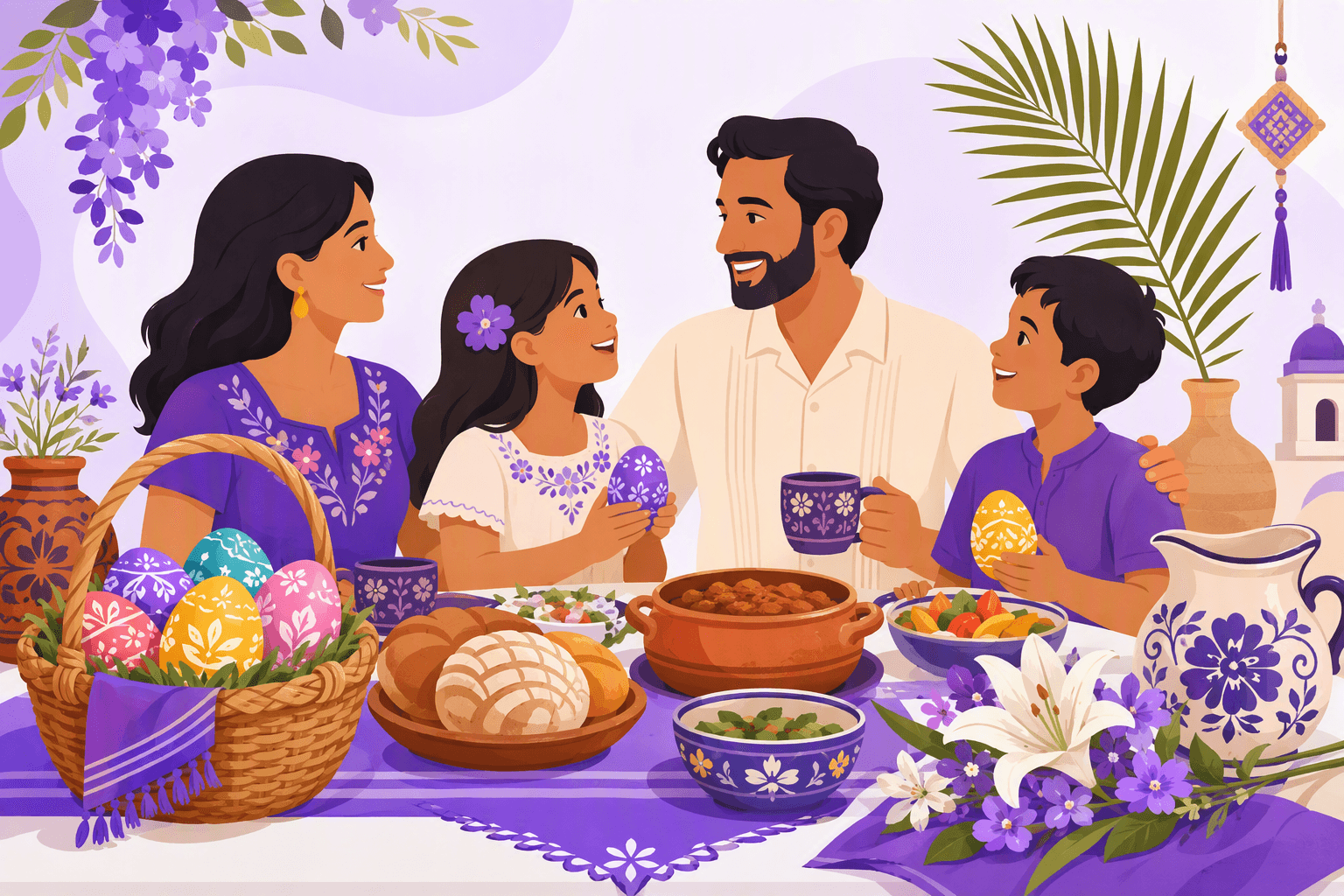
The best way to say Happy Easter in Spanish
Feliz Pascua
Feliz Pascua /feˈlis ˈpaskwa/ is the clearest translation of Happy Easter. The noun Pascua /ˈpaskwa/ usually refers to Easter in modern Spanish, particularly Easter Sunday and the Christian celebration of the resurrection.
The Real Academia Española defines Pascua /ˈpaskwa/ as a major Christian feast and records its wider historical links to Passover. That background matters because the word has religious weight, even when a sender uses it as a simple holiday greeting.
/feh-LEES PAHS-kwah/
Literal meaning: Happy Easter
“¡Feliz Pascua! Espero que pases un día bonito con tu familia.”
Happy Easter! I hope you have a lovely day with your family.
A dependable greeting for Easter Sunday, cards, messages, and polite conversation across Spanish-speaking communities.
The adjective feliz /feˈlis/ means happy, fortunate, or joyful. It does not change for gender here, because it describes the feminine noun Pascua /ˈpaskwa/ in the same form.
Felices Pascuas
Felices Pascuas /feˈlises ˈpaskwas/ literally means happy Easters, but English speakers should not read the plural too literally. Spanish often uses the plural to frame Easter as a holiday season rather than a single date.
This form is particularly familiar in Spain, where the full week is culturally prominent. It also appears in messages from Latin America, so it is never a risky choice.
/feh-LEE-sehs PAHS-kwahs/
Literal meaning: Happy Easters
“Te deseo unas felices Pascuas y mucho descanso.”
I wish you a happy Easter holiday period and plenty of rest.
Useful for greetings sent before Easter Sunday or when referring to the whole Easter break.
Use Feliz Pascua /feˈlis ˈpaskwa/ when you mean Easter Sunday specifically. Use Felices Pascuas /feˈlises ˈpaskwas/ when writing to someone before or during the broader holiday period.
Pascua and Semana Santa are not the same
A major learner mistake is treating Pascua /ˈpaskwa/ and Semana Santa /seˈmana ˈsanta/ as exact synonyms. They are connected, but they refer to different parts of the religious calendar.
Semana Santa /seˈmana ˈsanta/ means Holy Week. It begins on Palm Sunday and leads to Easter Sunday, while Domingo de Pascua /doˈmiŋɡo ðe ˈpaskwa/ means Easter Sunday.
| Spanish phrase | IPA | Best use |
|---|---|---|
| Feliz Semana Santa | /feˈlis seˈmana ˈsanta/ | Wish someone well during Holy Week |
| Feliz Pascua | /feˈlis ˈpaskwa/ | Easter Sunday greeting |
| Felices Pascuas | /feˈlises ˈpaskwas/ | The full Easter holiday period |
| Domingo de Pascua | /doˈmiŋɡo ðe ˈpaskwa/ | Naming Easter Sunday |
| Lunes de Pascua | /ˈlunes ðe ˈpaskwa/ | Easter Monday, where observed |
Feliz Semana Santa
Say Feliz Semana Santa /feˈlis seˈmana ˈsanta/ before Easter Sunday, especially if someone is traveling, attending religious events, or taking time off. It is polite and appropriate, though less common than Feliz Pascua /feˈlis ˈpaskwa/ as a direct Easter Sunday wish.
/feh-LEES seh-MAH-nah SAHN-tah/
Literal meaning: Happy Holy Week
“¡Feliz Semana Santa! Que tengas unos días tranquilos.”
Happy Holy Week! I hope you have some peaceful days.
Best used before or during Holy Week, rather than as a replacement for an Easter Sunday greeting.
In Spain, Semana Santa /seˈmana ˈsanta/ can be a major public cultural event. Cities including Seville, Málaga, Valladolid, and Zamora are known for processions, religious brotherhoods, music, and elaborate floats called pasos /ˈpasos/.
🌍 Easter in Spain is public as well as private
In many Spanish cities, Holy Week processions can last for hours and fill central streets. People may discuss a procession, a local brotherhood, a route, or the weather, even if they are not personally religious. Saying Feliz Semana Santa /feˈlis seˈmana ˈsanta/ recognizes the whole occasion.
Religious Easter greetings in Spanish
For people who are practicing Christians, Easter can call for a more explicitly religious message. The best-known proclamation is Cristo ha resucitado /ˈkɾisto a resusiˈtaðo/, meaning Christ has risen.
A traditional response is Verdaderamente ha resucitado /beɾðaðeɾaˈmente a resusiˈtaðo/, meaning He has truly risen. These lines are appropriate in church communities, religious family settings, and faith-based Easter cards, but they can feel too formal in a casual workplace chat.
Cristo ha resucitado
Cristo ha resucitado /ˈkɾisto a resusiˈtaðo/ uses the present perfect form ha resucitado /a resusiˈtaðo/. In everyday English, the closest equivalent is Christ has risen, not Christ has resurrected.
/KREES-toh ah reh-soo-see-TAH-doh/
Literal meaning: Christ has risen
“Cristo ha resucitado. Verdaderamente ha resucitado.”
Christ has risen. He has truly risen.
A religious Easter proclamation used among Christians, especially in worship services and faith-centered messages.
Spanish cultural meaning is carried by context as much as dictionary definition. Claire Kramsch, in Language and Culture, emphasizes that language use is shaped by social setting and shared cultural knowledge. The same principle explains why a secular colleague may prefer Felices Pascuas /feˈlises ˈpaskwas/, while a church friend may welcome Cristo ha resucitado /ˈkɾisto a resusiˈtaðo/.
Natural Easter wishes for texts, cards, and social media
You do not need a long message to sound sincere. Add a short wish after Feliz Pascua /feˈlis ˈpaskwa/, then choose language that fits your relationship.
Que tengas una feliz Pascua
Que tengas una feliz Pascua /ke ˈteŋɡas ˈuna feˈlis ˈpaskwa/ means Have a happy Easter. Use it with someone you address as tú /tu/, such as a friend, classmate, sibling, or close colleague.
For formal or plural situations, say Que tengan una feliz Pascua /ke ˈteŋɡan ˈuna feˈlis ˈpaskwa/. This works for several people, or for one person you address with usted /usˈteð/.
Que disfrutes la Pascua
Que disfrutes la Pascua /ke disˈfɾutes la ˈpaskwa/ means Enjoy Easter. It is friendly and relaxed, making it useful in a text, an Instagram caption, or a message to someone you know well.
Do not use it with a stranger or a formal business contact unless your relationship is already informal. Spanish politeness choices often depend on distance, age, setting, and local norms, as Brown and Levinson explain in Politeness: Some Universals in Language Usage.
Que pases un día bonito
Que pases un día bonito /ke ˈpases um ˈdia boˈnito/ means Have a lovely day. It is not Easter-specific, which makes it useful if you want warmth without making assumptions about someone’s faith.
Combine it naturally: Feliz Pascua, que pases un día bonito /feˈlis ˈpaskwa ke ˈpases um ˈdia boˈnito/. This is a good choice for neighbors, classmates, and colleagues.
Ready-to-send Happy Easter messages in Spanish
Here are messages you can copy, adapt, and send. Read each one aloud once before using it, paying attention to Spanish vowel clarity. Unlike English vowels, Spanish a /a/, e /e/, i /i/, o /o/, and u /u/ stay relatively stable.
| Situation | Spanish message | English meaning |
|---|---|---|
| Short text | ¡Feliz Pascua! Que disfrutes mucho el día. /feˈlis ˈpaskwa ke disˈfɾutes ˈmutʃo el ˈdia/ | Happy Easter! Enjoy the day. |
| Family message | Felices Pascuas para ti y toda tu familia. /feˈlises ˈpaskwas ˈpaɾa ti i ˈtoða tu faˈmilja/ | Happy Easter to you and your whole family. |
| Warm card | Te deseo una Pascua llena de paz, alegría y amor. /te deˈseo ˈuna ˈpaskwa ˈʝena de pas aleˈɣɾia i aˈmoɾ/ | I wish you an Easter full of peace, joy, and love. |
| Religious card | Que la alegría de la resurrección llene tu hogar. /ke la aleˈɣɾia de la resurekˈsjon ˈʝene tu oˈɣaɾ/ | May the joy of the resurrection fill your home. |
| Casual message | ¡Que lo pases genial esta Pascua! /ke lo ˈpases xeniˈal ˈesta ˈpaskwa/ | Have an awesome Easter! |
| Group message | Les deseo felices Pascuas a todos. /les deˈseo feˈlises ˈpaskwas a ˈtoðos/ | I wish everyone a happy Easter. |
The phrase paz, alegría y amor /pas aleˈɣɾia i aˈmoɾ/, meaning peace, joy, and love, is especially common in cards. It sounds warmer and more traditional than a simple translation from English.
For a romantic Easter message, you can add mi amor /mi aˈmoɾ/, meaning my love, to a message for a partner. Our guide to saying I love you in Spanish explains which affectionate phrases sound natural and which are more intense.
Easter vocabulary you may hear
| English | Spanish | Pronunciation | Note |
|---|---|---|---|
| Easter | Pascua | PAHS-kwah | Usually refers to Easter, especially Easter Sunday. |
| Holy Week | Semana Santa | seh-MAH-nah SAHN-tah | The week leading up to Easter Sunday. |
| Easter Sunday | Domingo de Pascua | doh-MEEN-goh deh PAHS-kwah | The Sunday celebration of Easter. |
| procession | procesión | proh-seh-SYOHN | A formal religious parade, especially prominent in Spain. |
| resurrection | resurrección | reh-soo-rehk-SYOHN | Religious term used in Easter messages. |
| Easter egg | huevo de Pascua | WEH-boh deh PAHS-kwah | Literally 'Easter egg'. |
| Easter bunny | conejo de Pascua | koh-NEH-hoh deh PAHS-kwah | Understood widely, though not central to every local tradition. |
| palm branch | rama de olivo | RAH-mah deh oh-LEE-boh | Olive branches are often associated with Palm Sunday in Spain. |
The huevo de Pascua /ˈweβo ðe ˈpaskwa/, or Easter egg, is widely understood. Yet Easter egg hunts and the conejo de Pascua /koˈnexo ðe ˈpaskwa/, Easter bunny, are not equally central in all Spanish-speaking communities.
In Spain, seasonal foods may be more culturally visible than rabbits or egg hunts. You may hear about torrijas /toˈrixas/, a sweet bread soaked in milk or wine, dipped in egg, and fried. In parts of Latin America, customs vary from local processions to family meals, church attendance, and regional sweets.
🌍 Do not assume every Easter tradition is the same
Spanish is spoken across Europe, the Americas, and parts of Africa. A Mexican family, a Spanish family, and an Argentine family may all say Feliz Pascua /feˈlis ˈpaskwa/ while celebrating very differently. Ask about someone's plans instead of assuming Easter eggs, parades, or religious observance.
Pronunciation tips for Feliz Pascua
The phrase Feliz Pascua /feˈlis ˈpaskwa/ has four clear vowel beats: fe-liz-pas-cua. The z in feliz /feˈlis/ sounds like /s/ in most of Latin America, while much of Spain uses /θ/, similar to the sound in English think.
The cua in Pascua /ˈpaskwa/ is one flowing sound sequence, /kwa/. Avoid turning it into pa-SOO-ah. Say Pascua /ˈpaskwa/ with the stress on the first syllable: PAHS-kwah.
If you are sending a voice message, speak slightly more slowly than you would in English. Spanish listeners generally expect distinct vowels rather than reduced vowel sounds.
When and how to use Easter greetings
Send Feliz Pascua /feˈlis ˈpaskwa/ on Easter Sunday. Send Felices Pascuas /feˈlises ˈpaskwas/ a few days earlier, over the weekend, or when referring to the entire break.
In Spain, many people begin discussing Semana Santa /seˈmana ˈsanta/ well before Easter Sunday. In a workplace or classroom, Que tengas una feliz Pascua /ke ˈteŋɡas ˈuna feˈlis ˈpaskwa/ is considerate and neutral enough for most situations.
End your message with a friendly farewell if needed. You can use Un abrazo /un aˈβɾaso/, meaning a hug, in warm but non-romantic messages, or choose a phrase from our guide to saying goodbye in Spanish.
A simple Easter greeting you can use today
For most people, this message is natural, warm, and easy to remember:
¡Felices Pascuas! Espero que pases un día precioso con las personas que quieres.
/felises ˈpaskwas esˈpeɾo ke ˈpases um ˈdia pɾeˈsjoso kon las peɾˈsonas ke ˈkjeɾes/
It means: Happy Easter! I hope you have a beautiful day with the people you love.
That message balances cultural warmth with flexibility. Whether Easter means a quiet Sunday, a family lunch, a church service, or a city procession, Feliz Pascua /feˈlis ˈpaskwa/ is the right place to begin.
Frequently Asked Questions
How do you say Happy Easter in Spanish?
Is Feliz Pascua used in every Spanish-speaking country?
What is the difference between Pascua and Semana Santa?
Can I say Felices Pascuas in Spanish?
How do Christians say Christ is risen in Spanish?
Sources & References
- Instituto Cervantes, El español: una lengua viva, 2024
- Real Academia Española, Diccionario de la lengua española: Pascua, accessed 2026
- UNESCO, Holy Week Processions in Mendrisio, accessed 2026
- David Crystal, The Cambridge Encyclopedia of Language, Cambridge University Press
- Claire Kramsch, Language and Culture, Oxford University Press
Start learning with Wordy
Watch real movie clips and build your vocabulary as you go. Free to download.


