Quick Answer
English uses thousands of words borrowed from French, especially in food, art, law, and everyday conversation. Many keep a French-style spelling and a French-ish pronunciation, but their meanings often shift in English. This guide teaches 60+ common French loanwords you actually hear, plus how to pronounce them clearly and use them without sounding forced.
English uses thousands of French words, from everyday basics like people and very to culture words like genre and cliché, because French shaped English vocabulary for centuries and still signals food, style, and prestige today.
French is also a living global language, which helps keep French loanwords circulating. Ethnologue (27th ed., 2024) estimates about 321 million French speakers worldwide, and the Organisation internationale de la Francophonie describes French as present across dozens of countries and territories in education and public life.
If you want a related map of borrowings from other languages, see our list of English words from Spanish and the broader English language overview.
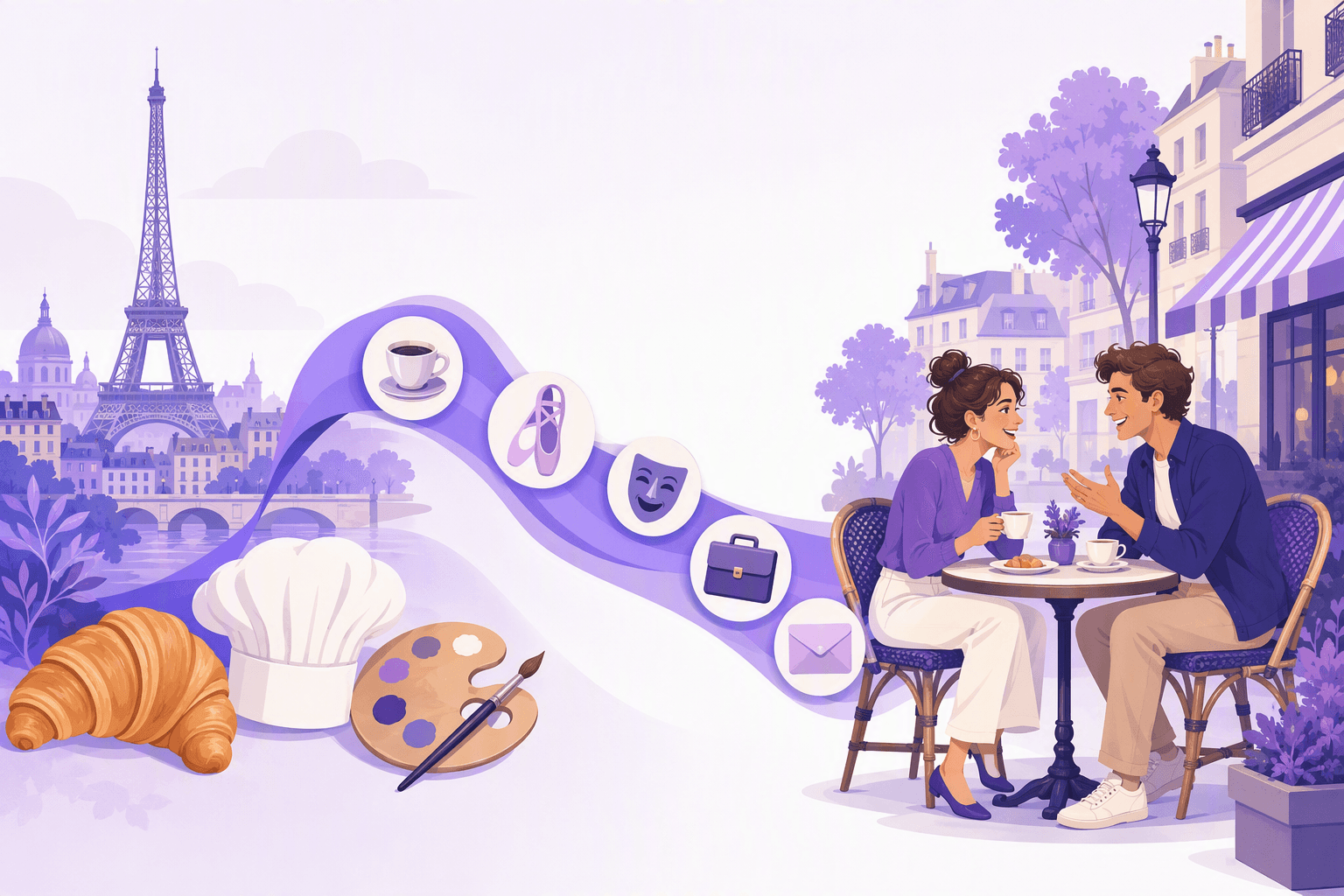
Why English has so many French words
A big reason is history. After the Norman Conquest, French (specifically Anglo-Norman) became the language of power in England, while English remained the language of most daily life. Encyclopaedia Britannica’s overview of the Norman Conquest is a solid starting point for how this social split shaped English vocabulary.
Over time, English absorbed French words in law, government, religion, and high culture, then later in fashion, cuisine, and art. The Oxford English Dictionary’s etymologies show how deeply French-origin terms are woven into English, including words many speakers do not recognize as borrowings.
French words that feel “fancy” in English
Even today, French loanwords can carry a social signal. Claire Kramsch’s work on language and culture is useful here: vocabulary is not just meaning, it is also identity and social positioning.
In English, choosing cuisine instead of cooking, or rendezvous instead of meeting, can sound playful, formal, or ironic depending on context.
💡 A practical rule
If a French loanword is common in your community, use it normally. If it feels rare, use it only when it adds a specific meaning, like déjà vu for the exact feeling, not just “I remember.”
How to pronounce French loanwords in English without overthinking it
You do not need a French accent. You need a stable English pronunciation that listeners recognize quickly.
Here are the patterns that cause the most trouble:
- Final consonants: Many French spellings end with consonants that are silent in French, but English may pronounce them (ballet vs buffet varies by dialect).
- Stress: English stress is strong and often early in the word. French stress is different, so English versions usually shift stress.
- Nasal vowels: English does not have French nasal vowels, so English approximations replace them with regular vowels plus n or m sounds.
If you are working on overall clarity, pair this with our English pronunciation guide.
60+ French loanwords you actually hear (grouped by topic)
Below is a practical list with clear, General American style pronunciations. Some words have multiple accepted pronunciations, but one clean version is better than trying to imitate Parisian French.
| Use/meaning in English | English | Pronunciation | Note |
|---|---|---|---|
| Coffee shop | café | kah-FAY | Often written 'cafe' without the accent in English. |
| A small restaurant | bistro | BEE-stroh | In English it can mean any casual, cozy place. |
| Buffet (self-serve meal) | buffet | buh-FAY | Also 'BUFF-it' exists for the furniture word in some dialects. |
| Croissant | croissant | krwah-SAHNT | Many English speakers also say 'krwah-SAHN'. |
| Cuisine (style of cooking) | cuisine | kwih-ZEEN | Often used for national or regional food styles. |
| Chef | chef | SHEF | Fully naturalized, no French accent needed. |
| Menu | menu | MEN-yoo | Everyday word in English. |
| Entrée (US: main course) | entrée | AHN-tray | In French it is closer to 'starter', English meaning shifted. |
| Appetizer | hors d'oeuvre | or-DURV | Plural often treated as singular in speech. |
| A sweet dessert | dessert | dih-ZURT | French-origin spelling, fully English pronunciation. |
| A small cake | macaron | MAK-uh-ron | Not the same as 'macaroon'. |
| Fancy restaurant rating | Michelin | MISH-uh-lin | Common in food media and travel talk. |
| A meeting (often romantic) | rendezvous | RAHN-duh-voo | Often playful or dramatic in tone. |
| A person engaged (male) | fiancé | fee-ahn-SAY | English keeps the gendered forms sometimes. |
| A person engaged (female) | fiancée | fee-ahn-SAY | Spelling differs, pronunciation usually the same in English. |
| A close friend | ami | AH-mee | Rare in everyday English, common in set phrases or stylized talk. |
| A feeling seen before | déjà vu | DAY-zhah VOO | Used as a noun: 'I had déjà vu'. |
| A witty remark | bon mot | bohn MOH | More common in writing than speech. |
| A mistake | faux pas | FOH pah | Often used for social mistakes. |
| A group of people | ensemble | ahn-SAHM-buhl | Music, theater, fashion. |
| A small group | clique | KLEEK | In English it often has a negative feel. |
| A person who knows a lot | connoisseur | kon-uh-SUR | Often food, wine, art. |
| Stylish | chic | SHEEK | Very common in fashion talk. |
| A fashion trend | à la mode | ah luh MOHD | Also means 'with ice cream' in US menus. |
| A short skirt | miniskirt | MIN-ee-skurt | Not a direct French form, but fashion vocabulary grew via French influence. |
| A bra | brassiere | bruh-ZEER | Often shortened to 'bra' in English. |
| A perfume | parfum | par-FUHM | In English, 'perfume' is more common than 'parfum'. |
| A hairstyle | bouffant | boo-FAHNT | Mostly in fashion or retro contexts. |
| A small bag | purse | PURS | Ultimately from French, now fully English. |
| A small accessory | boutique | boo-TEEK | Often implies curated or upscale. |
| A type/category | genre | ZHAHN-ruh | Film, music, books. |
| A repeated idea | cliché | klee-SHAY | Accent often dropped in English spelling. |
| A short scene in a film | montage | mon-TAHZH | Common in movie talk. |
| A preview | trailer | TRAY-ler | Not French, but film vocabulary often mixes sources. |
| A work of art | chef-d'oeuvre | SHEF DURV | More common in writing than speech. |
| A sudden insight | coup de foudre | KOO duh FOOD-ruh | Often used for 'love at first sight' in English. |
| A short improvised performance | cabaret | KAB-uh-ray | Also a venue style. |
| A theater term | matinée | MAT-uh-nay | Daytime showtime. |
| A beginner | novice | NOV-iss | French via Latin, fully English now. |
| A summary of work history | résumé | REH-zoo-may | Often spelled 'resume' in plain text. |
| A business founder | entrepreneur | ahn-truh-pruh-NUR | Very common in business English. |
| A helper role | attaché | ah-tuh-SHAY | Diplomatic and business contexts. |
| A trial run | début | day-BYOO | Also used for a first appearance. |
| A first version | prototype | PROH-tuh-type | Not French-only, but common in tech talk. |
| A military term | lieutenant | loo-TEN-uhnt | US pronunciation differs from many UK pronunciations. |
| A spy | agent | AY-jent | Fully English now. |
| A strong attack | assault | uh-SAWLT | French-origin, legal and everyday use. |
| A large group | regime | reh-ZHEEM | Often political. |
| A formal agreement | treaty | TREE-tee | French influence on legal vocabulary is huge. |
| A place to sleep (travel) | hotel | hoh-TEL | Often written 'hotel' without accent marks. |
| A driver | chauffeur | shoh-FUR | Still feels slightly formal. |
| A garage | garage | guh-RAHZH | Also 'GAR-ij' in some regions. |
| A ticket | ticket | TIK-it | Not French, but travel English mixes many sources. |
| A route | route | ROOT | Also 'ROWt' depending on region. |
| A feeling of sadness | ennui | ahn-WEE | Usually means bored restlessness, not just 'sad'. |
| A strong desire | desire | dih-ZY-er | Fully English now. |
| A memory | souvenir | SOO-vuh-neer | Travel and gifting. |
| A small detail | nuance | NOO-ahns | Common in academic and everyday talk. |
| A reason to be | raison d'être | RAY-zohn DET-ruh | Often used humorously in English. |
| A step-by-step plan | routine | roo-TEEN | French-origin, fully everyday English. |
Meaning shifts: when the English version is not the French one
Some French borrowings keep a French-looking form but develop a distinct English meaning. This is where learners get tripped up, especially if they also study French.
entrée
In American English, entrée usually means the main course. In French, entrée is closer to an entry or starter, which is why bilingual menus can be confusing.
café
In French, café can mean coffee itself or a coffee place depending on context. In English, it usually means the place.
chic
In English, chic is a general “stylish” label. In French, it can be used similarly, but English speakers often use it as a standalone adjective in a way that feels more like branding.
🌍 Why accents disappear in English spelling
English typing habits and publishing conventions often drop diacritics, especially in all-caps, URLs, and plain text systems. You will see 'resume' and 'cafe' constantly. Keeping the accents can look polished, but it can also look overly formal in casual messaging, so match your setting.
French loanwords you already know (but may not realize)
A lot of French-origin vocabulary is so integrated that it no longer feels foreign. Words like people, very, use, change, large, and question have French roots, and the OED etymologies make that clear, but modern English speakers treat them as basic English.
This matters for learning strategy: you do not need to “learn” these as French words. You just need to recognize that English spelling patterns often reflect French history, which helps explain why English can be hard to spell.
If spelling-pronunciation mismatches frustrate you, our American vs British English guide also helps, because some “weird spellings” are preserved differently across regions.
When French loanwords sound natural vs forced
French borrowings are normal in certain domains:
- Food and travel: café, cuisine, chauffeur
- Art and media: genre, montage, cliché
- Work and status: résumé, entrepreneur
- Social nuance: faux pas, déjà vu, ennui
They can sound forced when you use them to replace a simple English word with no added meaning. Saying rendezvous for every meeting, or raison d'être for any reason, can sound like you are performing sophistication.
This is close to what sociolinguists call style and register choice. William Labov’s work on variation and social meaning is a good lens: speakers shift vocabulary based on audience, setting, and identity, not just dictionary definitions.
How movie and TV dialogue helps you learn these words in context
Loanwords are easiest when you hear them used naturally, with the right tone. In real dialogue, faux pas often comes with humor, résumé comes with job stress, and cliché comes with mild judgment.
If you want listening practice built around real speech, start with our picks for the best movies to learn English. You will hear many of the words above in workplace scenes, restaurant scenes, and pop-culture conversations.
💡 A fast practice loop
Pick 10 loanwords from the table. For each one, write a one-sentence mini scene you could actually say out loud. Then listen for that word in a movie or show and copy the rhythm, not the accent.
Common mistakes learners make with French loanwords
Over-Frenching the pronunciation
If you push nasal vowels or drop consonants too aggressively, some listeners will not recognize the word quickly. Clear English beats “authentic French” in most English conversations.
Misplacing stress
Words like entrepreneur and rendezvous have stress patterns that English speakers expect. If you stress the wrong syllable, it can sound like a different word.
Treating diacritics as required
Accents like é and à are optional in most English writing. Use them when you want to be precise or polished, but do not assume they are mandatory.
Using rare words in casual settings
Some loanwords are common, others are “writerly.” Bon mot and chef-d'oeuvre are real, but many people rarely say them out loud.
If you are also exploring informal vocabulary, compare how loanwords differ from slang in our English slang guide. Slang is about in-group identity, while French loanwords are often about domain and register.
A quick note on French vs Latin in English
Many English words came through French but ultimately trace back to Latin. Dictionaries like Merriam-Webster and the OED separate these pathways carefully in their etymology notes.
For learners, the practical takeaway is simple: French acted as a bridge that brought huge amounts of Romance vocabulary into English, which is why English has pairs like:
- ask (Germanic) vs inquire (French/Latin pathway)
- help vs assist
- start vs commence
Knowing this helps you choose tone. Germanic words often feel direct and plain, Romance words often feel formal or abstract.
Using French loanwords with the right tone
Here are a few tone cues that match real usage:
- cliché often signals mild criticism.
- déjà vu signals a shared human experience, often with humor.
- rendezvous can sound romantic or playful.
- résumé is neutral-professional, but can also be stressful in job talk.
- ennui can sound literary, ironic, or self-aware.
If you want a different kind of “strong tone vocabulary,” our guide to English swear words shows the opposite end of the register spectrum. Loanwords and swearing both teach you something important: vocabulary is social.
A simple study plan (15 minutes a day)
-
Day 1 to 3: Learn the food and travel words, because you will actually use them.
-
Day 4 to 7: Add art and media words like genre and montage, then notice them in reviews and trailers.
-
Week 2: Add work words like résumé and entrepreneur, then write two sentences about your own life using them.
-
Ongoing: Keep a “loanword note” list. When you see a French-looking word in English, check its English pronunciation and whether the meaning shifted.
For a structured baseline of high-frequency English, pair this with the 100 most common English words list. Loanwords are useful, but core function words carry most real conversation.
Final takeaway
French words used in English are not a niche vocabulary set, they are part of how English expresses food, culture, work, and social nuance. Learn the common ones, pronounce them clearly in English, and pay attention to meaning shifts like entrée and café.
If you want to hear these words the way native speakers actually say them, use movie and TV dialogue as your input source, starting with our best movies to learn English, then build your own list of “words I keep hearing” from there.
Frequently Asked Questions
How many French words are in English?
Do I need to pronounce French loanwords with a French accent?
Why do some French loanwords have silent letters in English?
What are the most common French loanwords in everyday English?
Are French loanwords used differently in American vs British English?
Sources & References
- Oxford English Dictionary, entries and etymologies for French-origin words, accessed 2026
- Merriam-Webster Dictionary, etymology notes for French loanwords, accessed 2026
- Encyclopaedia Britannica, 'Norman Conquest' and its linguistic impact, accessed 2026
- Ethnologue, 27th edition, 2024
- Organisation internationale de la Francophonie (OIF), French language facts and figures, accessed 2026
Start learning with Wordy
Watch real movie clips and build your vocabulary as you go. Free to download.


