Quick Answer
French medical vocabulary includes practical words for body parts, symptoms, doctors, pharmacies, prescriptions, and emergencies. Learn these core terms before visiting a doctor or pharmacy in France or another French-speaking country.
French medical vocabulary helps you explain symptoms, buy medicine, make an appointment, and respond during an emergency. Start with médecin /me.d(ə).sɛ̃/ for doctor, pharmacie /faʁ.ma.si/ for pharmacy, douleur /du.lœʁ/ for pain, and urgence /yʁ.ʒɑ̃s/ for emergency, then learn the specific words that describe what hurts and how long it has been happening.
French is spoken by more than 321 million people worldwide, according to the Organisation internationale de la Francophonie, and it is an official language in 29 countries. Healthcare systems differ across those places, but the core vocabulary below is widely understood in France, Belgium, Switzerland, Québec, and many African French-speaking communities.
Before an appointment, review French greetings, too. A polite opening makes it easier to ask for help, especially when you are nervous or in pain.
| English | French | Pronunciation | Note |
|---|---|---|---|
| Doctor | médecin | mayd-SAN | IPA /me.d(ə).sɛ̃/. A general doctor is often called a médecin généraliste. |
| Hospital | hôpital | oh-pee-TAHL | IPA /o.pi.tal/. The h is silent. |
| Pharmacy | pharmacie | far-mah-SEE | IPA /faʁ.ma.si/. Look for a green cross in France. |
| Emergency room | les urgences | lay oor-ZHAHNSS | IPA /le.yʁ.ʒɑ̃s/. Usually used in the plural. |
| Clinic | clinique | klee-NEEK | IPA /kli.nik/. Can refer to a private medical facility. |
| Appointment | rendez-vous | rahn-day-VOO | IPA /ʁɑ̃.de.vu/. Also used for non-medical appointments. |
| Nurse | infirmier / infirmière | an-feer-MYAY / an-feer-MYAIR | IPA /ɛ̃.fiʁ.mje/ and /ɛ̃.fiʁ.mjɛʁ/. Masculine and feminine forms. |
| Specialist | spécialiste | spay-syah-LEEST | IPA /spe.sja.list/. Used for doctors in a specialty. |
| Waiting room | salle d'attente | sahl dah-TAHNT | IPA /sal da.tɑ̃t/. Literally 'waiting room'. |
| Health insurance card | carte Vitale | kart vee-TAHL | IPA /kaʁt vi.tal/. France's public health insurance card. |
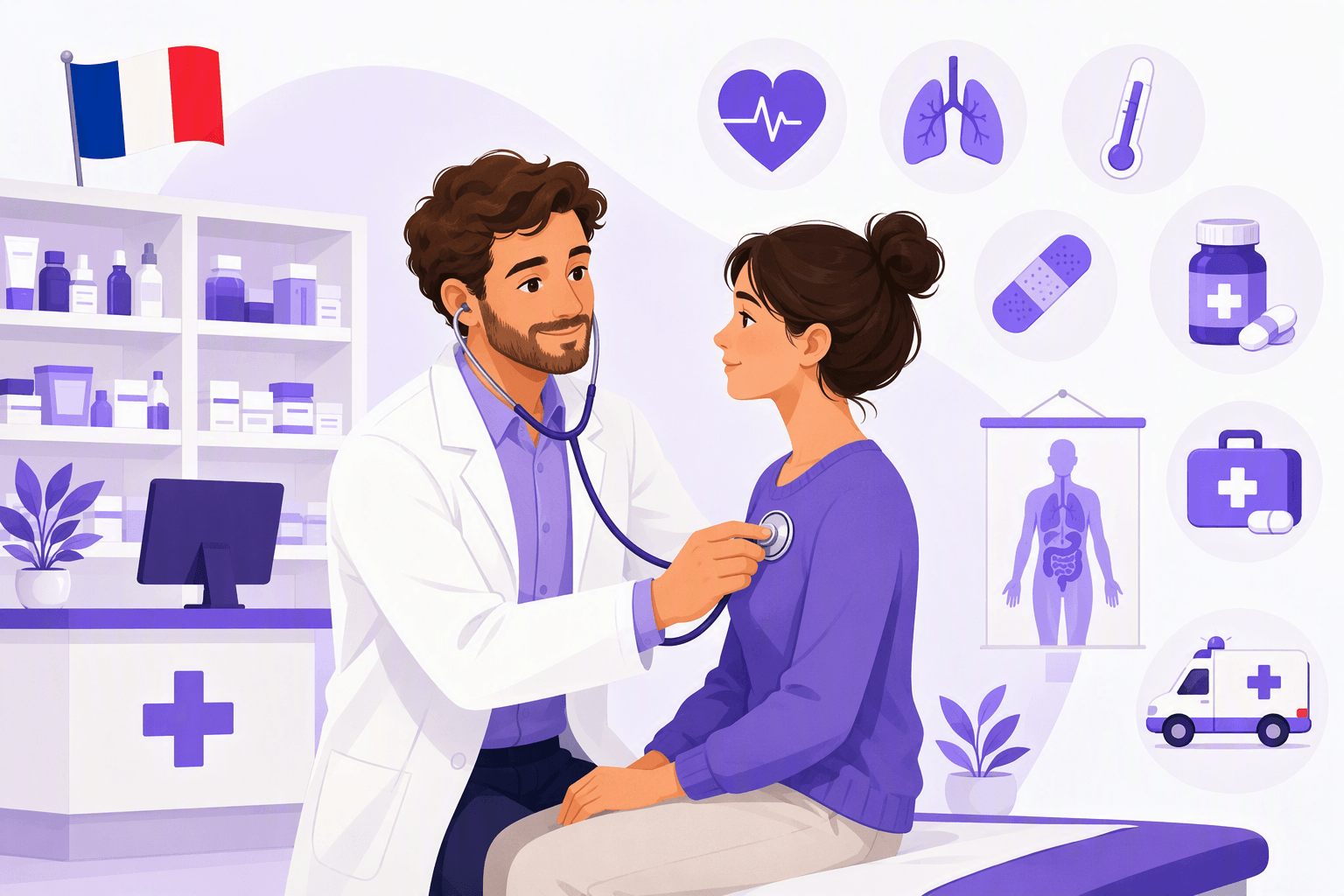
French healthcare vocabulary you will actually use
France has a mixed public and private healthcare system. The carte Vitale /kaʁt vi.tal/ is the health-insurance card used by people registered in the French system, while visitors often pay first and seek reimbursement through travel insurance.
In a non-life-threatening situation, a pharmacie /faʁ.ma.si/ is often a practical first stop. French pharmacies commonly offer advice for minor conditions, basic treatments, and directions to an appropriate clinician. The French health insurance body Assurance Maladie explains that a médecin traitant /me.d(ə).sɛ̃ tʁɛ.tɑ̃/, or primary doctor, has an important coordinating role in routine care.
Médecin
A médecin /me.d(ə).sɛ̃/ is a doctor. To ask whether one is available, say: Y a-t-il un médecin disponible ? /ja.t‿il œ̃ me.d(ə).sɛ̃ dis.po.nibl/ meaning “Is a doctor available?”
For a general practitioner, use médecin généraliste /me.d(ə).sɛ̃ ʒe.ne.ʁa.list/. A spécialiste /spe.sja.list/ is a specialist, such as a cardiologue /kaʁ.djo.lɔg/ for a heart doctor or a dermatologue /dɛʁ.ma.tɔ.lɔg/ for a skin doctor.
Pharmacie
A pharmacie /faʁ.ma.si/ is more than a place to buy painkillers. Pharmacists can suggest products for a cold, minor cut, insect bite, digestive discomfort, or seasonal allergy, and they can explain whether a product requires an ordonnance /ɔʁ.dɔ.nɑ̃s/, a prescription.
French pharmacy culture is distinct from the large drugstore model common in some countries. A pharmacy is recognizable by its illuminated green cross, and many towns have an on-call pharmacie de garde /faʁ.ma.si də ɡaʁd/ outside normal hours.
Urgences
Les urgences /le.yʁ.ʒɑ̃s/ means the emergency department. Go there, or call emergency services, for severe symptoms such as chest pain, difficulty breathing, loss of consciousness, uncontrolled bleeding, or signs of stroke.
In France, call 15 for SAMU /sa.my/, the emergency medical assistance service. You can also call 112, the European emergency number, which works throughout the EU. Knowing how to say goodbye in French is useful, but in an emergency, speak simply and give your location first.
⚠️ For emergencies, act first
If someone has severe chest pain, major breathing difficulty, a serious injury, or becomes unconscious, call 15 or 112 immediately. Do not spend time searching for perfect French. Say your location, the person's age if known, and the main symptom.
Symptoms and pain in French
Clear descriptions matter more than advanced grammar. Name the body part, identify the sensation, and say when it began. The phrase j'ai mal /ʒe mal/ means “I hurt” or “I have pain,” but it must be followed by à /a/ plus the relevant body part.
| English | French | Pronunciation | Note |
|---|---|---|---|
| Pain | douleur | doo-LUHR | IPA /du.lœʁ/. A feminine noun: une douleur. |
| Fever | fièvre | FYEVR | IPA /fjɛvʁ/. Often used with avoir: avoir de la fièvre. |
| Cough | toux | TOO | IPA /tu/. The final x is silent. |
| Sore throat | mal de gorge | mahl duh GORZH | IPA /mal də ɡɔʁʒ/. Literally 'throat pain'. |
| Headache | mal de tête | mahl duh TET | IPA /mal də tɛt/. Literally 'head pain'. |
| Stomachache | mal au ventre | mahl oh VAHNTR | IPA /mal o vɑ̃tʁ/. Literally 'pain in the stomach/belly'. |
| Dizziness | vertiges | vair-TEEZH | IPA /vɛʁ.tiʒ/. Usually used in the plural. |
| Nausea | nausée | noh-ZAY | IPA /no.ze/. A feminine noun. |
| Rash | éruption cutanée | ay-roop-SYOHN kew-tah-NAY | IPA /e.ʁyp.sjɔ̃ ky.ta.ne/. A skin eruption or rash. |
| Allergy | allergie | ah-lair-ZHEE | IPA /a.lɛʁ.ʒi/. State allergies clearly before treatment. |
How to describe where it hurts
Use the basic pattern j'ai mal à... /ʒe mal a/ followed by the body part. French contracts à /a/ with masculine singular nouns, producing au /o/, and with plural nouns, producing aux /o/.
| English | French pattern | IPA |
|---|---|---|
| My head hurts | J'ai mal à la tête. | /ʒe mal a la tɛt/ |
| My stomach hurts | J'ai mal au ventre. | /ʒe mal o vɑ̃tʁ/ |
| My back hurts | J'ai mal au dos. | /ʒe mal o do/ |
| My leg hurts | J'ai mal à la jambe. | /ʒe mal a la ʒɑ̃b/ |
| My eyes hurt | J'ai mal aux yeux. | /ʒe mal o զjø/ |
You can add a time expression: Depuis ce matin /də.pɥi sə ma.tɛ̃/ means “since this morning,” while depuis trois jours /də.pɥi tʁwa ʒuʁ/ means “for three days.” If symptoms are getting worse, say ça s'aggrave /sa sa.ɡʁav/.
Claire Kramsch, in Language and Culture, emphasizes that successful communication includes social expectations as well as grammar. In a French healthcare setting, calm directness works well: state the symptom, duration, severity, and any medication or allergy without trying to soften essential details.
Body parts and medical information
| English | French | Pronunciation | Note |
|---|---|---|---|
| Head | tête | TET | IPA /tɛt/. Used in mal de tête. |
| Throat | gorge | GORZH | IPA /ɡɔʁʒ/. Used in mal de gorge. |
| Chest | poitrine | pwa-TRIN | IPA /pwa.tʁin/. A feminine noun. |
| Back | dos | DOH | IPA /do/. The final s is silent. |
| Stomach / belly | ventre | VAHNTR | IPA /vɑ̃tʁ/. Common everyday word. |
| Medicine | médicament | may-dee-kah-MAHN | IPA /me.di.ka.mɑ̃/. Ask how and when to take it. |
| Prescription | ordonnance | or-doh-NAHNSS | IPA /ɔʁ.dɔ.nɑ̃s/. Required for many medicines. |
| Dosage | posologie | poh-zoh-loh-ZHEE | IPA /pɔ.zɔ.lɔ.ʒi/. Instructions for dose and timing. |
| Medical history | antécédents médicaux | ahn-tay-say-DAHN may-dee-KOH | IPA /ɑ̃.te.se.dɑ̃ me.di.ko/. Usually plural. |
| Side effect | effet secondaire | ay-FAY suh-gohn-DAIR | IPA /e.fɛ sə.ɡɔ̃.dɛʁ/. Report serious unexpected effects. |
Essential phrases for a doctor or pharmacy
These phrases are polite, short, and useful even at beginner level. Use bonjour /bɔ̃.ʒuʁ/ first, then make your request. In French, the formal vous /vu/ form is the normal choice with medical staff.
/zhay buh-ZWAN duh vwahr uhn mayd-SAN/
Literal meaning: I have need to see a doctor.
“Bonjour, j'ai besoin de voir un médecin aujourd'hui.”
Hello, I need to see a doctor today.
A clear request is appropriate. Add aujourd'hui if you need a same-day appointment.
/zhuh swee ah-lair-ZHEEK ah/
Literal meaning: I am allergic to...
“Je suis allergique à la pénicilline.”
I am allergic to penicillin.
Say this before receiving medication. If possible, show the allergy written down as well.
/koh-MAHN dwah zhuh PRAHNDR suh may-dee-kah-MAHN/
Literal meaning: How must I take this medicine?
“Comment dois-je prendre ce médicament, et pendant combien de jours ?”
How should I take this medicine, and for how many days?
Pharmacists are accustomed to explaining dose schedules and possible interactions.
/zhuh nuh kohm-PRAHN pah/
Literal meaning: I do not understand.
“Je ne comprends pas, pouvez-vous parler plus lentement ?”
I do not understand, can you speak more slowly?
This is safer than guessing about treatment directions. Ask staff to write down important instructions.
The phrase pouvez-vous parler plus lentement ? /pu.ve vu paʁ.le ply lɑ̃t.mɑ̃/ means “Can you speak more slowly?” It is especially useful when a clinician explains dosage, test results, or follow-up steps. For more help with this type of repair phrase, see our guide to saying you do not understand in French.
Prescriptions, tests, and follow-up care
A doctor may write an ordonnance /ɔʁ.dɔ.nɑ̃s/ for medication, blood work, imaging, or a specialist consultation. Bring it to a pharmacie /faʁ.ma.si/ for medicine, or ask where to go for a prise de sang /pʁiz də sɑ̃/, a blood test.
Useful words include analyse /a.na.liz/ for test or analysis, résultat /ʁe.zyl.ta/ for result, radio /ʁa.djo/ for X-ray, and échographie /e.ʃɔ.ɡʁa.fi/ for ultrasound. Do not confuse radio /ʁa.djo/ with a radio station in context: medical staff will understand it as shorthand for an X-ray.
The Académie française dictionary records the precise medical senses of many everyday terms, but real consultations also rely on context. Brown and Levinson’s work Politeness: Some Universals in Language Usage helps explain why formal address matters: using vous /vu/ signals appropriate respect without making your message less direct.
🌍 Why pharmacists matter in France
In France, a pharmacist is a qualified health professional and a visible local point of care. For minor symptoms, asking a pharmacist for advice is normal. For dangerous symptoms, chronic conditions, pregnancy-related concerns, or symptoms that persist, ask for a doctor or emergency service instead.
A practical medical French checklist
Prepare a note on your phone before traveling. Write your diagnoses, allergies, medications, dosage, emergency contact, and insurance details in both English and French. This is more reliable than trying to recall medical information under stress.
Use exact facts where possible: Je prends ce médicament tous les jours /ʒə pʁɑ̃ sə me.di.ka.mɑ̃ tu le ʒuʁ/ means “I take this medicine every day.” Je suis diabétique /ʒə sɥi dja.be.tik/ means “I am diabetic,” and je suis enceinte /ʒə sɥi ɑ̃.sɑ̃t/ means “I am pregnant.”
Avoid relying on literal translations for pain. English “I am sick” may mean nausea, a cold, or general illness, but French requires more detail. Say je suis malade /ʒə sɥi ma.lad/ for “I am ill,” then name the symptom: j'ai de la fièvre /ʒe də la fjɛvʁ/, j'ai la nausée /ʒe la no.ze/, or j'ai mal au ventre /ʒe mal o vɑ̃tʁ/.
Learning medical French is not about sounding perfect. It is about communicating safely, listening carefully, and asking for clarification when needed. After you master these high-value words, build confidence with real dialogue clips and everyday listening practice through French learning resources.
Frequently Asked Questions
What French medical vocabulary should tourists learn first?
How do I say that I need a doctor in French?
Can French pharmacists diagnose minor illnesses?
What number should I call for a medical emergency in France?
Do French doctors speak English?
Sources & References
- Ministère de la Santé et de l'Accès aux soins, Emergency numbers in France, accessed 2026
- Assurance Maladie, Understanding the French healthcare system, accessed 2026
- Académie française, Dictionnaire de l'Académie française, accessed 2026
- European Commission, 112 emergency number, accessed 2026
- Council of Europe, Common European Framework of Reference for Languages: Companion Volume
Start learning with Wordy
Watch real movie clips and build your vocabulary as you go. Free to download.


