Quick Answer
English weather vocabulary includes basic nouns such as rain, wind, cloud, and sunshine, plus forecast terms such as humid, drizzle, thunderstorm, and freezing. Learn these words with pronunciation and natural examples so you can understand weather apps, small talk, news reports, and movie dialogue.
English weather vocabulary gives you the words to describe what is happening outside, understand forecasts, and make everyday small talk. Begin with /ˈweðɚ/ weather, /reɪn/ rain, /wɪnd/ wind, /klaʊd/ cloud, /sʌn/ sun, /hɑt/ hot, and /koʊld/ cold, then learn more precise terms such as /ˈdrɪzəl/ drizzle, /hjuˈmɪd/ humid, and /ˈθʌndɚstɔrm/ thunderstorm.
Weather is an unusually useful topic because it is low-pressure conversation: you can mention it to a neighbor, coworker, taxi driver, or new acquaintance without asking anything personal. For more everyday foundations, pair this list with our 100 most common English words and English numbers guide, since forecasts constantly use numbers, dates, and temperatures.
English has about 1.5 billion total speakers worldwide according to Ethnologue, so weather vocabulary appears in many regional varieties. The core words are widely shared, but temperature scales, seasonal expectations, and phrases such as “a proper storm” can differ between the United States, the United Kingdom, Australia, and other English-speaking places.
| English | Pronunciation | Note |
|---|---|---|
| weather | WETH-er | General outdoor conditions. |
| sun | SUN | The bright star and its sunlight. |
| sunshine | SUN-shyne | Bright light from the sun. |
| cloud | KLOWD | A visible mass of water droplets. |
| rain | RAYN | Water falling from clouds. |
| snow | SNOH | Frozen white precipitation. |
| wind | WIND | Moving air. |
| fog | FOG | Low cloud that reduces visibility. |
| mist | MIST | Light fog, usually less dense. |
| storm | STORM | Severe weather with wind, rain, or snow. |
| thunder | THUN-der | The sound after lightning. |
| lightning | LYTE-ning | A flash of electricity in the sky. |
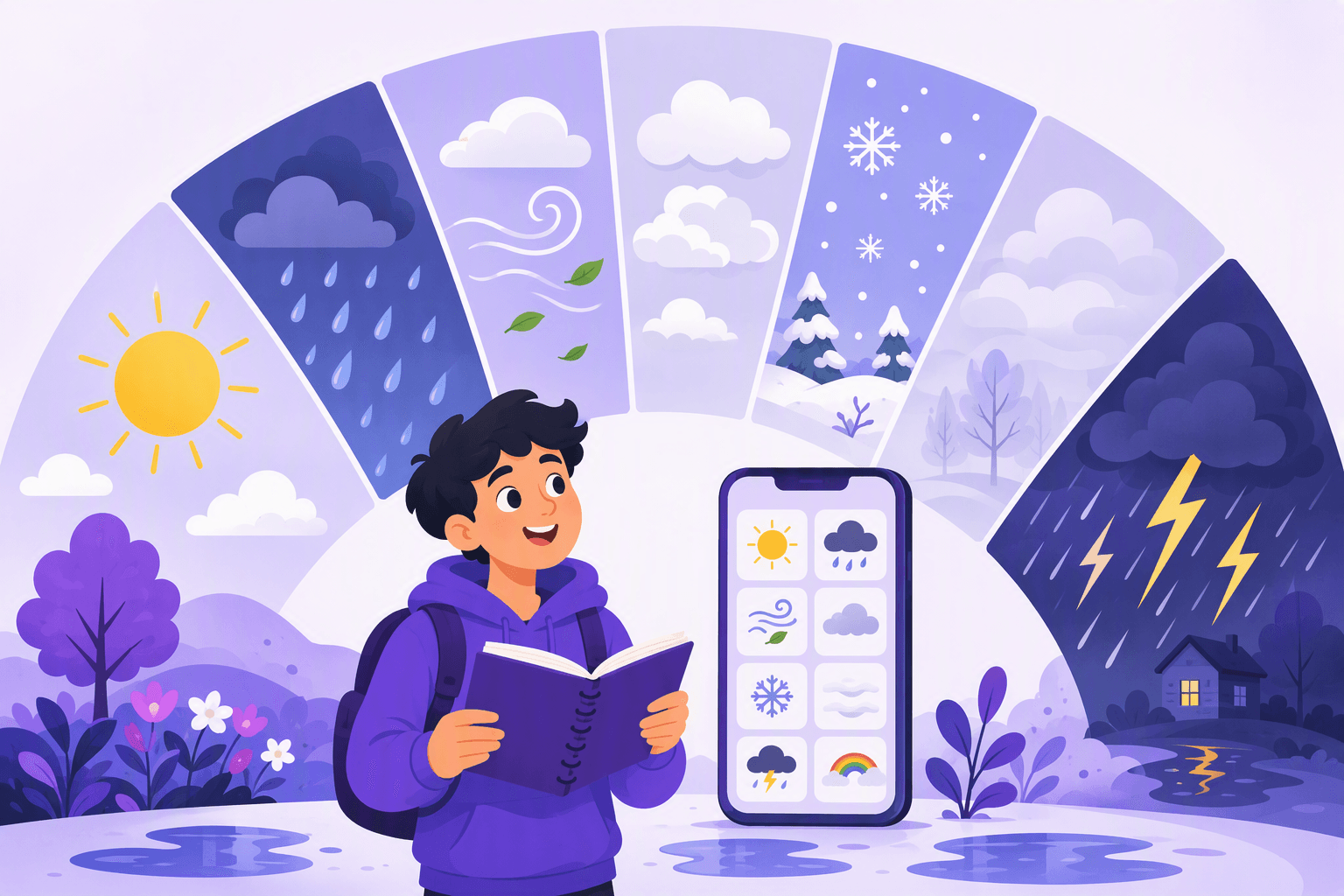
The basic weather words you need first
The broadest word is weather /ˈweðɚ/. It is normally uncountable, so say “The weather is lovely” rather than “The weather is a lovely.”
Use climate /ˈklaɪmət/ for a place’s typical weather over a long period. A single snowy afternoon is weather. A pattern of cold, snowy winters is climate.
sunny
Sunny /ˈsʌni/ means bright with lots of sunshine. It does not necessarily mean hot.
- It’s sunny today.
- We’re expecting sunny skies this weekend.
- The apartment gets very sunny in the afternoon.
You can also say clear /klɪr/ for a sky with few or no clouds. “Clear skies tonight” is especially common in forecasts.
cloudy and overcast
Cloudy /ˈklaʊdi/ means there are many clouds. It can still be dry and bright enough to go outside comfortably.
Overcast /ˈoʊvɚkæst/ is more specific: the sky is covered by a solid layer of cloud, often making the day look gray. A forecast may say, “Overcast with light rain later.”
rainy
Rainy /ˈreɪni/ describes a period or place with a lot of rain.
- It has been rainy all week.
- Bring a jacket, it looks rainy.
- April is often a rainy month here.
For rain happening now, English usually uses the verb: “It’s raining.” The structure it is is essential because English needs a subject even when no person or thing causes the action.
Rain vocabulary: drizzle, showers, and downpours
Not all rain feels the same. Forecast language distinguishes between light, short, steady, and intense rain, and knowing the difference makes weather reports much easier to follow.
| English | Pronunciation | Note |
|---|---|---|
| drizzle | DRIZ-uhl | Very light rain in tiny drops. |
| shower | SHOW-er | Rain that starts and stops, often briefly. |
| downpour | DOWN-pawr | A short period of very heavy rain. |
| heavy rain | HEV-ee RAYN | Rain falling with strong intensity. |
| chance of rain | CHANS uv RAYN | Forecast probability, not a promise. |
| forecast | FOR-kast | A prediction of future weather. |
| humidity | hyoo-MID-ih-tee | Amount of water vapor in the air. |
| humid | HYOO-mid | Warm and damp-feeling because of moisture. |
| temperature | TEM-per-uh-cher | How hot or cold the air is. |
| freezing | FREE-zing | At or below the freezing point, or extremely cold. |
| heatwave | HEET-wayv | An unusually long period of hot weather. |
| cold snap | KOHLD SNAP | A sudden short period of cold weather. |
drizzle
Drizzle /ˈdrɪzəl/ is very light rain made of fine drops. It can be annoying because it wets clothes and sidewalks without feeling like a dramatic storm.
- It’s only drizzling, but take an umbrella.
- The morning drizzle should stop by noon.
In the United Kingdom and Ireland, drizzle is a frequent practical topic. It is light enough that many people keep walking, but persistent enough to make a waterproof jacket useful.
showers
A shower /ˈʃaʊɚ/ is rain that comes and goes. “Scattered showers” means rain is expected in some places, not everywhere, and not continuously.
- We’ll have showers in the afternoon.
- The forecast says occasional showers.
- Wait ten minutes, this shower may pass.
A downpour /ˈdaʊnˌpɔr/ is much heavier. You can say “We got caught in a downpour” when rain begins suddenly and intensely.
wet
Wet /wɛt/ describes something covered with water or rain. Be careful: “It is wet” usually means the ground, road, or weather conditions are wet, not simply that rain is falling.
- The grass is still wet.
- The roads will be wet this morning.
- It’s wet and miserable outside.
Temperature words: from chilly to scorching
Temperature is one of the most common forecast categories. In the United States, air temperature is usually given in Fahrenheit. In the United Kingdom, Canada, Australia, and most other countries, forecasts generally use Celsius.
The National Weather Service and the UK Met Office both distinguish air temperature from the feels-like temperature, which accounts for factors such as wind and humidity. That is why 5°C can feel much colder in strong wind, and 30°C can feel oppressive in high humidity.
cool, chilly, and cold
Cool /kuːl/ is mildly cold and can be pleasant. A cool evening may call for a light jacket, not a heavy coat.
Chilly /ˈtʃɪli/ is colder and slightly uncomfortable. It often describes mornings, evenings, wind, or rooms.
Cold /koʊld/ is the neutral general word. Freezing /ˈfriːzɪŋ/ means at or below 0°C, also called 32°F, or expresses strong discomfort: “I’m freezing.”
- It’s cool in the shade.
- It’s a bit chilly this morning.
- It will be cold overnight.
- It’s freezing out there.
warm, hot, and scorching
Warm /wɔrm/ is comfortably hot. It often has a positive tone: “We had a warm, sunny afternoon.”
Hot /hɑt/ means high temperature and can be pleasant or uncomfortable depending on context. Scorching /ˈskɔrtʃɪŋ/ and boiling /ˈbɔɪlɪŋ/ are informal intensifiers for extreme heat.
- It’s getting warm.
- Today will be hot and humid.
- It was scorching at the beach.
- It’s boiling in here.
💡 Use 'it' for weather
Say “It’s hot,” “It’s raining,” and “It will be windy.” English uses the dummy subject “it” for weather conditions. Do not say “Is raining” without a subject in standard English.
Wind, storms, and winter conditions
Wind vocabulary describes both strength and effect. A breeze /briːz/ is a light, pleasant wind, while gusts /ɡʌsts/ are sudden short bursts of stronger wind.
A gale /ɡeɪl/ is a very strong wind, a term you may hear in coastal forecasts. A hurricane /ˈhɜrɪkeɪn/ is a tropical cyclone in the Atlantic and northeastern Pacific, while the same type of storm is generally called a typhoon /taɪˈfuːn/ in the northwestern Pacific.
thunder and lightning
Thunder /ˈθʌndɚ/ is the loud sound, while lightning /ˈlaɪtnɪŋ/ is the flash. Do not say “thunder lightning” as one item in formal English, although the two often happen together in a thunderstorm /ˈθʌndɚstɔrm/.
- There’s thunder in the distance.
- Did you see that lightning?
- A thunderstorm is moving in tonight.
snow, sleet, and ice
Snow /snoʊ/ can be a noun or verb: “Snow is expected” and “It might snow tonight.” A snowflake /ˈsnoʊˌfleɪk/ is one small piece of snow.
Sleet /sliːt/ means partially frozen precipitation. Its precise meaning differs somewhat by region, but it generally signals unpleasant icy conditions. Black ice /blæk aɪs/ is a thin, hard-to-see layer of ice on a road or sidewalk.
🌍 Why weather small talk matters
Weather talk is especially common in Britain, Ireland, and parts of North America because it creates an easy shared topic. “Lovely weather” can be sincere, but it can also be dry humor when conditions are clearly awful. Listening to tone matters as much as learning the words.
How to understand English weather forecasts
Forecasts use compressed grammar. Instead of “There will be rain in the morning,” a weather presenter might say, “Rain developing by mid-morning, clearing later.”
Donald Ahrens, author of Meteorology Today, explains weather through measurable atmospheric processes, but daily forecasts translate those processes into short practical labels. You do not need advanced meteorology to understand “partly cloudy,” “gusty,” or “a 40 percent chance of rain.”
Here are useful forecast patterns:
| Forecast phrase | Meaning |
|---|---|
| partly cloudy | A mix of sun and clouds |
| mostly cloudy | More cloud than sun |
| sunny intervals | Periods of sunshine between clouds |
| rain developing | Rain likely to begin later |
| clearing later | Clouds or rain likely to reduce |
| windy with gusts | Sustained wind plus stronger bursts |
| chance of precipitation | Probability of rain, snow, or other precipitation |
| overnight lows | Lowest temperatures expected during the night |
| highs of 25 degrees | Maximum daytime temperature around 25°C |
| turning colder | Temperatures will decrease |
Precipitation /prɪˌsɪpəˈteɪʃən/ is the technical umbrella word for rain, snow, hail, sleet, and similar water falling from the atmosphere. It is common in weather apps and news reports, but in conversation people usually say rain or snow.
The World Meteorological Organization has 193 member states and territories, and its international work relies on standardized observation and warning systems. Forecast terms may vary locally, but the practical concepts, temperature, wind, visibility, precipitation, and severe-weather alerts, are recognizable across English-language services.
Natural English phrases about weather
You do not need to sound like a meteorologist. These phrases are common in real conversation, television dialogue, and workplace chat.
“What’s the weather like?”
What’s the weather like? /wʌts ðə ˈwɛðɚ laɪk/ asks for a general description.
Possible answers include:
- It’s sunny but windy.
- It’s been raining all day.
- It’s quite humid.
- It looks like it might snow.
- It’s warmer than usual.
For more daily conversation patterns, see our guide to English greetings. A quick comment about the weather often comes right after hello.
“Looks like rain”
Looks like rain /lʊks laɪk reɪn/ means the speaker thinks rain is likely based on the sky, air, or forecast. The subject “it” is omitted in this casual expression.
Other useful phrases include:
- It’s clouding over /ɪts ˈklaʊdɪŋ ˈoʊvɚ/: The sky is becoming cloudier.
- The sun is coming out /ðə sʌn ɪz ˈkʌmɪŋ aʊt/: Sunshine is appearing.
- The rain has eased off /ðə reɪn hæz iːzd ɔf/: Rain has become lighter.
- It’s pouring /ɪts ˈpɔrɪŋ/: It is raining heavily.
- It’s bucketing down /ɪts ˈbʌkɪtɪŋ daʊn/: Informal British English for very heavy rain.
British and American English share most weather words. However, “bucketing down” is more British, while “It’s coming down hard” is widely understood in North America. Regional vocabulary is part of why watching real scenes helps: our best movies to learn English guide can help you hear different accents and conversational habits in context.
Weather idioms: useful, but not literal
English uses weather in many idioms. These expressions are memorable, but their meaning is usually figurative.
- Under the weather /ˈʌndɚ ðə ˈwɛðɚ/: feeling slightly ill.
- A storm in a teacup /ə stɔrm ɪn ə ˈtiːˌkʌp/: a small problem treated as a major crisis, mainly British.
- Save for a rainy day /seɪv fər ə ˈreɪni deɪ/: keep money for a future need.
- Every cloud has a silver lining /ˈɛvri klaʊd hæz ə ˈsɪlvɚ ˈlaɪnɪŋ/: bad situations may contain something positive.
- Come rain or shine /kʌm reɪn ɔr ʃaɪn/: regardless of the conditions.
John Houghton’s work on atmospheric science and climate communication highlights why precise terms matter when discussing global patterns. In ordinary conversation, though, weather idioms often prioritize emotion and social connection over scientific precision.
A practical way to memorize weather vocabulary
Learn weather words in scenes, not isolated lists. Watch a forecast, pause when you hear a phrase, repeat it, then describe your own view from the window using the same structure.
A simple daily routine works well:
- Check a weather app in English.
- Say three sentences about today’s conditions.
- Predict tomorrow’s weather with “It will be” or “It might.”
- Notice one weather phrase in a show, podcast, or video.
- Reuse it in a short message or voice note.
This approach builds both vocabulary and automatic grammar. It also helps you avoid a common learner mistake: knowing the noun rain /reɪn/ but not being able to say “It’s raining.”
Weather gives you a practical topic for every season. Start with the core words, listen for them in real dialogue, and gradually add forecast language. When you are ready for more natural informal language, explore our English slang guide, where context and tone matter just as much as dictionary meaning.
Frequently Asked Questions
What are the most important weather words in English?
How do English speakers talk about the weather naturally?
What is the difference between weather and climate?
Is chilly stronger than cold in English?
Why do British and American weather forecasts use different temperatures?
Sources & References
- Met Office, Weather Glossary, accessed 2026
- National Weather Service, Weather Glossary, accessed 2026
- World Meteorological Organization, Weather and Climate Resources, accessed 2026
- Ethnologue, English, 27th edition, 2024
- Donald Ahrens, Meteorology Today, Cengage
Start learning with Wordy
Watch real movie clips and build your vocabulary as you go. Free to download.


