English Homophones: 60+ Common Pairs, Pronunciation, and How to Avoid Mistakes
Quick Answer
English homophones are words that sound the same but have different meanings and spellings, like "their/there/they're" and "to/too/two." This guide teaches the most common homophones with clear pronunciation, real examples, and practical strategies to choose the right spelling in emails, schoolwork, and everyday writing.
English homophones are words that sound the same but have different meanings and spellings, and the fastest way to handle them is to learn the most frequent sets (like "their/there/they're" and "to/too/two") and apply a simple meaning test before you write. This guide gives you the high-impact homophones, pronunciation notes, and practical tricks so you stop losing points on spelling, clarity, and professionalism.
| English | English | Pronunciation | Formality |
|---|---|---|---|
| Place vs possession vs contraction | there / their / they're | thair (often the same sound) | formal |
| Direction vs writing | right / write | RYTE | formal |
| Preposition vs extra vs number | to / too / two | TOO | formal |
| Hear vs here | hear / here | HEER | formal |
| Past of 'break' vs metal | broke / broach (not a homophone) / bronze (not) | BROHK | formal |
| Weather vs whether | weather / whether | WEH-thur | formal |
| Buy vs by vs bye | buy / by / bye | BYE | casual |
| Allowed vs aloud | allowed / aloud | uh-LOWD | formal |
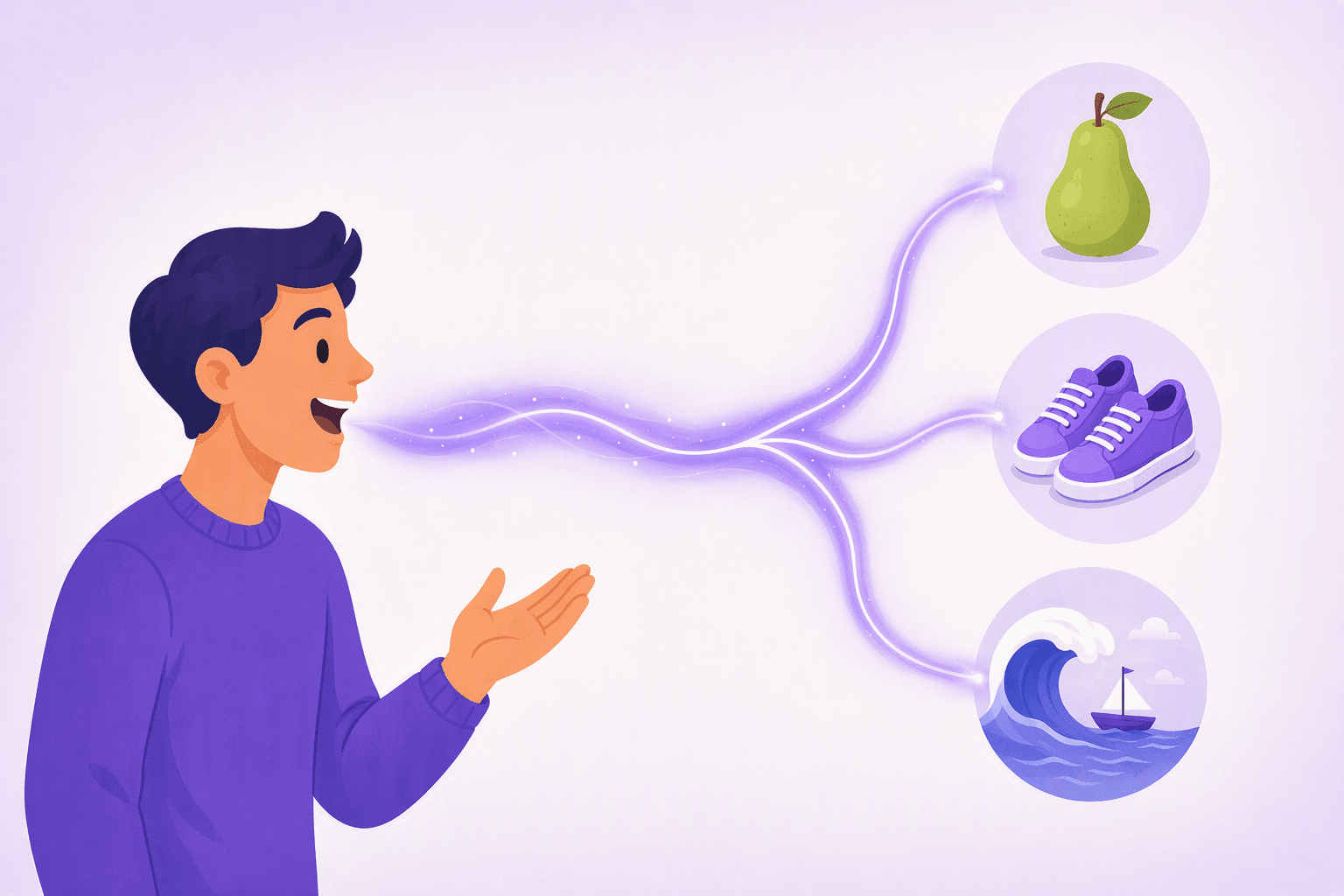
Why homophones matter in real English
Homophones are not a "spelling bee" problem, they are a meaning problem. In speech, context usually fixes ambiguity, but in writing you must choose one spelling, and the wrong one can change the message.
They also show up everywhere: emails, job applications, captions, and even auto-correct suggestions. If English is your second language, homophones can feel unfair because the sound gives you no clue.
English is used worldwide, and Ethnologue estimates about 1.5 billion speakers when you combine native and second-language speakers (Ethnologue, 2024). That global spread means your writing often reaches people who cannot "hear" your intended meaning.
"English spelling is not simply a representation of sound. It is a record of history."
David Crystal, linguist (Crystal, 2019)
That history is why homophones are so common. English kept older spellings, borrowed words from French and Latin, and changed pronunciation over centuries, so multiple spellings often landed on the same modern sound.
Homophones vs homonyms vs homographs (quick clarity)
People mix these terms up, so here is the clean distinction you can use in class or at work.
| Term | Same sound? | Same spelling? | Example |
|---|---|---|---|
| Homophones | Yes | No | "sea/see" |
| Homographs | Not required | Yes | "lead" (metal) vs "lead" (guide) |
| Homonyms | Often yes | Often yes | "bank" (river) vs "bank" (money) |
Dictionaries like the OED and Merriam-Webster track these distinctions because they affect meaning and usage (OED; Merriam-Webster).
The pronunciation trap: why they sound identical
Most homophones are identical in your accent, but not always in someone else’s. Pronunciation differences across regions can create or remove homophones.
Accent differences you will actually notice
Some examples depend on accent and are worth knowing if you work internationally.
| Pair | Often homophones in | Often not homophones in | Note |
|---|---|---|---|
| "cot/caught" | Many North American accents | Many UK accents | Vowel merger varies by region (Wells, 2008) |
| "Mary/marry/merry" | Many US regions | Many UK regions | Another common merger (Wells, 2008) |
| "aunt/ant" | Some US accents | Many UK accents | Vowel quality differs |
If you are learning pronunciation, pair this guide with Wordy’s clip-based listening practice, or review the patterns in our English pronunciation guide.
The most common homophones (high-frequency sets)
These are the sets that cause the most real-world mistakes, especially in school and professional writing. For each set, you get a meaning test and a pronunciation reminder.
there / their / they're
Pronunciation: often "thair" (rhymes with "air") in many accents.
- there: place or "there is/there are"
- their: possession
- they're: contraction of "they are"
Meaning test: if you can replace it with "they are", it must be "they're".
Examples:
- "They're late." (They are late.)
- "Their train is late." (Possession.)
- "The train is over there." (Place.)
to / too / two
Pronunciation: "TOO".
- to: direction, infinitive marker ("to go")
- too: also, excessive
- two: the number 2
Meaning test: if you can replace it with "also", use "too". If it is a number, use "two".
If numbers are a pain point, see our English numbers guide for spelling patterns that reduce errors.
your / you're
Pronunciation: "yor" (often like "yore").
- your: possession
- you're: "you are"
Meaning test: replace with "you are".
Examples:
- "You're right." (You are right.)
- "Your right hand." (Possession.)
its / it's
Pronunciation: "its" vs "it's" both often sound like "its".
- its: possessive determiner
- it's: "it is" or "it has"
Meaning test: replace with "it is" or "it has". If it works, use "it's".
Examples:
- "It's raining." (It is raining.)
- "The dog wagged its tail." (Possession.)
⚠️ The apostrophe trap
In English, apostrophes usually mark missing letters in contractions ("it's" = "it is"). Possessive pronouns do not take apostrophes: "its, your, their, whose". This is why "it's" is not the possessive form.
then / than
Pronunciation: "then" (THEN) vs "than" (THAN, often with a relaxed vowel).
- then: time, sequence
- than: comparison
Meaning test: if you are comparing, it is "than".
Examples:
- "Finish your homework, then watch TV."
- "She is taller than me."
affect / effect
Pronunciation: "uh-FEKT" vs "ih-FEKT".
- affect: usually a verb meaning influence
- effect: usually a noun meaning result
Meaning test: if you can put "the" in front ("the effect"), it is probably "effect".
Examples:
- "Noise can affect sleep."
- "The effect was immediate."
60+ common homophone pairs (with pronunciation)
This section is your core study list. Pronunciations are English approximations, so you can read them without IPA.
| English | English | Pronunciation | Note |
|---|---|---|---|
| air | air / heir | AIR | heir = person who inherits |
| allowed | allowed / aloud | uh-LOWD | aloud = out loud |
| ate | ate / eight | AYT | eight = 8 |
| bare | bare / bear | BAIR | bear = animal or tolerate |
| be | be / bee | BEE | bee = insect |
| blue | blue / blew | BLOO | blew = past of blow |
| break | break / brake | BRAYK | brake = on a car/bike |
| buy | buy / by / bye | BYE | by = next to, bye = goodbye |
| cell | cell / sell | SEL | cell = biology or phone |
| cent | cent / scent / sent | SENT | sent = past of send |
| chews | chews / choose | CHOOZ | choose = select |
| dear | dear / deer | DEER | deer = animal |
| die | die / dye | DYE | dye = color fabric |
| fair | fair / fare | FAIR | fare = ticket price or food |
| flour | flour / flower | FLOW-er | same sound for many speakers |
| for | for / four | FOR | four = 4 |
| hear | hear / here | HEER | here = this place |
| hole | hole / whole | HOHL | whole = complete |
| hour | hour / our | OW-er | our = belonging to us |
| knew | knew / new | NOO | new = not old |
| knight | knight / night | NYTE | knight = medieval soldier |
| mail / male | MAYL | male = gender | |
| meat | meat / meet | MEET | meet = encounter |
| morning | mourning / morning | MOR-ning | mourning = grief |
| one | one / won | WUN | won = past of win |
| pair | pair / pear | PAIR | pear = fruit |
| peace | peace / piece | PEES | piece = part |
| plain | plain / plane | PLAYN | plane = aircraft |
| principal | principal / principle | PRIN-suh-puhl | principal = person or main, principle = rule |
| right | right / write | RYTE | write = make text |
| sea | sea / see | SEE | see = look |
| son | son / sun | SUN | sun = star |
| stair | stare / stair | STAIR | stare = look fixedly |
| steal | steal / steel | STEEL | steel = metal |
| tail | tail / tale | TAYL | tale = story |
| their | there / their / they're | THAIR | triple set |
| threw | threw / through | THROO | through = from one side to another |
| toe | toe / tow | TOH | tow = pull a car |
| wait | wait / weight | WAYT | weight = heaviness |
| way | way / weigh | WAY | weigh = measure weight |
| weak | weak / week | WEEK | week = 7 days |
| weather | weather / whether | WEH-thur | whether = if |
| which | which / witch | WICH | witch = magic person |
| wood | wood / would | WOOD | would = modal verb |
🌍 Why 'knight' still has a 'k'
Silent letters are one reason English creates homophones. Many were pronounced in Middle English, and spelling often stayed conservative even after sounds disappeared. That is why "knight" and "night" now match in pronunciation for most speakers, but not in spelling.
How to choose the right spelling (fast decision tools)
You do not need to memorize every pair to get good. You need a reliable process.

1) The substitution test (best for contractions)
Use this for sets like "you're/your", "they're/their/there", "it's/its".
- If you can replace it with "you are", use "you're".
- If you can replace it with "they are", use "they're".
- If you can replace it with "it is" or "it has", use "it's".
This is fast enough to do while typing.
2) The grammar label test (noun vs verb)
This helps with "affect/effect" and "advice/advise" (not a perfect homophone in all accents, but commonly confused).
Ask: is the word acting like a thing (noun) or an action (verb)?
- "The effect" is a thing.
- "To affect" is an action.
3) The "category hook" memory trick
Attach each spelling to a category image.
- brake: think "bike"
- flour: think "baking"
- heir: think "inheritance"
- principal: think "pal" (the principal is your pal, if you want to remember the school person)
These hooks work because they connect spelling to meaning, not sound.
4) Use real reading, not only rules
Homophones are learned through exposure. The more you read, the more "wrong" spellings look wrong.
If you want a practical reading routine, combine this with short, modern texts and audio. Wordy’s movie and TV clips help because you hear the word, then you see the correct spelling in subtitles.
For more everyday vocabulary that shows up in media, browse English slang and notice how context carries meaning even when spelling is tricky.
Homophones in movies and TV: why they confuse learners
In fast dialogue, homophones are invisible because you only hear sound. Subtitles solve that, but only if you actively compare what you heard to what you read.
Here are common "movie moments" where homophones appear:
- Texting scenes: characters write "your" when they mean "you're" to show personality, age, or carelessness.
- Police or legal scenes: "principal/principle" and "right/write" appear in formal statements.
- Comedy: writers exploit ambiguity, especially "see/sea", "knight/night", "peace/piece".
If you like learning through entertainment, start with clips that repeat the same word in different contexts. That repetition is what turns a homophone from a trap into an automatic choice.
Common learner mistakes (and how to fix them)
Mixing up function words
Function words are short, frequent, and easy to mistype: "to/too/two", "then/than", "its/it's". These cause the most visible errors because they appear in almost every paragraph.
Fix: slow down on function words only. You can write fast everywhere else.
Over-trusting spellcheck
Spellcheck catches "teh", but it cannot always catch "their" used where "there" is needed, because both are real words. Grammar checkers help, but they are not perfect.
Fix: run the substitution test for the top three sets before sending important messages.
Confusing homophones with slang spellings
Online writing sometimes uses intentional misspellings for tone. That can blur the line between "wrong" and "stylistic".
Fix: separate contexts. Slang in DMs is fine, but in school and work, use standard spelling. If you are unsure where the line is, our English swear words guide explains how register changes across settings, and the same idea applies to spelling choices.
A mini practice routine (10 minutes a day)
Consistency beats cramming. Here is a routine that works for both native and non-native writers.
- Pick 5 homophone sets from the table.
- Write one sentence for each meaning, so you produce 10 sentences.
- Read them out loud, then cover the words and try to rewrite them correctly.
- The next day, keep 2 sets and swap 3 new ones.
After two weeks, you will have practiced about 70 meanings, not just 70 spellings. That is the real skill.
💡 Use dates and numbers as a spelling anchor
Pairs like "one/won", "four/for", and "eight/ate" are easier if you are confident with number spelling. If you still hesitate, review English months and English numbers together, since dates combine both skills in real life.
Quick checklist for error-free writing
Use this before you submit an essay or send an important email.
- Scan for: "their/there/they're", "your/you're", "its/it's", "to/too/two", "then/than"
- Run substitution tests on contractions
- Check comparison sentences for "than"
- Check time-sequence sentences for "then"
- If a sentence feels unclear, rewrite it to avoid the homophone entirely
Avoiding a homophone is not cheating. It is professional editing.
Learn homophones the way native speakers do
Native speakers usually do not "study homophones". They absorb them through reading, corrected writing, and repeated exposure to the same words in different contexts.
That is also why learning with real dialogue helps. You hear the word in a natural scene, then you connect it to the correct spelling and meaning.
If you want more structured learning paths, explore the Wordy blog and build a small cluster: pronunciation, slang, and core writing traps like homophones.
Frequently Asked Questions
What are homophones in English?
What is the difference between homophones and homonyms?
Why does English have so many homophones?
How can I stop mixing up their, there, and they're?
Do homophones change between American and British English?
Sources & References
- Crystal, David. The Cambridge Encyclopedia of the English Language. 3rd ed., Cambridge University Press, 2019.
- Oxford English Dictionary (OED), Oxford University Press, ongoing edition.
- Merriam-Webster Dictionary, Merriam-Webster, Incorporated, ongoing edition.
- Ethnologue: Languages of the World, 27th ed., SIL International, 2024.
- Wells, J.C. Longman Pronunciation Dictionary. 3rd ed., Routledge, 2008.
Start learning with Wordy
Watch real movie clips and build your vocabulary as you go. Free to download.


