Quick Answer
Comprehensible input in Portuguese means feeding yourself Portuguese you can mostly understand, learner podcasts, kids' cartoons, Brazilian Netflix series, graded readers, so the language is acquired through messages rather than memorized rules. Portuguese has fewer polished input libraries than Spanish, but more than enough to go from zero to native media: Fala Gringo and Speaking Brazilian for Brazilian Portuguese, Practice Portuguese for European, Turma da Mônica for beginner-friendly video, and series like 3% and Cidade Invisível once you reach B1-B2. This guide maps all of it by level and settles the Brazilian versus European question early.
Comprehensible input in Portuguese means building your hours around Portuguese you can mostly understand, learner podcasts, cartoons, Brazilian series with subtitles, graded readers, so that acquisition runs on understood messages instead of memorized conjugation tables. With around 264 million speakers across nine countries (Ethnologue, 27th edition, 2024), Portuguese is the most spoken language of the Southern Hemisphere, yet it has a fraction of the learner resources Spanish enjoys, which makes a curated map genuinely useful.
One housekeeping note first: a lot of people search for this topic as "comprehensive input Portuguese". The technical term is comprehensible input, input you can understand, not input that is exhaustive, but if the misspelling brought you here, you are in exactly the right place.
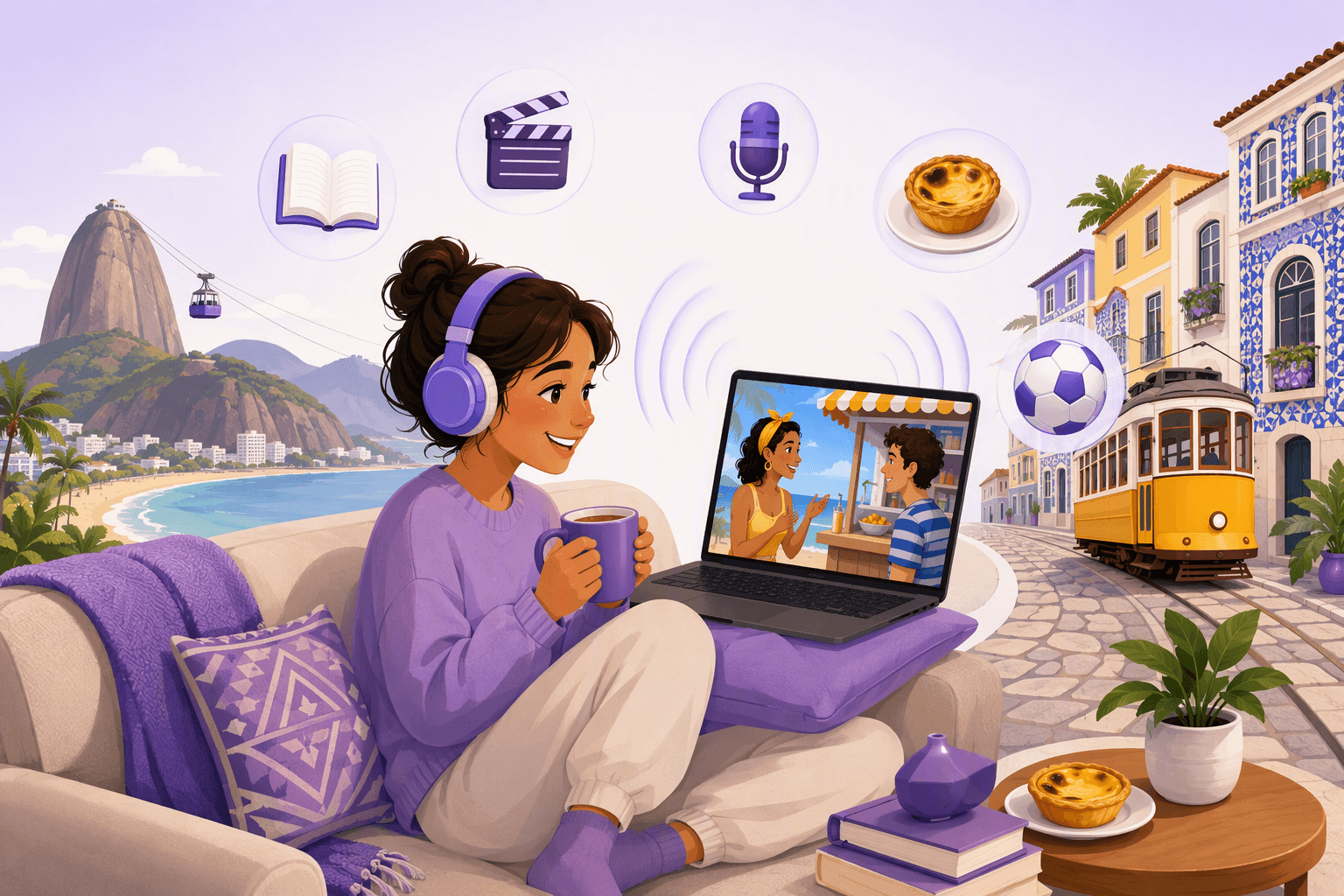
The fastest version of the answer, one best starting resource per level:
| Your level | Start here | Why |
|---|---|---|
| A1-A2 | Speaking Brazilian (YouTube) or Practice Portuguese (European) | Graded, learner-aware, real Portuguese from day one |
| B1-B2 | Fala Gringo podcast + 3% with Portuguese subtitles | Natural speed that stays followable with support |
| C1 | Native podcasts, Sintonia, films like Cidade de Deus | Slang, speed, and regional range |
i+1 in 60 seconds
Stephen Krashen's input hypothesis holds that we acquire language by understanding messages pitched one small step above our current level, his famous i+1: too easy teaches nothing, too hard is noise, and the narrow stretch zone between them is where the language sticks. The theory, the evidence for it, and its critics are covered in depth in our guide to what comprehensible input is; this article stays on the practical question of what that stretch zone looks like in Portuguese, month by month.
"We acquire language in only one way: when we understand messages." — Stephen Krashen, The Input Hypothesis (1985)
Finding your level in Portuguese
Skip the placement test and run three probes, moving up until comprehension breaks.
- The A2 probe. Play a Turma da Mônica episode on YouTube. If you can retell the little story afterward, you are at least strong A2. If you only catch isolated words, stay with learner-made beginner content.
- The B1 probe. Play five minutes of Fala Gringo (Brazilian) or a Practice Portuguese intermediate dialogue (European) without the transcript. Following the argument with occasional losses means B1 or better; catching topics but not sentences means late A2.
- The B2 probe. Play a scene of 3% or Cidade Invisível with Portuguese subtitles. Comfortable equals B2, and native media becomes your staple. Heavy pausing equals B1: keep native TV in scene-sized doses.
Calibrate against the research numbers: useful input sits where you understand roughly 90-98% of the words, and hitting about 95% coverage of film dialogue takes around the 3,000 most frequent word families (Webb and Rodgers, Applied Linguistics, 2009). Below that base, native telenovelas are ambience, not acquisition. For what the level labels formally mean, see the CEFR guide, and retest yourself every few weeks, because the most common failure in input learning is staying on easy material long after it stopped stretching you.
Choose your Portuguese first: Brazilian vs. European
For most languages the dialect question can wait; in Portuguese it should come first, because the two main varieties diverge more in sound than European and Latin American Spanish do. European Portuguese compresses and drops unstressed vowels, so spoken Lisbon Portuguese can be startlingly hard to parse for someone trained on Brazilian audio, while Brazilian Portuguese keeps vowels open and rhythms more even. Grammar diverges too: Brazil defaults to você and uses the gerund (estou falando) where Portugal keeps tu alongside você and prefers a plus infinitive (estou a falar).
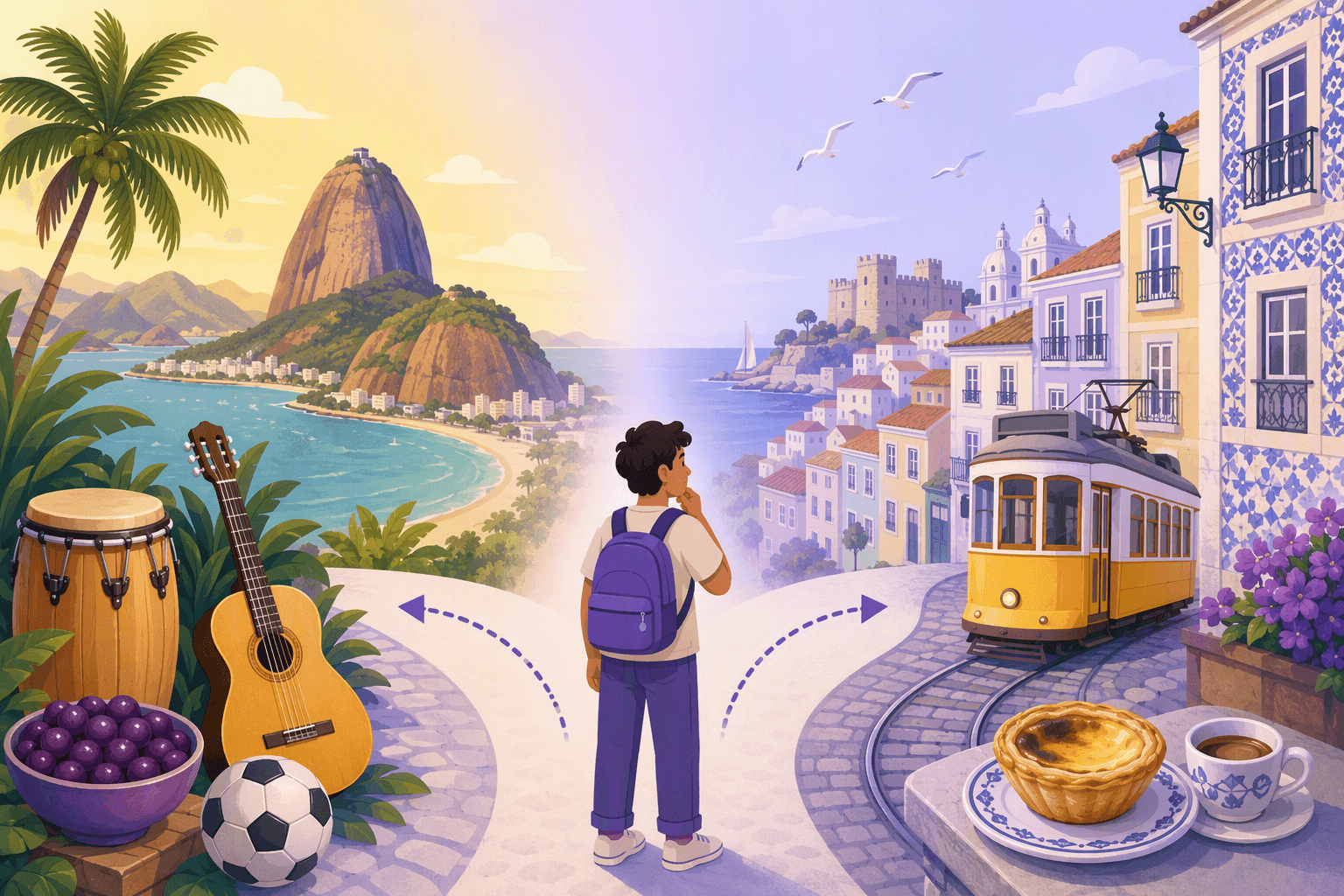
The practical decision rule: Brazilian Portuguese is the default; Portugal is a deliberate choice. Brazil holds the overwhelming majority of the language's speakers, its media catalog is vastly larger, and most learner resources are Brazilian. Choose European Portuguese if you are moving to, working with, or in love with Portugal, and in that case build your listening on European sources, Practice Portuguese and Portuguese With Leo, from day one, because retraining your ear later costs real time. Reading transfers almost completely between the varieties either way, so books and subtitles are shared territory.
Portuguese input sources by level
A1-A2: learner channels, kids' cartoons, first readers
Learner video and podcasts. For Brazilian Portuguese, Speaking Brazilian (Virginia Langhammer's YouTube channel and podcast) teaches in clear, deliberately paced Portuguese with subtitles, and works from the first weeks. For European Portuguese, Practice Portuguese is the anchor resource: a large library of dialogues, podcasts, and videos graded from absolute beginner upward, made by native speakers specifically as comprehensible input. Both let you start acquiring from real Portuguese instead of translation drills.
Kids' shows and cartoons. Turma da Mônica, Brazil's beloved comic-strip universe from Mauricio de Sousa, is the single best beginner video source: hundreds of short animated episodes free on YouTube, everyday vocabulary, clear child-directed speech, and stories simple enough to follow visually. The 2019 live-action film Turma da Mônica: Laços makes a gentle first movie. Dubbed Peppa Pig in Brazilian Portuguese adds short, domestic, repetitive episodes, and Irmão do Jorel, a Brazilian animated comedy, sits a notch higher, closer to B1 for its wordplay.
Graded readers. Olly Richards' Short Stories in Brazilian Portuguese (Teach Yourself) is the standard A2-B1 reader, eight stories with capped vocabulary and glossaries. Printed Turma da Mônica comics (gibis) are the native-material bridge: panel art keeps the 98%-comprehension rule reachable earlier than prose ever could.
B1-B2: real podcasts, Brazilian Netflix, scene-by-scene viewing
Podcasts carry this band. Fala Gringo is the standout Brazilian intermediate podcast: episodes about Brazilian culture, history, and society delivered in slowed but natural Portuguese, with transcripts, aimed exactly at B1-B2 learners. Practice Portuguese's intermediate and advanced episodes do the same for European Portuguese. When those start feeling easy, step to native podcasts made for Brazilians, an enormous ecosystem, from story-driven interview shows to the long-running Café Brasil, and treat the jump as your new i+1.
TV series and telenovelas. With Portuguese subtitles on and a scene-by-scene method, Brazilian Netflix becomes a genuine study library. 3%, the dystopian thriller that was Brazil's first Netflix original, has clear São Paulo speech and a plot that pulls you forward. Cidade Invisível wraps Brazilian folklore, saci, curupira, iara, in a detective story with clean dialogue. Coisa Mais Linda, set in 1950s Rio, is slower and beautifully enunciated. Save Sintonia for B2-C1: it is excellent, but its São Paulo periphery slang is a level of its own. On the European side, Glória, Netflix's first Portuguese original, is the natural pick. Globo's telenovelas, decades of them, offer the classic learner advantage of emotional, repetitive, context-rich dialogue.
Films. Central do Brasil is the canonical B2 Brazilian film, road-movie pacing and clear speech; the full ranked list, including when you are ready for the fast favela Portuguese of Cidade de Deus, is in our best movies to learn Portuguese guide.
YouTube. Easy Brazilian Portuguese interviews people on the street with dual subtitles, Portuguese With Leo does culture and language topics in clear European Portuguese, and Manual do Mundo, one of Brazil's biggest channels, explains science experiments in enthusiastic, well-articulated Portuguese that suits B1-B2 surprisingly well.
C1: native everything, regional range
At C1, the menu is simply Brazilian and Portuguese media at full speed: Sintonia and Cidade de Deus for slang, comedy channels like Porta dos Fundos for cultural fluency, native podcasts at podcast-host speed, news from Brazil and Portugal back to back, and deliberate accent work, carioca versus paulista versus northeastern Brazilian versus Lisbon. Subtitles off by default. Anything you enjoy counts; your i+1 now lives in registers and regions you have not met yet, so chase those.
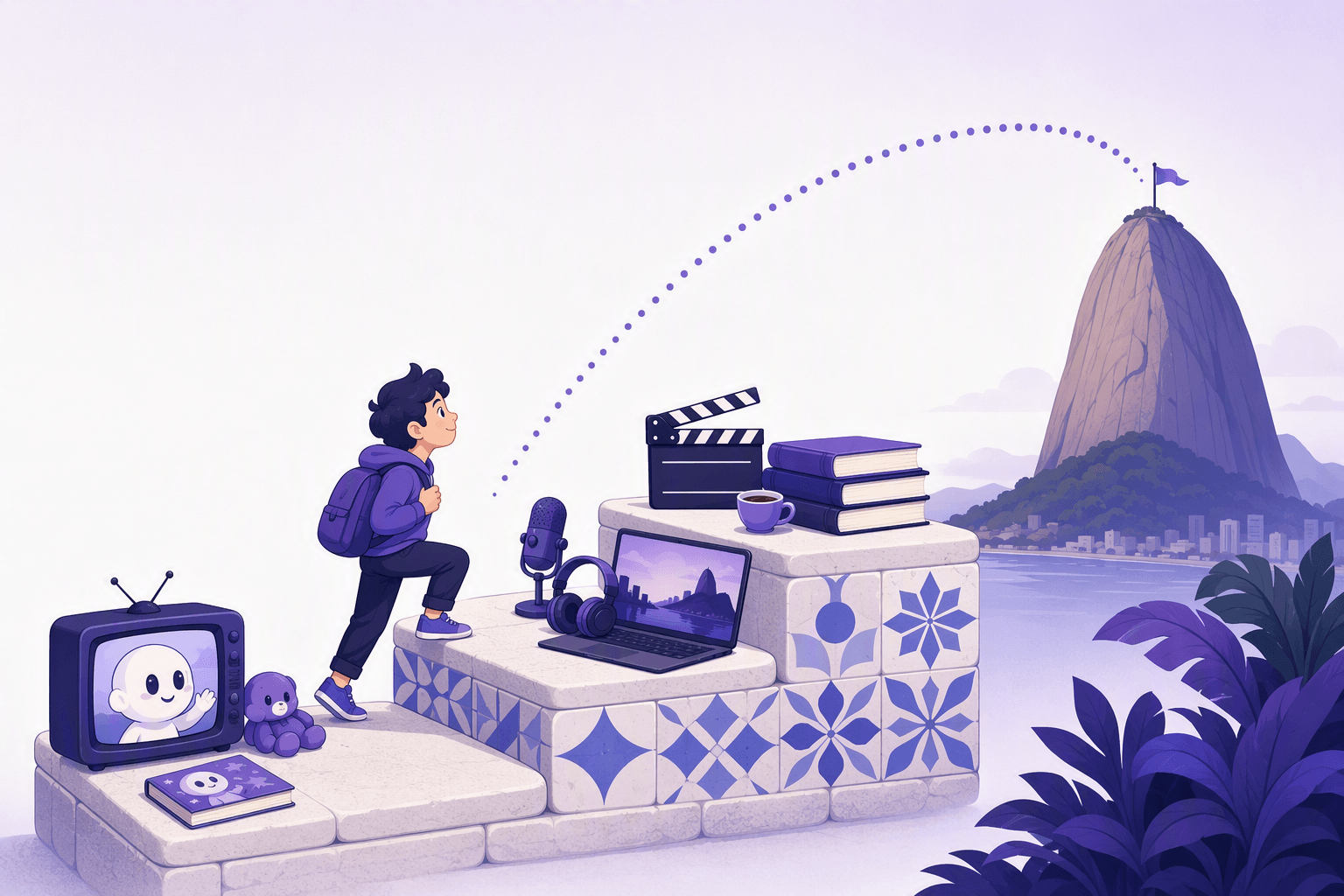
The clip-based repetition method
The densest input technique at any level is short-clip repetition: take 30 to 90 seconds of real Portuguese, watch it with Portuguese subtitles, rewatch without, and speak a line or two aloud. On the second and third pass, the same audio decodes differently, connected speech like tô for estou and swallowed vowels resolve into words you know. This is the exact method Wordy is built around: short curated clips from real shows and films, sized to be fully understood and replayed, with each clip's vocabulary flowing into spaced-repetition review. The manual version works too, as our guide to learning with movies shows; what matters is that repetition, not novelty, is doing the teaching.
💡 The scene ladder
Take one series, say 3%, and climb it in scenes: first pass with Portuguese subtitles, second pass without, third pass shadowing one or two lines aloud. One episode digested this way across a week outteaches a whole season half-understood in a weekend, and by season's end you will feel the show get easier in real time.
A sample week of Portuguese input (B1 learner, about 6 hours)
| Day | Input | Time |
|---|---|---|
| Monday | Fala Gringo episode on the commute, one 3% scene with Portuguese subtitles | 45 min |
| Tuesday | Speaking Brazilian videos, one clip studied line by line | 45 min |
| Wednesday | Fala Gringo reread with transcript, Turma da Mônica episode as dessert | 45 min |
| Thursday | Graded reader chapter, rewatch of Monday's scene without subtitles | 50 min |
| Friday | Easy Brazilian Portuguese interviews, one new clip with repetition | 45 min |
| Saturday | Long session: half of Central do Brasil with Portuguese subtitles, pausing freely | 90 min |
| Sunday | Comfort day: Manual do Mundo video plus finishing the reader chapter | 40 min |
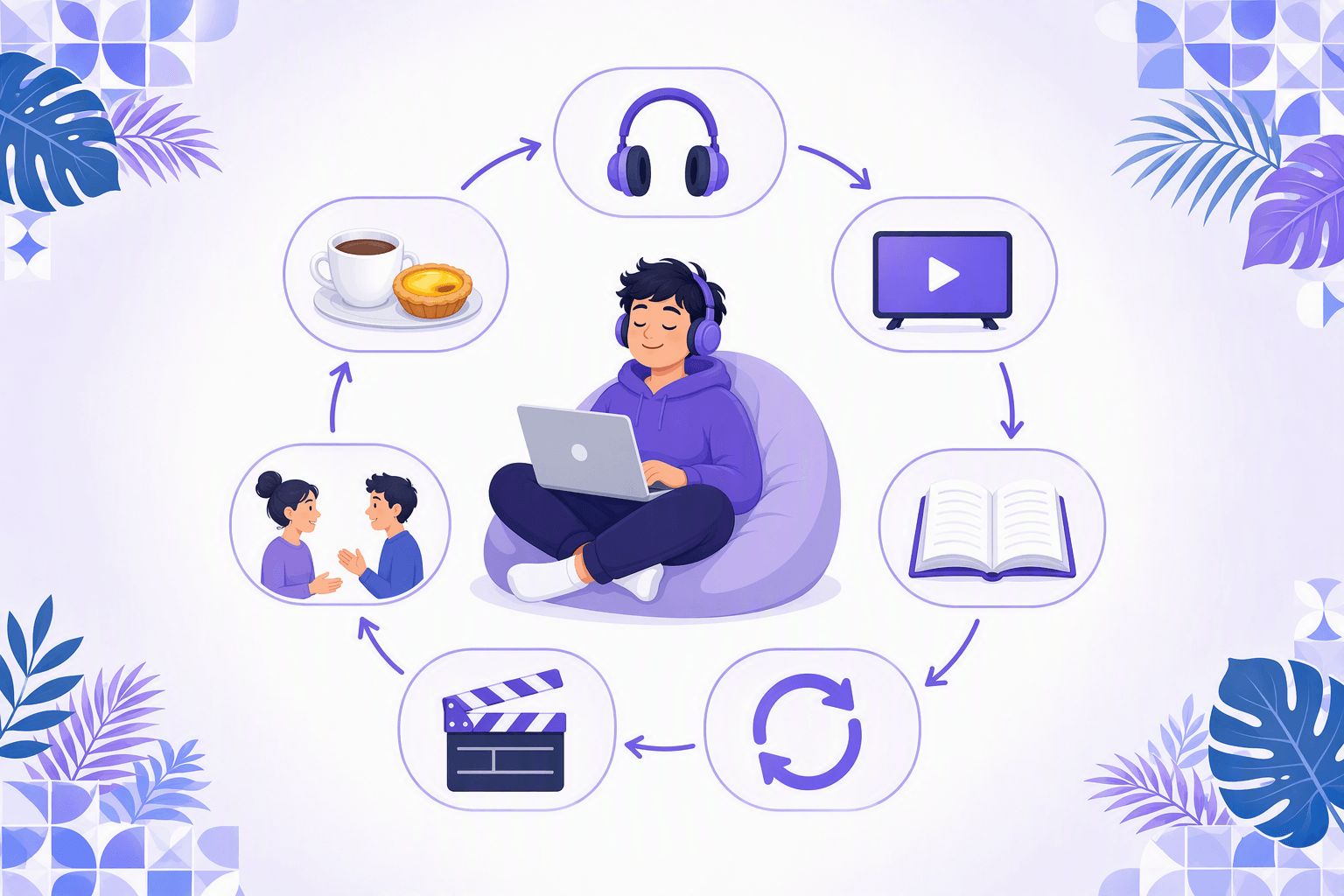
Copy the ratios, not the row-by-row detail: a daily anchor habit, mostly listening, one long weekend block, built-in repetition, everything inside your 90-98% comprehension band, and every slot filled with content you would half-choose anyway, since enjoyable input is what you reliably come back to. European-track learners can run the same grid on Practice Portuguese, Portuguese With Leo, and Glória. Keep the Portuguese hub at hand for grammar and pronunciation reference, and give the routine two to three months, which for a Category I language like Portuguese is enough time to feel native scenes shift from wall to window.
Frequently Asked Questions
Is it comprehensible input or comprehensive input?
What is the best comprehensible input for Portuguese beginners?
Should I learn Brazilian or European Portuguese?
Can I learn Portuguese with Netflix shows like 3%?
How long does it take to understand Portuguese TV?
Sources & References
- Ethnologue: Languages of the World, 27th edition, 2024 (Portuguese speaker statistics)
- Krashen, S., *The Input Hypothesis: Issues and Implications*, Longman, 1985
- Webb, S. & Rodgers, M.P.H., 'The Lexical Coverage of Movies', Applied Linguistics, 2009
- U.S. Department of State, Foreign Service Institute, foreign language training categories
- Comunidade dos Países de Língua Portuguesa (CPLP), member state data
Start learning with Wordy
Watch real movie clips and build your vocabulary as you go. Free to download.


