Quick Answer
K-dramas have driven a global surge in Korean language interest, with shows like Squid Game, Crash Landing on You, and Hometown Cha-Cha-Cha turning casual viewers into serious learners. The best apps to learn Korean with K-dramas in 2026 fall into a few camps: curated clip apps with translations built in, full-episode streamers, free browser extensions, and structured Korean courses to pair alongside. This ranked list covers seven options, each with the kind of Korean learner it suits, price, and which K-dramas pair best with it.
The best apps to learn Korean with K-dramas in 2026 are Wordy for curated drama and film clips with built-in translations, Lingopie for full episodes, Language Reactor as a free Netflix companion, and structured courses like Eggbun and LingoDeer to handle hangul and grammar. Pick one drama-based app and one structured app, then watch every day.
Korean has roughly 81 million speakers worldwide when you count the peninsula and the diaspora (Ethnologue, 27th edition, 2024). The King Sejong Institute Foundation, which runs Korean language centers in dozens of countries, has reported continued strong growth in enrollment, driven in large part by interest in K-pop, K-dramas, and Korean film. Shows like Squid Game and Crash Landing on You have turned millions of viewers into serious learners, and the apps below are built around that exact entry point.
If you want a primer on which shows to start with, our best K-dramas to learn Korean list pairs naturally with this guide. For broader app comparisons across languages, see our best language learning apps roundup.

Why K-Dramas Are Perfect for Korean Learners
K-dramas are unusually good language input because they show you Korean as it is actually spoken, with the social context attached.
Three reasons matter for learners:
- Natural speech rhythm: Dialogue moves at real conversational speed, with reductions, fillers, and overlapping turns that textbooks scrub out.
- Emotional and situational context: Facial expressions, body language, and on-screen relationships help you guess meaning before you look up the word, which is the foundation of comprehensible input.
- Visible formality levels: Korean has multiple speech levels, and dramas show you who uses panmal (반말, casual speech) with whom and when jondaetmal (존댓말, polite speech) is required. You see honorifics in action, not just in conjugation tables.
The linguist Stephen Krashen argued that learners acquire language most effectively from input they can mostly understand, slightly above their current level (Krashen, 1985). K-dramas are close to an ideal source of this kind of input, because the visual context lets you follow scenes even when the dialogue is faster than you can fully parse.
💡 Learn hangul before your first drama study session
Hangul (한글) is the Korean writing system, and you can learn to read it in roughly two to three hours. Do this before you start drama-based study. Once you can sound out words, the captions, app translations, and lookups all become several times faster. The National Institute of Korean Language and the King Sejong Institute both publish free hangul primers if you want a starting point.
What to Look For in a Korean K-Drama Learning App
Not every app handles Korean well. The ones worth your time share a few features:
- Tap-to-translate captions: You need to look up unfamiliar words in one tap, not by switching apps.
- Hangul and romanization side by side: Early on, romanization helps with pronunciation while you build hangul speed.
- Honorific awareness: Good apps flag formality levels and explain why a character switches register.
- Spaced repetition or review: Watching alone is not study. You need a system that brings vocabulary back.
- Korean catalog depth: Some apps technically support Korean but have thin libraries. Check the actual K-drama list before committing to a paid plan.
With those filters in mind, here is the ranked list.
7 Best Apps for Learning Korean with K-Dramas in 2026
1. Wordy: Best Curated K-Drama Clips for Active Study
Wordy is a language learning app that teaches through real movie and TV clips, including a strong catalog of K-dramas and Korean films. It launched in 2024 in Budapest, Hungary, supports more than 20 languages, and has built a Korean library that K-drama fans tend to recognize on sight.
The method is simple and well-suited to drama learning. You pick a curated 30 to 90 second scene, tap any word for an instant translation, and the word is saved back to its exact scene. Spaced repetition later replays the original clip when it is time to review, so you do not just see the word, you re-hear it in context with the same actor and intonation. Speech recognition lets you practice mimicking the line.
The library passes 15,000 curated clips, which is enough that you can spend months in Korean alone without seeing the same scene twice. Wordy has been profiled by TechCrunch (September 2024) and currently has more than 500,000 users with ratings around 4.7 to 4.8 stars across roughly 13,000 reviews.
For Korean specifically, the curated clip format helps with two of the language's hardest features: speed of natural speech and recognition of formality. You hear honorifics inside the relationships that produce them, not as isolated grammar.
There is a free tier so you can test the Korean catalog before paying. Paid options include a 7-day trial, monthly, annual, and lifetime plans. Wordy runs on iOS, Android, Chrome, and the web. URL: wordy.info.
- Method: Curated K-drama and film clips with tap-to-translate and spaced repetition
- Who it is for: Learners who want active study sessions, not passive binge sessions
- Price: Free tier, 7-day trial, monthly, annual, or lifetime
- Strength: Vocabulary is anchored to the exact scene, so retention is unusually high
- Weakness: Clips, not full episodes, so it is not a streaming replacement
- Verdict: The clearest best fit for K-drama learners who want measurable progress
2. Lingopie Korean: Full Episodes with Click Translations
Lingopie is a streaming-style app where you watch full episodes with dual subtitles and can click any word to look it up. The Korean catalog is growing and includes a mix of dramas, reality, and short-form content. The watching experience is closer to Netflix than to a study app, which works for learners who prefer immersion-first sessions.
Pricing lands around 12 USD per month on the annual plan as of 2026, with frequent promotions. Lingopie is best when you want long-form input and are happy to look up only the words that interest you. The trade-off is that without active review, vocabulary leaks out fast.
- Method: Full episodes with click-to-translate subtitles
- Who it is for: Passive immersion learners who want full shows
- Price: About 12 USD per month, annual
- Strength: Long-form viewing, no clip cutting
- Weakness: Lighter on review and retention features
- Verdict: Pair with a structured course like Eggbun or LingoDeer to make the vocabulary stick
3. Eggbun: Chat-Based Structured Korean Course
Eggbun teaches Korean through a chat interface with a friendly mascot named Lanny. Lessons cover hangul, grammar, vocabulary, and culture, and the conversational format keeps sessions feeling lighter than traditional drills. It is Korean-only, which is part of its strength.
For drama learners, Eggbun fills the gap that dramas leave behind: solid grammar foundations, formality drills, and reading practice. The free tier gives you a real taste, and the paid plan unlocks the full curriculum.
- Method: Chat-based lessons covering hangul, grammar, and vocabulary
- Who it is for: Beginners who want structure without textbook fatigue
- Price: Free tier plus paid premium
- Strength: Korean-only focus, friendly format, strong on hangul
- Weakness: No video content of its own
- Verdict: A clean structured pairing for any drama-based app
4. LingoDeer Korean: Structured Grammar App
LingoDeer is built by educators with Asian languages as a priority, and the Korean course reflects that. Grammar explanations are clearer than most general-purpose apps, and the lessons handle particles, verb endings, and honorific levels with care.
It is paid, with monthly, annual, and lifetime options. As a complement to drama watching, LingoDeer is useful when you keep hitting the same grammar pattern in scenes and want a proper breakdown rather than a one-line caption translation.
- Method: Structured Korean course with strong grammar focus
- Who it is for: Learners who want explanations, not just exposure
- Price: Paid, with annual and lifetime options
- Strength: Grammar depth and clarity, particularly on particles and verb endings
- Weakness: No drama or video content of its own
- Verdict: Best paired with a drama-based app for daily input
5. Language Reactor: Free Netflix K-Drama Overlay
Language Reactor is a Chrome extension that overlays dual subtitles on Netflix and YouTube, lets you click any Korean word for instant translation, slows playback, and exports vocabulary lists. It is free for the core features, with a premium tier for power users.
Because so many of the most-watched K-dramas live on Netflix, this is one of the highest-value free tools in the entire Korean learning stack. The catch is that it does not teach you anything by itself. It enhances watching, but the active study still falls on you.
- Method: Browser extension with dual subtitles and click translations
- Who it is for: Netflix-heavy learners who want a free upgrade
- Price: Free, with optional premium
- Strength: Works on the dramas you already watch
- Weakness: No structured study system
- Verdict: Install it today even if you also use a paid app
6. Drops Korean: Visual Vocabulary in Short Sessions
Drops teaches vocabulary with illustrations in tightly capped sessions, typically five minutes. It is fast, visually polished, and surprisingly effective for building a base lexicon you will later hear in dramas.
Drops does not teach grammar or reading in depth, and it is paid after the free tier. As a side dish to drama watching it is genuinely useful, particularly for nouns and food vocabulary that turn up constantly in K-drama dinner scenes.
- Method: Visual vocabulary drills in 5-minute sessions
- Who it is for: Busy learners who want a bite-sized daily habit
- Price: Free tier and paid premium
- Strength: Visual recall and clean UX
- Weakness: Light on grammar and listening
- Verdict: A supplement, not a core app
7. HelloTalk: Language Exchange with Korean Speakers
HelloTalk is a free language exchange app where you chat with Korean speakers who are learning your language. It is the speaking and writing piece that drama-watching alone cannot give you, and it is one of the few ways to practice Korean output for free.
For K-drama learners, HelloTalk is where you can finally use the casual phrases you have been collecting from dramas, and get a native speaker to tell you when a phrase is too formal, too casual, or out of style for your age and the context.
- Method: Text, voice, and video chat with native Korean speakers
- Who it is for: Learners who want real conversation practice
- Price: Free, with optional premium
- Strength: Free access to native speakers
- Weakness: Quality of exchanges depends entirely on your partners
- Verdict: An essential free addition to any drama-based study plan
K-Dramas to Pair with Each App
Match the show to your level so you stay in the comprehensible input zone.
Beginner slice-of-life: Reply 1988, Hometown Cha-Cha-Cha, and Because This Is My First Life. Everyday settings, recurring vocabulary, and clear delivery. Pair with Wordy or Language Reactor.
Romantic comedies: Crash Landing on You, Goblin, and What's Wrong with Secretary Kim. Paced for clarity but with more idiom. Pair with Wordy or Lingopie and use HelloTalk to ask native speakers about slang.
Intermediate thrillers: Squid Game, Vincenzo, and Itaewon Class. Faster dialogue and specialized vocabulary. Wait until slice-of-life scenes feel manageable. Lingopie's full-episode format works well here.
For a deeper guide to choosing K-dramas by learner level, see our best K-dramas to learn Korean breakdown.
🌍 Honorifics are the heart of K-drama dialogue
Korean uses several speech levels, and K-dramas show you when to switch and why. Younger characters typically address older characters with jondaetmal (존댓말, polite speech) and verb endings like -ㅂ니다 or -요. Close friends use panmal (반말, casual speech). The shift from polite to casual between two characters is one of the most-watched moments in Korean romance dramas because it signals a real change in the relationship. The National Institute of Korean Language documents these registers in the Standard Korean Dictionary, but dramas teach you to feel them, which is something no grammar table can do alone.
How to Actually Learn from K-Dramas (Not Just Binge)
Watching with Korean audio in the background is not study. To turn drama time into language progress, build a small repeatable loop.
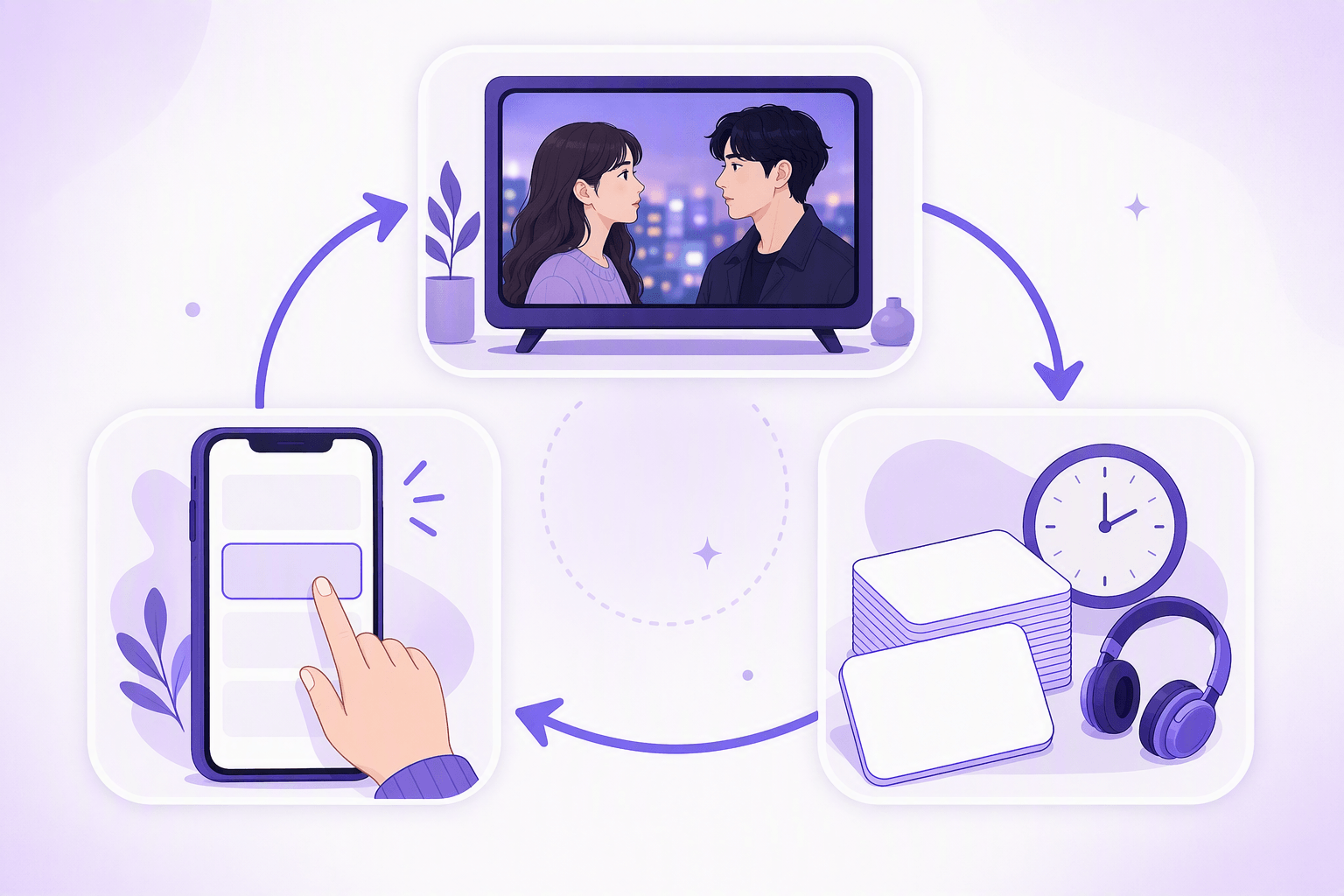
Subtitle strategy: Start with subtitles in your native language, but switch to Korean subtitles for short replays once you recognize hangul. Apps with dual subtitles like Language Reactor or Lingopie make this seamless. Wordy handles it by cutting the clip down to a length where you can study it at full attention.
Active study time: For each 20 minutes of watching, spend at least 5 minutes reviewing vocabulary, ideally in a system that brings the scene back, not just the word.
Formality recognition: Pay attention to who is using polite endings and who is using casual ones, and ask yourself why. This trains intuition no flashcard system can replicate.
Modern Korean vs sageuk: Sageuk (사극, historical dramas) like Mr. Sunshine and Kingdom use older vocabulary and grammar that is not spoken today. Save them for advanced study. Stick to modern dramas while you build everyday Korean.
To start a more general path through Korean, including grammar foundations and vocabulary, see our Korean learning hub.
"Acquisition requires meaningful interaction in the target language, natural communication, in which speakers are concerned not with the form of their utterances but with the messages they are conveying and understanding."
Stephen Krashen, The Input Hypothesis (1985)
That quote captures why K-dramas work so well. The actors are not performing grammar, they are performing relationships, and you absorb the language by following the meaning.
⚠️ Korean takes longer than you think
The Foreign Service Institute classifies Korean as a Category IV language for native English speakers, which means it requires roughly 2,200 class-hour-equivalents to reach professional working proficiency. That is more than four times what Spanish or French require. K-dramas make those hours far more enjoyable, but they do not shorten the road. Plan for years, not months, and judge progress by how much of a casual conversation you can follow, not by app streaks.
Final Verdict
For most learners, the best K-drama learning setup in 2026 is Wordy as your daily active study app, Language Reactor as your free Netflix companion, and Eggbun or LingoDeer for structured grammar and hangul fundamentals, with HelloTalk mixed in once a week for real conversation. That stack covers input, structure, and output without breaking your budget.
If you want the simplest possible plan, start with Wordy's free tier on a slice-of-life K-drama you already love, learn hangul in your first week, and add one structured grammar app once you have a daily watching habit. For a comparison with non-drama options, see our Duolingo review.
K-dramas will not make you fluent on their own. Paired with the right app and consistent daily study, they are the most enjoyable route into Korean that exists right now, and the catalog only keeps getting better.
Frequently Asked Questions
Can you learn Korean from K-dramas alone?
Best K-dramas for Korean beginners?
Free apps for Korean K-drama learning?
Wordy vs Lingopie for Korean?
How long does it take to learn Korean from K-dramas?
Sources & References
- Ethnologue, 27th edition, 2024
- National Institute of Korean Language (국립국어원, NIKL), Standard Korean Dictionary
- King Sejong Institute Foundation, Korean language education data
- Krashen, S., The Input Hypothesis, Longman, 1985
- TechCrunch, 'Wordy's new app helps you learn vocab while watching movies & TV shows,' September 2024
Start learning with Wordy
Watch real movie clips and build your vocabulary as you go. Free to download.


