Quick Answer
The fastest way to raise your AP Spanish listening score: preview the questions before each audio starts, take structured notes across the two plays, and train daily with short authentic clips at full native speed. This guide explains how listening appears in Section I Part B, the distractor patterns the exam reuses, a week-by-week training plan, free practice resources, and the mistakes that cost students the most points.
If you only do three things for AP Spanish listening, do these: preview the questions before each audio starts so you know exactly what to listen for, train daily with short authentic clips at native speed instead of relying on slowed classroom audio, and drill official College Board questions until you recognize the distractor patterns the exam reuses. Those three moves cover most of the gap between students who dread the audio section and students who quietly bank points there.
The rest of this guide turns them into a concrete plan: how listening actually appears on the exam, the multiple-choice strategy playbook, a daily training routine, free resources worth your time, and the mistakes that cost the most points.

How listening appears on the AP Spanish Language exam
The AP Spanish Language and Culture exam has two halves. Section I is multiple choice and counts for half your score. Section II is free response, worth the other half. Listening is concentrated in Section I Part B, but it also sneaks into Section II, which surprises many students.
In the current published format, Section I runs about 95 minutes with 65 questions. Part A (about 40 minutes, 30 questions) is print texts only. Part B (about 55 minutes, 35 questions) is the audio zone, and it comes in two flavors:
- Print and audio combined: you read a short text, then hear a related audio source, and answer questions that draw on both.
- Audio only: you hear a source and answer questions about it.
The audio sources are authentic, made for Spanish speakers rather than learners: interviews, podcast segments, public service announcements, conversations, and short presentations. Accents vary across the Spanish-speaking world, so a set may feature a speaker from Spain, Mexico, Colombia, or the Caribbean. Two features of the format work strongly in your favor:
- Every audio selection plays twice.
- You get designated time to read the introduction and skim the questions before the audio begins.
One caveat before you build a study plan around any numbers: College Board adjusts exam details from time to time. Treat the figures above as the shape of the exam, and verify the current timings and question counts on the official AP Spanish Language and Culture page before test day.
Listening also matters in Section II. The argumentative essay integrates three sources, one of which is audio, and the simulated conversation task requires you to understand a recorded speaker and respond within timed pauses. Training your ears pays off across the whole exam, not just Part B.
The MCQ strategy playbook
Applied linguist Larry Vandergrift, who spent his career studying how learners process spoken language, put the core problem plainly:
"Listening comprehension lies at the heart of language learning, but it is the least understood and least researched skill." — Larry Vandergrift, Language Teaching (2007)
Because listening is invisible, most students practice it passively: press play, hope for the best. The exam rewards the opposite, a deliberate process you run the same way on every set.
Preview the questions first
The seconds before the audio starts are the highest-value seconds in Part B. Use them in this order:
- Read the introduction line. It names the source type, topic, and origin. "Entrevista con una bióloga chilena" already tells you the format (interview), the domain (science), and a likely accent.
- Skim the question stems, not the answer choices. Underline question words: ¿quién?, ¿por qué?, ¿cuál es el propósito?
- Predict. An interview about conservation will almost certainly ask what problem the guest describes and what solution she proposes. Walking in with predictions turns listening from decoding into confirming.
Reading all four answer choices before the audio wastes preview time and plants distractor language in your head. Stems first; choices after you have notes.
The note-taking grid
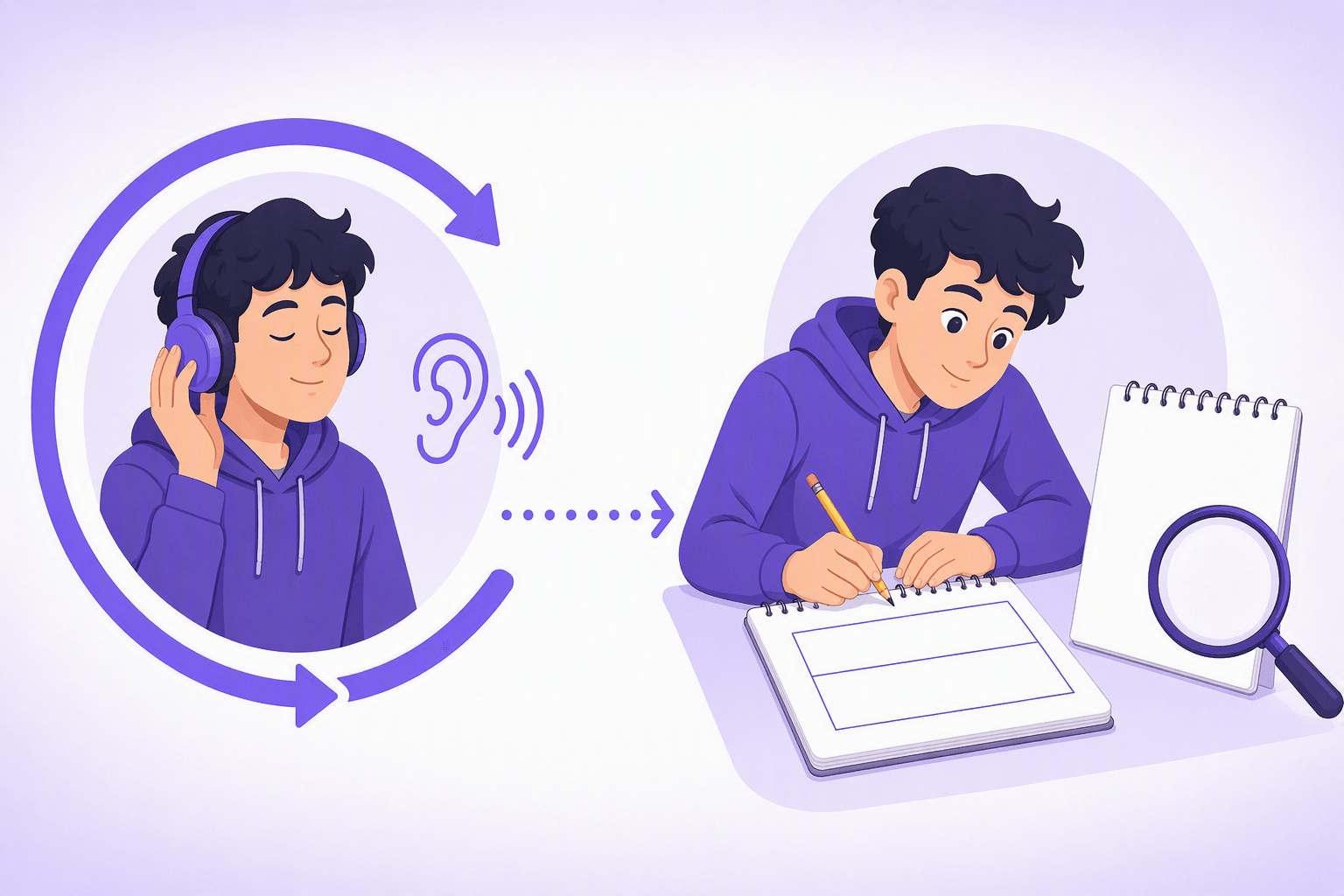
Give each play a job. Split your scratch space into two rows before the audio starts:
| Play | What you write |
|---|---|
| First play | Gist only: who is speaking, topic, purpose, attitude of each speaker |
| Second play | Details your questions target: numbers, names, reasons, proposals, opinions |
Write in whatever mix of Spanish, your own language, and symbols is fastest. Abbreviate ruthlessly (bc, ↑, ≠). The grid exists to stop the classic failure mode: frantically transcribing during play one, then having no attention left for meaning.
Know the distractor patterns
Official past questions reveal that wrong answers are built in predictable ways:
- The echo trap. The distractor recycles exact words you heard, used in the wrong context. Correct answers usually paraphrase the audio instead of quoting it. If a choice feels satisfyingly word-for-word, be suspicious.
- The plausible invention. A statement that sounds reasonable and topic-adjacent but was never said. Ask: did I hear this, or do I just agree with it?
- The wrong-speaker swap. In conversations and interviews, an opinion from speaker A gets attributed to speaker B. This is why your first-play notes should track who holds each view.
- The extreme version. The audio says "muchos jóvenes"; the distractor says "todos los jóvenes". Absolute words (siempre, nunca, todos) deserve a second look.
Drill 10 to 15 official sets while consciously labeling why each wrong answer is wrong, and you will start seeing the traps before you fall into them.
A daily listening training plan
Strategy only works on top of raw comprehension, and comprehension grows through daily exposure to real Spanish, ideally slightly above your comfort level. Here is a progression that takes you from classroom audio to exam-ready ears. Fifteen to thirty minutes a day is enough if it is actually daily.
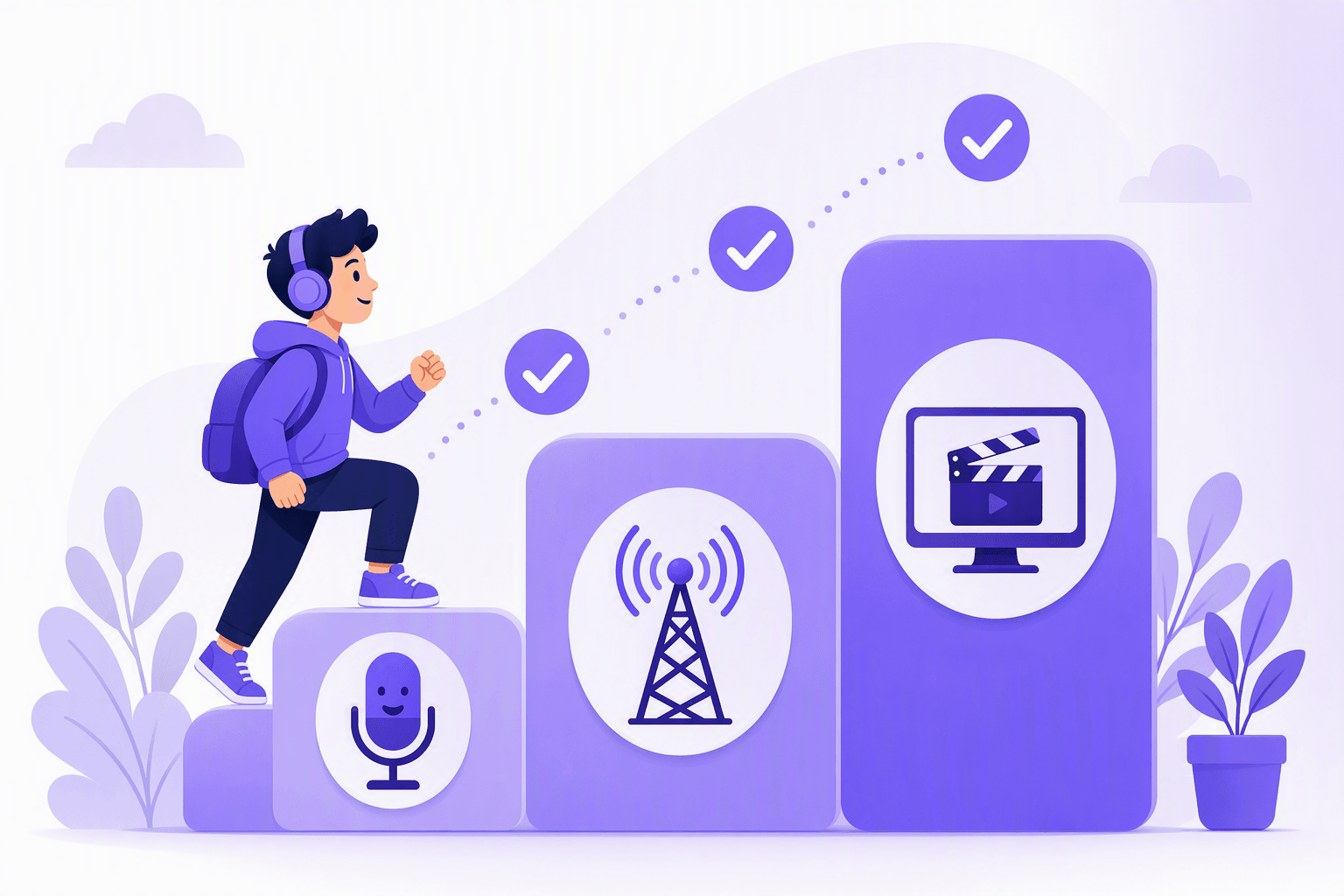
Weeks 1-2: learner podcasts at natural speed. Start with material made for intermediate learners that uses full-speed speech with clear structure, like News in Slow Spanish at its faster settings or intermediate episodes of learner podcasts. Goal: follow a five-minute segment and summarize it out loud in Spanish.
Weeks 3-4: news clips. Move to short authentic news audio and video from RTVE or BBC Mundo. News Spanish is fast but formally structured, which mirrors the presentations and announcements on the exam. Listen once for gist, once for details, then check yourself against the article text when one exists.
Weeks 5 and beyond: real conversation and TV scenes. Interviews and drama dialogue are the endgame: overlapping speakers, regional accents, connected speech. Work in short scenes, not full episodes, and repeat each scene until it opens up, first pass for gist, second with Spanish subtitles, third with no support. This clip-repetition loop is exactly how Wordy structures practice: short clips from real movies and shows, played and replayed with instant word lookups and quizzes, so every rewatch converts a little more native-speed audio into language you own.
Two rules keep the plan honest. Mix accents deliberately, alternating Spain and Latin America across the week, because the exam does. And say something after every session, a two-sentence summary in Spanish, since the simulated conversation task will demand exactly that listen-then-respond reflex.
Attitude and opinion questions are a recurring Part B type, and native speakers flag their stance with a small set of high-frequency markers. Here they are in unscripted, full-speed scenes: creo que, me parece, estoy de acuerdo.
💡 The two-play drill
Rehearse the exam's format in practice: play any clip exactly twice, taking gist notes on play one and detail notes on play two, then answer your own question: what was the speaker's purpose? Doing this three times a week makes the real Part B feel like routine.
Free AP Spanish listening practice resources
You do not need a paid prep course for the audio section. These cover every training stage:
- College Board AP Central. Past free-response questions with their audio sources are published free, and the Course and Exam Description includes sample Part B multiple-choice sets. Nothing predicts exam difficulty like the exam itself. If your teacher has AP Classroom, the progress checks add a full bank of official-style audio questions.
- AudioLingua. A free library of short recordings by native speakers, tagged by CEFR level (A1-C2). Filter Spanish at B1-B2 for exam-level material in two-minute doses.
- RTVE. Spain's public broadcaster offers news, documentaries, and podcasts, ideal for peninsular accents and formal registers.
- BBC Mundo. News video and audio in Latin American Spanish, usually short and current, perfect for the weeks 3-4 stage.
- Radio Ambulante. Narrative journalism from across Latin America with full transcripts, the single best free bridge between learner audio and native podcasts. Exam interviews and presentations sound a lot like its calmer segments.
For the TV-scene stage, our guide to the best movies and shows for learning Spanish sorts options by difficulty, and if you want the theory behind choosing audio at the right level, see comprehensible input for Spanish.
Common mistakes
Practicing only with slowed audio. Classroom recordings at 70% speed build confidence and nothing else. The exam plays authentic audio at full speed; your practice must too. Slow the clip length down, not the speech.
Trying to understand every word. Part B questions ask about main ideas, purpose, tone, and selected details. Students who chase 100% comprehension freeze at the first unknown word and miss the next two sentences. Train yourself to let unknowns pass and stay with the message.
Reading answer choices during the audio. Your eyes on the choices means your attention off the audio, and the choices are 75% traps by design. Notes first, choices after.
Ignoring accents you find hard. If everything you practice with is Mexican Spanish, a Caribbean speaker on exam day will feel like a different language. Rotate accents on purpose.
Leaving blanks. There is no penalty for wrong answers on AP exams, so an unanswered question is a donated point. Eliminate the echo trap and the extreme option, then guess from what remains.
Cramming listening. Reading can be crammed; ears cannot. Ten minutes daily for three months beats three-hour sessions in April. Listening improvement is compounding and slow, which is exactly why starting early is such an advantage.
Score-boosting tips from the scoring side
Understanding how the exam is built and scored changes how you prepare:
- Multiple choice is half your score, and Part B is the biggest chunk of it. In the published format, the 35 Part B questions outweigh any single free-response task. Listening practice is the highest-leverage hour in your AP Spanish week.
- Question types repeat. The interpretive questions cycle through a stable set: main idea, supporting detail, purpose of the text, intended audience, speaker's attitude, meaning of a phrase in context, and inference. Label every practice question by type and track which types you miss; most students discover one or two weak types, usually inference and tone, and fixing those is targeted work, not general work.
- Themes are announced. All sources connect to the course's six themes (families and communities, science and technology, beauty and aesthetics, contemporary life, global challenges, personal and public identities). Building vocabulary theme by theme means fewer unknown words on exam day.
- Listening earns free-response points too. The audio source in the argumentative essay must be cited, and the conversation task scores your ability to respond appropriately to what you heard. A stronger ear quietly lifts both.
- The exam rewards partial understanding. A student who catches the gist, the speakers' attitudes, and half the details answers most questions correctly. AP Spanish sits around B1-B2 on the CEFR scale, not native mastery; the bar is following authentic speech on familiar themes, and that is a trainable skill, not a talent.
Most students taking the exam, one of the most popular AP world language exams with well over one hundred thousand test-takers each year, walk in having practiced reading far more than listening. Flip that ratio for the final three months and Part B stops being the section you fear. Put in the daily clips, run the two-play drill, learn the traps, and the audio section becomes what it secretly is: the most predictable part of the exam.
Frequently Asked Questions
How long is the AP Spanish listening section?
Do you hear the audio twice on the AP Spanish exam?
How can I practice AP Spanish listening for free?
What level is AP Spanish?
Is AP Spanish listening hard?
Sources & References
- College Board, AP Spanish Language and Culture Course and Exam Description (latest edition)
- College Board, AP Central: AP Spanish Language and Culture past exam questions
- Vandergrift, L., 'Recent developments in second and foreign language listening comprehension research', Language Teaching, 2007
- Vandergrift, L. & Goh, C., Teaching and Learning Second Language Listening: Metacognition in Action, Routledge, 2012
- Council of Europe, Common European Framework of Reference for Languages (CEFR)
Start learning with Wordy
Watch real movie clips and build your vocabulary as you go. Free to download.


