Quick Answer
In modern English slang, 'cringe' means something is embarrassingly awkward, try-hard, or secondhand embarrassing. People use it as an adjective ('That’s cringe'), a noun ('the cringe'), or a verb ('I cringed'). The tone is usually judgmental or teasing, so it can easily sound rude if you aim it at a person instead of a situation.
In modern English, "cringe" means something is embarrassingly awkward or secondhand embarrassing, often because it feels forced, try-hard, or socially off. You will hear it online as a quick judgment ("That’s cringe"), and in everyday speech as a real reaction ("I cringed when I saw it").
If you are learning English, the key is tone: "cringe" is rarely neutral. It can be playful with close friends, but it can also land as rude if you use it to label a person.
For more modern usage like this, see our broader English slang guide and, for the line between edgy and offensive, our English swear words guide.
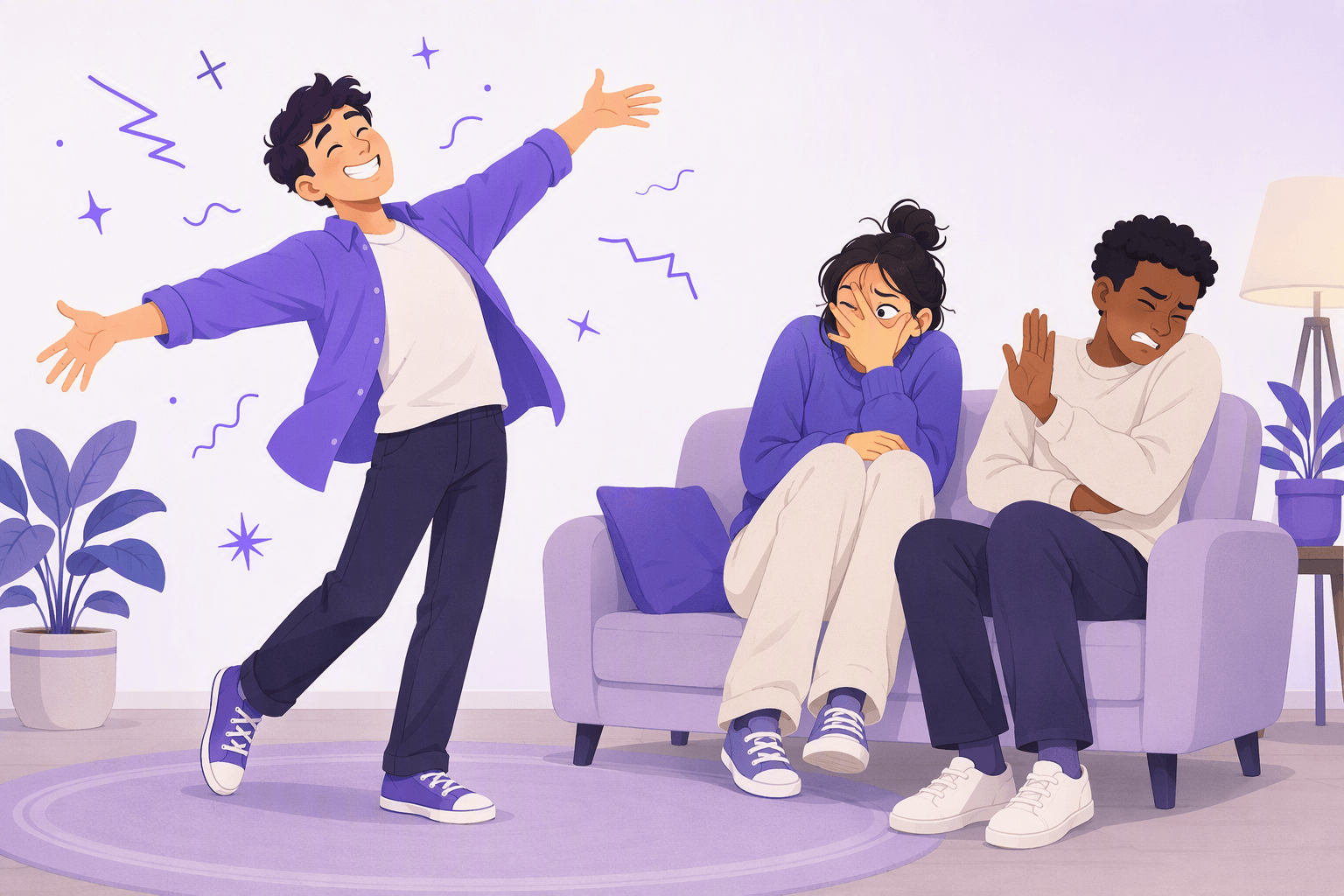
What "cringe" means (and what it does not)
"Cringe" has two lives in English.
One is the older, standard meaning: a physical or emotional recoil, like shrinking back in discomfort. Dictionaries still define this core sense (OED, Merriam-Webster, Cambridge Dictionary, accessed 2026).
The newer life is slang: a label for content, behavior, or moments that trigger embarrassment, especially secondhand embarrassment.
The core idea: secondhand embarrassment
Secondhand embarrassment is when you feel embarrassed for someone else. That is the emotional engine behind most slang uses.
A classic example is watching someone tell a joke that fails badly, then keep pushing it. You might not be the one failing, but you still feel the heat.
What "cringe" is not
"Cringe" is not the same as "bad" or "wrong." It is about social discomfort, not moral judgment.
It is also not always about fear. It can overlap with "yikes" or "ouch," but the center is embarrassment, not danger.
⚠️ A learner mistake that sounds harsh
Saying "You are cringe" is much stronger than many learners expect. If you want to sound softer, describe the moment: "That was kind of cringe" or "That came off a bit awkward."
Pronunciation and forms you will hear
In everyday speech, "cringe" sounds like KRINJ.
Here are the most common grammar patterns:
- Verb: "to cringe" (KRINJ), "cringed" (KRINJD), "cringing" (KRIN-jing)
- Adjective (slang): "cringe" (KRINJ), as in "That’s cringe"
- Noun (slang): "the cringe" (thuh KRINJ), as in "I can’t handle the cringe"
English learners often expect an adjective ending like "-y" ("cringey"), and that form exists too. You will see "cringey" (KRIN-jee) in writing when people want to make the adjective role obvious.
Where the slang sense comes from (internet culture, not just Gen Z)
The slang use grew through online communities that needed fast ways to rate social behavior. "Cringe" became a compact label for "this violates the vibe."
It also fits a wider pattern in English where verbs become adjectives in casual speech. Think "fail" ("That’s fail") or "win" ("That’s a win"), although "cringe" is more negative.
A useful cultural point: online platforms reward quick reactions. Short evaluative words travel well in comments, captions, and duets.
Pew Research Center’s reporting on teen internet use (accessed 2026) consistently shows that teens and young adults are heavy users of video and social platforms where reaction language spreads quickly. That social environment helps explain why "cringe" feels so common now.
How rude is "cringe"? Tone, targets, and social risk
"Cringe" is a judgment word. Even when it is funny, it ranks something as socially embarrassing.
The safest way to use it is to aim it at your own past self or a situation, not at a person’s identity.
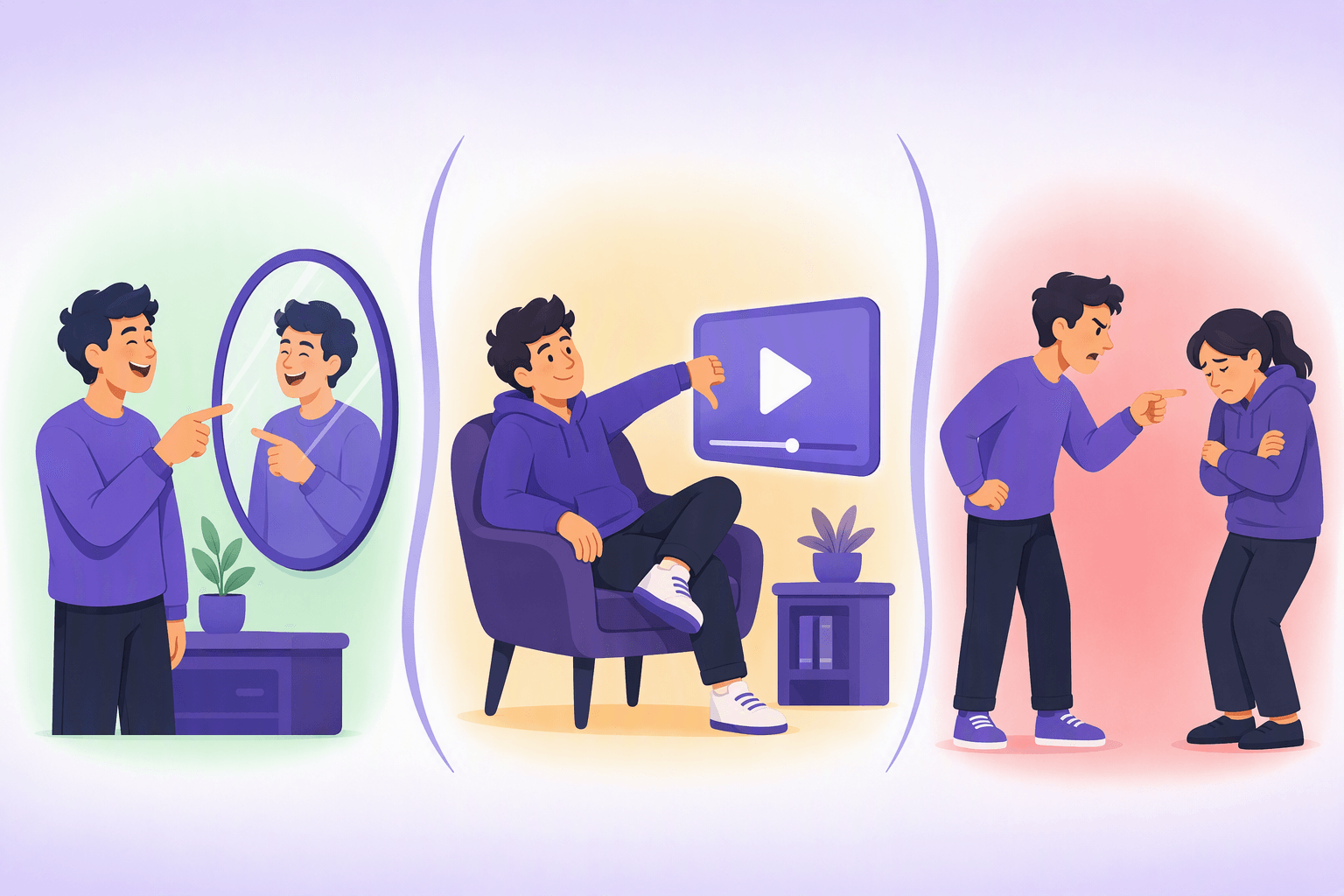
Low-risk: self-directed "cringe"
Self-directed use signals humility and humor.
Examples:
- "I re-read my old texts and cringed."
- "My 2016 haircut was so cringe."
This is one reason the word is popular: it lets you admit embarrassment without a long explanation.
Medium-risk: content-directed "cringe"
Calling a video, post, ad, or performance "cringe" is common online. It can still be mean, but it is less personal than aiming it at a person.
Examples:
- "That commercial is cringe."
- "Cringe compilation videos are everywhere."
High-risk: person-directed "cringe"
"You’re cringe" or "He’s cringe" can be socially aggressive. It frames someone as lacking social awareness.
If you need to criticize behavior, English often prefers indirectness. Research on politeness strategies in interaction (Brown and Levinson, Politeness: Some Universals in Language Usage, Cambridge University Press) helps explain why: direct negative judgments threaten the other person’s "face," meaning their public self-image.
If you want to sound more tactful, you can use softer alternatives:
- "That came off a bit awkward."
- "That was a little much."
- "That didn’t land."
Real-life examples you can copy (texts, friends, work)
You will see "cringe" in different registers. Here is what sounds natural.
In texts and DMs
Short, casual, sometimes exaggerated:
- "Stoppp, I’m cringing."
- "That’s cringe lol."
- "I just saw my old Facebook posts. The cringe is unreal."
If you are still building confidence, you can use a safer hedge:
- "Kinda cringe, not gonna lie."
In spoken conversation
Spoken English often adds a reaction word:
- "Oof, that was cringe."
- "I physically cringed."
- "I’m getting secondhand embarrassment."
At school or with coworkers
In many workplaces, "cringe" can sound immature or too online. You can still use it with the right audience, but "awkward" is safer.
Try:
- "That was awkward."
- "That was uncomfortable to watch."
- "That presentation had a few rough moments."
David Crystal’s work on how English varies by context and register (The Cambridge Encyclopedia of the English Language, Cambridge University Press) is a good reminder here: the same word can be perfectly normal in one setting and inappropriate in another.
💡 A simple rule for sounding natural
If you would not say "lol" out loud in that situation, avoid saying "cringe" out loud too. Use "awkward" or "uncomfortable" instead.
"Cringe" in movies and TV: why it is a listening goldmine
"Cringe" is a modern label, but the feeling is everywhere in film and TV: failed flirting, bad lies, awkward apologies, and public embarrassment.
If you want to train your ear for natural reactions, use scenes with:
- interruptions and overlap
- nervous laughter
- apologies and backtracking
- friends teasing each other
That is one reason learning from clips works well. You hear the tone, not just the dictionary meaning. For ideas, start with movies that help you learn English.
Common collocations: words that often appear near "cringe"
Native speakers do not use "cringe" alone. They build it with a few predictable patterns.
"So cringe"
"So" intensifies the judgment.
- "That’s so cringe."
- "It’s so cringe when people do that."
"Cringe-worthy"
"Cringe-worthy" (KRINJ-WUR-thee) is a more standard adjective form. It often sounds slightly more formal than "cringe" as an adjective.
- "It was cringe-worthy."
- "A cringe-worthy moment."
"I can’t watch"
This phrase often appears with cringe scenes.
- "I can’t watch, it’s too cringe."
- "I can’t handle the cringe."
"Secondhand embarrassment"
This is the explicit, non-slang label.
- "I’m getting secondhand embarrassment."
- "That gave me secondhand embarrassment."
If you want to sound less online, this phrase is a useful substitute.
"Cringe" vs similar words (awkward, corny, lame, embarrassing)
Choosing the right near-synonym is how you sound precise.
Awkward
"Awkward" is broader and often milder. It can be neutral.
- "The silence was awkward."
- "That was awkward, but it’s fine."
Embarrassing
"Embarrassing" is direct and can be serious. It does not always imply humor.
- "That was embarrassing."
- "I’m embarrassed."
Corny
"Corny" means overly sentimental, cheesy, or old-fashioned in a way that feels uncool.
- "That line was corny."
- "It’s corny, but I like it."
Lame
"Lame" is a general negative judgment. It is less about embarrassment and more about low quality or low excitement.
- "That’s lame."
- "The party was lame."
"Cringe" sits between "awkward" and "embarrassing," with an extra layer of social judgment.
Why English learners meet "cringe" so early
English is the world’s most widely learned second language, and it is used across a huge range of online spaces. Ethnologue estimates roughly 1.5 billion total English speakers worldwide when you combine native and second-language speakers (Ethnologue, 27th edition, 2024).
That matters because slang spreads fastest in global online English. Even if you are not in the US, you will still see American-influenced internet English in memes, gaming, and short-form video.
If you are building your foundation, pair slang learning with core vocabulary. Our 100 most common English words list helps you cover the high-frequency basics that appear in every conversation, not just online.
How to respond when someone says "That’s cringe"
If someone calls something you did "cringe," your response depends on closeness and intent.
If it is friendly teasing
You can play along:
- "I know, I know."
- "Let me live."
- "Fair. That was cringe."
If it is mean
You can set a boundary without escalating:
- "Okay, that’s not necessary."
- "You don’t have to be rude."
- "What exactly was cringe about it?"
If you are not sure what they mean
Ask for specifics. This is also a great learner move:
- "Do you mean awkward, or just not your style?"
- "Was it the way I said it?"
How to use "cringe" without sounding like a comment section
If your goal is natural spoken English, slang should be a spice, not the base.
Use it for clear, shared moments
"Cringe" works best when everyone can see the same awkward moment.
If you have to explain why it is cringe, it probably is not the right word.
Avoid it in formal writing
Do not use "cringe" in academic writing, professional emails, or customer service communication.
If you need a formal alternative:
- "inappropriate"
- "unprofessional"
- "ill-advised"
- "uncomfortable"
Avoid it as a personality label
English has many ways to critique behavior without labeling the person.
Instead of "You’re cringe," try:
- "That joke didn’t land."
- "That came off differently than you intended."
- "Maybe don’t post that."
This is where Deborah Tannen’s work on conversational style and interpersonal meaning (You Just Don’t Understand, Ballantine Books) is helpful: small wording choices can shift a message from playful to hostile.
"Cringe" in grammar: quick patterns you can imitate
Here are a few templates that match real usage.
"I cringed when..."
Use this for past embarrassment.
- "I cringed when I heard myself on video."
- "I cringed when he called her the wrong name."
"It’s cringe when..."
Use this for general habits.
- "It’s cringe when people brag nonstop."
- "It’s cringe when brands try to sound like teenagers."
"Don’t cringe, but..."
This is a playful warning that something might be embarrassing.
- "Don’t cringe, but I still like that song."
- "Don’t cringe, but I wrote you a poem."
A quick cultural note: "cringe" can be a social weapon
Online, "cringe" is not only a feeling. It is a way to enforce group norms.
Calling something cringe can mean, "This does not fit our group’s idea of cool." That can be harmless, but it can also be used to shame people for being sincere, new, or different.
If you are learning English, keep this in mind: sometimes "cringe" says more about the speaker’s values than the target’s behavior.
🌍 Why 'cringe' is everywhere in reaction culture
Short reaction words are efficient in comment-driven platforms. "Cringe" compresses a whole social judgment into one syllable, and it invites agreement or argument. That makes it sticky online, even when people disagree about what counts as cringe.
Practice: upgrade your "cringe" vocabulary in one week
If you want to understand "cringe" without overusing it, do this:
Day 1-2: Notice the trigger
When you see "cringe" online, ask: is it about awkwardness, sincerity, or trying too hard?
Write one sentence: "They called it cringe because..."
Day 3-4: Swap in a synonym
Rewrite the comment using "awkward," "embarrassing," or "corny." This trains nuance.
Day 5-7: Listen for the feeling in dialogue
Watch a few short scenes where someone fails socially, then pause and describe it in English. If you need a structure, use numbers to keep it simple, like "3 things that made it awkward." Our English numbers guide can help you say those lists quickly and clearly.
When you should not use "cringe"
Avoid "cringe" when:
- you are speaking to someone older who does not use internet slang
- you are in a professional setting
- you are criticizing someone you do not know well
- you are trying to sound empathetic
In those cases, "awkward" and "uncomfortable" are safer and more widely understood.
Final takeaway
"Cringe" means embarrassingly awkward, often in a way that triggers secondhand embarrassment, and it is usually a judgment rather than a neutral description. Use it lightly, aim it at moments instead of people, and switch to "awkward" in formal or unfamiliar settings.
If you want to hear how native speakers react in real-time, learn through dialogue-heavy scenes and subtitles, then recycle the exact phrasing in your own speech. Start with our best movies to learn English and keep a running list of reaction phrases you actually hear.
Frequently Asked Questions
What does 'cringe' mean in slang?
Is it rude to call someone 'cringe'?
What is the difference between 'cringe' and 'awkward'?
How do you use 'cringe' as a verb?
Why do people say 'the cringe'?
Sources & References
- Oxford English Dictionary, 'cringe' (verb/adjective), accessed 2026
- Merriam-Webster Dictionary, 'cringe', accessed 2026
- Cambridge Dictionary, 'cringe', accessed 2026
- Pew Research Center, Teens, Social Media and Technology reports, accessed 2026
- Ethnologue, 27th edition, 2024
Start learning with Wordy
Watch real movie clips and build your vocabulary as you go. Free to download.


