Quick Answer
BRB means 'be right back.' It’s a quick chat abbreviation used to tell someone you’re stepping away briefly but plan to return soon. It’s casual, common in texting, gaming, and online chat, and it can sound abrupt in formal or professional contexts where a fuller message is usually more polite.
BRB means "be right back", a casual chat abbreviation that signals you are stepping away briefly but plan to return soon.
If you have learned English through movies, you have probably noticed that people rarely say "BRB" out loud. It lives mostly in written chat, and the real skill is knowing what it implies socially: how long you can disappear, how polite it sounds, and what to say instead in work messages.
For more modern internet shorthand, pair this with our English slang guide and, for tone control in stronger language, our complete guide to English swear words.

What BRB actually communicates (beyond the literal words)
BRB does two things at once: it gives a reason for silence and it promises continuity. You are telling the other person, "Don’t assume I’m ignoring you, the conversation is still on."
That promise is why BRB can backfire if you vanish for a long time. If you say BRB and return 45 minutes later, the other person may read it as careless, even if your reason was valid.
The implied time window
In most chats, BRB implies minutes, not hours. In fast-moving contexts like gaming voice chat plus text, it can mean under 2 minutes.
If you need longer, English speakers often attach a number: "brb 5", "brb 10 min", "brb in 30". If you are learning numbers, our numbers in English guide helps you write these quickly and clearly.
The implied relationship
BRB assumes informality and shared context. It works best when the relationship is friendly, equal-status, and already conversational.
In more formal settings, the same act (stepping away) is fine, but the abbreviation can feel too clipped. This is a classic register issue, the kind of context-sensitive variation that linguist Deborah Tannen explores in her work on conversational style and involvement in everyday talk.
Pronunciation: do you say it as letters or as words?
In English, BRB is usually read as letters: "B-R-B" (pronounced "BEE ar BEE"). Some people also treat it as the full phrase "be right back" when reading.
In speech, most native speakers simply say the full sentence: "I’ll be right back." In a movie scene, you are far more likely to hear "Be right back" than "B-R-B."
💡 A learner-friendly rule
If you are speaking, say "be right back." If you are typing casually, "brb" is normal.
Where BRB comes from (and why it still survives)
BRB is older than many people think. It grew out of early online chat culture where speed mattered: IRC, instant messaging, and multiplayer games. In those spaces, you needed a quick way to explain silence without derailing the conversation.
David Crystal’s book Language and the Internet is a useful reference point here because it treats internet language as a real register with its own norms, not "bad English." BRB is a good example: it is not random, it is a conventional signal that manages turn-taking and expectations.
Even in 2026, BRB survives because it is short, widely understood, and emotionally neutral. Unlike slang that can sound trendy or performative, BRB is mostly functional.
How common is BRB, and who uses it?
English is the world’s most widely learned second language and also one of the most widely used online. Ethnologue estimates roughly 1.5 billion total English speakers worldwide (native plus second-language speakers), which helps explain why English chat abbreviations spread so easily across platforms and countries.
BRB is especially common in:
- gaming chats (where leaving without notice can affect a team)
- group chats (where messages keep flowing)
- casual DMs (where people multitask)
It is less common in:
- customer support chats (unless the agent is mirroring your casual tone)
- workplace messaging with external partners
When BRB is polite, and when it sounds abrupt
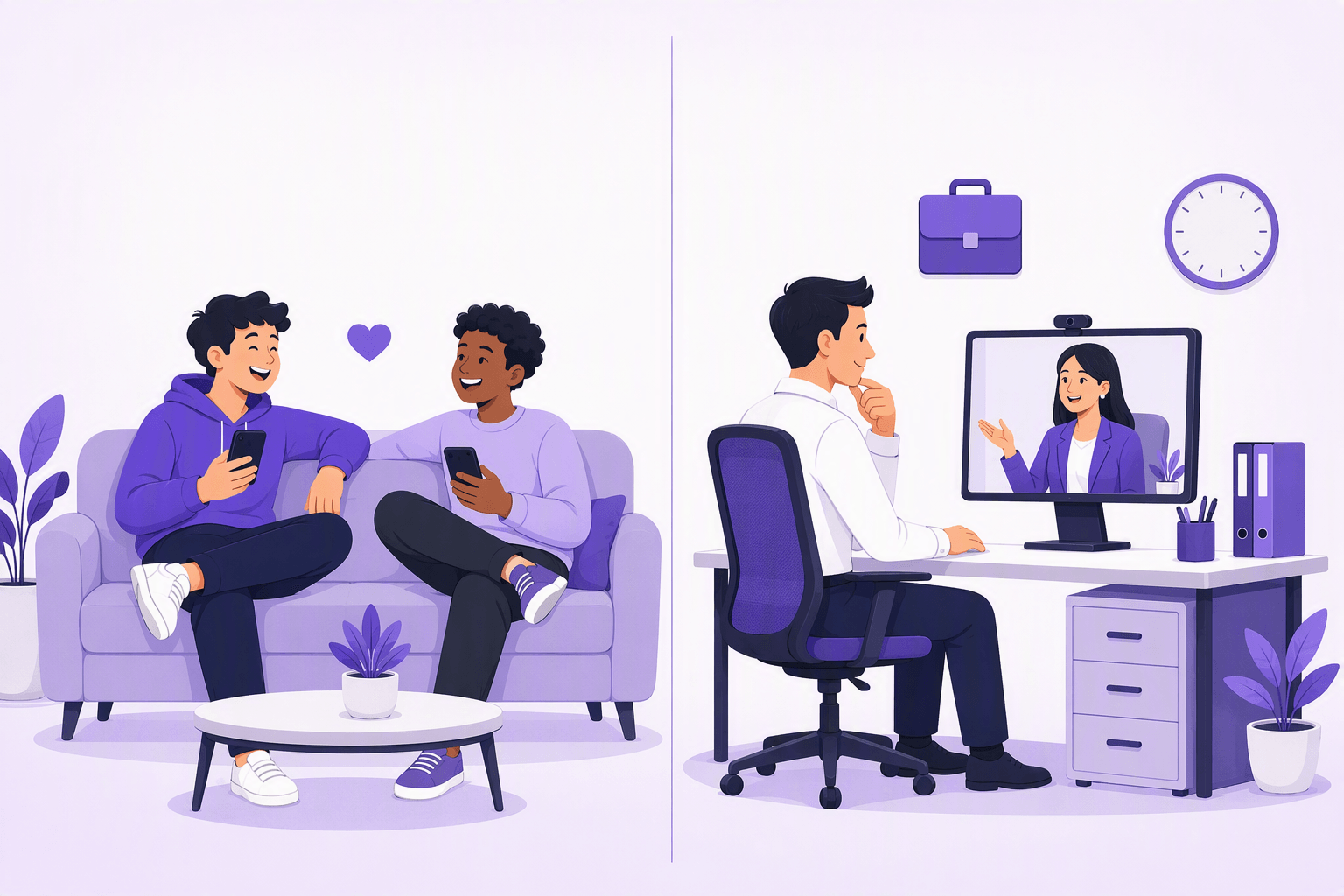
BRB can be considerate because it prevents the other person from guessing why you went silent. But it can also sound abrupt because it is minimal and gives no context.
Polite uses
BRB is polite when:
- you are already in an active back-and-forth
- you expect to return quickly
- the conversation is casual
- the other person does not need immediate action from you
Examples:
- "brb, doorbell"
- "brb grabbing water"
- "brb 2 min"
Abrupt or risky uses
BRB can feel off when:
- the other person is sharing something emotional
- you are in a professional setting
- you disappear for a long time after saying it
- you use it as a way to exit a conversation you do not want
In those cases, a slightly longer message is more face-saving. Research on politeness strategies in interaction (Brown and Levinson’s Politeness: Some Universals in Language Usage) helps explain why: giving a bit more context can reduce the social "cost" of interrupting the exchange.
⚠️ BRB in serious conversations
If someone is upset or vulnerable, "brb" can look dismissive. A better option is: "Give me two minutes, I want to reply properly."
Better alternatives to BRB (by situation)
BRB is not wrong, but English has many small variations that sound more human, more polite, or more specific.
Casual chat alternatives
These keep the same casual vibe:
- "sec" or "one sec"
- "gimme a minute"
- "back in a bit"
- "hold on"
These are often softer than BRB because they sound like spoken English.
Polite, clear alternatives for work chat
If you are on Slack, Teams, or a work WhatsApp group, these usually land better:
- "Stepping away for 5 minutes, back soon."
- "Quick break, back at 3:15."
- "I’m away from my desk for a moment, will reply shortly."
They do not require the other person to decode an abbreviation, and they set expectations.
If you might not return soon
BRB is a promise. If you are not sure, avoid it. Try:
- "I have to run, I’ll message you later."
- "Something came up, I’ll get back to you tonight."
- "I might be slow to reply for a bit."
This is especially useful in cross-cultural chats where "right back" may be interpreted literally.
BRB vs similar abbreviations (and how to choose)
A lot of confusion comes from treating these as interchangeable. They are not.
BRB
Use when you will return soon and you want the conversation to continue.
AFK
AFK means "away from keyboard." It is strongly associated with gaming and computer-based chat. It can imply you are not able to respond at all.
If you are on your phone, AFK can feel slightly odd, because you are not literally at a keyboard. People still use it loosely, but BRB is more general.
TTYL
TTYL means "talk to you later." This is closer to ending the conversation, or at least pausing it for a longer time.
If you say "brb" and then "ttyl," you are sending mixed signals.
GTG / G2G
"Got to go" is an exit. It is more final than BRB.
Real examples you can copy and paste
Short chat messages are hard for learners because every word carries tone. Here are practical templates.
Friendly DM
- "brb, phone call"
- "brb 5 min, making coffee"
- "brb, need to check something"
Group chat
- "brb 10, dinner"
- "brb, driving, will text when I’m home"
Gaming
- "brb 2 min, bio"
- "brb, reconnecting"
- "brb, lagging hard"
Work chat
- "Stepping away for 10 minutes, back soon."
- "Back at 14:30, will reply then."
- "In a meeting, I’ll respond after."
Common mistakes English learners make with BRB
Using BRB as a goodbye
BRB is not "bye." If you are leaving for the day, use "talk later" or "I have to go."
If you want more natural leave-taking phrases, our movie-based listening picks in best movies to learn English help because you hear how people actually exit conversations.
Saying BRB and then not returning
If you cannot come back soon, update the other person:
- "sorry, got pulled into something, back now"
- "still busy, will reply later tonight"
This repair move matters socially. It shows you respect the other person’s time.
Using BRB with the wrong tone in professional contexts
In a workplace, abbreviations can signal closeness, but they can also signal low effort. If you are not sure, write the full sentence once. After you have rapport, you can mirror the team’s style.
Cultural nuance: why BRB feels normal in some spaces
BRB is a product of high-tempo, multitasking communication. In many online communities, being "present" does not mean continuous attention, it means you are reachable.
That is why BRB is common in:
- communities where people keep a chat open while doing other tasks
- spaces where silence is interpreted as disengagement
- real-time coordination, like raids, matches, or group planning
In contrast, in contexts that value full attention, BRB can feel like you are downgrading the interaction. This is one reason you see fewer abbreviations in email, where the expected pace is slower and the norms are more formal.
🌍 Why 'brb' can be friendlier than silence
In many English-speaking online spaces, silence can be read as passive rejection. A quick 'brb' is a small courtesy that keeps the social connection intact, even if you are only away for a minute.
BRB in movies and TV: what you will actually hear
You will almost never hear a character say "B-R-B." Scripted dialogue tends to reflect spoken norms, and spoken English prefers full phrases.
What you will hear are equivalents:
- "Be right back."
- "Hold on."
- "Give me a second."
- "I’ll be back in a minute."
If you want to train your ear for these, focus on short, high-frequency chunks. Wordy-style clip learning works well here because you can replay the same micro-situation until the timing and intonation feel automatic.
Quick usage guide (so you do not overthink it)
Use BRB when all three are true:
- The chat is casual.
- You will return soon.
- You want the conversation to continue.
If any of those are not true, choose a clearer alternative.
💡 The safest upgrade
Instead of "brb", try: "Back in 5 minutes." It is still short, but it sets expectations and works in more contexts.
Related internet shorthand worth learning next
BRB is part of a wider set of English chat shortcuts. If you want to understand tone, not just meaning, learn them in clusters:
- response signals (lol, lmao, haha)
- stance signals (idk, imo)
- timing signals (brb, afk, ttyl)
Our English slang article is a good next step because it focuses on expressions you actually see and hear, not outdated lists.
A final note on clarity for international English
Because English is used globally, your chat partner might be a second-language speaker too. In international contexts, clarity beats cleverness.
If you are messaging across time zones, or with someone you do not know well, writing "Back in 10 minutes" is often better than BRB. It reduces ambiguity and avoids the risk that "right back" is taken literally.
If you are learning English through real dialogue, keep an eye on how often native speakers choose the full sentence even in casual contexts. That is usually the most transferable option.
If you want more everyday, high-frequency English you can recognize instantly, start with the 100 most common English words and then practice them in context through clips and subtitles on /learn/english.
Frequently Asked Questions
What does BRB mean in texting?
How long is 'right back' when someone says BRB?
Is BRB rude or unprofessional?
What is the difference between BRB and AFK?
Should BRB be capitalized?
Sources & References
- Merriam-Webster, 'BRB' definition, accessed 2026
- Oxford English Dictionary, 'BRB' entry, accessed 2026
- Cambridge Dictionary, 'BRB' meaning, accessed 2026
- Ethnologue, 27th edition, 2024
- Crystal, David, Language and the Internet, Cambridge University Press
Start learning with Wordy
Watch real movie clips and build your vocabulary as you go. Free to download.


