Quick Answer
Spanish uses different past tenses to show how you view an event: completed (pretérito), ongoing or habitual (imperfecto), or connected to the present (pretérito perfecto). If you can choose between preterite and imperfect reliably, you will understand most real Spanish storytelling, from casual chats to TV dialogue.
Spanish past tense is not one tense, it is a choice: use preterite (pretérito, preh-TEH-ree-toh) for completed events, imperfect (imperfecto, eem-pehr-FEHK-toh) for background and habits, and present perfect (pretérito perfecto, preh-TEH-ree-toh pehr-FEHK-toh) for past actions tied to the present, especially in Spain.
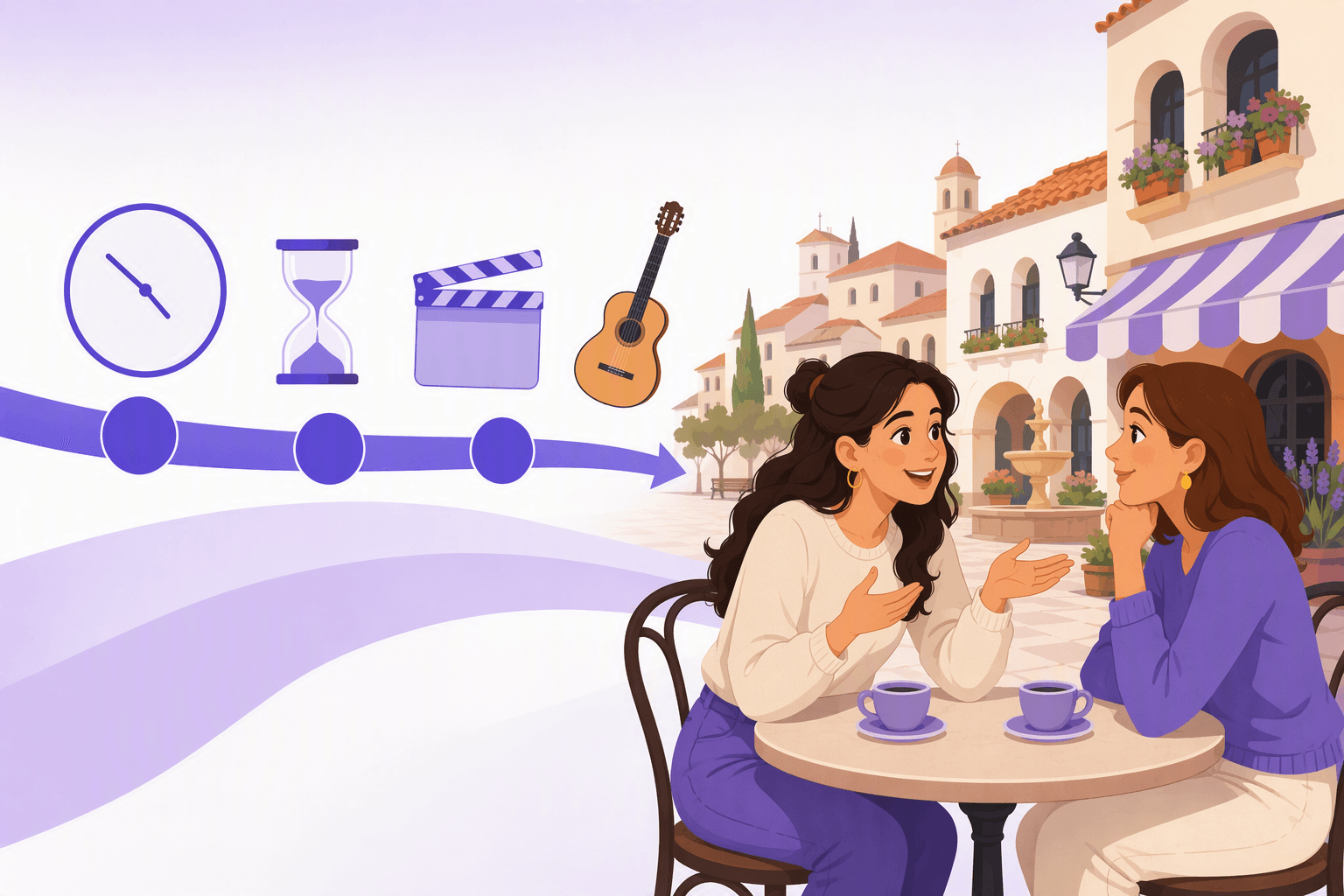
| English | Spanish | Pronunciation | Formality |
|---|---|---|---|
| I ate (finished event) | Comí | koh-MEE | casual |
| I was eating (ongoing/background) | Comía | koh-MEE-ah | casual |
| I have eaten (relevant to now) | He comido | eh koh-MEE-doh | polite |
| I went (finished event) | Fui | FWEE | casual |
| I used to go / I would go | Iba | EE-bah | casual |
| I was (state) | Era | EH-rah | casual |
Spanish is spoken by hundreds of millions of people across more than 20 countries, so you will hear different past-tense preferences depending on the region (Instituto Cervantes, 2023). The good news is that the core logic is stable across the Spanish-speaking world.
If you are also building everyday conversation basics, pair this guide with how to say hello in Spanish so you can greet naturally before you tell your story.
Why Spanish has multiple past tenses
English often uses one simple past for many meanings, but Spanish marks the speaker’s perspective. The same real-world event can be framed as a completed action, an ongoing scene, or something relevant to the present moment.
This is why Spanish storytelling feels precise. A single verb form can tell you whether something was a one-time event, a repeated routine, or the background setting.
"Tense and aspect are not just about time, they are about how speakers choose to 'package' an event for the listener."
Bernard Comrie, Aspect (as discussed in modern reference grammars and aspect research)
In Spanish grammar terms, this is often explained as aspect: whether an action is seen as bounded (completed) or unbounded (ongoing/habitual). The RAE’s grammar treats these contrasts as central to the pretérito vs imperfecto system (RAE & ASALE, 2009).
The three past tenses you will use most
Pretérito (indefinido)
Pretérito (preh-TEH-ree-toh) is also called pretérito indefinido (preh-TEH-ree-toh een-deh-feh-NEE-doh) or, in many textbooks, the preterite. It presents an action as completed.
Use it for a sequence of events in a story. It is the tense of "what happened next".
Imperfecto
Imperfecto (eem-pehr-FEHK-toh) describes ongoing past situations, repeated habits, and background details. It is the tense of "what things were like" and "what was going on".
It often sets the scene so the preterite can deliver the events.
Pretérito perfecto (present perfect)
Pretérito perfecto (preh-TEH-ree-toh pehr-FEHK-toh) is formed with haber + past participle: he comido (eh koh-MEE-doh). It links a past action to the present, often inside an unfinished time frame like "today".
Regional note: in Spain it is very common for "today/this week". In much of Latin America, speakers often prefer the preterite in the same contexts (RAE, DPD, 2005).
Preterite vs imperfect: the decision that matters most
Most learners struggle here because both tenses can translate to English simple past. The fix is to stop translating and start choosing a viewpoint.
Use this mental model: preterite moves the plot, imperfect paints the background.
A simple timeline test
Ask yourself:
- Did the action have a clear endpoint in the story?
- Is it a single completed event, or a series of completed events?
If yes, choose preterite.
If instead you are describing a state, a habit, or an ongoing action that was interrupted, choose imperfect.
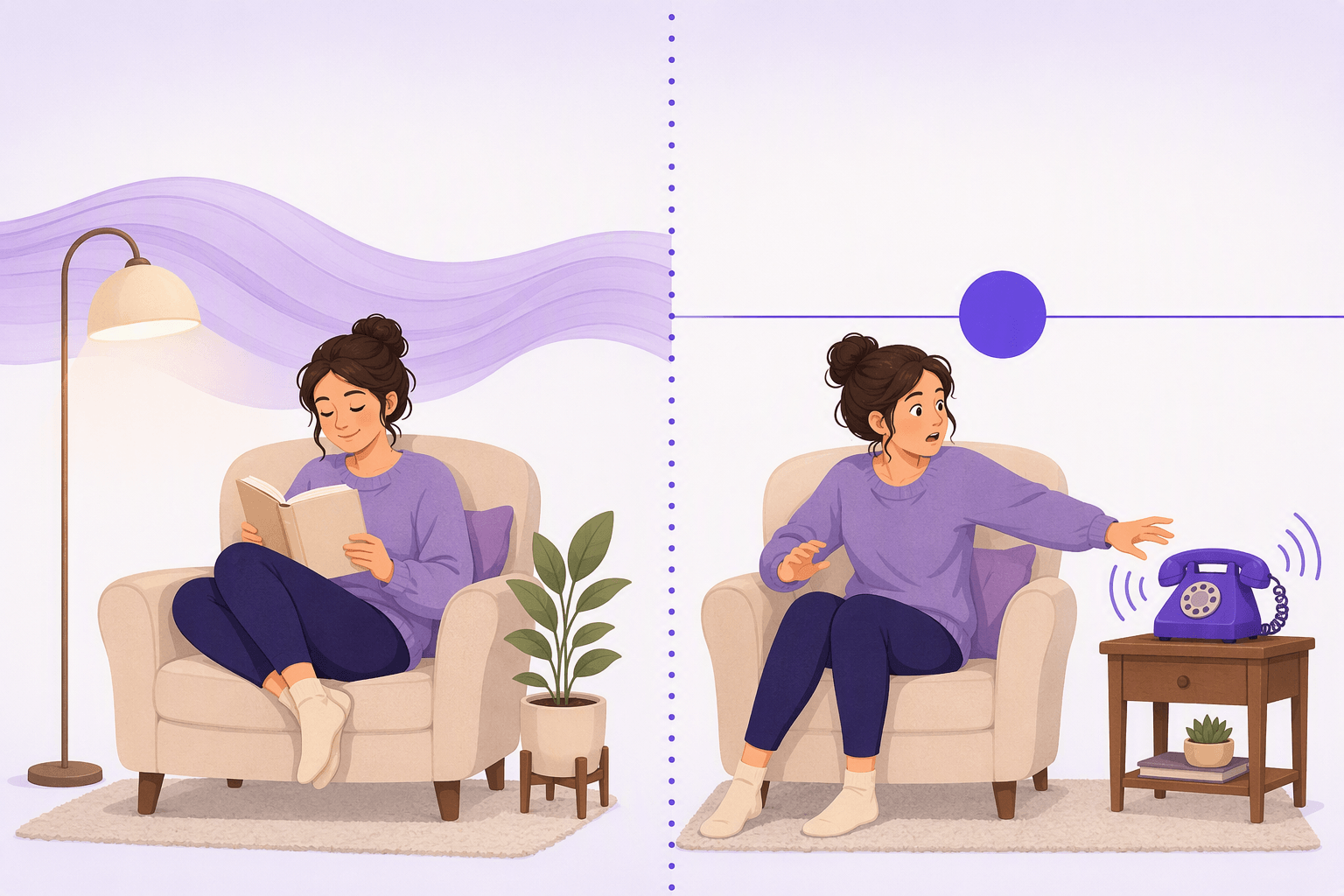
The "interrupted action" pattern
This is one of the most common real-life combinations:
- Imperfect for what was happening
- Preterite for what interrupted it
Example:
- Yo estaba en casa cuando sonó el teléfono.
- estaba (eh-STAH-bah): "I was (being) at home" as background
- sonó (soh-NOH): "it rang" as a completed interruption
Pretérito: core uses with examples
Completed actions (one-time events)
Use preterite for actions that happened and finished.
- Ayer llegué tarde. (ah-YEHR yeh-GEH TAR-deh)
- El año pasado viajamos a México. (ehl AHN-yoh pah-SAH-doh vee-ah-HAH-mohs ah MEH-hee-koh)
Time markers that often trigger preterite:
- ayer (ah-YEHR), anoche (ah-NOH-cheh), la semana pasada (lah seh-MAH-nah pah-SAH-dah)
- en 2019 (ehn dohs meel dee-eh-see-NWEH-beh)
A chain of events in a story
Preterite is the default for narration.
- Me levanté, me duché y salí. (meh leh-bahn-TEH, meh doo-CHEH, ee sah-LEE)
This is exactly how dialogue in movies and TV tends to run when characters recount what happened.
Beginnings and endings
Preterite is common with verbs like empezar (ehm-peh-SAHR) and terminar (tehr-mee-NAHR).
- La película empezó a las ocho. (lah peh-LEE-koo-lah ehm-peh-SOH ah lahs OH-choh)
Imperfecto: core uses with examples
Habitual actions in the past
If it means "used to" or "would (habitually)", imperfect is your friend.
- Cuando era niño, jugaba mucho. (KWAN-doh EH-rah NEE-nyoh, hoo-GAH-bah MOO-choh)
Common habit markers:
- siempre (see-EHM-preh), a menudo (ah meh-NOO-doh), todos los días (TOH-dohs lohs DEE-ahs)
Descriptions and background
Imperfect describes age, weather, time, feelings, and ongoing situations.
- Hacía frío y estaba oscuro. (ah-SEE-ah FREE-oh ee eh-STAH-bah ohs-KOO-roh)
- Eran las diez. (EH-rahn lahs dee-EHS)
Ongoing actions (without focusing on the endpoint)
- Mientras estudiaba, escuchaba música. (mee-EHN-trahs ehs-too-dee-AH-bah, ehs-koo-CHAH-bah MOO-see-kah)
Verbs that change meaning: preterite vs imperfect
Some high-frequency verbs shift meaning depending on the tense. This is not random, it is viewpoint.
Below is a practical table you can memorize.
| Verb | Imperfect (background) | Preterite (event/change) |
|---|---|---|
| saber (sah-BEHR) | sabía (sah-BEE-ah): "I knew" | supe (SOO-peh): "I found out" |
| conocer (koh-noh-SEHR) | conocía (koh-noh-SEE-ah): "I knew (a person/place)" | conocí (koh-noh-SEE): "I met" |
| poder (poh-DEHR) | podía (poh-DEE-ah): "I was able to (in general)" | pude (POO-deh): "I managed to" |
| querer (keh-REHR) | quería (keh-REE-ah): "I wanted" | quise (KEE-seh): "I tried to / I refused" (context) |
| tener (teh-NEHR) | tenía (teh-NEE-ah): "I had" | tuve (TOO-beh): "I got / I had (as an event)" |
A movie-style example:
- No podía dormir, pero al final pude.
(no poh-DEE-ah dor-MEER, peh-roh ahl fee-NAHL POO-deh)
First is a state, second is a successful outcome.
Pretérito perfecto: how it works and when it sounds natural
Formation: haber + participle
Present perfect uses haber (ah-BEHR) as an auxiliary:
| Person | Haber | Example with comer |
|---|---|---|
| yo | he (eh) | he comido (eh koh-MEE-doh) |
| tú | has (ahs) | has comido (ahs koh-MEE-doh) |
| él/ella/usted | ha (ah) | ha comido (ah koh-MEE-doh) |
| nosotros | hemos (EH-mohs) | hemos comido (EH-mohs koh-MEE-doh) |
| vosotros | habéis (ah-BAYS) | habéis comido (ah-BAYS koh-MEE-doh) |
| ellos/ustedes | han (ahn) | han comido (ahn koh-MEE-doh) |
Past participles are usually:
- -ar verbs: -ado (ah-doh), hablar → hablado (ah-BLAH-doh)
- -er/-ir verbs: -ido (EE-doh), comer → comido (koh-MEE-doh), vivir → vivido (vee-BEE-doh)
Typical uses
Use it for:
- Life experience with relevance now: He viajado mucho. (eh vee-ah-HAH-doh MOO-choh)
- Unfinished time period: Esta semana he trabajado demasiado. (EHS-tah seh-MAH-nah eh trah-bah-HAH-doh deh-mah-see-AH-doh)
Spain vs Latin America in real conversation
The RAE’s pan-Hispanic guidance recognizes both patterns as standard, with regional distribution (RAE, DPD, 2005). If you watch Spanish series, you will hear hoy he... constantly.
If you watch Mexican, Colombian, or Argentine shows, you will often hear preterite for the same "today" idea. Matching your input is the fastest path to sounding natural.
💡 Pick a 'home variety' for consistency
If your main goal is conversation, choose one reference variety for your own speech, Spain or a specific Latin American region. Understand both, but produce one consistently. This reduces hesitation and makes your past-tense choices automatic.
Preterite conjugation patterns (regular verbs)
You do not need every tense at once. You need the high-frequency patterns first.
-ar verbs (hablar)
| Person | Ending | Example |
|---|---|---|
| yo | -é | hablé (ah-BLEH) |
| tú | -aste | hablaste (ah-BLAHS-teh) |
| él/ella/usted | -ó | habló (ah-BLOH) |
| nosotros | -amos | hablamos (ah-BLAH-mohs) |
| vosotros | -asteis | hablasteis (ah-BLAHS-tays) |
| ellos/ustedes | -aron | hablaron (ah-BLAH-rohn) |
-er and -ir verbs (comer, vivir)
| Person | Ending | comer example | vivir example |
|---|---|---|---|
| yo | -í | comí (koh-MEE) | viví (vee-BEE) |
| tú | -iste | comiste (koh-MEES-teh) | viviste (vee-BEES-teh) |
| él/ella/usted | -ió | comió (koh-MYOH) | vivió (vee-BYOH) |
| nosotros | -imos | comimos (koh-MEE-mohs) | vivimos (vee-BEE-mohs) |
| vosotros | -isteis | comisteis (koh-MEES-tays) | vivisteis (vee-BEES-tays) |
| ellos/ustedes | -ieron | comieron (koh-MYEH-rohn) | vivieron (vee-BYEH-rohn) |
Imperfect conjugation patterns (regular verbs)
Imperfect is easier than preterite: fewer irregulars, very stable endings.
-ar verbs (hablar)
| Person | Ending | Example |
|---|---|---|
| yo | -aba | hablaba (ah-BLAH-bah) |
| tú | -abas | hablabas (ah-BLAH-bahs) |
| él/ella/usted | -aba | hablaba (ah-BLAH-bah) |
| nosotros | -ábamos | hablábamos (ah-BLAH-bah-mohs) |
| vosotros | -abais | hablabais (ah-BLAH-bays) |
| ellos/ustedes | -aban | hablaban (ah-BLAH-bahn) |
-er and -ir verbs (comer, vivir)
| Person | Ending | comer example | vivir example |
|---|---|---|---|
| yo | -ía | comía (koh-MEE-ah) | vivía (vee-BEE-ah) |
| tú | -ías | comías (koh-MEE-ahs) | vivías (vee-BEE-ahs) |
| él/ella/usted | -ía | comía (koh-MEE-ah) | vivía (vee-BEE-ah) |
| nosotros | -íamos | comíamos (koh-MEE-ah-mohs) | vivíamos (vee-BEE-ah-mohs) |
| vosotros | -íais | comíais (koh-MEE-ays) | vivíais (vee-BEE-ays) |
| ellos/ustedes | -ían | comían (koh-MEE-ahn) | vivían (vee-BEE-ahn) |
The irregulars that pay off first (with pronunciation)
You will see these constantly in subtitles and dialogue. Learn them early.
Ser and ir
Both share the same preterite forms:
- fui, fuiste, fue, fuimos, fuisteis, fueron
(FWEE, FWEES-teh, FWEH, FWEE-mohs, FWEES-tays, FWEH-rohn)
Imperfect:
- era (EH-rah), ibas (EE-bahs), etc.
Context decides meaning:
- Ayer fui al cine. (I went)
- Ayer fui muy feliz. (I was, as a completed state in that time frame)
Estar
Preterite:
- estuve (eh-STOO-beh), estuviste (eh-stoo-BEES-teh), estuvo (eh-STOO-boh)
Imperfect:
- estaba (eh-STAH-bah)
Tener, hacer, decir
Preterite:
- tuve (TOO-beh)
- hice (EE-seh)
- dije (DEE-heh)
These are classic "plot verbs" in stories.
⚠️ A common learner mistake
Do not use imperfect just because something lasted a long time. Duration does not force imperfect. If you present it as a completed block, you can use preterite: "Viví allí cinco años" (vee-BEE ah-YEE SEEN-koh AH-nyohs).
Cultural insight: how Spanish speakers tell stories
In many Spanish-speaking cultures, storytelling is a social skill. People often build suspense with imperfect background, then deliver the key event in preterite.
You hear this pattern constantly in everyday anecdotes: first the setting (era tarde, hacía calor), then the event (de repente apareció). If you want to sound natural, practice that rhythm, not isolated sentences.
If you are learning through dialogue, Wordy-style clip practice helps because you hear tense choices in context, not as abstract rules. For more everyday expressions that show up in real scripts, see Spanish slang and, for strong language you might hear in crime dramas, Spanish swear words.
A practical method to master past tenses with media
Step 1: Tag time markers
While watching, pause and note any time phrase:
- ayer, anoche, esta semana, cuando era niño, mientras
Time markers do not guarantee a tense, but they strongly predict what comes next.
Step 2: Identify "scene" vs "event"
Write S or E in your notes:
- S (scene): descriptions, feelings, ongoing actions
- E (event): completed actions, interruptions, sequence
Then check the verb form. This trains your intuition quickly.
Step 3: Retell in two versions
Take one short clip and retell it twice:
- As a sequence of events (more preterite)
- As a scene description (more imperfect)
This forces you to control viewpoint, which is the real skill.
For conversation building alongside grammar, add a few social basics like how to say goodbye in Spanish and how to say I love you in Spanish. These phrases show up in past-tense conversations more than you expect, especially in relationship storylines.
Quick self-check exercises (with answers)
Exercise 1: Choose preterite or imperfect
- Cuando (ser) ___ niño, (vivir) ___ en Lima.
- Ayer (ver) ___ una película y (llorar) ___.
- Yo (estudiar) ___ cuando (llegar) ___ mi amiga.
Answers
- era (EH-rah), vivía (vee-BEE-ah)
- vi (VEE), lloré (yoh-REH)
- estudiaba (ehs-too-dee-AH-bah), llegó (yeh-GOH)
Exercise 2: Meaning change
Translate the idea, not word-for-word:
- "I met Ana in 2020." → Conocí a Ana en 2020. (koh-noh-SEE ah AH-nah)
- "I knew Ana well." → Conocía bien a Ana. (koh-noh-SEE-ah byehn ah AH-nah)
Wrap-up: the shortest reliable rule set
If you remember only this, you can choose correctly most of the time:
- Preterite: completed events, plot, interruptions, beginnings/endings.
- Imperfect: background, habits, descriptions, ongoing past actions.
- Present perfect: past connected to now, especially common in Spain for "today/this week".
Spanish has hundreds of millions of speakers worldwide (Instituto Cervantes, 2023; Ethnologue, 2024), so you will hear variation. Your goal is not one "perfect" rule, it is consistent choices that match the Spanish you listen to most.
If you want more structured learning paths beyond grammar explanations, start at the Spanish learning page and keep a small set of story-ready phrases from how to say hello in Spanish so you can actually use the past tense in conversation.
Frequently Asked Questions
What is the difference between preterite and imperfect in Spanish?
When do I use the present perfect in Spanish (he comido)?
Why does Spain use present perfect more than Latin America?
How can I quickly choose between preterite and imperfect while speaking?
What are the most common irregular preterite verbs?
Sources & References
- Real Academia Española (RAE) & Asociación de Academias de la Lengua Española (ASALE), Nueva gramática de la lengua española, 2009
- Real Academia Española (RAE), Diccionario panhispánico de dudas (DPD), 2005
- Instituto Cervantes, El español: una lengua viva (Annual report), 2023
- Butt, J. & Benjamin, C., A New Reference Grammar of Modern Spanish, 6th ed., Routledge, 2011
- Ethnologue, Spanish (27th edition), 2024
Start learning with Wordy
Watch real movie clips and build your vocabulary as you go. Free to download.


