Quick Answer
Language immersion at home works when you replace passive exposure with structured, daily contact: lots of understandable listening, repeated viewing, deliberate vocabulary review, and regular speaking. You do not need to move abroad, but you do need consistency, a media system, and a way to turn what you hear into something you can say.
Language immersion at home works when you build a daily environment where the language is unavoidable and usable: you hear it in understandable chunks, you repeat the same material until it becomes automatic, and you practice producing it out loud. You do not need to live abroad, but you do need a system that turns entertainment into training.
What "immersion at home" actually means (and what it does not)
Immersion is not background noise while you scroll. It is sustained contact with meaning, where your brain can connect sound, words, and intention.
A good definition is close to Stephen Krashen’s idea of comprehensible input: you learn fastest when you understand most of what you hear or read, with a small stretch. At home, you create that condition on purpose, instead of hoping it happens.
Immersion at home is also not a single tool. It is a mix of input (listening, reading), output (speaking, writing), and feedback (corrections, noticing gaps).
💡 The simplest rule
If you cannot answer "What did they mean?" after a clip, it is not immersion yet. Slow down, add subtitles, or choose easier material until meaning is clear.
Why immersion works, with real numbers
English is the most learned second language in the world, and that matters for home immersion because you can access huge amounts of content and conversation partners.
Ethnologue estimates roughly 1.5 billion total English speakers worldwide (native plus second-language speakers), spread across many countries and media markets (Ethnologue, 27th edition, 2024). That scale creates an advantage: you can immerse without leaving home because English is already everywhere online.
The British Council has also documented English’s role as a global lingua franca in education, business, and international communication (British Council, The English Effect, accessed 2026). In practical terms, you can find graded readers, podcasts at every level, and communities for any hobby.
For learning speed, the CEFR framework is useful because it describes what you can do at each level (Council of Europe, CEFR, accessed 2026). Your immersion plan should match your level, because A2 listening needs different content than B2 listening.
The 4 building blocks of immersion you can control at home
1) Input you can mostly understand
If your comprehension is under 70%, your brain spends most of its effort guessing. You can still learn, but it is slow and frustrating.
Choose material where you can follow the story without translating every sentence. Sitcoms, reality shows, and workplace dramas often work better than fantasy, because the vocabulary is more everyday.
If you are learning English, start with content designed for learners, then move into native media. You can also use curated movie scenes, because they are short enough to repeat without burning out.
For movie-based learning, see our guide to best movies to learn English.
2) Repetition, not variety
Variety feels productive, but repetition is what builds automaticity. Paul Nation’s work on vocabulary learning emphasizes repeated encounters with words in meaningful contexts, not one-time exposure.
At home, repetition is your superpower because you can replay the same 30 seconds until it becomes easy. That is hard to do in real life abroad.
3) Output that is small but daily
Speaking is not only for testing. It is a learning tool because it forces retrieval, and retrieval exposes what you do not know.
Your output does not need to be long. Two minutes of shadowing plus two minutes of speaking from prompts is enough to create daily pressure to produce.
4) Feedback loops
Without feedback, you can fossilize mistakes. Feedback can come from a tutor, a language exchange partner, or even your own recordings.
The key is to pick one or two feedback channels you will actually use weekly.
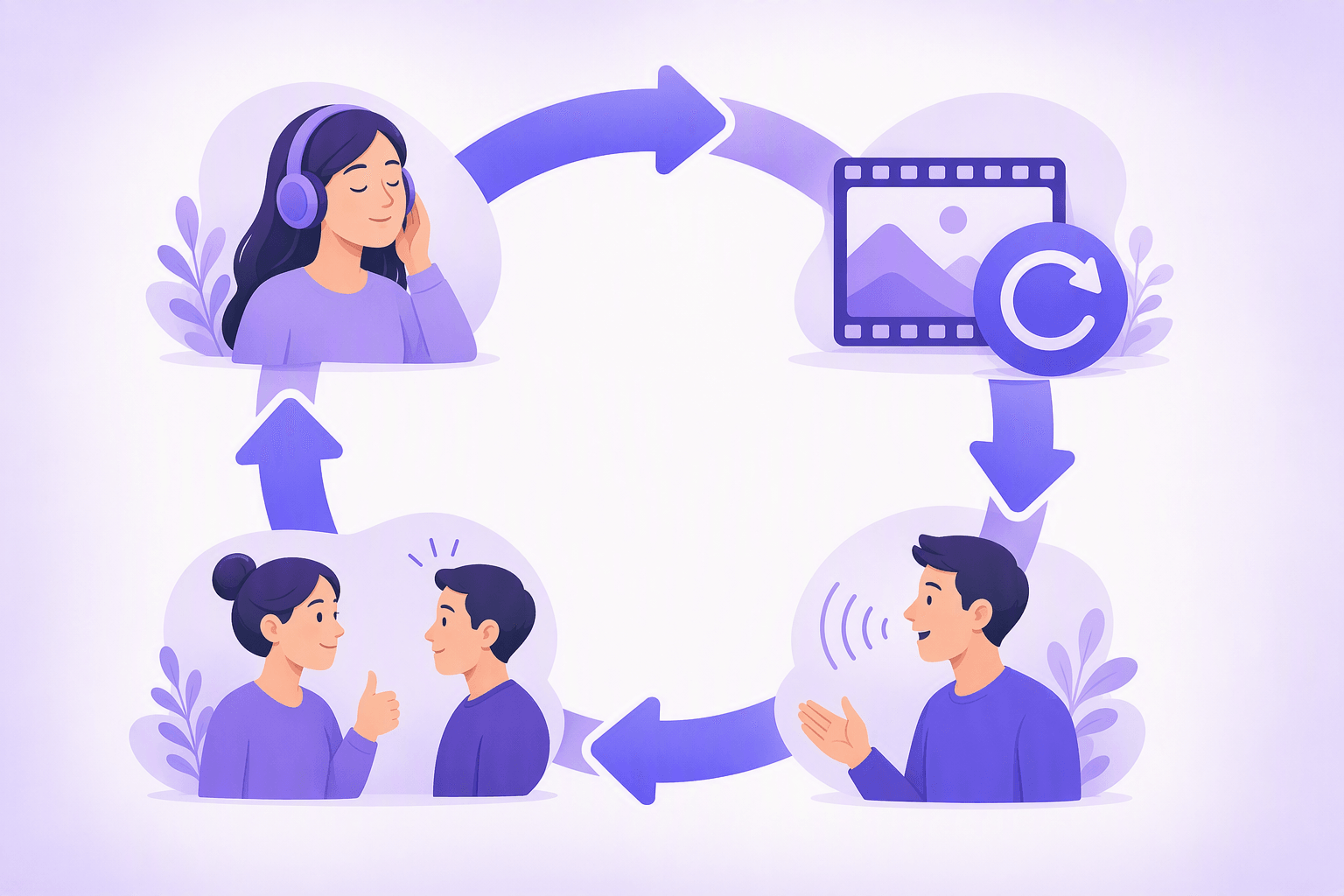
A realistic daily immersion routine (60 to 90 minutes)
This routine is designed for people with jobs, school, and limited energy. It is also designed to prevent the most common failure mode: doing a lot of input but never turning it into usable speech.
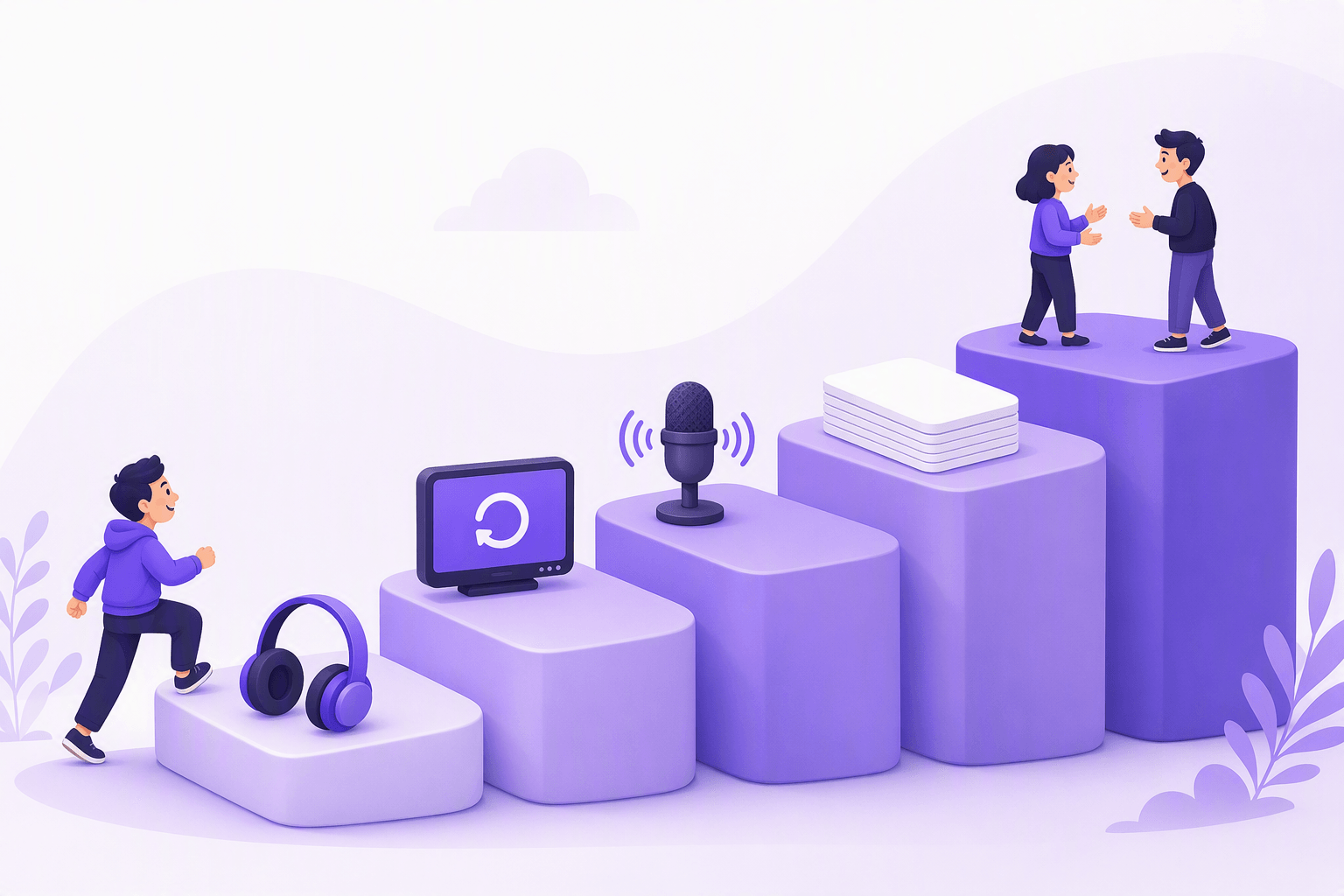
Step 1: 15 minutes of easy listening
Pick something below your level. The goal is flow, not struggle.
Examples:
- A slow podcast for learners
- A familiar TV episode you have already seen
- A short news summary with clear diction
If you are learning English pronunciation, pair this with targeted sound work from our English pronunciation guide.
Step 2: 20 minutes of "one scene, many passes"
Choose a single scene, ideally 30 to 90 seconds.
Pass A: Watch with target-language subtitles. Pass B: Rewatch and pause to repeat key lines. Pass C: Watch again without subtitles if possible.
This is where home immersion beats living abroad. Abroad, you cannot rewind real life.
Step 3: 10 minutes of shadowing
Shadowing means speaking along with the audio, matching rhythm and stress. Alexander Arguelles popularized shadowing for language learners as a way to train pronunciation and fluency.
Start by copying short chunks, then build to full sentences. Record yourself once a week to hear progress.
Step 4: 15 minutes of vocabulary review
Do not collect hundreds of words. Collect the words that keep showing up in your scenes.
If you want a structured base, learn high-frequency words first. Our list of 100 most common English words is a good anchor for beginners.
Step 5: 5 to 10 minutes of speaking prompts
Use prompts tied to your scene:
- "What happened?"
- "Why did they say that?"
- "What would I say instead?"
Keep it short. The goal is daily retrieval, not a perfect monologue.
⚠️ Avoid the 'content trap'
If your routine is 90 minutes of watching and 0 minutes of speaking, you are building recognition faster than you build conversation. Add even 5 minutes of output to balance it.
How to set up your home environment for immersion
Make English the default, not a special event
Small defaults create big exposure:
- Phone and computer language in English
- YouTube and Netflix profiles in English
- One social media feed in English only
This is not about forcing difficulty. It is about removing friction so English appears without you choosing it every time.
Build "zones" in your day
Create predictable immersion zones:
- Breakfast: easy listening
- Commute: one repeated episode
- Evening: one scene study
Your brain likes routines. When the time and place are stable, the habit becomes easier.
Use hobbies as immersion fuel
If you like cooking, watch cooking channels in English. If you like gaming, watch game reviews in English.
This aligns with research in motivation and identity in language learning, often discussed in Zoltán Dörnyei’s work on learner motivation. When the language supports your interests, you persist longer.
Subtitles: the practical rules that keep you improving
Subtitles can help or hurt depending on how you use them.
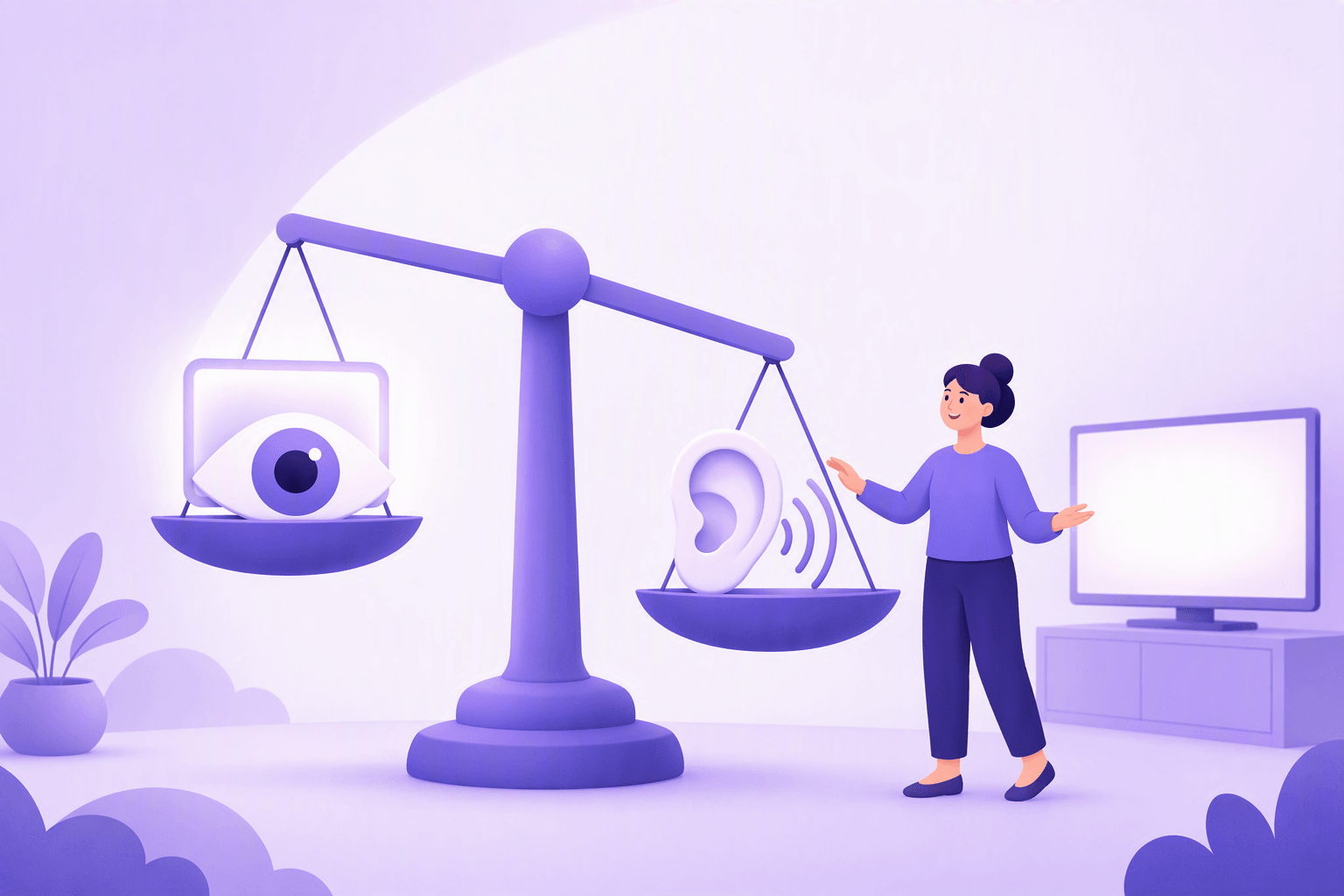
Use target-language subtitles as your default
For English learners, English subtitles help you map sounds to spelling. This is especially helpful for reduced speech, like "gonna" or "kinda".
If you want to understand how informal speech works, pair this with our English slang guide so you do not misread tone.
Use native-language subtitles only as a temporary bridge
If you are lost, use them for one pass to get the story. Then switch back to English subtitles and rewatch.
The goal is to keep your ears engaged. If you read everything in your native language, your listening skill grows slowly.
Turn subtitles off when you are ready
A simple test: if you can follow the scene with subtitles off and still answer what happened, you are ready to do at least one no-subtitles pass.
What to watch and listen to, by level
Beginner (A1 to A2): clarity beats authenticity
Choose:
- Learner podcasts
- Kids shows with clear speech
- Sitcoms with simple plots
Avoid:
- Fast talk shows
- Crime dramas with heavy jargon
- Anything where you cannot summarize the scene
A beginner win is understanding 80% of a simple scene, not 20% of a complex one.
Intermediate (B1 to B2): repetition plus real dialogue
This is the sweet spot for movie and TV immersion. You can understand enough to learn from context, and you still have plenty of gaps to fill.
Choose:
- Workplace comedies
- Family dramas
- Reality competition shows
This is also where you start noticing slang, swearing, and tone markers. If you want to understand what people mean without copying risky language, read our English swear words guide for context and severity.
Advanced (C1 to C2): specialize and refine
At advanced levels, immersion is less about basic comprehension and more about:
- Register control (formal vs casual)
- Humor and irony
- Professional vocabulary
Choose content tied to your goals: meetings, interviews, academic lectures, or specific industries.
Speaking at home without feeling awkward
Many learners avoid speaking because it feels fake. You can make it feel real by giving yourself a role and a reason.
Use "micro-scripts" from scenes
Take 3 lines from your scene and reuse them in your own situations.
Example:
- "Are you serious?"
- "That makes sense."
- "I’m not sure about that."
You are not memorizing random phrases. You are building a reusable toolkit.
Do "one-minute retells"
After a scene, retell it in one minute. Then retell it again in 30 seconds.
This trains fluency and forces you to choose simpler words, which is exactly what real conversation requires.
Get real interaction twice a week
Home immersion is powerful, but interaction adds pressure and feedback.
Two options:
- Language exchange calls
- A tutor session focused on correcting your retells
Even 30 minutes twice a week changes your trajectory.
🌍 Why 'sounding natural' is often about rhythm
In English, sounding natural is often less about perfect sounds and more about stress and reduction. Native speakers compress function words and stress content words. That is why shadowing works: it trains timing and emphasis, not just pronunciation.
Vocabulary: what to learn first (and what to ignore)
Prioritize high-frequency words and chunks
Single words matter, but chunks matter more:
- "Do you want to..."
- "I’m trying to..."
- "It depends."
Chunks reduce the load on your working memory. They also help you speak faster because you are not building every sentence from scratch.
If you are still building your basics, do not skip numbers. They show up everywhere: time, prices, dates, sports, and work. Use our numbers in English guide to lock them down.
Avoid rare words that only appear once
A good rule: if you have not seen a word three times in a week, do not add it to your review system yet.
This keeps your vocabulary work aligned with your actual input.
Measuring progress without burning out
Progress in immersion is often invisible day to day. You need simple metrics.
Track these three signals
- Rewatch speed: how quickly a scene becomes easy.
- Subtitle dependence: how often you can turn them off.
- Retell quality: how much you can say without pausing.
Use monthly "same clip" tests
Pick one clip and keep it as a benchmark. Revisit it every month.
You will hear improvements you cannot notice inside your daily routine.
💡 A good sign you are improving
You start noticing what you missed before: small words, sarcasm, and why a line is funny. Noticing is progress.
Common mistakes that make home immersion fail
Mistake 1: choosing content that is too hard
Hard content feels serious, but it often produces shallow learning. If you cannot summarize, lower the difficulty.
Mistake 2: never repeating anything
If you always chase new episodes, you are training novelty, not fluency. Repeat scenes until they feel boring, then repeat once more.
Mistake 3: treating slang as "advanced vocabulary"
Slang is not automatically advanced, it is socially specific. Learn it to understand, but be careful copying it.
If you want a safe map of what is common vs what is risky, start with our English slang article.
Mistake 4: no output, no feedback
Input builds comprehension. Output builds control. Feedback keeps you accurate.
You need all three to sound confident.
A simple 14-day immersion challenge you can actually finish
Day 1 to 3: Choose one show and one podcast. Set your devices to English. Day 4 to 7: Do one-scene repetition daily. Start shadowing 5 minutes. Day 8 to 10: Add one-minute retells. Record yourself once. Day 11 to 14: Do two real conversations (exchange or tutor). Keep the same scene routine.
After two weeks, you should feel a clear shift: faster recognition, less subtitle dependence, and more ready-to-use phrases.
Using Wordy-style clip learning without turning it into homework
Movie clips work because they are short, emotional, and repeatable. You can focus on one moment until it becomes part of your speech.
If you want a structured way to do this, Wordy focuses on real movie and TV clips with interactive subtitles and review. The key is not the app, it is the method: short scenes, repeated passes, and vocabulary tied to what you just heard.
For more ideas on media-based learning, browse the Wordy blog and start with the guides that match your level.
The bottom line
Language immersion at home is not a vibe, it is a routine: understandable input, heavy repetition, small daily speaking, and weekly feedback. If you do that for 60 to 90 minutes a day, your listening and fluency will move faster than most classroom-only plans.
If you want a ready-made source of repeatable scenes, start with our best movies to learn English picks, then build your daily scene routine around them.
Frequently Asked Questions
Can you really get fluent with immersion at home?
How many hours a day should I do immersion at home?
Should I use subtitles for immersion?
What is the fastest at-home immersion routine for beginners?
What should I watch for immersion if I want real conversation?
Sources & References
- Ethnologue, 27th edition, 2024
- British Council, The English Effect (accessed 2026)
- OECD, Education at a Glance (accessed 2026)
- Council of Europe, Common European Framework of Reference for Languages (CEFR) (accessed 2026)
Start learning with Wordy
Watch real movie clips and build your vocabulary as you go. Free to download.


