Quick Answer
Language families are groups of languages that share a common ancestor, like Spanish, French, and Italian descending from Latin. Linguists identify families by systematic sound and grammar patterns, not by shared alphabets or borrowed words. The biggest families by native speakers include Indo-European, Sino-Tibetan, Niger-Congo, Afro-Asiatic, and Austronesian.
Language families are how linguists group languages that share a common ancestor, meaning they developed from the same earlier language over time, like Spanish, French, and Italian descending from Latin. The point of a language family is not “these languages look similar,” but “these languages show systematic inherited patterns” in sounds, grammar, and core vocabulary.
Understanding families makes language learning more predictable: if you know one Romance language, you can often guess vocabulary and sentence structure in another. It also helps you avoid false assumptions, like thinking Japanese is “basically Chinese” because it uses kanji, or that English is “Latin-based” because it has many Latin and French loanwords.
If you are learning English through real speech, pairing this overview with movies and TV for English listening helps you notice which parts of English are Germanic (core verbs, everyday words) and which are Romance (formal vocabulary, academic terms).
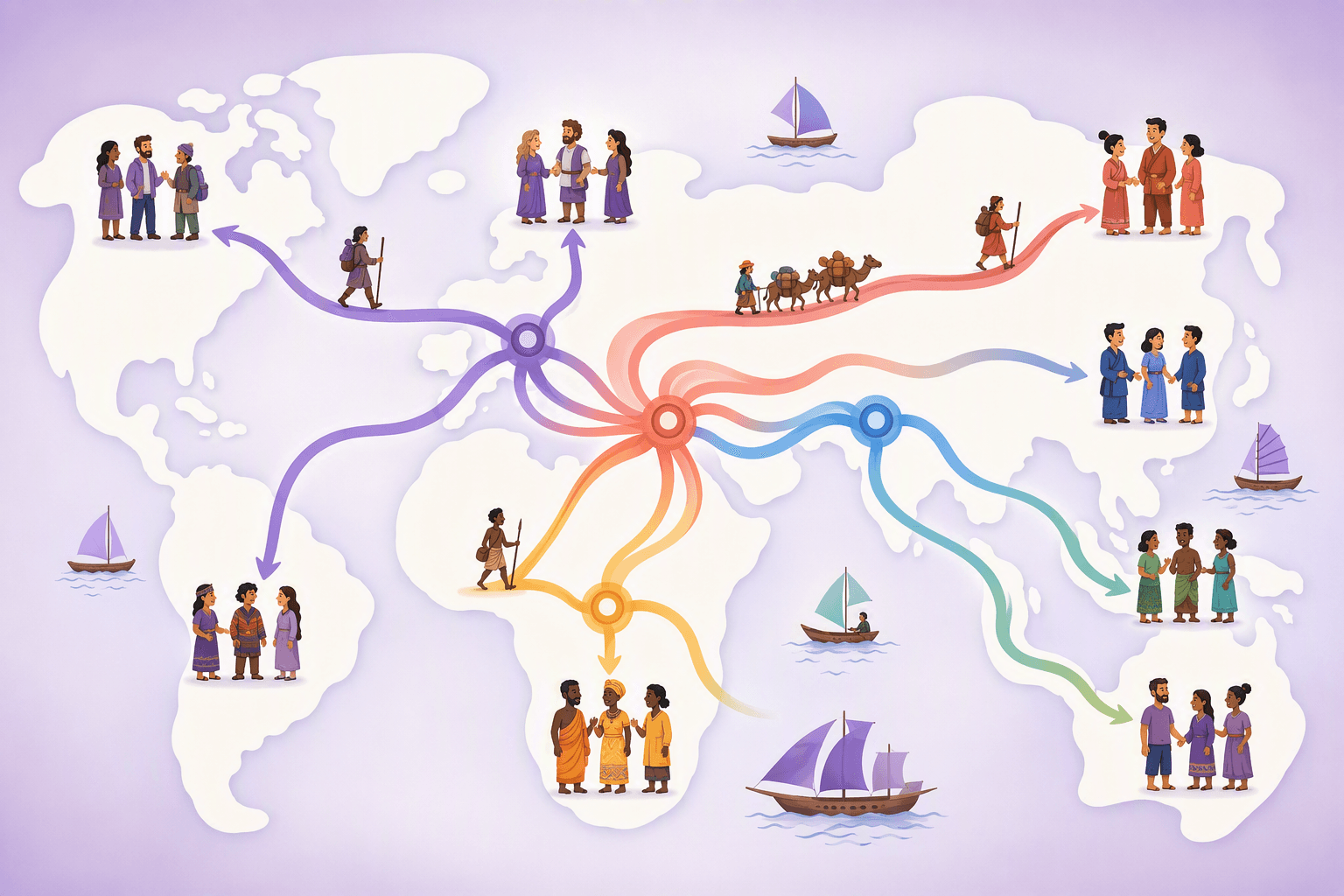
What counts as a language family (and what does not)
A language family is a genetic classification: languages are related because they descend from a proto-language. Linguists use the comparative method to reconstruct parts of that proto-language by comparing modern and historical forms.
Borrowing does not create a family. English borrowed thousands of words from French and Latin, but English is still Germanic because its core grammar and basic vocabulary patterns trace back to Proto-Germanic.
Writing systems do not define families either. Vietnamese uses the Latin alphabet today, but it is Austroasiatic, not Romance. Hindi and Urdu can be written in different scripts, but they are closely related within Indo-Aryan.
How linguists test relatedness
The key idea is regular sound correspondences across many words. If a sound in Language A consistently matches a sound in Language B in the same environment, across a large set of basic vocabulary, that is evidence of inheritance.
Historical linguist Lyle Campbell, in his work on historical linguistics, emphasizes that look-alike words are not enough. The patterns have to be systematic, and they have to show up in vocabulary that is usually resistant to borrowing, like kinship terms, body parts, and basic verbs.

The big picture: how many languages and how many families?
Ethnologue’s 27th edition (2024) reports roughly 7,000-plus living languages worldwide, depending on how you count language vs dialect. Glottolog, maintained by the Max Planck Institute, catalogs languages and higher-level groupings and is often used for a more conservative, evidence-focused classification.
The number of families depends on your classification standard. Some groupings are widely accepted (Indo-European, Austronesian). Others are debated, split, or merged depending on evidence and methodology.
💡 A practical way to think about it
If you want a learner-friendly map: focus on a handful of large families, plus a short list of important isolates. That gets you most of the cultural and linguistic landscape without turning it into a PhD project.
Indo-European: the family that spread with empires, trade, and migration
Indo-European is often treated as the largest family by native speakers, largely because it includes the Indo-Aryan branch (Hindi and related languages) and many major European languages.
Major branches you actually hear about
Romance: Spanish, French, Italian, Portuguese, Romanian. These descend from Latin, and they share features like grammatical gender and many cognates.
Germanic: English, German, Dutch, Swedish, Danish, Norwegian, Icelandic. English is Germanic in its skeleton: core verbs (be, have, go), pronouns, and many everyday words.
Slavic: Russian, Polish, Czech, Ukrainian, Serbian/Croatian/Bosnian. Slavic languages often have rich case systems and aspect-heavy verb systems.
Indo-Aryan: Hindi, Bengali, Punjabi, Marathi, Gujarati, Urdu (closely related to Hindi at a structural level). This branch accounts for a huge share of Indo-European speakers.
A cultural insight: why English feels “two-layered”
English has a Germanic core and a Romance “register layer.” In everyday speech you say help, start, buy, and ask. In formal contexts you reach for assist, commence, purchase, and inquire.
This is one reason English learners often feel that “simple English” and “academic English” are almost different languages. The family story explains it: the grammar stayed Germanic, while vocabulary expanded massively through contact.

If you want a fun window into how modern English shifts registers, compare everyday dialogue with slang-heavy scenes in our English slang guide. You will see how much of casual speech leans back toward the Germanic core.
Sino-Tibetan: a huge family with very different writing traditions
Sino-Tibetan includes Sinitic languages (often grouped under “Chinese,” like Mandarin and Cantonese) and many Tibeto-Burman languages.
A common misconception is that “Chinese is one language.” In reality, many Sinitic varieties are not mutually intelligible, even if they share a writing system in Chinese characters.
Why “Chinese characters” do not equal “Chinese language”
A writing system can unify a culture without unifying speech. Historically, written Chinese served as a prestige written standard across regions with different spoken varieties.
This matters for learners because it separates two skills: reading characters vs understanding speech. You can recognize a character and still not understand a fast conversation.
Niger-Congo: Africa’s largest family by number of languages
Niger-Congo is one of the world’s largest families by number of distinct languages, spanning much of Sub-Saharan Africa. It includes major languages such as Swahili (often classified within Bantu, a major subgroup) and Yoruba, among many others.
One of the best-known features in many Niger-Congo languages is noun class systems, which can be more elaborate than the gender systems familiar from Romance languages.
A cultural insight: language diversity and identity
In many African countries, multilingualism is normal rather than exceptional. People may use one language at home, another in the market, and a national or official language in school.
This everyday multilingual reality is one reason “country count” is a misleading way to measure a language’s reach. A language can be central to daily life across borders without being the sole national language anywhere.
Afro-Asiatic: Semitic and beyond
Afro-Asiatic includes Semitic languages like Arabic and Hebrew, plus other branches such as Berber and Cushitic.
Arabic is a special case culturally because there is a strong relationship between Modern Standard Arabic (a formal written and broadcast standard) and many spoken varieties that can differ significantly by region.
Diglossia in real life
Linguist Charles A. Ferguson is closely associated with the concept of diglossia: a “high” variety used in formal writing and a “low” variety used in everyday speech. Arabic is one of the classic examples discussed in that tradition.
For learners, this means you should be clear about your goal: reading news, having conversations, or both. The family label alone does not tell you how big the gap is between formal and spoken forms.
Austronesian: the ocean-spanning family
Austronesian stretches from Madagascar across maritime Southeast Asia into the Pacific. It includes Malay/Indonesian, Tagalog (Filipino), Javanese, and many Oceanic languages.
Austronesian’s geographic spread is one of the clearest examples of how seafaring, migration, and trade can shape language history. It is also a reminder that “continent-based” assumptions about language families often fail.
Dravidian: a major family in South Asia
Dravidian languages, including Tamil, Telugu, Kannada, and Malayalam, are primarily spoken in southern India and parts of Sri Lanka. They are not Indo-European, even though they exist alongside Indo-Aryan languages in the same countries.
This is a good example of why “national language” narratives can hide deep linguistic diversity. A single state can contain multiple families with long, independent histories.
Turkic: a family tied together by structure and history
Turkic languages include Turkish, Azerbaijani, Kazakh, Uzbek, Kyrgyz, and others. Many Turkic languages share features that learners notice quickly, like vowel harmony and agglutinative word-building (stacking suffixes to express grammar).
The Turkic family also illustrates how language families can span modern political boundaries. The family map does not match today’s borders, because it reflects older migrations and contact zones.
Uralic: Finnish, Hungarian, and the “not Indo-European” surprise in Europe
Uralic languages include Finnish, Estonian, and Hungarian, plus several smaller languages in Russia and the surrounding region.
Many people assume Hungarian is Slavic because of geography. It is not. Hungarian is Uralic, and its structure can feel very different from neighboring Indo-European languages.
A cultural insight: “European” does not mean “Indo-European”
Europe is often taught as if it is linguistically uniform. It is not. Uralic languages, Basque (an isolate), and languages of the Caucasus show that Europe’s linguistic history includes deep layers that predate modern nation-states.
Japonic, Koreanic, and the limits of “family” certainty
Japanese (Japonic) and Korean (Koreanic) are generally treated as separate families, not as proven members of a larger shared family. There have been proposals linking them to other groups, but strong consensus is limited.
Japanese
Japanese has heavy historical borrowing from Chinese, including a large portion of its Sino-Japanese vocabulary and the use of kanji. That borrowing can create surface similarities, but it does not prove genetic relatedness.
If you are learning Japanese pronunciation, remember it is mora-timed. For example, 星座 (seiza) is SAY-za, two morae for sei plus za, not “SEH-zah.”
Korean
Korean has also borrowed vocabulary historically (including from Chinese), but its grammar and sound system are distinct. Like Japanese, it is often treated as its own family for classification purposes.
If you want the writing-system angle, see how different scripts can shape perception of “relatedness”: Japanese uses kanji, hiragana, and katakana, while Korean uses Hangul. Script can make languages look closer or farther apart than they really are.
Language isolates: families of one
A language isolate is a language with no proven relatives. The most famous example in Europe is Basque.
Isolates are important because they remind us that language history includes extinctions and gaps. A language can be the last surviving member of a once larger family, or it can be so old and so changed that relationships are hard to prove with current evidence.
⚠️ Be cautious with viral 'everything is related' charts
Some online trees connect families with speculative super-families as if they were settled fact. For learning and general knowledge, stick to widely accepted families and treat deeper links as hypotheses unless a source like Glottolog supports them.
How language families affect language learning (practical takeaways)
Cognates help, but only within limits
If you know Spanish, you will recognize many French and Italian words. That is a family advantage.
But cognates can mislead too. False friends happen because meanings drift. Family relationships increase the odds of similarity, not the guarantee of identical meaning.
Grammar “feel” often travels with family
Word order tendencies, how verbs mark tense or aspect, and how nouns mark roles (cases, prepositions) often cluster by family. This is why learners sometimes say a language “thinks differently.”
WALS (World Atlas of Language Structures) is useful here because it separates genetic inheritance from typology. Two unrelated languages can share a feature because of contact or because it is a common structural solution.
Family is not destiny: contact zones reshape languages
English is Germanic but heavily Romance in vocabulary. Swahili is Bantu but has significant Arabic borrowing. Japanese is Japonic but has deep Chinese influence.
This is why learning through real media matters. In actual dialogue, you hear the contact layer: loanwords, code-switching, and register shifts. That is one reason movie-based practice can accelerate listening, especially for high-frequency conversational patterns.
A learner-friendly “mini map” of the world’s families
If you want a manageable set to remember, start with:
- Indo-European (Germanic, Romance, Slavic, Indo-Aryan)
- Sino-Tibetan
- Niger-Congo
- Afro-Asiatic
- Austronesian
- Dravidian
- Turkic
- Uralic
- A short list of isolates (Basque is the classic example)
From there, you can add regional families as needed, especially in the Americas, New Guinea, and Australia, where diversity is high and many families are smaller.
Language endangerment and why families shrink
UNESCO’s Atlas of the World’s Languages in Danger highlights that many smaller languages face serious risk. When a language disappears, we lose unique cultural knowledge, and we also lose evidence that could clarify family relationships.
This is not only a cultural issue, it is a classification issue. Fewer living languages and fewer records make it harder to test hypotheses about deep relatedness.
Common misconceptions (and the quick fixes)
“If two languages share lots of words, they must be related”
Not necessarily. Borrowing can be massive, especially in religion, science, and technology. English and Japanese share many modern loanwords from global English, but they are not related.
“If two languages use the same alphabet, they must be related”
No. The Latin alphabet is used for languages across many families. Script is a tool, not a family marker.
“Dialects are just accents”
Some “dialects” are mutually unintelligible and could be considered separate languages depending on social and political context. The boundary is not purely linguistic.
Linguist John McWhorter, in his popular writing on language change and diversity, often emphasizes how social history shapes what we label a language vs a dialect. The family tree is linguistic, but the labels are also political.
Using language families to learn English more efficiently
English learners get extra value from family awareness because English is a contact-heavy language. You can build vocabulary faster by noticing which words are likely Romance (often longer, more formal) and which are likely Germanic (short, common, conversational).
For example, you will often hear Germanic words in everyday scenes, including emotional reactions and insults. If you are curious how that plays out in real usage, compare casual dialogue with the stronger register of English swear words. The contrast is a real-world register lesson, not just a vocabulary list.
Also, if you are building your core English foundation, pairing this with a structured list like English numbers helps because high-frequency basics are where family patterns show up most clearly.
A simple way to study families with movies and TV
Pick one clip and do two passes:
- First pass: focus on meaning and rhythm.
- Second pass: notice word origins and register. Is the speaker choosing short everyday words or longer formal ones?
This is especially effective in English because the same idea can be expressed with different layers: help vs assist, ask vs inquire, start vs commence. Over time, you start to feel which layer fits the scene.
If you want a curated starting point, use our English movie list and choose scenes with clear everyday dialogue.
💡 One-sentence takeaway
Language families explain why some languages feel familiar, but real listening shows you how history actually lives inside modern speech.
To keep exploring how English works in real contexts, browse the full Wordy blog and focus on topics that match what you hear most often in your favorite shows.
Frequently Asked Questions
What is a language family in simple terms?
What is the biggest language family in the world?
Are Chinese and Japanese in the same language family?
How do linguists prove languages are related?
Why do some languages have no known relatives?
Sources & References
- Ethnologue, 27th edition, 2024
- Glottolog (Max Planck Institute for Evolutionary Anthropology), accessed 2026
- Encyclopaedia Britannica, 'Language family', accessed 2026
- UNESCO Atlas of the World's Languages in Danger, accessed 2026
- World Atlas of Language Structures (WALS Online), accessed 2026
Start learning with Wordy
Watch real movie clips and build your vocabulary as you go. Free to download.


