Quick Answer
Japanese months follow an elegantly simple pattern: just combine the number (一 through 十二) with 月 (gatsu, meaning 'month'). January is 一月 (ichigatsu), February is 二月 (nigatsu), and so on through December, 十二月 (jūnigatsu). No gendered nouns, no irregular forms, no exceptions. Japan also has a poetic traditional naming system called 和風月名 (wafū getsumai) still used in literature, tea ceremony, and formal contexts.
Japanese months are among the simplest vocabulary sets in the entire language. Unlike French, German, or Spanish (where every month has a unique name you must memorize individually), Japanese uses a perfectly logical formula: number + 月 (gatsu). If you already know the numbers one through twelve, you already know the months.
With approximately 125 million speakers according to Ethnologue's 2024 data, Japanese is the ninth most spoken language in the world. Whether you are planning a trip to see cherry blossoms in April, scheduling a business meeting in Tokyo, or reading a Japanese novel, months appear constantly. The good news is that this particular vocabulary set requires almost zero memorization.
"Japanese is remarkably systematic in its approach to time vocabulary. The numbered month system is one of the most transparent calendrical structures among the world's major languages, making it an ideal early acquisition target for learners."
(David Crystal, The Cambridge Encyclopedia of Language, Cambridge University Press)
This guide covers the modern numbered months, the ancient poetic names still used today, essential grammar patterns, and the cultural events that define each month in Japan.

The 12 Months in Japanese
Every Japanese month follows the same pattern: the Sino-Japanese number (一 through 十二) plus the kanji 月, which means "moon" or "month." The reading of 月 in this context is always gatsu.
| English | Japanese | Pronunciation |
|---|---|---|
| January | 一月 (いちがつ) | ee-chee-GAH-tsoo |
| February | 二月 (にがつ) | nee-GAH-tsoo |
| March | 三月 (さんがつ) | sahn-GAH-tsoo |
| April | 四月 (しがつ) | shee-GAH-tsoo |
| May | 五月 (ごがつ) | goh-GAH-tsoo |
| June | 六月 (ろくがつ) | roh-koo-GAH-tsoo |
| July | 七月 (しちがつ) | shee-chee-GAH-tsoo |
| August | 八月 (はちがつ) | hah-chee-GAH-tsoo |
| September | 九月 (くがつ) | koo-GAH-tsoo |
| October | 十月 (じゅうがつ) | joo-GAH-tsoo |
| November | 十一月 (じゅういちがつ) | joo-ee-chee-GAH-tsoo |
| December | 十二月 (じゅうにがつ) | joo-nee-GAH-tsoo |
That is the entire list. No exceptions, no irregular forms, no gender agreement. The Japan Foundation's 2024 survey notes that months are typically introduced in the first 20 hours of beginner Japanese instruction because of how quickly students can master them.
💡 April and September Pronunciation
Note that April is 四月 (shigatsu), using the shi reading of 四, not yongatsu. Similarly, September is 九月 (kugatsu), using the ku reading of 九, not kyūgatsu. July uses 七 as shichi, not nana. These are the standard readings established by NHK pronunciation guidelines, and there are no alternative forms.
The Number + 月 System
The beauty of Japanese months lies in their transparency. Once you learn the Sino-Japanese numbers (which you need for counting, dates, prices, and dozens of other contexts) you automatically know the months.
Here is the formula:
Number (一~十二) + 月 (gatsu) = Month name
This system dates to 1873, when the Meiji government adopted the Gregorian calendar and replaced the traditional lunisolar calendar. The decision to use numbered months rather than adapting the old poetic names was deliberate: it aligned Japan with international standards while simplifying official documents and commerce.
The kanji 月 itself is a pictograph of the crescent moon. In the context of month names, it is always read gatsu (がつ). You will encounter the same kanji read as tsuki (つき) when it means "moon" or in certain compound words, and as getsu (げつ) in words like 月曜日 (getsuyōbi, Monday). Context makes the reading clear.
🌍 Why Numbered Months?
Before 1873, Japan used a lunisolar calendar where months did not align with the Western system. When Emperor Meiji modernized the calendar, the government jumped directly from the 2nd day of the 12th month of Meiji 5 to January 1, 1873 (Meiji 6). The numbered month system was part of this rapid modernization, and it has remained unchanged for over 150 years.
和風月名 (Wafū Getsumai): Traditional Month Names
Before the Meiji era, each month had a poetic name rooted in nature, agriculture, and cultural life. These names are called 和風月名 (wafū getsumai, literally "Japanese-style month names"), and they remain an important part of Japanese literary and cultural identity.
| English | Japanese | Pronunciation | Note |
|---|---|---|---|
| January | 睦月 (むつき) | MOO-tsoo-kee | Month of affection/harmony |
| February | 如月 (きさらぎ) | kee-SAH-rah-gee | Month of changing clothes |
| March | 弥生 (やよい) | YAH-yoh-ee | Month of new life/growth |
| April | 卯月 (うづき) | OO-dzoo-kee | Month of the deutzia flower |
| May | 皐月 (さつき) | SAH-tsoo-kee | Month of early rice planting |
| June | 水無月 (みなづき) | mee-NAH-dzoo-kee | Month of water (rainy season) |
| July | 文月 (ふみづき) | foo-MEE-dzoo-kee | Month of letters/literature |
| August | 葉月 (はづき) | HAH-dzoo-kee | Month of leaves |
| September | 長月 (ながつき) | NAH-gah-tsoo-kee | Month of long nights |
| October | 神無月 (かんなづき) | kahn-NAH-dzoo-kee | Month without gods |
| November | 霜月 (しもつき) | shee-MOH-tsoo-kee | Month of frost |
| December | 師走 (しわす) | SHEE-wah-soo | Month of teachers running |
These names paint a vivid picture of life in pre-modern Japan. NINJAL (National Institute for Japanese Language and Linguistics) research traces most of these names to the Nara period (710-794 CE), making them over 1,200 years old.
睦月 (Mutsuki): January
The name means "month of affection" or "month of harmony," reflecting the New Year tradition of families gathering together. The character 睦 means "friendly" or "harmonious."
弥生 (Yayoi): March
One of the most recognizable traditional names, 弥生 means "new life" or "increasing growth," marking the arrival of spring. This name is so embedded in Japanese culture that it became a common female given name and lends its name to the Yayoi period (300 BCE - 300 CE) of Japanese history.
神無月 (Kannadzuki): October
This evocative name means "month without gods." According to Shinto tradition, all the gods of Japan travel to the Izumo Grand Shrine in Shimane Prefecture during October for an annual meeting. The rest of Japan is "without gods" for the month. In Shimane Prefecture alone, October is called 神在月 (kamiarizuki, "month with gods").
師走 (Shiwasu): December
Perhaps the most charming name: "teachers running." The idea is that even Buddhist monks and teachers, normally calm and composed, are so busy with year-end duties that they must run from place to place. Modern Japanese people still use this word to describe the hectic rush of December.
🌍 Where You Will Encounter Traditional Names
You will see 和風月名 on traditional Japanese calendars, in poetry and haiku, during tea ceremony (sadō), on formal invitations, and in classical literature. Some are also used as given names: 弥生 (Yayoi), 皐月 (Satsuki), 葉月 (Hazuki), and 如月 (Kisaragi) are all common female names.
Pronunciation Guide
Japanese month pronunciation is consistent and predictable, but there are a few points that trip up beginners.
The gatsu ending: Always pronounced GAH-tsoo, with the stress on the first syllable. The tsu (つ) sound does not exist in English. It is a voiceless alveolar affricate. Place your tongue behind your upper teeth and release a quick "ts" sound, like the end of "cats."
Four (四) in April: Uses the reading shi (し), not yon. This is the only context where the shi reading is standard for months. The Japan Foundation teaches shigatsu exclusively.
Seven (七) in July: Uses shichi (しち), not nana. Some learners confuse July (shichigatsu) with April (shigatsu); listen for the extra chi syllable in July.
Nine (九) in September: Uses ku (く), not kyū. This shorter reading makes kugatsu crisp and easy to distinguish from other months.
Grammar: Using Months in Sentences
Knowing the month names is only half the battle. You also need to know how to use them in sentences with the correct particles.
Particle に (ni): "in" a month
The particle に marks a specific point in time. Use it when saying something happens in a particular month.
- 四月に学校が始まります。(Shigatsu ni gakkō ga hajimarimasu.) "School starts in April."
- 八月にお盆があります。(Hachigatsu ni Obon ga arimasu.) "Obon is in August."
- 十二月に日本へ行きます。(Jūnigatsu ni Nihon e ikimasu.) "I'm going to Japan in December."
Asking "what month?"
To ask "what month," use 何月 (nangatsu):
- お誕生日は何月ですか?(Otanjōbi wa nangatsu desu ka?) "What month is your birthday?"
- 三月です。(Sangatsu desu.) "It's March."
Counting Duration: ヶ月 (Kagetsu)
One of the most important distinctions in Japanese time vocabulary is the difference between naming a month and counting months as duration.
- 月 (gatsu) = the name of a specific month (三月 = March)
- ヶ月 (kagetsu) = a duration of months (三ヶ月 = three months)
| English | Japanese | Pronunciation | Note |
|---|---|---|---|
| 1 month | 一ヶ月 (いっかげつ) | EEK-kah-geh-tsoo | Note: いっ not いち |
| 2 months | 二ヶ月 (にかげつ) | nee-KAH-geh-tsoo | |
| 3 months | 三ヶ月 (さんかげつ) | sahn-KAH-geh-tsoo | |
| 6 months | 六ヶ月 (ろっかげつ) | ROHK-kah-geh-tsoo | Note: ろっ not ろく |
| 12 months | 十二ヶ月 (じゅうにかげつ) | joo-nee-KAH-geh-tsoo |
⚠️ Don't Confuse Gatsu and Kagetsu
This is a common beginner mistake. If someone asks 日本にどのくらいいましたか?(How long were you in Japan?), answering 三月 (sangatsu) means "March." You need 三ヶ月 (sankagetsu) for "three months." The ヶ character (a small katakana ケ) is the key difference.
Note the sound changes: one month is ikkagetsu (いっかげつ), not ichikagetsu, and six months is rokkagetsu (ろっかげつ), not rokukagetsu. These are standard phonetic contractions called 促音 (sokuon, double consonants) that make the words flow more naturally.
Cultural Calendar: Key Events by Month
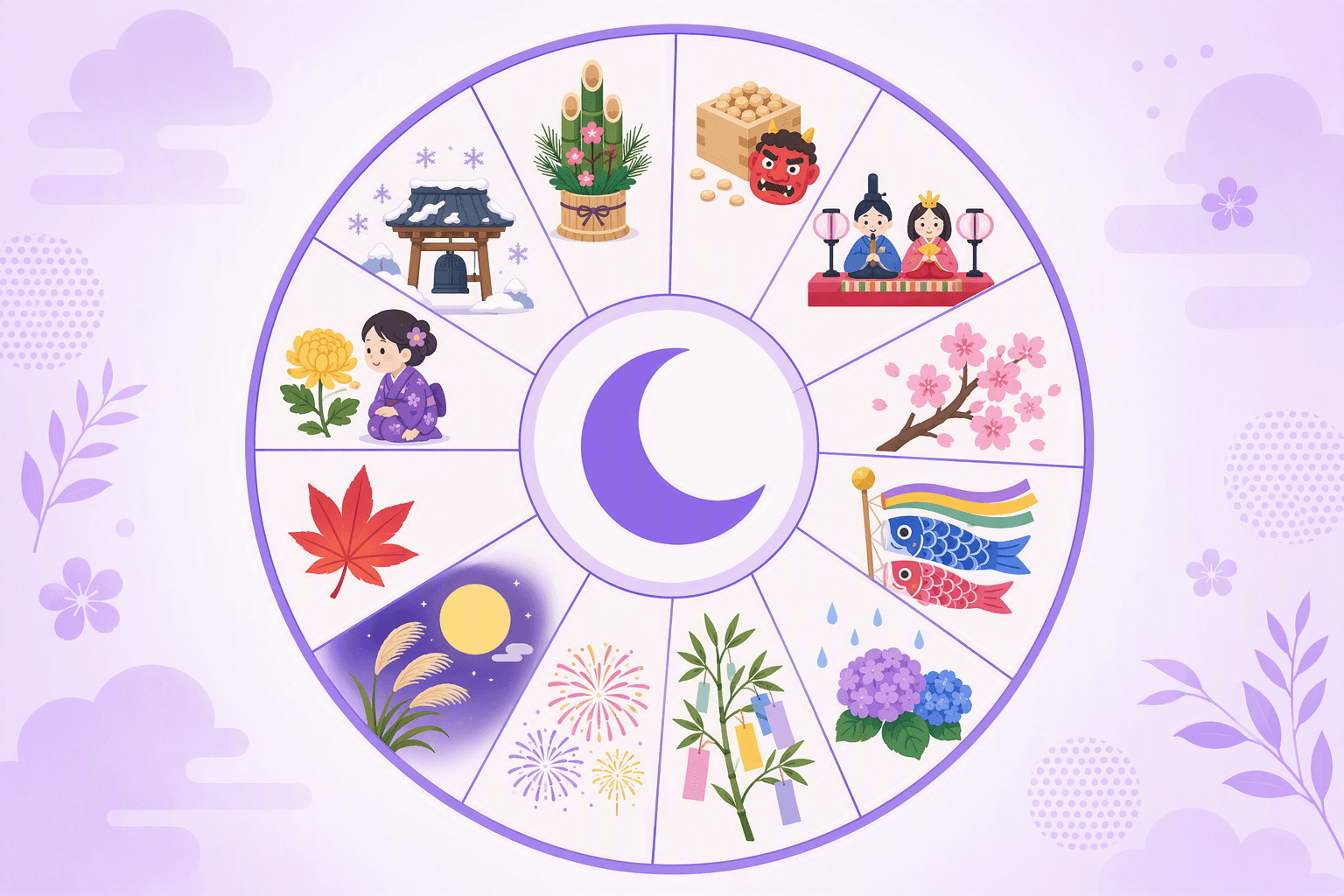
Understanding Japanese months means understanding the cultural rhythm of the year. Japan's calendar is rich with seasonal celebrations, many tied to specific months.
一月 (Ichigatsu): January
正月 (Shōgatsu), New Year, is the most important holiday in Japan. Families gather, visit shrines (hatsumōde), eat traditional foods like おせち料理 (osechi ryōri), and send New Year cards (年賀状, nengajō). Most businesses close from January 1-3.
二月 (Nigatsu): February
節分 (Setsubun) on February 3 marks the transition to spring. People throw roasted soybeans (mamemaki) while shouting 鬼は外、福は内 (Oni wa soto, fuku wa uchi, "Demons out, good fortune in").
三月 (Sangatsu): March
ひな祭り (Hina Matsuri, Girls' Day) on March 3 features elaborate displays of emperor and empress dolls. It is also graduation season for schools across Japan.
四月 (Shigatsu): April
花見 (Hanami), cherry blossom viewing, defines April in Japan. The school year and fiscal year both begin in April, making it a month of new beginnings. NHK dedicates extensive coverage to the sakura zensen (cherry blossom front) as it moves northward across the country.
八月 (Hachigatsu): August
お盆 (Obon) in mid-August is a Buddhist festival honoring ancestors. Many Japanese people return to their hometowns, creating the largest travel rush of the year. Companies typically grant Obon yasumi (Obon vacation) of 3-5 days.
十一月 (Jūichigatsu): November
七五三 (Shichi-Go-San, literally "seven-five-three") on November 15 celebrates children aged 7, 5, and 3. Families dress children in kimono and visit shrines to pray for their healthy growth.
十二月 (Jūnigatsu): December
大晦日 (Ōmisoka) on December 31 is New Year's Eve. Temples ring their bells 108 times (joya no kane) at midnight, representing the 108 earthly desires in Buddhism. Families eat buckwheat noodles (年越しそば, toshikoshi soba) for longevity.
Practice with Real Japanese Content
Months appear constantly in everyday Japanese, from scheduling appointments to discussing seasons to reading event announcements. The seasonal awareness embedded in Japanese culture means that knowing the months connects you to a deeper understanding of how Japanese people experience the year.
Japanese movies and anime are full of month references, especially in slice-of-life stories where seasonal changes drive the narrative. Cherry blossom scenes in April, summer festival episodes in August, and New Year specials in January all reinforce month vocabulary naturally. Check out our guide to the best movies for learning Japanese for films that immerse you in Japan's seasonal rhythm.
Wordy lets you practice month vocabulary in real context by watching Japanese content with interactive subtitles. When a month or date appears in dialogue, you can tap it to see the kanji, hiragana reading, and cultural context. Explore our blog for more Japanese learning guides, or visit our Japanese learning page to start building your vocabulary today.
Frequently Asked Questions
What are the 12 months in Japanese?
Why are Japanese months just numbers?
What is the difference between 月 (gatsu) and ヶ月 (kagetsu)?
What are the traditional Japanese month names?
Which particle do you use with months in Japanese?
Sources & References
- Japan Foundation (国際交流基金), Survey of Japanese-Language Education Abroad, 2024
- National Institute for Japanese Language and Linguistics (NINJAL, 国立国語研究所), Historical Japanese calendar terminology research
- NHK Broadcasting Culture Research Institute, Modern Japanese pronunciation standards
- Ethnologue: Languages of the World, 27th edition (2024), Japanese language entry (125M speakers)
- Crystal, D., The Cambridge Encyclopedia of Language (Cambridge University Press)
Start learning with Wordy
Watch real movie clips and build your vocabulary as you go. Free to download.


