Quick Answer
The essential Japanese emotion words are 嬉しい (ureshii, happy), 悲しい (kanashii, sad), 怒っている (okotte iru, angry), 怖い (kowai, scared), and 楽しい (tanoshii, fun/enjoyable). Japanese also has uniquely untranslatable emotion concepts like 切ない (setsunai, bittersweet longing), 懐かしい (natsukashii, warm nostalgia), 物の哀れ (mono no aware, awareness of impermanence), and 甘え (amae, sweet dependence), words that reveal how Japanese culture perceives and categorizes emotional experience.
The most important emotion words in Japanese are 嬉しい (ureshii, happy), 悲しい (kanashii, sad), 怒っている (okotte iru, angry), 怖い (kowai, scared), and 楽しい (tanoshii, fun/enjoyable). But Japanese emotional vocabulary extends far beyond simple translations of English feelings. It includes concepts that have no equivalent in any Western language.
Japanese is spoken by approximately 125 million native speakers, and according to the Japan Foundation's 2021 survey, over 3.8 million people worldwide are actively studying the language. One reason learners find Japanese fascinating is its extraordinary emotional granularity. The word 気持ち (kimochi, feeling) appears in everyday conversation far more frequently than "feeling" does in English, reflecting a culture that pays close attention to emotional nuance. Japanese has single words for experiences that require entire sentences to describe in English: the ache of nostalgia, the beauty of impermanence, the frustration of losing to yourself.
"Every language makes available to its speakers a particular set of emotion concepts, and these concepts reflect and perpetuate a cultural perspective on human emotional life. Japanese provides an especially rich case, with emotion terms like amae, setsunai, and natsukashii encoding cultural models of feeling that have no one-to-one equivalents in English."
(Anna Wierzbicka, Emotions Across Languages and Cultures, Cambridge University Press)
This guide covers 40+ essential Japanese emotion words organized by category, including uniquely Japanese concepts that reveal how this culture understands the inner world. For interactive practice with real Japanese content, visit our Japanese learning page.
Basic Emotions (基本感情)
These are the foundational emotion words every Japanese learner needs. Paul Ekman's cross-cultural research identified six universal emotions, and Japanese has clear terms for each, though the way they are expressed and regulated differs significantly from Western norms.
| English | Japanese | Pronunciation | Note |
|---|---|---|---|
| Happy / Glad | 嬉しい (ureshii) | oo-reh-SHEE | i-adj. Triggered by specific events |
| Sad | 悲しい (kanashii) | kah-nah-SHEE | i-adj. General sadness |
| Angry | 怒っている (okotte iru) | oh-KOT-teh ee-roo | Verb form: 'is angry' |
| Scared / Afraid | 怖い (kowai) | koh-WHY | i-adj. Also means 'scary' |
| Surprised | 驚いた (odoroita) | oh-doh-ROY-tah | Past tense of 驚く (odoroku) |
| Disgusted | 気持ち悪い (kimochi warui) | kee-MOH-chee wah-ROO-ee | Lit. 'feeling bad.' Physical or emotional |
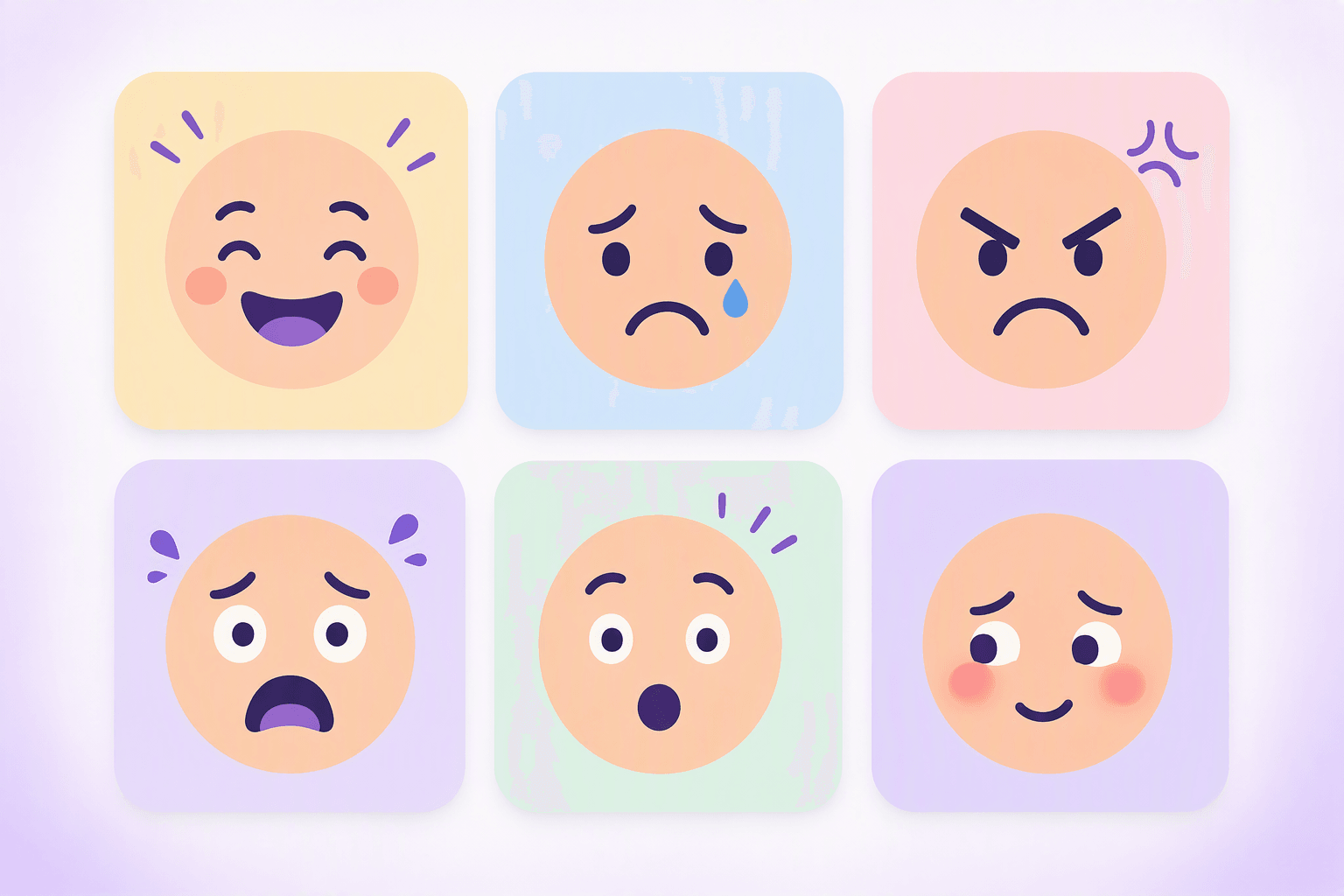
Notice that most basic emotions in Japanese are い-adjectives (i-adjectives): 嬉しい, 悲しい, 怖い. This means they conjugate directly (嬉しくない (ureshikunai, not happy), 悲しかった (kanashikatta, was sad)) without needing a copula verb. Anger, however, uses the verb 怒る (okoru, to get angry), so "I'm angry" is expressed as a continuing state: 怒っている (okotte iru).
Positive Emotions (ポジティブな感情)
Japanese distinguishes between different types of positive feeling with more precision than English typically does. The difference between 嬉しい and 楽しい, for instance, is a distinction every learner must master.
| English | Japanese | Pronunciation | Note |
|---|---|---|---|
| Fun / Enjoyable | 楽しい (tanoshii) | tah-noh-SHEE | i-adj. Enjoyment during an activity |
| Gratitude | 感謝 (kansha) | KAHN-shah | Noun. Deep thankfulness |
| Pride | 誇り (hokori) | hoh-KOH-ree | Noun. Used carefully; modesty valued |
| Relief | 安心 (anshin) | AHN-sheen | Noun/na-adj. Peace of mind |
| Happiness / Bliss | 幸せ (shiawase) | shee-ah-WAH-seh | na-adj. Lasting contentment, not event-specific |
| Excitement | ワクワク (wakuwaku) | WAH-koo-WAH-koo | Onomatopoeia. Heart-racing anticipation |
| Energetic / Well | 元気 (genki) | GEN-kee | na-adj. Vitality, good spirits. Very common |
💡 嬉しい vs. 楽しい vs. 幸せ, Three Kinds of Happy
These three words all translate to "happy" but describe fundamentally different experiences. 嬉しい (ureshii) is reactive happiness from a specific trigger: getting a compliment, receiving good news. 楽しい (tanoshii) is experiential enjoyment happening right now: having fun at a festival, enjoying a conversation. 幸せ (shiawase) is a deeper state of contentment or blessedness: feeling grateful for your life, being at peace. Mixing them up is one of the most common mistakes learners make.
ワクワク (wakuwaku) belongs to Japanese onomatopoeia (擬態語, gitaigo), words that represent feelings and states through sound symbolism. Japanese has hundreds of these: ドキドキ (dokidoki, heart pounding from nervousness or excitement), ホッとする (hotto suru, feeling relieved), イライラ (iraira, irritated). These expressive words are used constantly in spoken Japanese and appear throughout anime and Japanese films.
Negative Emotions (ネガティブな感情)
Japanese negative emotion vocabulary includes several words with no clean English translation, reflecting cultural attitudes toward shame, social obligation, and self-improvement.
| English | Japanese | Pronunciation | Note |
|---|---|---|---|
| Anxiety / Unease | 不安 (fuan) | FOO-ahn | na-adj. Worry about the uncertain future |
| Frustration at own failure | 悔しい (kuyashii) | koo-YAH-shee | i-adj. No exact English equivalent |
| Lonely / Missing someone | 寂しい (sabishii) | sah-BEE-shee | i-adj. Also written 淋しい |
| Embarrassed / Shy | 恥ずかしい (hazukashii) | hah-zoo-KAH-shee | i-adj. Shame + embarrassment combined |
| Annoyed / Irritated | イライラする (iraira suru) | ee-RAH-ee-rah soo-roo | Onomatopoeia. Simmering frustration |
| Jealous / Envious | 羨ましい (urayamashii) | oo-rah-yah-MAH-shee | i-adj. Less negative than English 'jealous' |
| Worried | 心配 (shinpai) | SHEEN-pie | na-adj/noun. Concern for someone or something |
悔しい
悔しい (kuyashii) deserves special attention because it is one of the most culturally significant Japanese emotion words. It describes the burning frustration you feel when you lose, fail, or are outdone, specifically when you believe you could have performed better. A student who fails an exam by two points feels 悔しい. An athlete who loses a close match feels 悔しい. The word carries an implicit motivation to try harder next time, which is why Japanese coaches and teachers actually consider 悔しい a positive emotional response to failure. The Agency for Cultural Affairs' language surveys consistently show 悔しい among the most frequently used emotion adjectives in Japanese.
恥ずかしい
恥ずかしい (hazukashii) covers a broader range than English "embarrassed." It includes shyness, shame, self-consciousness, and the feeling of being exposed, all in one word. A child hiding behind their parent when meeting strangers is 恥ずかしい. Someone who made a public mistake feels 恥ずかしい. A person complimented too directly might say 恥ずかしい. This broad scope reflects the central role of shame awareness in Japanese social psychology.
Uniquely Japanese Emotions (日本独自の感情)
These are the words that make Japanese emotional vocabulary truly extraordinary. Each one encodes a cultural perspective that takes a full paragraph to explain in English.
| English | Japanese | Pronunciation | Note |
|---|---|---|---|
| Awareness of impermanence | 物の哀れ (mono no aware) | MOH-noh noh ah-WAH-reh | Aesthetic concept. Beauty in transience |
| Beauty in imperfection | 侘寂 (wabi-sabi) | WAH-bee SAH-bee | Aesthetic concept. Finding peace in flaws |
| Bittersweet longing | 切ない (setsunai) | seh-TSOO-nai | i-adj. Painful yet beautiful sadness |
| Warm nostalgia | 懐かしい (natsukashii) | nah-tsoo-KAH-shee | i-adj. Fond longing for the past |
| Sweet dependence | 甘え (amae) | ah-MAH-eh | Noun. Desire to be indulged by a close person |
| Sunlight through leaves | 木漏れ日 (komorebi) | koh-moh-REH-bee | Noun. The emotional warmth of dappled sunlight |
物の哀れ
物の哀れ (mono no aware) is perhaps the most celebrated concept in Japanese aesthetics. Articulated by Edo-period literary scholar Motoori Norinaga (1730-1801), it describes the bittersweet awareness that all beautiful things are transient. The quintessential example is cherry blossom viewing (花見, hanami), where the blossoms are cherished precisely because they fall within days. This concept permeates Japanese literature from The Tale of Genji to modern anime, and understanding it is essential to grasping how Japanese people relate to beauty, loss, and the passage of time.
切ない
切ない (setsunai) describes a specific type of emotional pain that is simultaneously beautiful, a tightness in the chest from longing, separation, or witnessing something painfully beautiful. It is the feeling of watching a sunset knowing someone you love is far away. It is hearing a song that reminds you of a relationship that ended gently. Unlike simple sadness (悲しい), 切ない carries an aesthetic quality; the pain itself has a poignant beauty. This word appears constantly in Japanese song lyrics, film, and literature.
懐かしい
When Japanese speakers encounter something from their past (a childhood toy, an old photograph, a song from their school days) they exclaim 懐かしい! (natsukashii!). This is not merely "nostalgic" in the English sense, which often carries melancholy. 懐かしい is predominantly warm and pleasant, a joyful recognition of something fondly remembered. Research from NINJAL's Corpus of Everyday Japanese Conversation shows that 懐かしい is one of the most frequently exclaimed emotion words in casual Japanese speech.
甘え
甘え (amae) was famously analyzed by psychiatrist Doi Takeo in his 1971 book The Anatomy of Dependence. It describes the desire to be indulged, pampered, or taken care of by someone close, a behavior that is socially accepted and even valued in Japanese relationships. A child acting clingy with their mother is showing 甘え. An adult partner who wants to be spoiled is engaging in 甘え. While Western cultures often view dependence negatively, Japanese culture recognizes 甘え as a natural expression of intimacy and trust.
Honne and Tatemae: The Emotional Divide
🌍 本音 (Honne) vs. 建前 (Tatemae)
Understanding Japanese emotions requires understanding Japan's fundamental distinction between 本音 (honne, true feelings) and 建前 (tatemae, public face). In Japanese social life, expressing raw emotions directly is often considered immature or inconsiderate. Instead, people modulate their emotional expression based on context, relationship, and social obligation. This does not mean Japanese people are emotionless; research by Ekman and others confirms that Japanese individuals experience emotions with the same intensity as anyone else. Rather, Japanese culture has developed sophisticated norms about when, where, and how emotions should be expressed. Learning emotion vocabulary is only half the picture; understanding these display rules is equally important.
This cultural framework explains why Japanese has such rich vocabulary for internal emotional states. When outward expression is modulated, inner experience becomes more linguistically differentiated. The word 我慢 (gaman, endurance/patience), the ability to bear discomfort without complaint, is considered a virtue. The phrase 空気を読む (kuuki wo yomu, "reading the air") describes the essential social skill of sensing others' unspoken emotions.
Emotion Grammar: い-Adjectives, な-Adjectives, and Nouns
Japanese emotion words fall into three grammatical categories, and each behaves differently in sentences.
い-Adjective Emotions
Most common emotion words are い-adjectives that modify nouns directly and conjugate on their own:
| Emotion | Dictionary Form | Negative | Past | Example |
|---|---|---|---|---|
| Happy | 嬉しい | 嬉しくない | 嬉しかった | 嬉しいニュース (happy news) |
| Sad | 悲しい | 悲しくない | 悲しかった | 悲しい映画 (sad movie) |
| Scary | 怖い | 怖くない | 怖かった | 怖い話 (scary story) |
| Lonely | 寂しい | 寂しくない | 寂しかった | 寂しい夜 (lonely night) |
| Frustrating | 悔しい | 悔しくない | 悔しかった | 悔しい結果 (frustrating result) |
な-Adjective Emotions
Some emotions are な-adjectives. They need な (na) before nouns and だ/です (da/desu) at the end of sentences:
| Emotion | Before Noun | End of Sentence | Example |
|---|---|---|---|
| Healthy/Well | 元気な | 元気だ / 元気です | 元気な子供 (energetic child) |
| Peaceful | 安心な | 安心だ / 安心です | 安心な気持ち (peaceful feeling) |
| Anxious | 不安な | 不安だ / 不安です | 不安な気持ち (anxious feeling) |
| Happy/Blessed | 幸せな | 幸せだ / 幸せです | 幸せな人 (happy person) |
Noun Emotions
Some emotions are pure nouns and need the particle を (wo) or が (ga) in sentences:
- 感謝の気持ち (kansha no kimochi): a feeling of gratitude
- 誇りを持つ (hokori wo motsu): to hold pride
- 甘えが強い (amae ga tsuyoi): strong dependence
⚠️ Common Mistake: Using the Wrong Category
One of the most common errors is treating noun emotions like adjectives. You cannot say ×感謝い (kanshai) or ×誇りな (hokori na). If you are unsure whether an emotion is an い-adjective, な-adjective, or noun, check the dictionary entry. As a general rule: if it ends in い and is not a noun, it is likely an い-adjective. If it ends in a kanji compound (like 安心, 不安, 感謝), it is usually a な-adjective or noun.
Expressing Emotions: Casual vs. Polite
Japanese formality levels change how emotions are expressed. Here are the key patterns:
| Meaning | Casual | Polite (です/ます) | Formal/Keigo |
|---|---|---|---|
| I'm happy | 嬉しい! | 嬉しいです | 大変嬉しく存じます |
| I'm sad | 悲しい... | 悲しいです | 悲しく思います |
| I'm worried | 心配だ | 心配です | 心配しております |
| I'm grateful | ありがたい | ありがたいです | 感謝いたします |
In casual speech, simply stating the adjective is natural: 嬉しい! (ureshii!, I'm happy!). In polite speech, adding です (desu) is sufficient. In keigo (formal/honorific language), emotions are typically expressed through humble verb forms like 存じます (zonjimasu) or いたします (itashimasu), which soften the directness of the emotional statement.
Practice Japanese Emotions With Real Content
Emotion vocabulary comes alive when you hear it in context. Japanese films, anime, and dramas are packed with emotional expression, from 悔しい moments in sports anime to 切ない scenes in romantic films. Characters in Studio Ghibli movies alone demonstrate dozens of the emotion words covered in this guide.
Wordy lets you watch Japanese content with interactive subtitles. When an emotion word appears in dialogue, tap it to see the kanji, reading, and meaning in context. Instead of drilling isolated vocabulary, you absorb 嬉しい, 悲しい, and 切ない naturally as native speakers actually use them.
Browse our blog for more Japanese vocabulary guides, or check out the best anime and movies to learn Japanese for viewing recommendations that bring these emotion words to life.
Frequently Asked Questions
What is the Japanese word for 'feelings' or 'emotions'?
What is mono no aware (物の哀れ)?
What is the difference between 嬉しい (ureshii) and 楽しい (tanoshii)?
What does 悔しい (kuyashii) mean? Is there an English equivalent?
How do you say 'I'm happy' in Japanese?
Why does Japanese have so many untranslatable emotion words?
Sources & References
- Agency for Cultural Affairs (文化庁), Survey on the Japanese Language, 2024
- Ekman, P., 'An Argument for Basic Emotions,' Cognition & Emotion (1992)
- Wierzbicka, A., Emotions Across Languages and Cultures (Cambridge University Press, 1999)
- Japan Foundation (国際交流基金), Survey of Japanese-Language Education Abroad, 2021
- National Institute for Japanese Language and Linguistics (NINJAL), Corpus of Everyday Japanese Conversation
Start learning with Wordy
Watch real movie clips and build your vocabulary as you go. Free to download.


